Dragon Bridge (Cầu Rồng): Da Nang's Iconic Han River Crossing
Dragon Bridge is Da Nang's most recognizable landmark, a 666-meter road bridge shaped like a dragon rising from the Han River. Free to walk across any time, it draws the biggest crowds on weekend nights when it breathes real fire and water at 9pm.
Quick Facts
- Location
- Nguyen Van Linh Street, Hai Chau District, Da Nang (spans Han River to Son Tra)
- Getting There
- Taxi or ride-hail to Cau Rong (10–15 min from city center); walkable from Bach Dang riverfront
- Time Needed
- 20–30 min to walk and photograph; 1.5 hrs if staying for the 9pm show
- Cost
- Free — no tickets, no registration required
- Best for
- Night photography, families, first-time visitors to Da Nang
What Dragon Bridge Actually Is
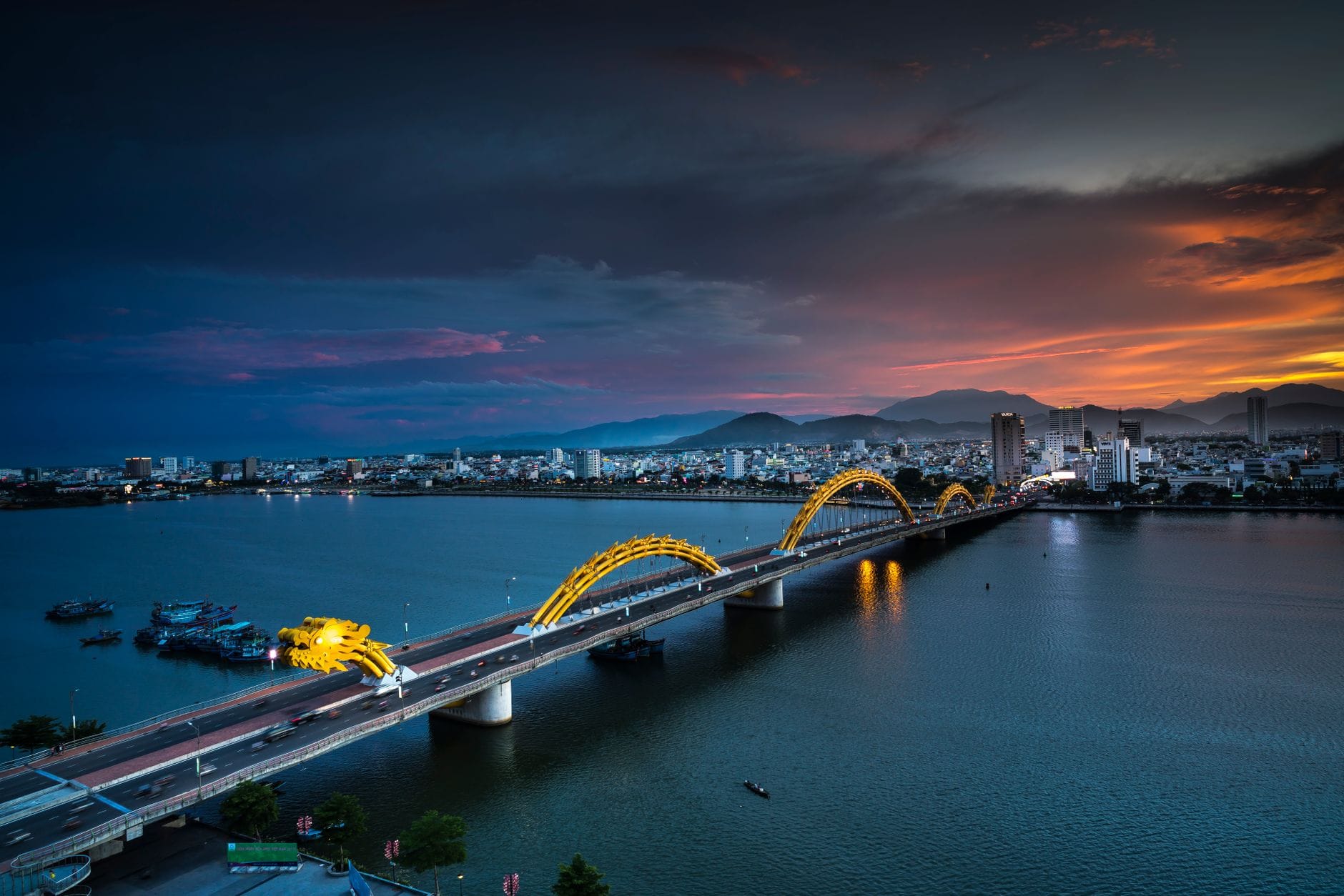
Dragon Bridge, known locally as Cầu Rồng, is a six-lane road bridge spanning 666 meters across the Han River in central Da Nang. It opened to traffic on 29 March 2013, after construction began in July 2009 at a cost of nearly 1.5 trillion Vietnamese đồng. At 37.5 meters wide, it is one of the broadest bridges in Vietnam, and its design is deliberately theatrical: the entire structure takes the shape of a dragon, with a scaled body arching above the carriageway and a head pointing eastward toward the river.
The dragon holds deep cultural significance in Vietnamese tradition, representing power, good fortune, and the country's origin myth. Da Nang's city authorities commissioned this shape intentionally as the city underwent rapid post-renovation modernization in the late 2000s. The bridge is not just infrastructure — it functions as a civic statement about Da Nang's ambitions and its identity as a coastal city reconnecting with growth after decades of postwar recovery.
ℹ️ Good to know
The fire and water show runs on Fridays, Saturdays, Sundays, and major public holidays at 9:00 PM. Traffic is stopped from approximately 8:45 PM, and the show lasts about 10 to 15 minutes. No tickets are needed — just arrive early for a good spot on the riverfront.
The Fire and Water Show: What Actually Happens
Three nights a week, the dragon's head at the western end of the bridge becomes the focal point of a short pyrotechnic display. Three nights a week, the dragon's head at the western end of the bridge becomes the focal point of a short display. At 9:00 PM, the mouth of the dragon emits bursts of fire — followed by arcs of water spraying from jets set into the dragon's lower jaw. The sequence repeats in short intervals over the span of the show. It is loud, physically warm if you are standing directly beneath the head, and genuinely impressive for those who haven't seen it before.
The important caveat: the show runs for roughly 10 to 15 minutes of active effects. The full traffic closure window is longer, which means some visitors who arrive expecting a longer spectacle leave feeling it was brief. If you are traveling with children who have been anticipating it, calibrate expectations in advance. That said, the atmosphere surrounding the show — hundreds of locals on motorbikes lining the closed lanes, families sitting on the riverbank, the lit skyline reflecting in the water — is worth the evening out regardless of the show itself.
For the best viewing angle, position yourself on the Hai Chau (city center) side of the river, along the Bach Dang walking street promenade. You will have an unobstructed sightline to the dragon's head and can watch the crowd as much as the bridge itself. The Son Tra side offers a different angle looking back toward the city skyline, useful for photography but involving a longer walk or a separate taxi drop-off.
Tickets & tours
Live prices and dates from our booking partner. If you book, we may earn a commission at no extra cost to you.
Da Nang museums and Dragon Bridge half-day tour
From 36 €Instant confirmationFree cancellationTour to Ba Na Hills, Golden Bridge, Fantasy Park with Buffet Lunch
From 89 €Instant confirmationFree cancellationBa Na Hills Sun World and Golden Bridge day tour from Da Nang
From 57 €Instant confirmationFree cancellationBa Na Hills Cable Car Adventure and Golden Bridge Full-Day Tour
From 144 €Instant confirmation
Visiting During the Day: A Different Experience Entirely
Most travel content focuses on the weekend night show, which undersells what the bridge offers at other times. During the day, particularly in the morning between 6:30 AM and 8:30 AM, the bridge sidewalks attract local joggers and commuters. The air carries a mix of salt from the nearby coast and the faint diesel of city traffic. The dragon's golden scales catch direct sunlight and reflect it differently depending on the angle — the textured body is far more detailed than it appears in most photographs.
Late afternoon, roughly 4:30 PM to 6:00 PM, is one of the quieter moments on foot. Traffic is heavy across the carriageway, but the pedestrian sidewalks thin out between the lunch crowd and the evening promenaders. This is when the bridge's engineering becomes more apparent: the span is genuinely wide, the views upriver toward the city center and downriver toward the coast are clear, and you can observe the Han River ferry traffic and the cluster of other bridges Da Nang has built in recent decades.
💡 Local tip
For photography, arrive 30 to 45 minutes before sunset. The bridge lights activate as dusk falls, creating a transitional period where you can capture both the warm natural light on the scales and the beginning of the LED illumination — a more layered shot than pure nighttime or pure daylight offers.
Getting There and Getting Around
Dragon Bridge sits at the eastern edge of Hai Chau District, the city's administrative and commercial core. The western approach is via Nguyen Van Linh Street; the eastern landing connects into Son Tra District toward the beach. Taxis and ride-hailing apps (Grab is widely used in Da Nang) are the most practical option for most visitors. Drop-off on the Hai Chau side puts you directly onto the riverfront promenade.
If you are staying near the city center or along the Han River, the bridge is often walkable. The Bach Dang riverfront runs parallel to the water on the Hai Chau side and connects naturally to the bridge approach. Plan 10 to 15 minutes on foot from the central riverfront hotels. For visitors coming from Hoi An, public bus No. 01 connects Hoi An to Da Nang for approximately 20,000 VND, depositing you in the city where a short taxi ride reaches the bridge.
If you are combining Dragon Bridge with other Han River sights in the same evening, the Love Bridge (Cầu Tình Yêu) is a short walk north along the riverbank and makes a natural pairing before the 9pm show. The area between the two bridges fills with food carts and coffee vendors after dark, particularly on weekends.
Accessibility and Crowd Conditions
The bridge has two wide pedestrian sidewalks separated from traffic lanes, making it physically accessible for most visitors. The surface is flat and paved. The approach roads on both sides have curb cuts. During the weekend fire show, however, conditions change substantially: the closed lanes fill with parked motorbikes and standing spectators, the riverfront becomes extremely dense, and navigating through the crowd with a stroller or mobility aid becomes difficult. Arriving 30 minutes early allows you to claim a position before the surge.
If you prefer to avoid crowds entirely, a weekday morning visit gives you essentially a private experience of the bridge itself. You will not see the fire show, but the bridge in daylight with light pedestrian traffic is genuinely more pleasant for taking time to notice the sculptural details.
⚠️ What to skip
During major Vietnamese public holidays — including Tet (Lunar New Year), National Day (2 September), and Liberation Day (30 April) — the show schedule may expand and crowds become significantly larger than a typical weekend. If you are visiting during these periods, arrive at least an hour early.
How Dragon Bridge Fits Into Da Nang's Wider Landscape
Dragon Bridge is one of several bridges crossing the Han River in Da Nang, and it helps to understand it in that context rather than in isolation. The Han River Bridge to the north is an older swing bridge that rotates on weekend nights to allow river traffic. Further south, the Tran Thi Ly Bridge has a distinctive sail-like pylon. Together these bridges reflect Da Nang's post-2000 infrastructure investment and the city's effort to connect its west-bank urban core with its east-bank coastal and Son Tra Peninsula areas. For a broader sense of how the river shapes the city, the Da Nang viewpoints guide covers several elevated spots from which you can see all three bridges in a single frame.
The bridge also serves as a useful orientation point for first-time visitors. East of it lies Son Tra Peninsula and My Khe Beach; west of it is the city's commercial core, the Han Market, and the dense street grid of Hai Chau District. Crossing it on foot, even without stopping, gives you a physical sense of Da Nang's geography that no map quite replicates.
Photography Notes
The bridge is extremely well lit at night with color-changing LED systems across the dragon's full body length. On show nights, the illumination shifts through color sequences — typically cycling between green, red, and gold before the fire sequence begins. A wide-angle lens from the riverbank captures the full body span; a telephoto lens from further back on the Hai Chau promenade isolates the dragon's head during the fire burst. Long exposures from a tripod on the riverbank work well for the water reflection, though the crowd on show nights makes stable tripod placement difficult.
For drone photography: Da Nang has designated drone-free zones around active bridges and the city center. Verify current Civil Aviation Authority of Vietnam regulations before flying any unmanned aircraft near Dragon Bridge. Enforcement is inconsistent but penalties can be significant.
Insider Tips
- The best unobstructed view of the dragon's head during the fire show is from the small plaza directly below the western (Hai Chau) landing, not from the riverbank promenade further north. Most tourists cluster on the promenade; the plaza is closer and less crowded.
- Weekday evenings around 8:00 PM are a quiet sweet spot: the bridge is fully lit, the riverfront is active but not packed, and you can walk across the sidewalk without fighting the weekend show crowd.
- The dragon's scales have considerably more sculptural texture than photographs suggest. Walk at least partway across during daylight to see the surface detail up close — it changes the impression of the bridge substantially.
- Food and drink vendors set up along both riverbanks from around 7:00 PM on show nights. Ordering a ca phe sua da (Vietnamese iced coffee) from one of the riverside carts and waiting for the show is a very local way to spend the evening.
- If you want a quiet photograph of the full bridge at night without crowds in frame, come on a Tuesday or Wednesday around 9:30 PM — the bridge is illuminated, traffic is light, and the riverbanks are nearly empty.
Who Is Dragon Bridge For?
- First-time visitors to Da Nang wanting an orientation walk with a payoff
- Families with children who will respond to the fire and water show
- Night photographers looking for long-exposure river reflection shots
- Travelers combining an evening riverfront stroll with dinner nearby
- Anyone wanting to understand Da Nang's east-west geography by crossing it on foot
Nearby Attractions
Other things to see while in Han River & Downtown:
- Asia Park & Sun Wheel
Asia Park, home to the 115-metre Sun Wheel Ferris wheel, is Da Nang's most recognizable evening landmark. Open from late afternoon into the night, it offers sweeping city views, a modest collection of rides, and an easy, affordable few hours on the western bank of the Han River.
- Bach Dang Walking Street
Opened in June 2024, Bach Dang Walking Street runs along the west bank of the Han River between Dragon Bridge and Tran Thi Ly Bridge. Free to enter, it operates daily from mid‑afternoon to midnight, with stricter vehicle bans on weekend evenings, and offers food kiosks, live performances, and unobstructed river views — making it one of the most accessible evening destinations in central Da Nang.
- Con Market
Con Market, known locally as Chợ Cồn, is the beating commercial heart of central Da Nang. Covering around 14,000 square metres in Hai Chau District, this sprawling market has served the city since at least the 1950s and remains the place where locals actually shop. Entry is free, the food is exceptional, and the atmosphere changes completely depending on what time you arrive.
- Da Nang Cathedral (Pink Church)
Built in 1923 by French priest Louis Vallet, Da Nang Cathedral is the city's only surviving French colonial-era church. Officially the Sacred Heart of Jesus Cathedral, it stands nearly 70 meters tall on Tran Phu Street in Hai Chau District, painted an unmistakable shade of rose pink and crowned by a rooster-shaped weathervane that gives it a second, more affectionate nickname: Nha Tho Con Ga.
Planning a trip? Discover personalized activities with the Nomado app.