Han Market (Chợ Hàn): Da Nang's Downtown Trading Heart
Han Market has anchored daily life in Da Nang's city centre for generations. Housed in a two-storey building at the corner of Trần Phú and Bạch Đằng streets, it sells everything from fresh seafood and tropical fruit to silk fabric and lacquerware — all within walking distance of the Han River. Entry is free, the hours are long, and the atmosphere shifts dramatically from early morning chaos to a quieter afternoon browse.
Quick Facts
- Location
- 119 Trần Phú Street, Hải Châu District, Da Nang (corner of Trần Phú and Bạch Đằng)
- Getting There
- Grab or taxi from city centre hotels (under 10 min); 5-min walk from Da Nang Cathedral; no metro service in Da Nang
- Time Needed
- 45 minutes to 1.5 hours depending on shopping goals
- Cost
- Free entry; budget 100,000–500,000 VND for snacks, souvenirs, or fabric
- Best for
- Local food, souvenir shopping, cultural atmosphere, early-morning market experience
What Han Market Actually Is
Chợ Hàn — Han Market — is a working traditional market, not a tourist showpiece. It serves Da Nang residents buying groceries, fabric, and household goods alongside travellers hunting for souvenirs and street snacks. That dual function is what makes it interesting. The building sits at a major downtown intersection where Trần Phú and Bạch Đằng streets meet, two blocks from the Han River waterfront. It is compact compared to Hanoi's Đồng Xuân or Ho Chi Minh City's Bến Thành, but what it lacks in size it compensates for in density and accessibility.
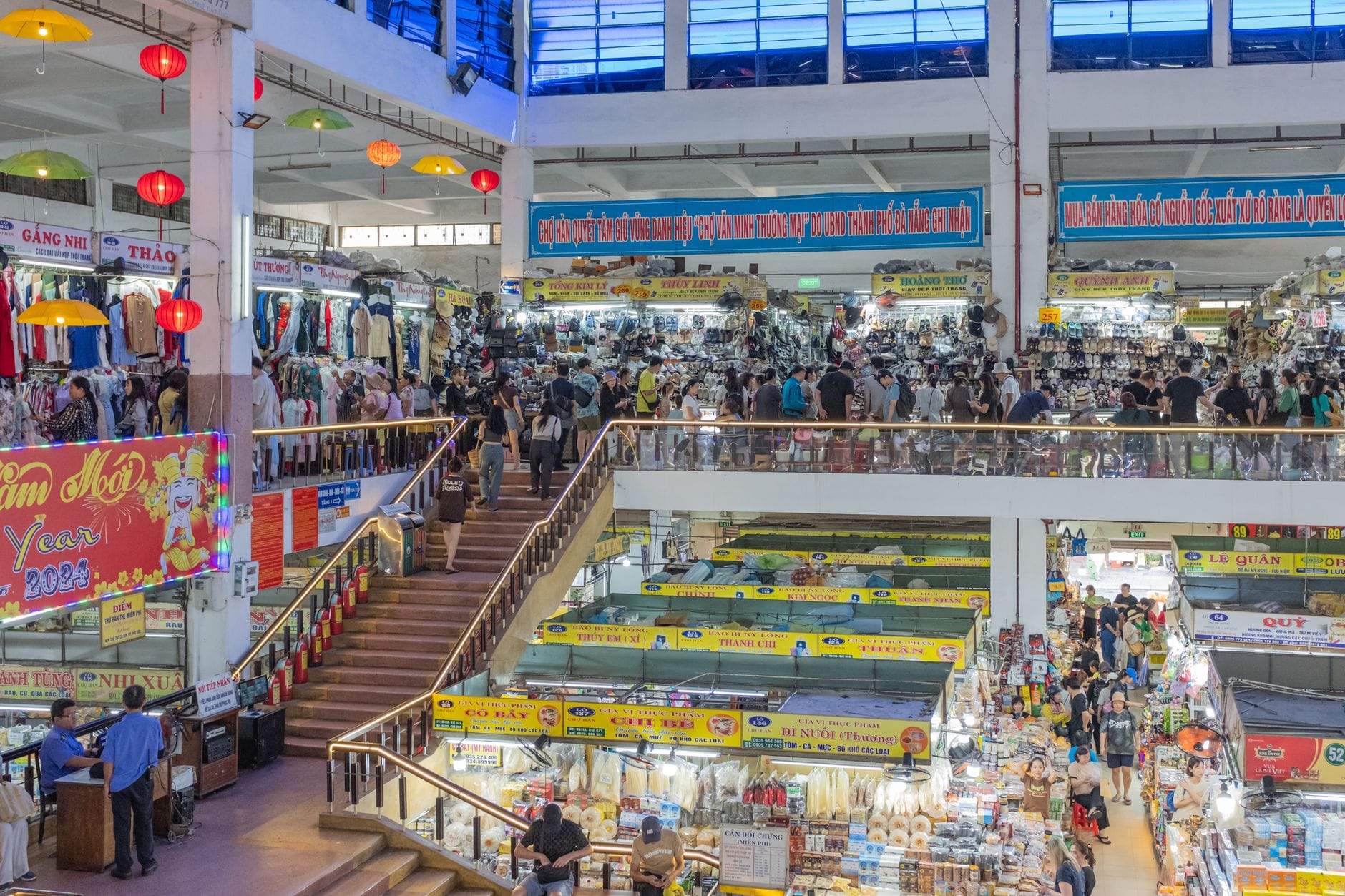
The structure is a two-storey covered building with street-level entrances on multiple sides. Ground floor stalls concentrate on fresh produce, seafood, meat, dried goods, and food vendors. The upper floor leans toward clothing, fabric by the metre, shoes, and souvenir items including lacquerware, silk scarves, and locally made gifts. Navigating between floors requires using stairs, and current guides do not confirm the presence of a lift or ramp, so visitors with significant mobility limitations should plan around the ground floor.
ℹ️ Good to know
Opening hours: Daily approximately 6:00 AM to 7:00 PM. Some peripheral stalls and food vendors start as early as 5:00 AM. Most stalls are winding down by 6:30 PM, so plan to arrive no later than 5:00 PM if you want the full selection.
How the Market Changes Through the Day
Arrive between 6:00 AM and 8:00 AM and you encounter the market at full intensity. The fish and seafood section near the ground floor entrance is loud and wet underfoot, with vendors calling out prices, ice being shifted in polystyrene crates, and the sharp smell of fresh catch mixing with the fainter sweetness of nearby fruit stalls. Local women in conical hats move quickly through the aisles with practiced efficiency. This is when the selection is broadest and the produce freshest, but it is also the most crowded and least visitor-friendly if you are easily overwhelmed.
By mid-morning, roughly 9:00 AM to 11:00 AM, the market finds a useful middle ground. The fresh produce rush has passed, vendors have their stalls fully arranged, and the aisles are more navigable. This is the window where browsing feels less pressured, prices are still fair, and food stalls are serving breakfast dishes at their peak. The light inside the market at this hour — diffuse and warm, filtering through the building's upper vents — is also the most photogenic.
Afternoon visits, from 1:00 PM onward, are quieter and the fresh sections begin to thin out as vendors sell down remaining stock. Souvenir and fabric stalls on the upper floor remain well-stocked through the afternoon. If your only goal is shopping for gifts and textiles, an afternoon visit avoids the morning crowds with little sacrifice in choice.
💡 Local tip
Photography tip: The upper floor near the fabric stalls catches good natural light in the mid-morning. Ask vendors before photographing them directly — most are fine with it, but a quick gesture of respect goes a long way.
Tickets & tours
Live prices and dates from our booking partner. If you book, we may earn a commission at no extra cost to you.
Marble Mountain, Lady Buddha and Han River Night Cruise with Dinner
From 65 €Instant confirmationFree cancellation5-Hours Cooking Class Tour in Cam Thanh village with Market Shopping
From 85 €Instant confirmationHoa Phu Thanh Tourist Area Entrance Ticket with Rafting Experience
From 5 €Instant confirmationFree cancellationHalf-Day Tour to Cam Thanh Eco Water Coconut Village with Fishing
From 67 €Instant confirmation
What to Buy and What to Eat
The ground floor food section is worth treating as a meal stop in itself. Look for stalls selling bánh mì, fresh spring rolls (gỏi cuốn), and bowls of quảng noodles — a Central Vietnamese speciality with a lighter, oilier broth than the northern pho style. A bowl costs somewhere in the range of 30,000 to 60,000 VND. Dried shrimp, peanut brittle, and packets of rice crackers are also sold in bulk and make practical snacks or edible souvenirs that travel well.
On the souvenir side, Han Market is one of the more honest places in Da Nang to buy silk scarves and ao dai fabric by the metre. Prices are negotiable, and vendors expect a counter-offer — starting at around 70 to 80 percent of the quoted price is reasonable without being insulting. Lacquerware items (bowls, trays, boxes) and mother-of-pearl inlay pieces are common, though quality varies significantly between stalls. Handle items carefully before buying and check for chips or uneven finish on lacquer edges.
If you are looking for a more curated souvenir experience after Han Market, Con Market — Da Nang's other major traditional market — is a short ride away and skews slightly more local, with less souvenir merchandise and more everyday goods. For evening food browsing, the Helio Night Market offers a very different atmosphere after dark.
Historical Context and Cultural Significance
Han Market is considered one of Da Nang's oldest established trading centres. Its name references the Han River, which runs past the eastern edge of the city's Hải Châu district — the administrative and commercial core of Da Nang since the colonial period. Markets like Chợ Hàn served as the economic backbone of Vietnamese urban life long before modern retail arrived, functioning as daily gathering points that organised neighbourhood commerce, social exchange, and food distribution.
Da Nang's position as a major port city on the South Central Coast meant that Han Market historically traded goods moving through the Han River corridor — connecting inland agricultural production with coastal and maritime commerce. While the building in its current form does not date to the 19th century, the site's function as a central trading point reflects this deeper commercial geography. Visitors who have already explored the city's French-era architecture — including Da Nang Cathedral nearby — will find the market a useful contrast: the formal colonial city on one side of the street, the messy, productive, local market economy on the other.
For a fuller picture of the city's history and the objects that moved through trading routes like this one, the Museum of Cham Sculpture is one of the most significant cultural institutions in central Vietnam and sits within the same downtown area.
Getting There and Practical Logistics
Han Market is located at 119 Trần Phú Street in Hải Châu District, one of the flattest and most walkable parts of central Da Nang. From most downtown hotels near the Han River, it is reachable on foot in under 15 minutes. A Grab ride from anywhere in the city centre typically costs around 20,000–40,000 VND. Taxis are also reliable and abundant in Da Nang's urban core. There is no metro system in Da Nang; city buses exist but schedules and routes are not consistently published in English, so ride-hailing is the practical choice for most visitors.
Parking a motorbike is possible on surrounding streets, but the area around Trần Phú and Bạch Đằng is dense with traffic during morning hours. Walking or arriving by Grab from your hotel avoids the congestion. Da Nang Cathedral is roughly a 5-minute walk from the market, making it easy to combine both into a short downtown walk.
If you are planning a broader downtown morning, the waterfront on Bạch Đằng Walking Street is steps away from the market's eastern entrance and provides a pleasant way to start or end the visit. The Dragon Bridge is visible from the riverfront and easily included in a walking loop from Han Market.
⚠️ What to skip
Watch your belongings: crowded aisles in the morning are a standard pickpocket environment in any Vietnamese market. Keep your bag in front of you and avoid carrying a wallet in a back pocket.
Who This Is Really For — and Who Should Skip It
Han Market is worth the visit if you want authentic sensory contact with daily Vietnamese commerce — the sounds, the smells, the negotiated transactions, the practical disorder of a real working market. It is not a sanitised experience and it is not trying to be. The fresh produce section can be confronting for visitors unused to live seafood and raw meat displayed in open stalls without refrigeration, particularly in warm weather.
Travellers who are primarily interested in curated handicrafts, air-conditioned shopping, or guaranteed-quality souvenirs will find Han Market frustrating rather than rewarding. The quality of goods varies and nothing is certified. If that level of uncertainty does not appeal, it is honest to say that a couple of hours at Han Market will feel like a chore rather than a highlight.
For those planning a wider trip through the region, Han Market pairs naturally with a day in Hội An, where the Ancient Town market also sells silk and lacquerware but with more tourist-oriented curation. See the guide on getting from Da Nang to Hội An for transport options. And if you are wondering how to organise your time across the city overall, a dedicated Da Nang itinerary will help set priorities.
Insider Tips
- Go to the upper floor fabric stalls with a specific colour or material in mind. Vendors will pull options quickly once they understand what you need, and the selection of ao dai silk and raw cotton is better than most shops on the tourist strip.
- The small food stalls tucked into the interior of the ground floor — not the ones facing the main entrance — tend to have lower prices and are used by market vendors themselves. Follow where the stall workers eat.
- If you are buying dried seafood (shrimp, squid) as a gift, ask the vendor to vacuum-seal it. Most have the equipment and it makes transport through airport security far less odorous.
- Bargaining is expected on souvenirs and textiles but not on fresh food. Attempting to haggle over a bowl of noodles or a bag of fruit will create awkwardness rather than savings.
- Combine the market with a walk to Da Nang Cathedral, which is less than five minutes away on foot. The contrast between the cathedral's pink façade and the market's functional chaos captures two very different layers of the city's history in a single morning.
Who Is Han Market For?
- Travellers who want to experience how Da Nang residents actually shop and eat, not just how the city presents itself to tourists
- Food-focused visitors looking for local breakfast dishes, dried regional specialities, and tropical fruit at fair prices
- Shoppers hunting for silk fabric, ao dai cloth, or lacquerware who are comfortable negotiating prices and assessing quality themselves
- Photographers interested in candid market scenes and the textures of working Vietnamese commerce
- Anyone spending a morning in the downtown area who wants to understand the city's commercial character before heading to beaches or viewpoints
Nearby Attractions
Other things to see while in Han River & Downtown:
- Asia Park & Sun Wheel
Asia Park, home to the 115-metre Sun Wheel Ferris wheel, is Da Nang's most recognizable evening landmark. Open from late afternoon into the night, it offers sweeping city views, a modest collection of rides, and an easy, affordable few hours on the western bank of the Han River.
- Bach Dang Walking Street
Opened in June 2024, Bach Dang Walking Street runs along the west bank of the Han River between Dragon Bridge and Tran Thi Ly Bridge. Free to enter, it operates daily from mid‑afternoon to midnight, with stricter vehicle bans on weekend evenings, and offers food kiosks, live performances, and unobstructed river views — making it one of the most accessible evening destinations in central Da Nang.
- Con Market
Con Market, known locally as Chợ Cồn, is the beating commercial heart of central Da Nang. Covering around 14,000 square metres in Hai Chau District, this sprawling market has served the city since at least the 1950s and remains the place where locals actually shop. Entry is free, the food is exceptional, and the atmosphere changes completely depending on what time you arrive.
- Da Nang Cathedral (Pink Church)
Built in 1923 by French priest Louis Vallet, Da Nang Cathedral is the city's only surviving French colonial-era church. Officially the Sacred Heart of Jesus Cathedral, it stands nearly 70 meters tall on Tran Phu Street in Hai Chau District, painted an unmistakable shade of rose pink and crowned by a rooster-shaped weathervane that gives it a second, more affectionate nickname: Nha Tho Con Ga.
Planning a trip? Discover personalized activities with the Nomado app.