Bến Thành Market (Chợ Bến Thành): What to Expect Before You Go
Bến Thành Market has anchored the heart of Saigon since 1912 and remains one of Ho Chi Minh City's most recognizable landmarks. With nearly 1,500 booths spread across 13,000 square meters, it sells everything from fresh produce and dried seafood to ao dai fabric, lacquerware, and street food. This guide covers the realities of visiting, including when it is worth your time and when it is not.
Quick Facts
- Location
- Lê Lợi Street, Bến Thành Ward, District 1, Ho Chi Minh City
- Getting There
- Walk from Nguyen Hue or Dong Khoi area; taxi and ride-hailing apps drop off at Quách Thị Trang Square (south entrance)
- Time Needed
- 45 minutes to 2 hours depending on shopping intent
- Cost
- Free entry; prices at stalls are negotiable
- Best for
- First-time visitors, souvenir shoppers, food explorers
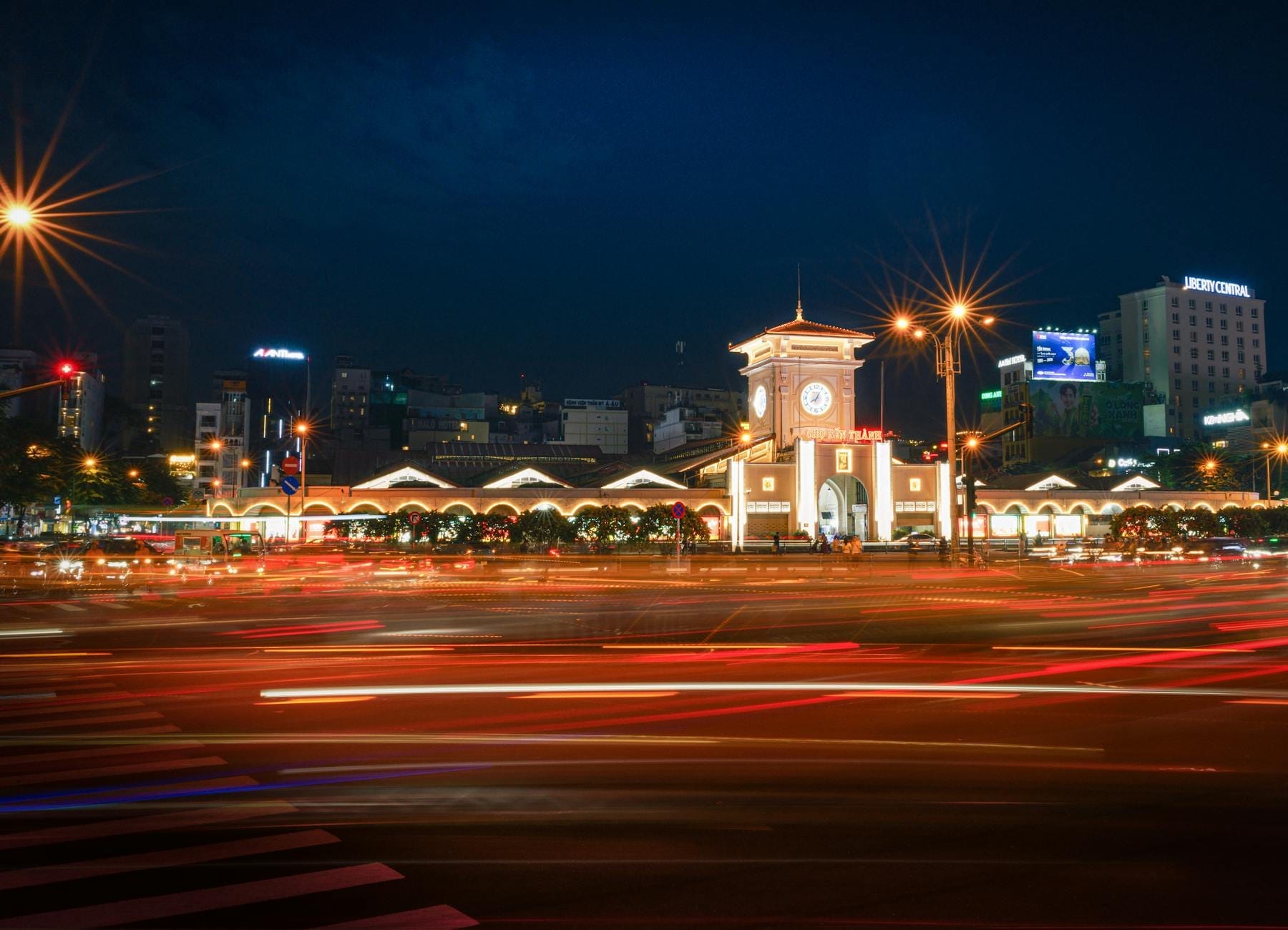
What Bến Thành Market Actually Is
Chợ Bến Thành, as it is formally known in Vietnamese, is a covered municipal market occupying a rectangular block at the intersection of four major streets in District 1. The building you see today dates to 1912, though a market has operated near this part of central Saigon in some form since before French colonial rule. It sits on roughly 13,056 m² of floor space, divided into several wings organized loosely by product category: fresh food toward the center and rear, dry goods and clothing in the outer aisles, and souvenirs concentrated near the main south entrance on Lê Lợi Street.
The market's clock tower above the south gate has become an unofficial symbol of the city, appearing on postcards, phone cases, and government tourism materials. The building itself is colonial-era French architecture, with four entrance gates oriented to the cardinal directions and a high central roof that allows heat to rise and keeps the interior marginally cooler than the street outside. Marginally.
ℹ️ Good to know
Bến Thành Market is free to enter and open daily from approximately 6 AM to 6 PM for the main day market. A smaller night market operates in the surrounding streets until around 10 PM.
The Building and Its History
The current market structure was completed in 1912, replacing an earlier covered market that had occupied multiple sites near the Saigon River since the late 17th century. A major fire destroyed one predecessor building in 1870. The 1912 construction placed it at what was then the edge of the developed urban grid, beside a large pond that was subsequently drained to create the plaza now known as Quách Thị Trang Square.
The gates were upgraded in 1952 and the interior underwent renovation in 1985. Despite the renovations, the exterior silhouette has remained essentially unchanged for over a century, which explains the building's symbolic weight in Saigon's visual identity. For context, it predates most of the landmarks that surround it and has survived colonial administration, wartime, reunification, and the full arc of the post-1986 Đổi Mới economic reforms that transformed the city around it.
The market's position in District 1 places it within easy walking distance of other colonial-era landmarks. The Saigon Central Post Office and Notre-Dame Cathedral are both under 15 minutes on foot to the northeast.
Tickets & tours
Live prices and dates from our booking partner. If you book, we may earn a commission at no extra cost to you.
Long Thanh or Song Be car hire with driver from Thu Duc in Ho Chi Minh
From 109 €Instant confirmationFree cancellationPrivate full-day trip from Ho Chi Minh City to Mekong Delta
From 52 €Instant confirmationFree cancellationLandmarks of Ho Chi Minh City half-day tour
From 33 €Instant confirmationFree cancellationCu Chi tunnels guided experience from Ho Chi Minh City
From 33 €Instant confirmationFree cancellation
How the Market Changes Through the Day
Early morning is when the market functions most authentically as a working food market. Between 6 AM and 8 AM, the fresh produce, meat, and fish sections in the interior are active with local vendors and household shoppers. The smell of raw seafood is strong, the floor is wet in sections, and the lighting is utilitarian. This is not a prettified experience, but it is the most honest version of the market.
By mid-morning, the tourist-facing outer stalls are fully open and the souvenir zone near the south entrance starts to fill with visitors. Prices quoted to obvious tourists are higher at this hour because vendors have not yet made their first sale of the day, which in local tradition sets the tone for the rest of the day's trading. Arriving between 9 AM and 10 AM can actually put you at a slight disadvantage in negotiations.
The early afternoon, roughly 1 PM to 3 PM, is the hottest and most crowded period. Tour groups tend to arrive in this window. The interior, despite its high roof, retains heat, and the narrow stall corridors make it feel significantly warmer than the street. If you are sensitive to heat or confined spaces, this is the window to avoid.
💡 Local tip
The best time to visit for a quieter experience with more negotiating leverage is between 10 AM and 11:30 AM on a weekday, after the morning food rush but before the midday tour bus wave.
What You Can Buy and What It Costs
The market divides roughly into three zones by product type. The inner section holds fresh food: tropical fruit, vegetables, dried spices, fish sauce, shrimp paste, and cuts of meat. These stalls serve local customers more than tourists and prices are closer to market rate. The outer corridors moving toward each gate shift into dry goods: fabric by the meter (including silk and ao dai materials), ready-made clothing, bags, shoes, and household goods.
The south-gate corridor and the stalls immediately inside it are the most heavily tourist-oriented. Here you will find lacquerware bowls, embroidered tablecloths, conical hats, coffee, pepper, cashews, silk scarves, and the full range of Vietnamese souvenir staples. Quality varies significantly between stalls selling the same category of item. A cursory comparison of three or four stalls before committing is worthwhile.
Bargaining is expected and necessary. Opening prices quoted to tourists are routinely two to three times what a vendor will accept. A calm, polite counter at around 50 percent of the asking price is a reasonable starting point. Walking away slowly often results in a lower final offer being called out. Avoid aggressive or dismissive bargaining, as it tends to harden positions rather than soften them.
⚠️ What to skip
Several stalls near the south entrance operate on commission referrals from nearby hotels. If a hotel concierge specifically recommends a vendor by name, be aware the price you receive may already have a commission built in.
Food at the Market
The food stalls inside Bến Thành offer a condensed version of Vietnamese street food staples: bánh mì, phở, bún bò Huế, chè (sweet dessert soups), fresh fruit shakes, and grilled items. The cooked food section occupies part of the interior and several vendors along the inner perimeter. Hygiene standards are serviceable, though the seating is cramped and shared across multiple stalls.
Prices at the food stalls are higher than comparable dishes found two streets away. This is a consistent pattern at tourist-adjacent markets across Southeast Asia and is not unique to Bến Thành. If eating here, treat it as a convenience rather than a value decision. For a more substantive food exploration in the surrounding area, the streets immediately north of the market toward Lê Thánh Tôn hold better options at fairer prices.
For broader eating context in the city, the Ho Chi Minh City street food guide covers neighborhoods and dishes worth prioritizing beyond the market circuit.
Practical Walkthrough: Getting There and Getting Around
Bến Thành Market sits at the convergence of four named streets in District 1, making it straightforward to locate without navigation. The south entrance on Lê Lợi Street, facing Quách Thị Trang Square, is the most commonly used entry point and where ride-hailing apps and taxis typically drop passengers. The north entrance on Lê Thánh Tôn, east entrance on Phan Bội Châu, and west entrance on Phan Châu Trinh are all accessible and somewhat less congested.
From the core of District 1, the market is walkable from most hotels. The Nguyen Hue walking street, the People's Committee Building area, and Dong Khoi Street are all within a 10 to 15 minute walk. Ben Thanh Station on Metro Line 1 (Ben Thanh–Suoi Tien), which opened in late 2024, provides direct metro access to the market area. A second metro line (Line 2, Ben Thanh–Tham Luong) is planned for the future.
Visitors staying in the Phạm Ngũ Lão backpacker district will find the market roughly a 10-minute walk west along Lê Lợi Street.
Inside the market, navigation is intuitive once you understand the basic layout: the main corridors run parallel to each of the four walls and a central interior section holds the wet market. There are no maps posted at the entrances, but the floor plan is a simple rectangle and getting oriented takes less than five minutes. Wear light, breathable clothing and flat shoes, as the floor surfaces vary between smooth concrete and uneven tiles.
💡 Local tip
Photography is generally tolerated in the souvenir and dry goods sections. Ask before photographing individual vendors, particularly in the fresh food area. A smile and a gesture toward your camera is usually sufficient communication.
Is Bến Thành Market Worth It?
For first-time visitors to Ho Chi Minh City, yes, with appropriate expectations. The market is not a local secret or an off-the-beaten-path experience. It is one of the most visited tourist sites in the country, and the pricing and vendor behavior at many stalls reflect that reality. What it does offer is a physical landmark with genuine historical depth, a concentrated range of Vietnamese goods in one location, and a manageable introduction to the bargaining culture of Vietnamese commerce.
Repeat visitors to Vietnam or travelers who have already spent time in other Vietnamese markets, such as Ben Tay Market in Cholon or the covered markets of Hanoi, may find Bến Thành's tourist-facing sections underwhelming compared to earlier experiences. For this group, the inner fresh food sections remain interesting but the souvenir zone offers little novelty.
Travelers interested in a more locally-oriented market atmosphere with a strong cultural history might also consider Bình Tây Market in Cholon, which serves the wholesale trade and has a different character entirely.
Those with limited time in the city and a full itinerary of major historical sites should probably allocate no more than an hour here and focus the rest of their time on sites like the War Remnants Museum or Reunification Palace, which are harder to replicate elsewhere. The market, by contrast, can be absorbed as a 45-minute stop while walking between other District 1 landmarks.
Insider Tips
- The north gate (Lê Thánh Tôn side) receives a fraction of the pedestrian traffic of the south gate. Entering and exiting from here avoids the most congested vendor corridor and gives you a cleaner first impression of the interior layout before the souvenir stalls crowd your attention.
- Dried goods, including Vietnamese coffee, whole peppercorns, and cashews, are genuinely good value at Bến Thành compared to airport shops or hotel gift stores. Buy vacuum-sealed rather than loosely bagged items if you are traveling onward.
- The night market that activates around the exterior streets after 6 PM is a different and more relaxed experience than the daytime interior. Clothing and street food dominate, prices are slightly softer in the late evening, and the street atmosphere is cooler and less frantic.
- If a vendor quotes you a price and you counter, do not backtrack to a higher offer after they have accepted a lower one. This breaks trust and sours the interaction. Know your ceiling before you start negotiating.
- The square outside the south entrance, Quách Thị Trang Square, is a useful meeting point and gives the best unobstructed view of the market's clock tower facade for photographs. Early morning before 8 AM offers the cleanest shot with minimal pedestrian traffic in frame.
Who Is Bến Thành Market For?
- First-time visitors to Ho Chi Minh City looking for a concentrated overview of Vietnamese goods
- Travelers wanting to practice bargaining in a relatively low-stakes environment
- Those interested in early 20th-century French colonial commercial architecture
- Anyone building a walking circuit through District 1's central landmarks
- Shoppers on a time budget who want souvenirs and dried goods in a single stop
Nearby Attractions
Other things to see while in District 1 (Colonial Quarter):
- Bến Nghé Canal & Riverside Walk
The Bến Nghé Canal cuts through the heart of District 1 as one of Ho Chi Minh City's oldest urban waterways, linking the Saigon River to the city's colonial core. Free to walk any hour of the day, the riverside path offers a grounded, unhurried perspective on a city that rarely slows down.
- Bitexco Financial Tower & Saigon Skydeck
The Bitexco Financial Tower is District 1's most recognizable skyscraper, its lotus-inspired silhouette rising 262 meters above the Saigon River. The Saigon Skydeck on the 49th floor offers a glass-enclosed, 360-degree panorama that takes in the whole city at once, from colonial rooftops to the river bends to the sprawling suburbs beyond.
- Saigon Central Post Office
Built between 1886 and 1891 and attributed to Gustave Eiffel's engineering office, the Saigon Central Post Office is one of the finest French colonial buildings in Southeast Asia. It functions as a working post office to this day, meaning you can mail a postcard home from inside a genuine architectural landmark. Free to enter and centrally located in District 1, it earns its place on most itineraries.
- Đồng Khởi Street
Once the elegant Rue Catinat of French colonial Saigon, Đường Đồng Khởi runs 630 meters through the heart of District 1, running from Nguyễn Du Street (across from Notre Dame Cathedral) to the Saigon River waterfront at Bạch Đằng Quay. Today it is a compact corridor of colonial facades, high-end boutiques, art galleries, and landmark buildings that together form a living archive of the city's layered history.
Planning a trip? Discover personalized activities with the Nomado app.