Dong Khoi Street: Saigon's Most Storied Promenade
Once the elegant Rue Catinat of French colonial Saigon, Đường Đồng Khởi runs 630 meters through the heart of District 1, running from Nguyễn Du Street (across from Notre Dame Cathedral) to the Saigon River waterfront at Bạch Đằng Quay. Today it is a compact corridor of colonial facades, high-end boutiques, art galleries, and landmark buildings that together form a living archive of the city's layered history.
Quick Facts
- Location
- District 1, Ho Chi Minh City (between Saigon River and Nguyen Hue Boulevard)
- Getting There
- Walk from Ben Thanh Market (~15 min) or take a Grab/xe om to the area near Notre Dame Cathedral; no direct metro line yet
- Time Needed
- 1–2 hours for a relaxed walk; half a day if you enter buildings along the route
- Cost
- Free to walk; individual shops, cafés, and gallery entry vary
- Best for
- Architecture lovers, first-time visitors, photographers, evening strollers
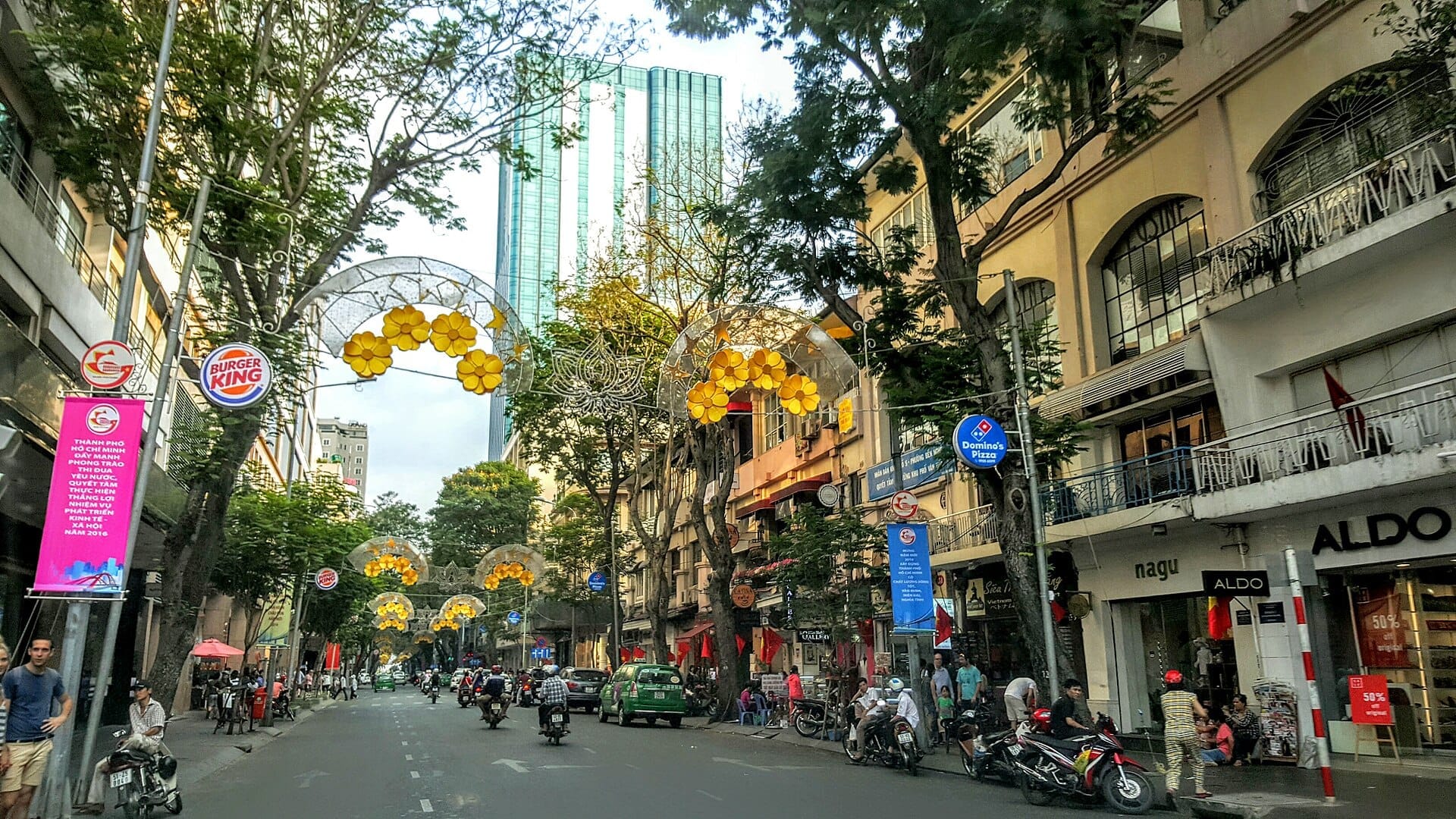
What Is Dong Khoi Street?
Đường Đồng Khởi is a 630-meter public street in District 1, Ho Chi Minh City, running from Nguyễn Du Street (across from Notre Dame Cathedral) in the west to the Saigon River waterfront at Bạch Đằng Quay in the east, passing through one of the densest concentrations of French colonial architecture in Southeast Asia. It is free to walk at any hour, requires no ticket, and anchors a cluster of the city's most recognizable landmarks within a short radius.
The street sits at the geographic and cultural center of District 1, meaning most major sights are reachable on foot. The Saigon Opera House occupies one end, the Notre Dame Cathedral and Central Post Office sit a block to the north, and the Saigon River lies just beyond its eastern terminus. Few streets in Vietnam deliver this much concentrated context in so short a distance.
💡 Local tip
Start at the Saigon River end in the morning when the light falls directly down the street toward the Opera House. The colonial facades photograph best between 7:00 and 9:00 AM before vehicle traffic thickens.
A Street With Four Names: The History Behind the Address
Few streets in Asia carry as many historical identities as this one. Under the Nguyen dynasty it was simply Street No. 16, a utilitarian designation for what was then a modest thoroughfare in a port city. The French colonial administration renamed it Rue Catinat on February 1, 1865, after the French warship Catinat, which participated in the bombardment of Tourane (Da Nang) in 1858. Under that name it became the social spine of colonial Saigon: the address for European hotels, tailor shops, cafés, and the political gossip of a colonial outpost.
In 1955, the South Vietnamese government renamed it Tu Do (Freedom Street) and took on a different kind of notoriety during the American presence in Saigon: bars, nightclubs, and the civilian traffic of wartime. After 1975, the government renamed it Đồng Khởi, meaning General Uprising, a reference to the armed uprisings against South Vietnamese rule in 1960. Each name is a chapter marker, and the buildings still standing have witnessed all of them.
Tickets & tours
Live prices and dates from our booking partner. If you book, we may earn a commission at no extra cost to you.
Private full-day trip from Ho Chi Minh City to Mekong Delta
From 52 €Instant confirmationFree cancellationLandmarks of Ho Chi Minh City half-day tour
From 33 €Instant confirmationFree cancellationCu Chi tunnels guided experience from Ho Chi Minh City
From 33 €Instant confirmationFree cancellationHalf-day Cu Chi Tunnels guided tour from Ho Chi Minh City
From 21 €Instant confirmationFree cancellation
What You Actually See Walking the Street
The eastern approach from the river is the most atmospheric opening. The street climbs very gently from the waterfront, lined by low-rise colonial buildings with shuttered balconies and terracotta tile roofs sitting incongruously beside newer glass-fronted retail units. At ground level, the mix is distinctly contemporary: luxury brand stores, lacquerware shops, silk outlets, and art galleries occupy the street-level arcades of buildings whose upper floors retain their original proportions.
Midway along the street, the pace changes noticeably. Café terraces spill onto the pavement under awnings, and the pedestrian flow slows as shoppers move between neighboring Dong Du and Ly Tu Trong lanes. Several of the galleries in this section stock Vietnamese lacquer paintings and silk embroidery aimed squarely at the tourist market, but if you look for the smaller, less-signposted doors you will find independent art spaces with more serious contemporary work.
The eastern end reaches the Saigon River, while the western end starts near the Notre Dame Cathedral area before approaching the Saigon Opera House further along, a 1897 French-built theater that is still an active performance venue. The building's ornate yellow facade, with its relief sculptures and arched windows, is one of the most-photographed structures in the city. At this junction, Dong Khoi effectively dissolves into the wider civic square shared with the Continental Hotel and the beginning of Nguyen Hue Walking Street.
The Opera House forecourt connects directly to the Nguyen Hue Walking Street, which extends the pedestrian experience north toward the People's Committee Building. If you have energy after Dong Khoi, this is the natural continuation of the walk.
How the Street Changes by Time of Day
Morning: 7:00–10:00 AM
The morning hours are the least crowded and the most photogenic. Delivery motorcycles are still weaving between the parked vehicles, café staff are setting out chairs on the pavement, and the low equatorial light comes in at a long angle that makes the colonial facades glow yellow-white. The smell at this hour is a combination of strong Vietnamese coffee from the open-fronted cafés and exhaust from the Dong Khoi junction. Shops generally open between 8:30 and 9:30 AM, so this window is better for architecture and atmosphere than for retail.
Midday: 10:00 AM–3:00 PM
Heat is the defining feature of midday Dong Khoi. Temperatures in Ho Chi Minh City's dry season (roughly November to April) can exceed 35°C by noon, and the street offers limited shade outside of the arcaded stretches near the Opera House end. This is when the air-conditioned interior of the Continental Hotel lobby or one of the larger café spaces along the street becomes genuinely useful as a rest point. If you are visiting in the wet season (May to October), afternoon downpours can arrive quickly and briefly turn the street into a shallow river.
⚠️ What to skip
In the wet season, carry a compact umbrella or light rain jacket. Afternoon storms can arrive with little warning and last 30–60 minutes. Most shops have overhanging awnings but not all of them.
Evening: 5:30 PM–9:00 PM
The evening is when Dong Khoi is most alive. The heat softens, the street lights come on along the colonial facades, and the pavement cafés fill with a mix of office workers, tourists, and Vietnamese families. Motorbikes slow to a crawl along the vehicle lanes, and street photographers set up near the Opera House steps where the theatrical lighting makes a reliable backdrop. The scent of grilled food drifts in from side streets. This is the most rewarding time for a relaxed walk and the best window for dinner at one of the French-influenced restaurants a block off the main street.
Practical Walkthrough: How to Approach the Visit
Dong Khoi is short enough to walk end to end in under 20 minutes if you keep moving. The useful approach is to treat it as a spine connecting other destinations rather than a destination where you stand still. Start at the river end near Bến Bạch Đằng, walk west toward the Opera House, then either continue on Nguyen Hue or cut north toward Notre Dame Cathedral and the Central Post Office. That circuit covers the core of District 1's colonial quarter in two to three hours.
Comfortable shoes matter more than most visitors expect. The pavement surface along parts of the street is uneven, and the side streets feeding off it have kerb heights that are inconsistent. There is no dedicated wheelchair-friendly route confirmed along the full length, so visitors with mobility considerations should plan the eastern third of the street as the most navigable section.
Dong Khoi is walkable from Ben Thanh Market in approximately 15 minutes on foot heading east along Le Loi Street. Alternatively, any Grab car or traditional taxi can drop you at the Opera House junction or the river end depending on which direction you want to walk.
For a fuller picture of what District 1 has to offer beyond this street, the things to do in Ho Chi Minh City guide covers the broader mix of history, markets, and neighborhoods worth building into your itinerary.
Photography Notes
The Opera House end of Dong Khoi is the single most photographed viewpoint on the street. Standing at the base of the Opera House steps and shooting back east along the corridor gives you the full length of the street with the colonial rooflines receding toward the Saigon River. Early morning provides the cleanest light and the fewest pedestrian obstructions. By late afternoon, the sun moves around to the north side, and the street falls into shadow that works better for moody street photography than for architectural shots.
The details reward attention: wrought-iron balcony railings, decorative ceramic tile borders above shop doors, peeling painted shutters on upper floors still used as residences. These textures are easier to appreciate on foot than from a vehicle, and they make for more interesting images than the wide-angle facade shots.
Is Dong Khoi Worth Your Time?
It depends heavily on what you came to Ho Chi Minh City to see. If your primary interest is the city's French colonial architectural layer, Dong Khoi is the single best street to understand it because nearly every building type from that era is present in one 630-meter stretch. If you are primarily interested in history museums, pagodas, or the war period, the street is pleasant as a connecting route but not a destination in itself.
The retail on Dong Khoi skews toward the expensive end of the Saigon shopping spectrum. Lacquerware, silk, and branded goods at these addresses carry premium prices. Visitors looking for market-style shopping or street food should plan to be elsewhere for that part of the trip.
If luxury retail is a priority alongside the architecture walk, the District 1 hotel and area guide can help you position yourself to cover Dong Khoi as part of a larger neighborhood morning without special transport logistics.
Insider Tips
- The Continental Hotel, near the Opera House along Dong Khoi, has been operating since 1880 and its lobby terrace is open to non-guests for coffee. Sitting there for 30 minutes costs the price of a drink and puts you at one of the most historically layered café spots in the city.
- Several buildings mid-street have ground-floor galleries that are free to enter and show contemporary Vietnamese art alongside the usual lacquerware tourist pieces. Look for doors set back from the main arcade level with stairs leading up rather than down.
- If you want to photograph the Opera House facade with few people in the frame, 7:00 AM on a weekday is close to ideal. By 9:00 AM tour groups begin arriving and the forecourt stays occupied until late evening.
- The side streets running off Dong Khoi, particularly Dong Du and Mac Thi Buoi, have a denser concentration of independent restaurants and are noticeably cooler in the evenings than the main thoroughfare because they are narrower and receive less direct sun.
- Dong Khoi's street number system runs roughly from 1 at the river end increasing westward toward the Opera House, which makes navigating specific addresses on the street more logical than most streets in District 1.
Who Is Đồng Khởi Street For?
- First-time visitors to Ho Chi Minh City wanting a single walk that encapsulates the city's colonial period
- Architecture enthusiasts interested in French Indochina-era urban planning and building typology
- Photographers looking for a manageable, walkable urban landscape with strong architectural anchors
- Evening strollers combining the walk with dinner at the restaurants and cafés on adjacent streets
- Travelers using the street as a connective route between the Saigon River waterfront, the Opera House, and Notre Dame Cathedral
Nearby Attractions
Other things to see while in District 1 (Colonial Quarter):
- Bến Nghé Canal & Riverside Walk
The Bến Nghé Canal cuts through the heart of District 1 as one of Ho Chi Minh City's oldest urban waterways, linking the Saigon River to the city's colonial core. Free to walk any hour of the day, the riverside path offers a grounded, unhurried perspective on a city that rarely slows down.
- Bến Thành Market
Bến Thành Market has anchored the heart of Saigon since 1912 and remains one of Ho Chi Minh City's most recognizable landmarks. With nearly 1,500 booths spread across 13,000 square meters, it sells everything from fresh produce and dried seafood to ao dai fabric, lacquerware, and street food. This guide covers the realities of visiting, including when it is worth your time and when it is not.
- Bitexco Financial Tower & Saigon Skydeck
The Bitexco Financial Tower is District 1's most recognizable skyscraper, its lotus-inspired silhouette rising 262 meters above the Saigon River. The Saigon Skydeck on the 49th floor offers a glass-enclosed, 360-degree panorama that takes in the whole city at once, from colonial rooftops to the river bends to the sprawling suburbs beyond.
- Saigon Central Post Office
Built between 1886 and 1891 and attributed to Gustave Eiffel's engineering office, the Saigon Central Post Office is one of the finest French colonial buildings in Southeast Asia. It functions as a working post office to this day, meaning you can mail a postcard home from inside a genuine architectural landmark. Free to enter and centrally located in District 1, it earns its place on most itineraries.
Planning a trip? Discover personalized activities with the Nomado app.