Bitexco Financial Tower & Saigon Skydeck: Ho Chi Minh City from 262 Meters Up
The Bitexco Financial Tower is District 1's most recognizable skyscraper, its lotus-inspired silhouette rising 262 meters above the Saigon River. The Saigon Skydeck on the 49th floor offers a glass-enclosed, 360-degree panorama that takes in the whole city at once, from colonial rooftops to the river bends to the sprawling suburbs beyond.
Quick Facts
- Location
- 36 Hồ Tùng Mậu, Bến Nghé Ward, District 1, Ho Chi Minh City
- Getting There
- 10–15 min walk from Bến Thành Market; accessible by taxi or ride-hailing app from anywhere in central District 1
- Time Needed
- 45–90 minutes for the Skydeck; add time if visiting the tower's restaurants or shops
- Cost
- Paid admission for the Saigon Skydeck (49th floor); check the official website or ticketing desk for current prices in VND
- Best for
- City orientation, skyline photography, first-time visitors wanting a bird's-eye read of Ho Chi Minh City's layout
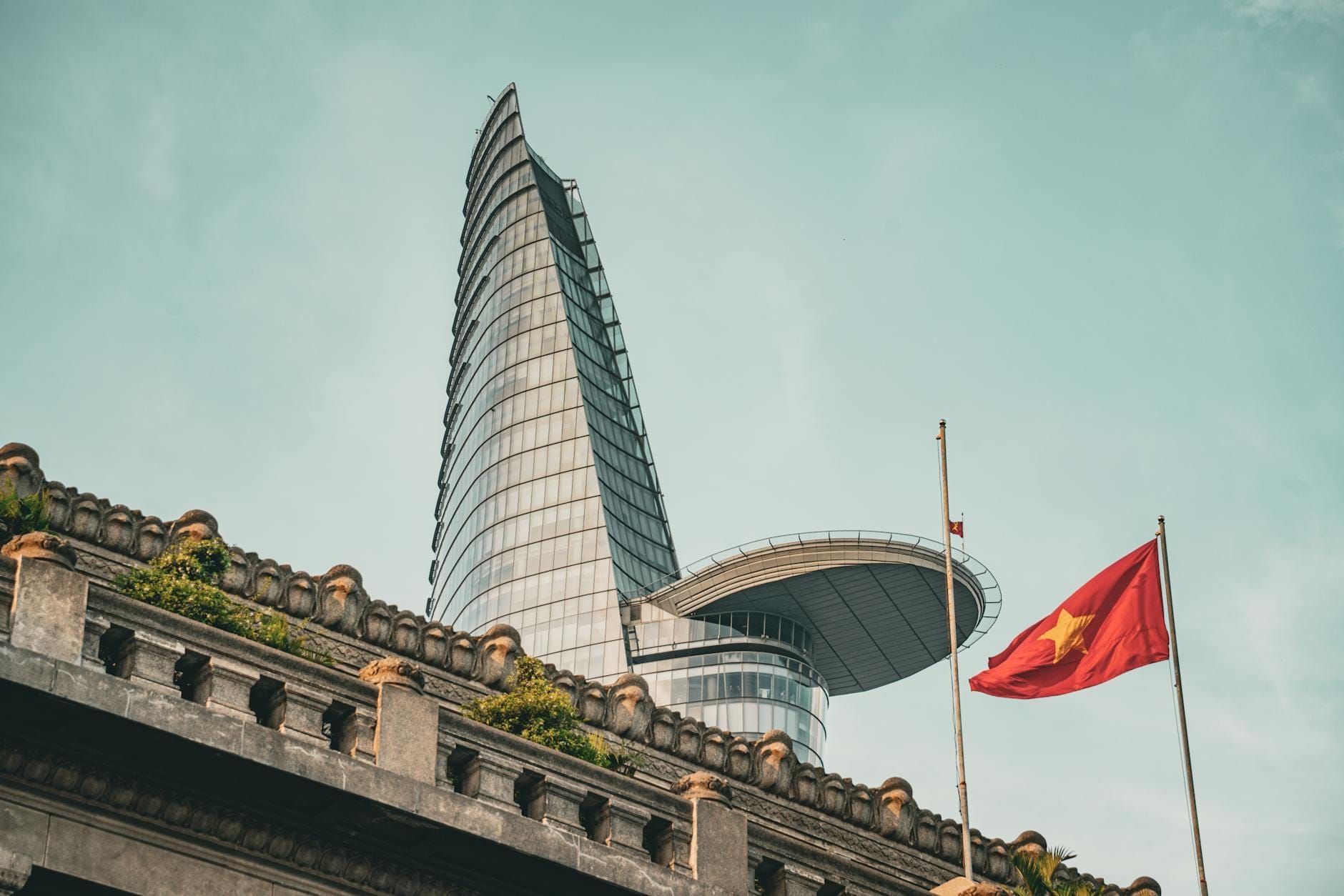
What the Bitexco Financial Tower Actually Is
The Bitexco Financial Tower (Tòa Tháp Tài Chính Bitexco) has defined District 1's skyline since it was completed on October 31, 2010. Designed by American architect Carlos Zapata and standing 262 meters across 68 floors above ground, it was Ho Chi Minh City's tallest building upon completion and is now Vietnam's fourth-tallest structure. For a traveler arriving in the city for the first time, it is the building that orients everything else: you can spot it from the Saigon River, from the rooftops of Notre-Dame Cathedral, and from nearly every elevated vantage in central Saigon.
Zapata drew the building's profile from the lotus blossom, Vietnam's national flower. The result is a tapered tower with a dramatic outward-curving lip near the top, where a helipad cantilevered over nothing seems to float against the sky. The shape is most striking when viewed from the river or from across Mê Linh Square at ground level, where the full curve of the facade reads clearly. Up close, the tower is clad in reflective glass panels that shift from blue-green to silver depending on the hour and weather.
Below the Skydeck, the lower floors house high-end retail, a cinema, offices, and dining options. The World of Heineken experience occupies floors 58 to 60, though that operates on its own ticketing and schedule. Most visitors come solely for the observation deck, and that is the worthwhile focus.
The Saigon Skydeck: What the 49th Floor Actually Shows You
The Saigon Skydeck sits on the 49th floor, enclosed entirely in glass, with viewing platforms oriented in all directions. The lift ride is fast and pressurized; your ears will pop slightly. When the doors open, the city spreads out below in a way that no map quite prepares you for.
To the northwest, you can pick out the green rectangle of the Saigon Zoo and Botanical Garden and, on clear days, the steeple of Notre-Dame Cathedral. The rooftop pattern of colonial-era buildings in central District 1 is immediately visible: low, pale structures interrupted by the occasional newer tower. To the east and southeast, the Saigon River bends through the frame. Directly east across the water, you can see the Thu Thiem development zone. To the south and southwest, the city dissolves into dense, low-rise residential grids that extend as far as visibility allows.
The deck is fully enclosed, which means photographs through glass. The glass is generally kept clean, but there is always some reflection to manage. Shoot at an angle to the surface rather than straight on, and move as close to the pane as possible to reduce glare. Wide-angle lenses or smartphone wide modes work well here given the scale of what you are framing.
💡 Local tip
Photography tip: Press your lens or phone camera directly against the glass at an angle to cut reflection. Morning visits offer the clearest air; late afternoon delivers warm golden light on the river, though haze can thicken by then.
Tickets & tours
Live prices and dates from our booking partner. If you book, we may earn a commission at no extra cost to you.
How the Experience Changes by Time of Day
Morning visits, from opening at 9:30 AM through roughly 11 AM, offer the sharpest visibility. Ho Chi Minh City's air is at its clearest before midday traffic and heat build up atmospheric haze. Crowds are also thin: on most weekday mornings, the deck feels nearly private, and you can move between viewing panels without queuing.
Midday brings more visitors, particularly tour groups, and the city below shimmers in the flat overhead light, which is not ideal for photography. If you visit during this window, the interior exhibits and displays on the deck help pass the time while groups rotate through.
Sunset and early evening are the most visually dramatic windows. The Saigon River catches the orange and pink light in the west, the city switches on its LED signage and street lighting, and the colonial roofscape below takes on a cinematic quality. The last ticket is sold at 8:45 PM, and the full-night view of the illuminated city from the 49th floor is genuinely striking. Expect the deck to be at its busiest between 5:30 PM and 8 PM on weekends.
⚠️ What to skip
Haze advisory: Ho Chi Minh City can experience significant atmospheric haze, especially during dry season afternoons and after periods of high traffic or burning. On hazy days, visibility from the Skydeck drops noticeably. Check air quality conditions before paying for a ticket if your primary goal is photography.
Getting There and Practical Details
The tower's address is 36 Hồ Tùng Mậu, Bến Nghé Ward, District 1. The most reliable approach for most visitors is a grab-hail (Grab, the dominant ride-hailing app in Vietnam) directly to the tower entrance. Drop-off and pick-up work smoothly on the street-level plaza.
On foot from Bến Thành Market, the walk takes roughly 10 to 15 minutes heading southeast along Hàm Nghi boulevard. It is a flat, straightforward route with wide sidewalks for most of the way. From Nguyễn Huệ Walking Street, the tower is visible from the street and a five-minute walk south.
The Skydeck is open daily from 9:30 AM to 9:30 PM, with the last ticket sold at 8:45 PM. Tickets are purchased at the dedicated counter in the tower lobby. Admission is paid in Vietnamese Dong (VND); current prices should be confirmed at the desk or via the tower's official ticketing channels, as they are subject to change. The elevator to the 49th floor is fast, smooth, and fully accessible. The deck itself is enclosed and level, suitable for wheelchair users.
There is no strict dress code for the Skydeck. The interior is air-conditioned, which can feel cold after the street heat outside. A light layer is useful if you plan to stay for an extended period, especially for evening visits when you may spend 30 to 45 minutes on the deck.
Context: Why This Building Matters to Ho Chi Minh City
When Bitexco Financial Tower was completed in 2010, Ho Chi Minh City had been accelerating economically for roughly two decades since the Doi Moi reform era began in the 1980s. The tower was a deliberate statement: a Vietnamese-owned property developer commissioning a globally significant architectural form and the country's most prominent commercial tower. The lotus design was not incidental. It placed the building firmly within Vietnamese cultural symbolism while pointing the skyline outward toward the kind of global city identity that the country's leadership was cultivating.
Today, the tower has company. Landmark 81 in Bình Thạnh district surpassed it in height and scale after opening in 2018, at 461 meters across 81 floors. But Bitexco remains the more central and more symbolically significant of the two. It sits in the heart of District 1, surrounded by the colonial-era streetscape that defines Saigon's historic core, and its silhouette is the one that appears on postcards and in the background of news broadcasts from the city.
Honest Assessment: Is the Skydeck Worth It?
The Saigon Skydeck is a solid attraction, but it is not the most spectacular observation deck in Southeast Asia by modern standards. The view is genuinely informative and the building itself is architecturally interesting, but the enclosed glass format limits the raw sensory experience compared to open-air observation decks found in other major cities.
For a first-time visitor to Ho Chi Minh City, the Skydeck serves a real function: it lets you read the city's geography in a way that hours of street-level exploration cannot replicate. You understand how the river curves, where the neighborhoods shift, and how large the urban area actually is. That spatial orientation pays dividends for the rest of your trip.
Visitors who have already spent several days in the city and are comfortable with its layout may find the Skydeck less essential. Similarly, travelers who are sensitive to the glass-enclosed format, or who are visiting on a notably hazy day, may come away underwhelmed relative to the ticket cost. If your primary goal is a dramatic height experience rather than urban orientation, Landmark 81 across the river offers a taller vantage point, though it requires more travel time from District 1's center.
ℹ️ Good to know
If you are combining multiple attractions in one day, the Skydeck pairs naturally with a walk along Nguyễn Huệ Walking Street and a visit to the nearby Central Post Office or Reunification Palace, all within the District 1 core.
Insider Tips
- Buy your ticket at the lobby counter rather than through third-party booking platforms. The queue is usually short, and you avoid any surcharge from resellers.
- Weekday mornings between 9:30 AM and 11 AM are reliably the least crowded windows. You can spend as much time as you want at each panel without being jostled.
- The tower's ground-level plaza, facing the Hồ Tùng Mậu side, gives you the best angle to photograph the full lotus-curve silhouette of the building without having to step far back.
- If you are visiting around golden hour, arrive at the ticket desk by 5:00 PM at the latest on weekends. The elevator queues build quickly as sunset approaches.
- The air-conditioned lobby area and ground-floor retail give you a comfortable place to wait if you arrive during a rain shower. The tower's glass facade also makes it a useful weather landmark: if you can see it clearly from across the river, visibility from the top will be good.
Who Is Bitexco Financial Tower & Saigon Skydeck For?
- First-time visitors to Ho Chi Minh City who want to orient themselves spatially before exploring on foot
- Architecture enthusiasts interested in contemporary Vietnamese commercial design and Carlos Zapata's lotus-form concept
- Photographers seeking city-wide compositions, particularly at dawn or during the evening lighting transition
- Families with children who enjoy high-rise views and need an air-conditioned, accessible indoor experience
- Travelers combining a cluster of District 1 landmarks into a single afternoon itinerary
Nearby Attractions
Other things to see while in District 1 (Colonial Quarter):
- Bến Nghé Canal & Riverside Walk
The Bến Nghé Canal cuts through the heart of District 1 as one of Ho Chi Minh City's oldest urban waterways, linking the Saigon River to the city's colonial core. Free to walk any hour of the day, the riverside path offers a grounded, unhurried perspective on a city that rarely slows down.
- Bến Thành Market
Bến Thành Market has anchored the heart of Saigon since 1912 and remains one of Ho Chi Minh City's most recognizable landmarks. With nearly 1,500 booths spread across 13,000 square meters, it sells everything from fresh produce and dried seafood to ao dai fabric, lacquerware, and street food. This guide covers the realities of visiting, including when it is worth your time and when it is not.
- Saigon Central Post Office
Built between 1886 and 1891 and attributed to Gustave Eiffel's engineering office, the Saigon Central Post Office is one of the finest French colonial buildings in Southeast Asia. It functions as a working post office to this day, meaning you can mail a postcard home from inside a genuine architectural landmark. Free to enter and centrally located in District 1, it earns its place on most itineraries.
- Đồng Khởi Street
Once the elegant Rue Catinat of French colonial Saigon, Đường Đồng Khởi runs 630 meters through the heart of District 1, running from Nguyễn Du Street (across from Notre Dame Cathedral) to the Saigon River waterfront at Bạch Đằng Quay. Today it is a compact corridor of colonial facades, high-end boutiques, art galleries, and landmark buildings that together form a living archive of the city's layered history.
Planning a trip? Discover personalized activities with the Nomado app.