Saigon Central Post Office: The Colonial Landmark That Still Delivers
Built between 1886 and 1891 and attributed to Gustave Eiffel's engineering office, the Saigon Central Post Office is one of the finest French colonial buildings in Southeast Asia. It functions as a working post office to this day, meaning you can mail a postcard home from inside a genuine architectural landmark. Free to enter and centrally located in District 1, it earns its place on most itineraries.
Quick Facts
- Location
- 2 Cong Xa Paris Street, Saigon Ward, District 1, Ho Chi Minh City
- Getting There
- Walk from Ben Thanh Market (15 min) or take a GrabCar/taxi; Metro Line 1 Opera House station is nearby
- Time Needed
- 30–60 minutes to appreciate the interior and browse the souvenir stalls
- Cost
- Free entrance; postal services charged at standard rates
- Best for
- Architecture lovers, photographers, first-time visitors to Ho Chi Minh City
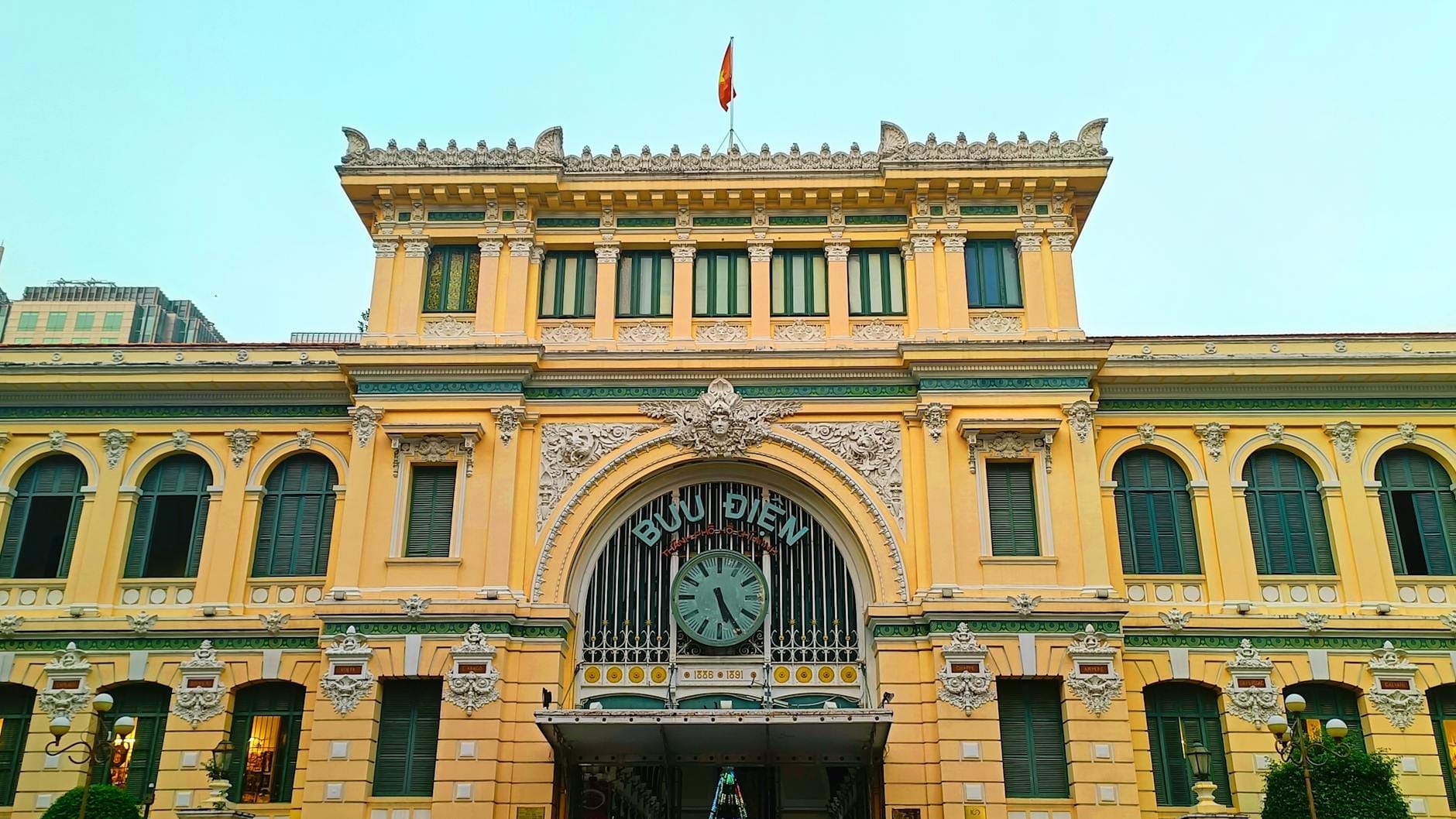
What You're Actually Looking At
The Saigon Central Post Office, officially known in Vietnamese as Bưu điện Trung tâm Sài Gòn, sits on Cong Xa Paris Street directly facing Notre Dame Cathedral in the heart of District 1. The two buildings face each other across a small square, creating one of the most photographed colonial streetscapes in Vietnam. The post office is the more accessible of the two: the cathedral has been closed to the public for extensive restoration, while the post office remains open and fully operational.
The facade is immediately striking. A large arched clock above the main entrance is inscribed with the construction dates 1886–1891, and the iron-and-glass barrel vault that spans the main hall draws comparisons to a Parisian train station rather than a government office. That similarity is not accidental. The building was constructed under French colonial rule and the structural engineering is attributed to the office of Gustave Eiffel, the same engineer behind the Eiffel Tower, completed just two years before this post office opened. The architectural design itself is credited to Alfred Foulhoux.
ℹ️ Good to know
Opening hours: Every day 7:00 AM – 7:00 PM. Entrance is free.
Inside the Hall: What to Notice
Step through the main entrance and the scale of the interior becomes clear. The central hall stretches roughly 60 meters from end to end beneath the vaulted ceiling, with light filtering through the upper glass panels in long, pale shafts. The floor is a pale terrazzo, and the counter service desks line both walls, currently numbering 38 service windows. The space is large enough that it never feels claustrophobic even at midday when tourist numbers peak.
Look up at the two large hand-painted maps mounted on the interior walls. These date to the colonial period and show the telegraph and road networks of Cochinchine (southern Vietnam) and the wider Indochina region as they existed in the late 19th century. They are preserved originals and offer a genuine window into how the French administration understood and connected the territory it controlled. Few visitors spend time with them, which makes them worth seeking out.
At the far end of the hall, beneath a large portrait of Ho Chi Minh, is a small cluster of wooden desks. One of these belongs to Duong Van Ngo, a letter-writer who has been assisting visitors and locals with correspondence in English and French for decades. He is something of a living institution within the building, though his availability is not guaranteed on any given day.
Tickets & tours
Live prices and dates from our booking partner. If you book, we may earn a commission at no extra cost to you.
Ho Chi Minh Saigon River Dinner Cruise with Live Music
From 81 €Instant confirmationFree cancellationSaigon countryside guided bike tour with lunch
From 107 €Instant confirmationSaigon markets and streets seasonal walking tour
From 23 €Instant confirmationFree cancellationSaigon shopping tour of markets, malls and hidden gems
From 17 €Instant confirmation
How the Experience Changes by Time of Day
Arrive before 8:30 AM and you catch the building in its working mode. Locals queue at the postal counters, the atmosphere is functional rather than touristic, and the morning light through the east-facing glass panels is at its warmest. The souvenir stalls along the interior walls are still setting up, and the postcard vendors have not yet arranged their full displays. This is genuinely the best time to photograph the interior without crowds obscuring the floor lines.
Between 9:30 AM and noon, tour groups arrive in volume. Large groups tend to cluster near the entrance for photographs and then move quickly to the souvenir counters. The noise level rises noticeably, and the echo in the vaulted space amplifies conversation. If you visit at this time, move to the far end of the hall where foot traffic is lighter and the atmosphere quieter.
The early afternoon, roughly 1:00 PM to 2:30 PM, sees a lull as the midday heat discourages casual wandering. By late afternoon, around 4:00 PM onward, the light quality through the glass vault shifts to a warmer amber and the building takes on a noticeably different character. This is worth knowing if photography is a priority.
💡 Local tip
For the cleanest interior photographs, arrive before 8:30 AM on a weekday. The hall is rarely empty but crowds are manageable and the early light through the glass ceiling is considerably better than midday.
The Postal Service Still Works
One detail that separates this from many heritage buildings open to the public: it genuinely functions as a post office. You can buy stamps, mail letters, send packages internationally, and purchase postcards from the souvenir counters that line the hall. The postcards on sale range from standard tourist photography to reproduction vintage prints of Saigon street scenes. Prices are modest by international standards.
Mailing a postcard from inside the Saigon Central Post Office is a small but specific pleasure. The act of dropping something into the postbox inside a landmark Eiffel-era building, knowing it will travel to the other side of the world, has a romantic logic to it. International delivery times from Vietnam vary, but postcards to Europe and North America typically arrive within two to four weeks.
Historical Context: More Than a Pretty Facade
An earlier post office existed from 1860-1863. The current building replaced it and was completed in 1891, during the height of French colonial investment in Saigon's urban infrastructure. The French administration poured considerable resources into the city's civic architecture during this period: the opera house, the city hall (now the People's Committee Building), and Notre Dame Cathedral all date from roughly the same era.
The building underwent significant renovation in 2014 and remains in excellent structural condition. Unlike some of the city's colonial-era buildings that have been converted into shopping malls or hotels, the post office has retained its original civic function. That continuity is unusual and worth appreciating. For broader context on how these colonial landmarks fit into the city's character today, the Ho Chi Minh City Museum nearby covers the full sweep of the city's history, from pre-colonial settlement to the present.
The Surrounding Area and How to Combine Visits
The post office sits within a tight cluster of significant colonial-era landmarks in District 1. Notre Dame Cathedral is directly across the square, though access inside has been restricted during its ongoing restoration. A ten-minute walk south brings you to the Reunification Palace, one of the most historically significant buildings in the country. In the other direction, the main shopping and cafe strip of Dong Khoi Street runs south toward the river.
This cluster of landmarks forms a natural walking circuit that most visitors to Ho Chi Minh City complete on their first full day. If you are building an itinerary, the post office pairs well with the War Remnants Museum and the Reunification Palace for a half-day of colonial and 20th-century history. For a full suggested route, see the Ho Chi Minh City itinerary guide.
Practical Details and Honest Assessment
Getting here is straightforward. The post office is walkable from Ben Thanh Market in about 15 minutes on flat ground. GrabCar and GrabBike, the dominant ride-hailing services in Ho Chi Minh City, can drop you directly outside. Metro Line 1 is now operational, with the nearby Opera House station a short walk away. English-language signage is present throughout the building.
Photography inside is permitted and encouraged. There are no restricted zones in the main hall. A wide-angle lens or a phone with an ultra-wide mode captures the vault best; the hall is long and narrow and a standard lens will struggle to communicate the scale from most angles.
Who should skip it: travelers with very limited time who have already seen French colonial architecture elsewhere in Asia will find the visit pleasant but not revelatory. The interior, while impressive, is a single room with souvenir counters lining the walls. If architecture is not a priority and your schedule is tight, the time might be better spent at the Reunification Palace or the War Remnants Museum, which offer more substantive historical content.
⚠️ What to skip
Notre Dame Cathedral across the square has been closed for renovation for several years with no confirmed reopening date. Do not plan your visit around accessing the cathedral interior.
Insider Tips
- The two large colonial-era maps on the interior walls showing Indochina's telegraph and road networks are overlooked by most visitors. Stand in front of them for a few minutes; they are original and genuinely rare.
- Buy your postcards from the souvenir counters inside the hall rather than from street vendors outside. The selection is better and prices are comparable or lower.
- If you want to mail something, the service windows toward the far end of the hall typically have shorter queues than those near the entrance.
- The exterior of the building reads differently in the evening light even though the post office is closed by then. If you are walking along Dong Khoi Street after dinner, the illuminated facade from the square is worth a short detour.
- The building is air-conditioned, which makes it a practical midday refuge during the hot season. Linger longer than you planned.
Who Is Saigon Central Post Office For?
- First-time visitors to Ho Chi Minh City building a colonial architecture circuit
- Photographers looking for interior light and structural scale
- Travelers who want a genuinely working piece of history rather than a museum recreation
- Anyone who wants to mail a postcard or letter from a landmark building
- Families with older children interested in architecture or history
Nearby Attractions
Other things to see while in District 1 (Colonial Quarter):
- Bến Nghé Canal & Riverside Walk
The Bến Nghé Canal cuts through the heart of District 1 as one of Ho Chi Minh City's oldest urban waterways, linking the Saigon River to the city's colonial core. Free to walk any hour of the day, the riverside path offers a grounded, unhurried perspective on a city that rarely slows down.
- Bến Thành Market
Bến Thành Market has anchored the heart of Saigon since 1912 and remains one of Ho Chi Minh City's most recognizable landmarks. With nearly 1,500 booths spread across 13,000 square meters, it sells everything from fresh produce and dried seafood to ao dai fabric, lacquerware, and street food. This guide covers the realities of visiting, including when it is worth your time and when it is not.
- Bitexco Financial Tower & Saigon Skydeck
The Bitexco Financial Tower is District 1's most recognizable skyscraper, its lotus-inspired silhouette rising 262 meters above the Saigon River. The Saigon Skydeck on the 49th floor offers a glass-enclosed, 360-degree panorama that takes in the whole city at once, from colonial rooftops to the river bends to the sprawling suburbs beyond.
- Đồng Khởi Street
Once the elegant Rue Catinat of French colonial Saigon, Đường Đồng Khởi runs 630 meters through the heart of District 1, running from Nguyễn Du Street (across from Notre Dame Cathedral) to the Saigon River waterfront at Bạch Đằng Quay. Today it is a compact corridor of colonial facades, high-end boutiques, art galleries, and landmark buildings that together form a living archive of the city's layered history.
Planning a trip? Discover personalized activities with the Nomado app.