Ho Chi Minh City Museum: History Inside a Colonial Palace
Housed in the grand French colonial Gia Long Palace, the Ho Chi Minh City Museum covers the city's history from prehistoric times through reunification. It is one of the most architecturally striking museum buildings in District 1, and rewards visitors who arrive with a little context.
Quick Facts
- Location
- 65 Ly Tu Trong Street, Ben Nghe Ward, District 1, Ho Chi Minh City
- Getting There
- Walking distance from Ben Thanh Market and Reunification Palace; accessible by taxi, grab, or city bus (Red Route stops nearby)
- Time Needed
- 1.5 to 2.5 hours
- Cost
- Admission fee applies; verify current prices directly with the museum before visiting
- Best for
- History enthusiasts, architecture lovers, travelers wanting context before visiting the War Remnants Museum or Reunification Palace
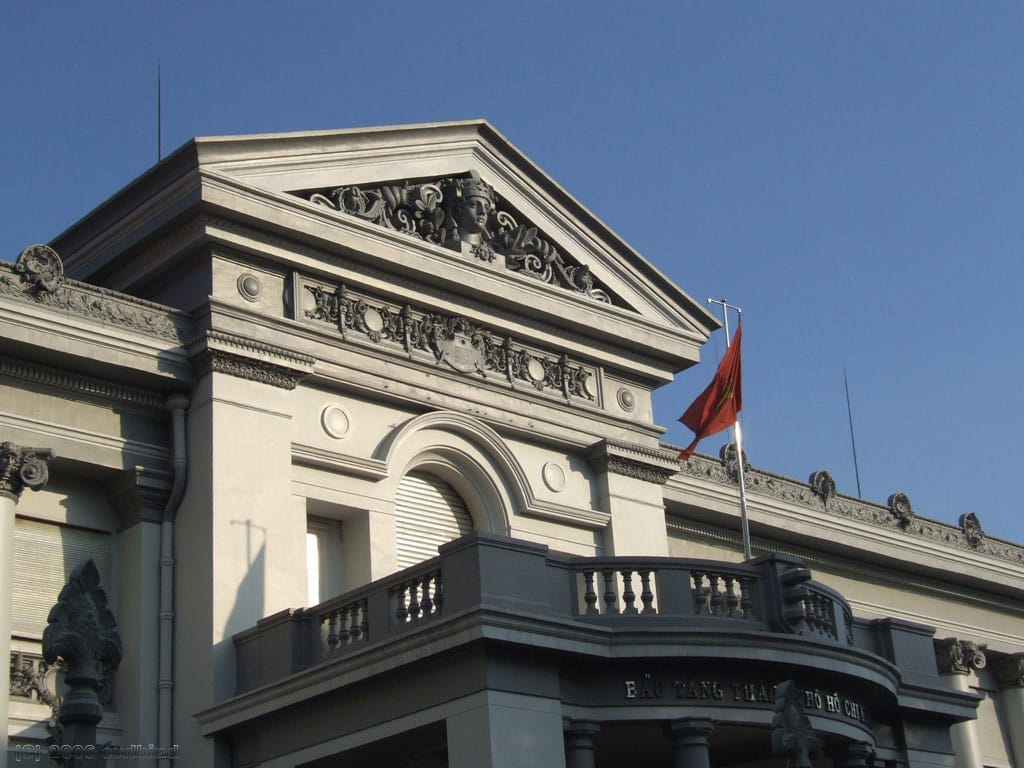
What Is the Ho Chi Minh City Museum?
The Ho Chi Minh City Museum (Bảo tàng Thành phố Hồ Chí Minh) sits at 65 Ly Tu Trong Street in the heart of District 1, occupying the former Gia Long Palace, a neoclassical French colonial building constructed between 1885 and 1890. The museum chronicles the city's long arc from prehistoric human settlement through the French colonial era, the American War period, and the reunification of Vietnam in 1975.
The building itself deserves as much attention as its contents. Its symmetrical facade, pale yellow render, louvred shutters, and elevated entrance staircase are classic expressions of French colonial civic architecture in Southeast Asia. Standing at the foot of those steps before you go inside, you get a strong sense of how the colonial administration wanted power to look and feel in Saigon. That visual weight is part of what makes the exhibits inside land harder.
The museum is located just a short walk from several of District 1's most significant landmarks, including the Reunification Palace and Notre Dame Cathedral. Visiting all three on the same day is entirely practical and gives a coherent picture of the city's colonial and post-colonial layers.
💡 Local tip
Arrive at opening time (8:00 AM) on a weekday if you want the galleries largely to yourself. Tour groups tend to arrive mid-morning and can crowd the ground-floor rooms significantly.
The Building's History: From Gia Long Palace to City Museum
Before it became a museum, this building carried a different kind of weight. Constructed as a colonial administrative and ceremonial structure, it later served under the name Gia Long Palace. After 1975, it was repurposed as a Revolutionary Museum and renamed the Ho Chi Minh City Museum. That succession of identities, colonial showcase, revolutionary archive, city history museum, is itself one of the most interesting stories in the building.
The architectural details have been preserved carefully. Inside, high ceilings create natural cross-ventilation, a practical colonial design choice for a tropical climate that still makes the rooms feel cooler than the street outside even without air conditioning running at full strength. Wooden floor panels in the upper galleries creak underfoot in the way that only genuinely old buildings do. The staircases are wide and formal, designed to impress.
Note that the Ho Chi Minh City Museum (this building in District 1) is a separate institution from the Ho Chi Minh Museum Branch at Nha Rong Wharf in District 4. The Nha Rong Wharf site commemorates Ho Chi Minh's 1911 departure from Vietnam. Both are worth visiting, but they are different places with different focuses. Confusion between the two is common, so confirm your destination before you get in a taxi.
Tickets & tours
Live prices and dates from our booking partner. If you book, we may earn a commission at no extra cost to you.
Private full-day trip from Ho Chi Minh City to Mekong Delta
From 52 €Instant confirmationFree cancellationLandmarks of Ho Chi Minh City half-day tour
From 33 €Instant confirmationFree cancellationCu Chi tunnels guided experience from Ho Chi Minh City
From 33 €Instant confirmationFree cancellationHalf-day Cu Chi Tunnels guided tour from Ho Chi Minh City
From 21 €Instant confirmationFree cancellation
What the Exhibits Cover
The permanent collection is organized roughly chronologically across multiple floors. Ground-floor galleries handle prehistoric and early historical periods, including artifacts from the Óc Eo culture (a trading civilization that flourished in the Mekong Delta region roughly 1st to 7th century CE). These rooms tend to be quieter and less immediately dramatic than the floors above, but they do an important job of establishing that this was a place of dense human activity long before European contact.
Upper floors move through the French colonial period with maps, photographs, and administrative documents that illustrate how Saigon was redesigned and expanded to serve colonial economic interests. The exhibits here are not triumphalist, nor are they particularly neutral. They present colonialism as an extractive system, which is what it was. Photography is generally permitted in most areas, though flash tends to wash out the older photographs on display.
The section covering the American War period and the 1975 reunification is where most visitors spend the most time. Artifacts include weapons, military equipment, personal items, and a considerable amount of documentary photography. If you are visiting the War Remnants Museum on the same trip, there is some thematic overlap, but the framing and curation differ enough that both are worth seeing.
For travelers building a structured itinerary around the city's history, this museum pairs well with a morning visit to the War Remnants Museum and an afternoon at Reunification Palace. See our Ho Chi Minh City itinerary guide for a practical day-by-day breakdown.
How the Experience Changes by Time of Day
Early morning, roughly 8:00 to 9:30 AM, is the clearest window for a calm, unhurried visit. The light coming through the upper-floor windows at that hour is soft and raking, which works well for photographing the architectural details of the interior. Staff tend to be attentive rather than overwhelmed. The garden surrounding the building is worth a slow walk at this hour before the heat climbs.
By mid-morning, school groups and organized tour parties arrive in numbers. The ground-floor rooms, which feed directly from the main entrance, can become congested. If you arrive during this window, consider starting on the upper floors and working downward. The noise level in a full building is significant. It is not a silent, contemplative museum experience at peak hours.
Afternoons are quieter again after roughly 2:00 PM, though the building can become warm. The museum closes at 5:00 PM. Arriving at 3:30 PM gives you sufficient time to cover the main galleries without rushing if you are selective about what you linger over.
⚠️ What to skip
The museum is open daily from 8:00 AM to 5:00 PM, but hours can change during public holidays and special events. Confirm with the museum directly or via the official city portal before planning a tightly scheduled visit.
Practical Walkthrough: Getting There and Around
The museum is on Ly Tu Trong Street, a wide tree-lined road in the civic core of District 1. From Ben Thanh Market it is roughly a 12-minute walk heading southeast. The street has footpaths broad enough to walk comfortably, though motorbike parking clusters near the entrance can narrow the approach slightly. City buses on the Red Route stop nearby; a grab bike or taxi from anywhere in central District 1 should cost very little and take under five minutes.
If you are combining this visit with nearby attractions, Saigon Central Post Office and Notre Dame Cathedral are both within a 10-minute walk to the northwest. Dong Khoi Street is a few minutes to the northeast if you want to continue into the city's commercial and café corridor afterward.
Wear comfortable shoes. The upper floors require stair climbing, and the garden paths are uneven in places. Light, breathable clothing is appropriate year-round given the tropical climate, but a thin layer is useful in heavily air-conditioned interior sections. Bring a reusable water bottle. There is no dedicated café inside the museum, though vendors operate near the entrance gate.
Specific accessibility information (ramps, elevator availability for upper floors) is not confirmed in official sources. Visitors with mobility limitations should contact the museum directly before visiting to confirm current arrangements.
Photography and What to Bring
Photography is generally permitted in the permanent galleries. The building offers strong photographic interest beyond just the exhibits: the main staircase, the colonnaded exterior walkways, and the garden framing the facade are all worth the time. For exterior shots, mid-morning light hits the front facade directly and can produce harsh shadows by 10:00 AM. The golden hour before 8:00 AM, when the street is quiet and the light is warm, gives the best conditions for the building's exterior.
Inside, the display cases use older-style lighting that tends toward yellow. A phone camera with a decent low-light mode handles it adequately. Dedicated camera users will find a fast prime lens more useful than a zoom in the relatively tight gallery spaces.
ℹ️ Good to know
Some temporary exhibitions may have specific no-photography rules. Check with staff at the ticket desk when you enter if you plan to photograph extensively.
Honest Assessment: Is It Worth Your Time?
The Ho Chi Minh City Museum is a solid, well-maintained regional history museum with an exceptional building around it. It is not the most internationally polished museum experience. Multilingual labeling exists but is inconsistent in quality across sections, and some display cases feel dated in their curation approach. Travelers expecting the level of interpretive design found in major European or North American institutions may find the presentation underwhelming in places.
What it does well is breadth and context. If you are visiting Ho Chi Minh City without much prior knowledge of Vietnamese history, this museum gives you a reliable orientation across a long timeline. It also gives you that timeline inside a building that is itself a piece of the city's history, which counts for more than a neutral gallery space would.
Travelers who are primarily interested in the American War period specifically and who have limited time will find the War Remnants Museum a more focused and emotionally direct experience. Travelers who want to understand the city on its own terms, rather than primarily through the lens of the 20th century conflict, will get more from spending time here first.
To plan the broader context of your visit, the full guide to things to do in Ho Chi Minh City covers how this museum fits into a longer stay.
Insider Tips
- The exterior garden is a genuinely pleasant space to sit and observe the building before entering. Many visitors walk straight past it on the way to the ticket desk. Spend five minutes here first.
- The Gia Long Palace tunnel system, reportedly used during the 1960s period of South Vietnamese governance, is referenced in exhibits but is not a publicly accessible part of the current museum visit.
- Docents are sometimes available for guided tours in Vietnamese and basic English. Ask at the ticket desk when you arrive rather than assuming none are available.
- The museum building photographs dramatically from the far end of its front garden. Move back as far as the fence line allows to get the full facade in frame without distortion from a wide-angle lens.
- Combine this visit with the nearby Reunification Palace on the same morning. Both sites together give a much more complete picture of the 1975 period than either does alone, and the walking distance between them is under 10 minutes.
Who Is Ho Chi Minh City Museum For?
- Travelers wanting historical context before visiting the War Remnants Museum or Reunification Palace
- Architecture and colonial history enthusiasts who appreciate the building as much as the collection
- First-time visitors to Ho Chi Minh City who want a broad orientation to the city's history
- Photographers interested in French colonial civic architecture
- Travelers with older children looking for a structured, air-conditioned indoor experience
Nearby Attractions
Other things to see while in District 1 (Colonial Quarter):
- Bến Nghé Canal & Riverside Walk
The Bến Nghé Canal cuts through the heart of District 1 as one of Ho Chi Minh City's oldest urban waterways, linking the Saigon River to the city's colonial core. Free to walk any hour of the day, the riverside path offers a grounded, unhurried perspective on a city that rarely slows down.
- Bến Thành Market
Bến Thành Market has anchored the heart of Saigon since 1912 and remains one of Ho Chi Minh City's most recognizable landmarks. With nearly 1,500 booths spread across 13,000 square meters, it sells everything from fresh produce and dried seafood to ao dai fabric, lacquerware, and street food. This guide covers the realities of visiting, including when it is worth your time and when it is not.
- Bitexco Financial Tower & Saigon Skydeck
The Bitexco Financial Tower is District 1's most recognizable skyscraper, its lotus-inspired silhouette rising 262 meters above the Saigon River. The Saigon Skydeck on the 49th floor offers a glass-enclosed, 360-degree panorama that takes in the whole city at once, from colonial rooftops to the river bends to the sprawling suburbs beyond.
- Saigon Central Post Office
Built between 1886 and 1891 and attributed to Gustave Eiffel's engineering office, the Saigon Central Post Office is one of the finest French colonial buildings in Southeast Asia. It functions as a working post office to this day, meaning you can mail a postcard home from inside a genuine architectural landmark. Free to enter and centrally located in District 1, it earns its place on most itineraries.
Planning a trip? Discover personalized activities with the Nomado app.