Notre-Dame Cathedral Basilica of Saigon: What to Expect Before You Visit
One of the most photographed landmarks in Ho Chi Minh City, the Notre-Dame Cathedral Basilica of Saigon rises 58 meters above District 1 with twin bell towers and Toulouse red brick that has never been painted. The exterior is free to view any time, though the interior is reserved for religious services only.
Quick Facts
- Location
- 1 Cong Xa Paris Street, Ben Nghe Ward, District 1, Ho Chi Minh City
- Getting There
- 10-minute walk from Ben Thanh Market; easily reached by taxi or ride-hailing app from anywhere in District 1
- Time Needed
- 20–40 minutes for the exterior and surrounding Paris Square
- Cost
- Free to view from outside; interior access limited to Mass attendees
- Best for
- Architecture lovers, history buffs, photographers, and those combining it with the nearby Central Post Office
What It Actually Is
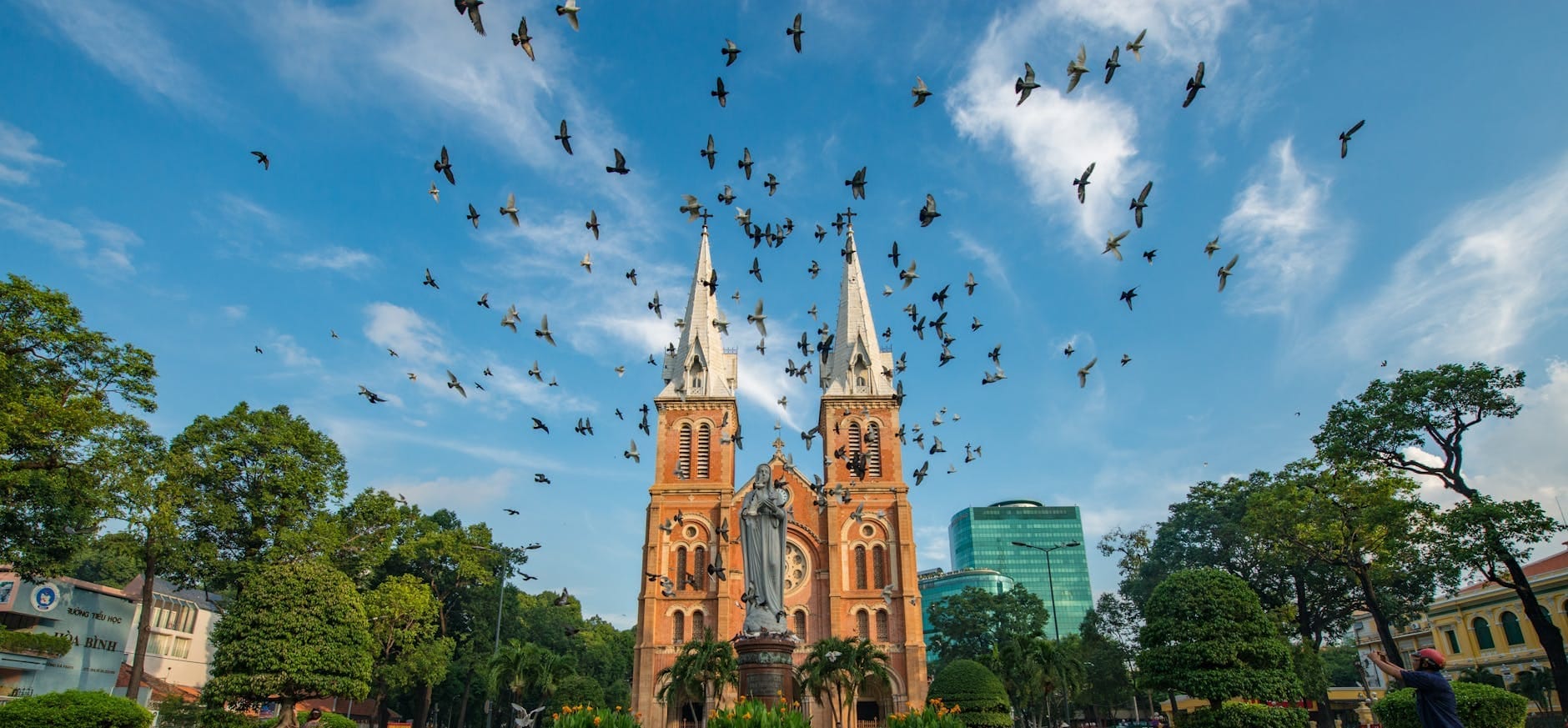
The Notre-Dame Cathedral Basilica of Saigon, known in Vietnamese as Nhà thờ Đức Bà Sài Gòn, is a Roman Catholic cathedral completed in 1880; basilica status was conferred by the Vatican in 1962 and the name Notre-Dame Cathedral used since 1959 when the Virgin Mary statue was installed. It sits at the top of District 1's administrative core, flanked by Paris Square and facing the Saigon Central Post Office. The two address each other across a short forecourt in what is one of the most intact examples of French colonial urban planning still standing in Southeast Asia.
Despite the name, this is not a replica of the cathedral in Paris. The Saigon basilica draws from French Romanesque-Gothic traditions but was designed specifically for its site by architect Jules Bourard. What makes it distinctive is the material: every brick was fired in Marseille and shipped to Vietnam. None of the exterior has ever been painted or plastered, and after more than 140 years the terracotta red has held remarkably well in the tropical climate.
⚠️ What to skip
The cathedral does not admit general tourists inside. Only Catholics attending Mass may enter the building. Do not expect to walk through the interior as you would at a museum or open church.
The Architecture Up Close
The two bell towers, with spires added in 1885, reach a height of 58 meters (190 feet). Each tower is topped with iron spires that catch the late-afternoon light at a distinctive angle. The towers are the tallest vertical elements in this part of the city center and are visible from several blocks away.
Standing in Paris Square and looking up, the facade reads in layers: a row of arched windows at the lower level, a wide rose window above the main entrance, and the twin spires rising symmetrically above. The brickwork is the detail worth slowing down for. Up close, the texture is rough and deeply colored, with none of the smoothness you would expect from a rendered surface. In 2023, the South China Morning Post named this cathedral among Asia's 10 most magnificent churches, and the exterior is the primary reason.
A white marble statue of the Virgin Mary stands in the forecourt. It was placed there in 1959 and remains a focal point for worshippers arriving before Mass, who often stop to light incense or leave flowers at its base.
Tickets & tours
Live prices and dates from our booking partner. If you book, we may earn a commission at no extra cost to you.
Ho Chi Minh Saigon River Dinner Cruise with Live Music
From 81 €Instant confirmationFree cancellationSaigon countryside guided bike tour with lunch
From 107 €Instant confirmationSaigon markets and streets seasonal walking tour
From 23 €Instant confirmationFree cancellationSaigon shopping tour of markets, malls and hidden gems
From 17 €Instant confirmation
How the Experience Changes by Time of Day
Early morning, before 7:30 AM, is the quietest window. The forecourt is nearly empty except for a few churchgoers heading to the 5:30 AM or 6:45 AM Sunday services. The light at this hour is soft and comes from the east, directly behind the cathedral from the direction of the river, which means the facade is in shade and easier to photograph without harsh shadows or blown-out sky.
By mid-morning on weekends, tour groups arrive and the square fills quickly. School groups often gather here too, particularly on weekday mornings. The square never becomes oppressively crowded by international standards, but between 9 AM and noon it loses the calm that makes the architecture easier to appreciate.
Late afternoon, roughly 4 PM to 6 PM, brings the day's most interesting light. The western sun hits the brick towers directly, pulling out the deep red of the Toulouse clay against whatever sky is above. On overcast days, the lack of harsh contrast actually suits the architecture better than bright sun. Sunday evenings have multiple Mass times from 4 PM onward, so the square has a steady rhythm of arrivals that adds life without overwhelm.
💡 Local tip
Photography tip: Stand at the far end of Paris Square, near the street, and use the low perimeter fence as a foreground anchor. This framing captures the full height of the towers without requiring a wide-angle lens.
Historical Context Worth Knowing
Construction began in 1877 under French colonial authority, with the completion ceremony held on Easter Sunday, April 1880. The choice to import all building materials from France, rather than using local stone or brick, was deliberate. It was an assertion of permanence and metropolitan identity, a physical statement that this was not a temporary colonial outpost.
The cathedral stands in a district that concentrates much of Saigon's French-era civic architecture. Within a few minutes' walk are the Saigon Central Post Office, the People's Committee Building, and the Saigon Opera House. Visiting them together as a circuit takes two to three hours and gives a coherent picture of how the French colonial administration shaped the city's spatial logic.
The basilica has remained an active Catholic parish through all of the city's political transitions. It was neither repurposed nor demolished after 1975, which sets it apart from a number of other colonial-era religious buildings in Vietnam. Today it serves a sizable Catholic community in a city where Catholicism has deep historical roots introduced by Portuguese and French missionaries from the 17th century onward.
Attending Mass as a Visitor
The only way to see the interior is to attend a Mass service. Foreign visitors, Catholic or not, are generally welcome to attend as silent observers provided they dress appropriately and behave respectfully. Shoulders and knees should be covered. Shorts, sleeveless tops, and hats worn inside are not appropriate. The Sunday 9:30 AM Mass is conducted in English, making it the most accessible for English-speaking visitors.
Weekday Masses are at 5:30 AM and 5:30 PM. Sunday services run from 5:30 AM through 6:30 PM with multiple slots. If you plan to attend, arrive five to ten minutes early. The interior is relatively modest by European cathedral standards, with colored glass windows and a high vaulted nave, but the acoustics and atmosphere during a full Sunday service are genuinely affecting.
ℹ️ Good to know
Dress code for Mass: Long trousers or a skirt covering the knee, and a top covering the shoulders. Carry a light layer if you plan to attend early morning services, as the interior can be cool.
Planning Your Visit
The cathedral is most naturally combined with the Saigon Central Post Office, which sits directly opposite and is open to visitors as a functioning historic building. From there, Reunification Palace is about a 15-minute walk through leafy streets. Together, these three sites form a logical half-day loop through the civic heart of District 1.
Getting here is straightforward. The cathedral is walkable from Ben Thanh Market in about ten minutes on foot, heading northeast along Le Loi or Nguyen Du. Taxis and ride-hailing apps (Grab is the most widely used in Ho Chi Minh City) drop off directly on Cong Xa Paris Street in front of the square. Street parking for motorbikes exists along the surrounding blocks.
The cathedral has been undergoing extensive restoration since 2017, and visitors should expect scaffolding on the exterior; the building's silhouette remains recognizable, but close-up photographs of the facade may be partially obscured by construction materials. The surrounding area is well shaded by mature trees along the adjacent streets, but Paris Square itself offers little shade in the middle of the day. During the dry season (roughly November to April), midday visits in direct sun are uncomfortable. During the wet season, afternoon thunderstorms can arrive quickly, so carry a compact rain jacket or umbrella if you are spending time outdoors in the district.
For broader context on moving around the city, the getting around Ho Chi Minh City guide covers transport options in detail. If you are planning a full itinerary that incorporates this landmark alongside other District 1 sites, the Ho Chi Minh City itinerary guide lays out a practical day-by-day framework.
Who Should Skip This
If you are not interested in colonial architecture or Catholic heritage, the Notre-Dame Cathedral Basilica of Saigon offers a limited experience. The exterior viewing takes under thirty minutes, and without interior access, there is no museum, no exhibition, and no interpretive material. Travelers who prioritize immersive cultural experiences, street-level activity, or Vietnamese history will find more depth at other nearby landmarks.
Those with limited time in the city and a focus on Vietnamese history specifically may prefer to spend that time at the War Remnants Museum or the Reunification Palace, both of which offer substantive interior experiences. The cathedral is worth passing by as part of a broader District 1 walk, but it does not sustain a dedicated trip on its own unless you are attending a service.
Insider Tips
- The Sunday 9:30 AM Mass is conducted in English and is the most accessible service for international visitors who want to experience the interior. Arrive by 9:20 AM to find a seat.
- The Central Post Office directly opposite the cathedral is open to the public and free to enter. Its interior is one of the best-preserved French colonial interiors in the city. Combine both in a single stop.
- For the cleanest architectural photographs, overcast days produce more even light on the red brick than bright sunshine, which creates uneven shadows across the facade and spires.
- The marble Virgin Mary statue in the forecourt is a working devotional site. On religious holidays and around Christmas, the square around it fills with flowers and candles placed by local parishioners — a significantly more atmospheric scene than a regular weekday.
- If you are visiting around Christmas or Easter, expect the square and surrounding streets to be filled with worshippers and visitors, particularly on Christmas Eve. The atmosphere is unlike any other time of year, but parking and access by vehicle become difficult.
Who Is Notre-Dame Cathedral Basilica of Saigon For?
- Architecture and design enthusiasts interested in French colonial construction techniques
- Photographers looking for the strongest exterior landmark in District 1
- Catholic travelers who want to attend a Mass in a historically significant basilica
- Travelers doing a colonial-era walking circuit of District 1 landmarks
- First-time visitors to Ho Chi Minh City who want an orientation to the city's French-period urban core
Nearby Attractions
Other things to see while in District 1 (Colonial Quarter):
- Bến Nghé Canal & Riverside Walk
The Bến Nghé Canal cuts through the heart of District 1 as one of Ho Chi Minh City's oldest urban waterways, linking the Saigon River to the city's colonial core. Free to walk any hour of the day, the riverside path offers a grounded, unhurried perspective on a city that rarely slows down.
- Bến Thành Market
Bến Thành Market has anchored the heart of Saigon since 1912 and remains one of Ho Chi Minh City's most recognizable landmarks. With nearly 1,500 booths spread across 13,000 square meters, it sells everything from fresh produce and dried seafood to ao dai fabric, lacquerware, and street food. This guide covers the realities of visiting, including when it is worth your time and when it is not.
- Bitexco Financial Tower & Saigon Skydeck
The Bitexco Financial Tower is District 1's most recognizable skyscraper, its lotus-inspired silhouette rising 262 meters above the Saigon River. The Saigon Skydeck on the 49th floor offers a glass-enclosed, 360-degree panorama that takes in the whole city at once, from colonial rooftops to the river bends to the sprawling suburbs beyond.
- Saigon Central Post Office
Built between 1886 and 1891 and attributed to Gustave Eiffel's engineering office, the Saigon Central Post Office is one of the finest French colonial buildings in Southeast Asia. It functions as a working post office to this day, meaning you can mail a postcard home from inside a genuine architectural landmark. Free to enter and centrally located in District 1, it earns its place on most itineraries.
Planning a trip? Discover personalized activities with the Nomado app.