People's Committee Building: Saigon's Colonial City Hall Up Close
Standing at the northern end of Nguyen Hue Walking Street, the People's Committee Building is one of Ho Chi Minh City's most photographed facades. Built between 1898 and 1908 by French architect Fernand Gardès, it blends Baroque, Rococo, and Art Nouveau into a single pale-yellow statement. Entry is free, and the exterior is accessible at any hour.
Quick Facts
- Location
- 86 Le Thanh Ton Street, Ben Nghe Ward, District 1, Ho Chi Minh City
- Getting There
- Walk from Ben Thanh Market (10–15 min); grab-bike or taxi to Nguyen Hue Walking Street
- Time Needed
- 20–45 minutes for the exterior; longer if combining with Nguyen Hue Walking Street
- Cost
- Free (exterior); interior tours free but require prior registration
- Best for
- Architecture lovers, evening photographers, history-curious visitors
What You're Actually Looking At
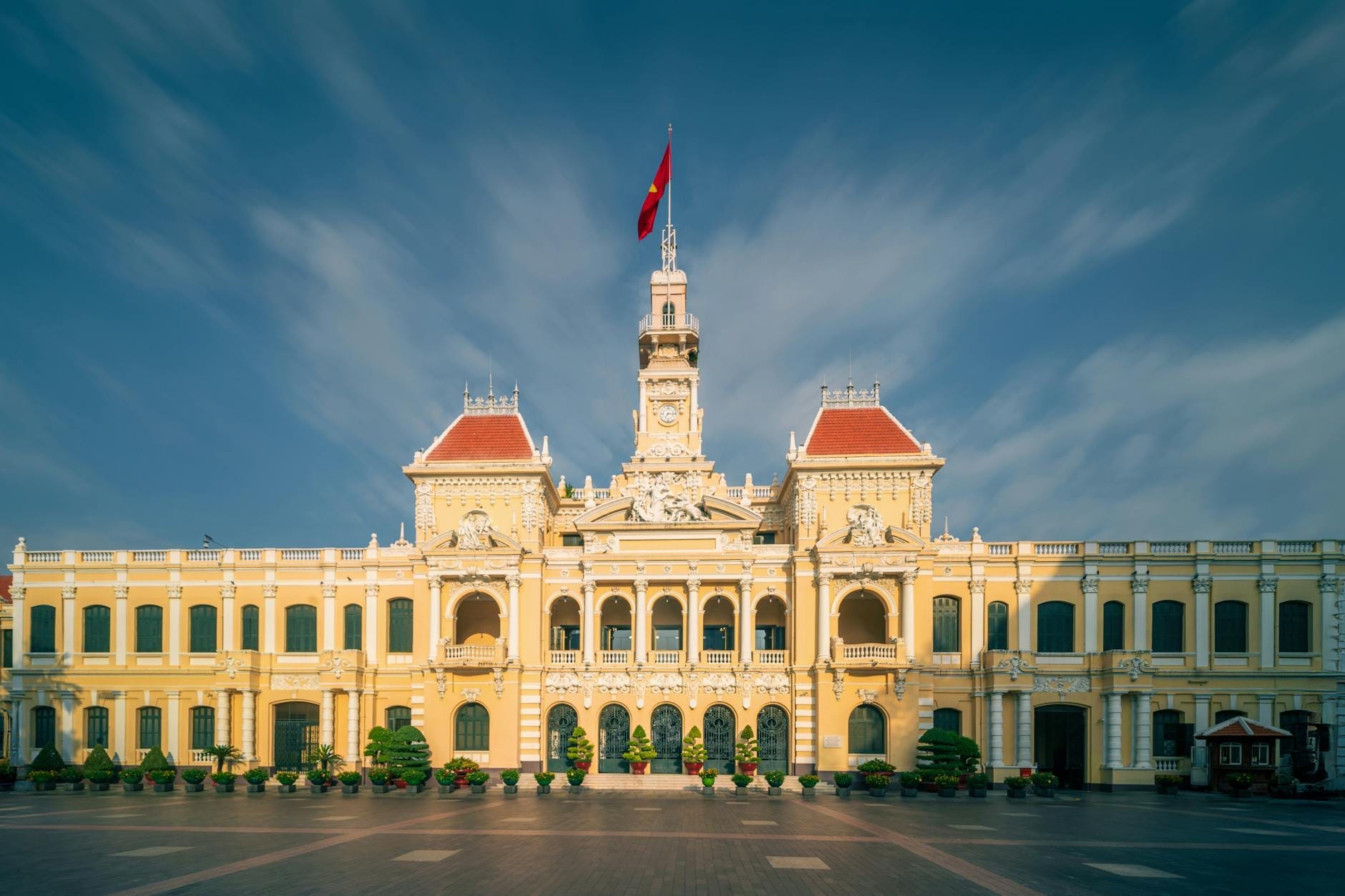
The People's Committee Building, officially Tòa Đô Chánh Thành Phố Hồ Chí Minh, sits at the northern terminus of Nguyen Hue Walking Street like a stage backdrop that the rest of District 1 was arranged around. The building is still a functioning government headquarters, which means you cannot simply walk inside, but that barely matters. The exterior alone is worth the detour.
The facade runs across a compound of approximately 7,500 square meters. Five wide arched gates span the ground floor, each framed with carved floral reliefs. The pale yellow and white paintwork gives the whole structure a warmth that photographs cannot fully capture in flat midday light. A central clock tower anchors the roofline, and the Vietnamese flag flies from the belfry above, a detail that quietly signals how thoroughly the building's identity has been rewritten since 1975.
Architect Fernand Gardès drew from Baroque, Rococo, and Art Nouveau influences, layering them over a Renaissance and European classical skeleton. The result is ornate without being chaotic: every surface has detail, but the overall composition reads clearly from the far end of the pedestrian boulevard. The side buildings were expanded to two stories in the 1940s, largely invisible from the street.
History: From Hôtel de Ville to City Hall
Construction began in 1898 and the building officially opened in 1909 under its original name, Hôtel de Ville de Saigon. For the first half of the twentieth century it served as the civic anchor of French colonial Saigon, administering one of the most commercially active cities in Southeast Asia. The French poured considerable resources into the design, and that ambition is still readable in the stonework today.
After 1975, the building became the headquarters of the Ho Chi Minh City People's Committee, the municipal government of the newly unified country. The name changed; the architecture did not. In 2020, Vietnam formally recognized the building as a national architectural and artistic heritage site, giving it legal protection as well as cultural status.
The building was beautifully renovated in 2023. That date, the anniversary of the fall of Saigon in 1975, was chosen deliberately. If you want interior access, see the registration process described below. For context on the neighborhood surrounding the building, the District 1 area guide covers the full sweep of colonial-era landmarks within walking distance.
Tickets & tours
Live prices and dates from our booking partner. If you book, we may earn a commission at no extra cost to you.
Private full-day trip from Ho Chi Minh City to Mekong Delta
From 52 €Instant confirmationFree cancellationLandmarks of Ho Chi Minh City half-day tour
From 33 €Instant confirmationFree cancellationCu Chi tunnels guided experience from Ho Chi Minh City
From 33 €Instant confirmationFree cancellationHalf-day Cu Chi Tunnels guided tour from Ho Chi Minh City
From 21 €Instant confirmationFree cancellation
Morning, Afternoon, and After Dark: How the Experience Changes
💡 Local tip
The building is illuminated by an artistic lighting system installed by specialists from Lyon, France in 2005. After dark, the facade shifts from pale yellow to a warm amber-gold. Evening is unambiguously the best time for photographs and for simply sitting on the walking street and taking it in.
Early morning, before 8 AM, the area is quiet enough that you can stand directly in front of the gate without crowds. Vendors are still setting up along Nguyen Hue, and the light comes in low from the east. This is the window to photograph the building without tour groups or selfie sticks in the frame.
By mid-morning and through the afternoon, Nguyen Hue Walking Street fills with locals on motorbikes circling the pedestrian zone perimeter, tourists, and school groups. The building itself stays calm since no one can enter without a registered tour, but the surrounding plaza gets loud and the midday sun bleaches the facade into an uninteresting white in photographs. Heat also concentrates in the open concrete boulevard, regularly reaching 34–36°C in the dry season.
Evenings from around 6 PM onward are when the street transforms. Families walk the length of Nguyen Hue, food stalls open nearby, and the illuminated building becomes the natural focal point. Weekends see larger crowds, particularly around public holidays. For a quieter evening version, a Tuesday or Wednesday works well.
Getting There and Getting In
The building is centrally located in District 1 and easy to reach on foot from most central hotels. From Ben Thanh Market, walk north along Le Loi or Nguyen Hue for about ten to fifteen minutes. From Dong Khoi Street, it is a five-minute walk west. Grab-bikes and taxis drop off easily along Le Thanh Ton Street, the road running directly in front of the building.
For the exterior, no planning is required. Show up whenever suits you. For interior tours, registration has been required since the tours opened in April 2023. Check directly with the People's Committee Building or the city's tourism offices for current registration procedures, as these details change. If you are planning a full day in the center, pair this stop with the Nguyen Hue Walking Street, the Saigon Central Post Office four blocks east, and Notre Dame Cathedral just beyond it. All three are walkable from here within twenty minutes.
ℹ️ Good to know
Opening hours for the compound are listed as 7:00 AM to 5:00 PM. The exterior plaza and street view are accessible at any hour. Admission is free.
Photography: What Works and What Doesn't
The classic shot is from the far southern end of Nguyen Hue Walking Street, framing the building at the end of the boulevard with the Ho Chi Minh statue in the mid-ground. A wide-angle lens at 24mm or equivalent captures both. The fountain in the plaza foreground adds a reflective element on calm evenings.
Tighter architectural shots reward patience. The carved reliefs above the arched gates and the clock tower details need a longer focal length from across the street. The transition between the original 1909 structure and the 1966 additions is visible from the side angles on Le Thanh Ton Street, and that contrast is more interesting architecturally than the straight-on facade.
Avoid shooting between 11 AM and 3 PM. The overhead sun flattens all the relief work and turns the yellow facade into a washed-out white. A polarizing filter helps slightly but does not solve the problem. The French-designed lighting system at night does the opposite: it rakes light across the facade at angles that bring every carved detail into relief.
Honest Assessment: What This Place Is and Isn't
The People's Committee Building is a very good piece of French colonial civic architecture in an exceptionally good location. It is not a museum, not an interactive experience, and not accessible beyond the gate on a standard visit. If you are expecting the rich interior experience of, say, the Saigon Opera House two blocks away, you will be underwhelmed. What you get here is a beautifully maintained facade, a sense of colonial-era ambition frozen in stone, and a pedestrian boulevard that makes the whole composition work.
Travelers with limited time who want depth over spectacle may find more reward at the Reunification Palace, where interior access is straightforward and the historical layering is explicit. The People's Committee Building works best as a stop woven into a walking route rather than a standalone destination. It is also a natural anchor for an evening out along Nguyen Hue, with Book Street nearby for a quieter detour before or after.
Anyone who dislikes heat, crowds, or has mobility concerns should note that the open plaza offers no shade and the surrounding streets are uneven. The building itself has steps at the main entrance. Accessibility to the interior for visitors with mobility impairments is not documented in available public sources.
Insider Tips
- The Ho Chi Minh statue in the plaza in front of the building faces south down Nguyen Hue. If you position yourself behind the statue looking north toward the building, you get the compositional framing most postcards use. This angle is less obvious than standing at the south end of the boulevard.
- Public holidays, especially April 30 (Reunification Day) and September 2 (National Day), bring organized lighting displays and crowds to the plaza. The building becomes a backdrop for official celebrations, which can be impressive or obstructive depending on your goals.
- The registration process for interior tours was new as of April 30, 2023. Procedures may still be evolving. Contact the Ho Chi Minh City Department of Tourism directly rather than relying on third-party booking platforms for interior access.
- Le Thanh Ton Street, which runs along the building's east side, has a cluster of Korean restaurants and a street that locals call the Korean district. It is a useful place to eat after an evening visit without going far.
- The lighting from Lyon was installed in 2005 and is specifically calibrated to the building's facade color and surface texture. On overcast nights, the light diffuses and the building glows more evenly. On clear nights, shadows deepen and the relief work reads more dramatically.
Who Is People's Committee Building For?
- Architecture enthusiasts who appreciate French colonial civic design and want to understand Saigon's urban layout
- Evening photographers looking for a well-lit, landmark-scale subject at the end of a pedestrian boulevard
- History-focused travelers tracing the transition from colonial Saigon to modern Ho Chi Minh City
- Casual walkers combining the Nguyen Hue corridor with nearby colonial-era buildings in a single loop
- Travelers who want a free, low-effort orientation point in the center of District 1
Nearby Attractions
Other things to see while in District 1 (Colonial Quarter):
- Bến Nghé Canal & Riverside Walk
The Bến Nghé Canal cuts through the heart of District 1 as one of Ho Chi Minh City's oldest urban waterways, linking the Saigon River to the city's colonial core. Free to walk any hour of the day, the riverside path offers a grounded, unhurried perspective on a city that rarely slows down.
- Bến Thành Market
Bến Thành Market has anchored the heart of Saigon since 1912 and remains one of Ho Chi Minh City's most recognizable landmarks. With nearly 1,500 booths spread across 13,000 square meters, it sells everything from fresh produce and dried seafood to ao dai fabric, lacquerware, and street food. This guide covers the realities of visiting, including when it is worth your time and when it is not.
- Bitexco Financial Tower & Saigon Skydeck
The Bitexco Financial Tower is District 1's most recognizable skyscraper, its lotus-inspired silhouette rising 262 meters above the Saigon River. The Saigon Skydeck on the 49th floor offers a glass-enclosed, 360-degree panorama that takes in the whole city at once, from colonial rooftops to the river bends to the sprawling suburbs beyond.
- Saigon Central Post Office
Built between 1886 and 1891 and attributed to Gustave Eiffel's engineering office, the Saigon Central Post Office is one of the finest French colonial buildings in Southeast Asia. It functions as a working post office to this day, meaning you can mail a postcard home from inside a genuine architectural landmark. Free to enter and centrally located in District 1, it earns its place on most itineraries.
Planning a trip? Discover personalized activities with the Nomado app.