Nguyễn Huệ Walking Street: Saigon's Grand Civic Promenade
Stretching 670 metres through the heart of District 1, Nguyễn Huệ Walking Street is Ho Chi Minh City's most photogenic public space. Framed by the colonial-era People's Committee Building at one end and the Saigon River at the other, it transforms from a quiet morning walkway into a lively evening gathering place, all for free.
Quick Facts
- Location
- District 1, Ho Chi Minh City (between People's Committee Building and Bach Dang Wharf)
- Getting There
- Walk from Bến Thành Market (~10 min), Bitexco Financial Tower (~3 min), or Đồng Khởi Street (~2 min)
- Time Needed
- 30–90 minutes for a casual stroll; longer on festival evenings
- Cost
- Free entry at all times
- Best for
- Evening strolls, architecture photography, people-watching, Lunar New Year flower fairs
What Is Nguyễn Huệ Walking Street?
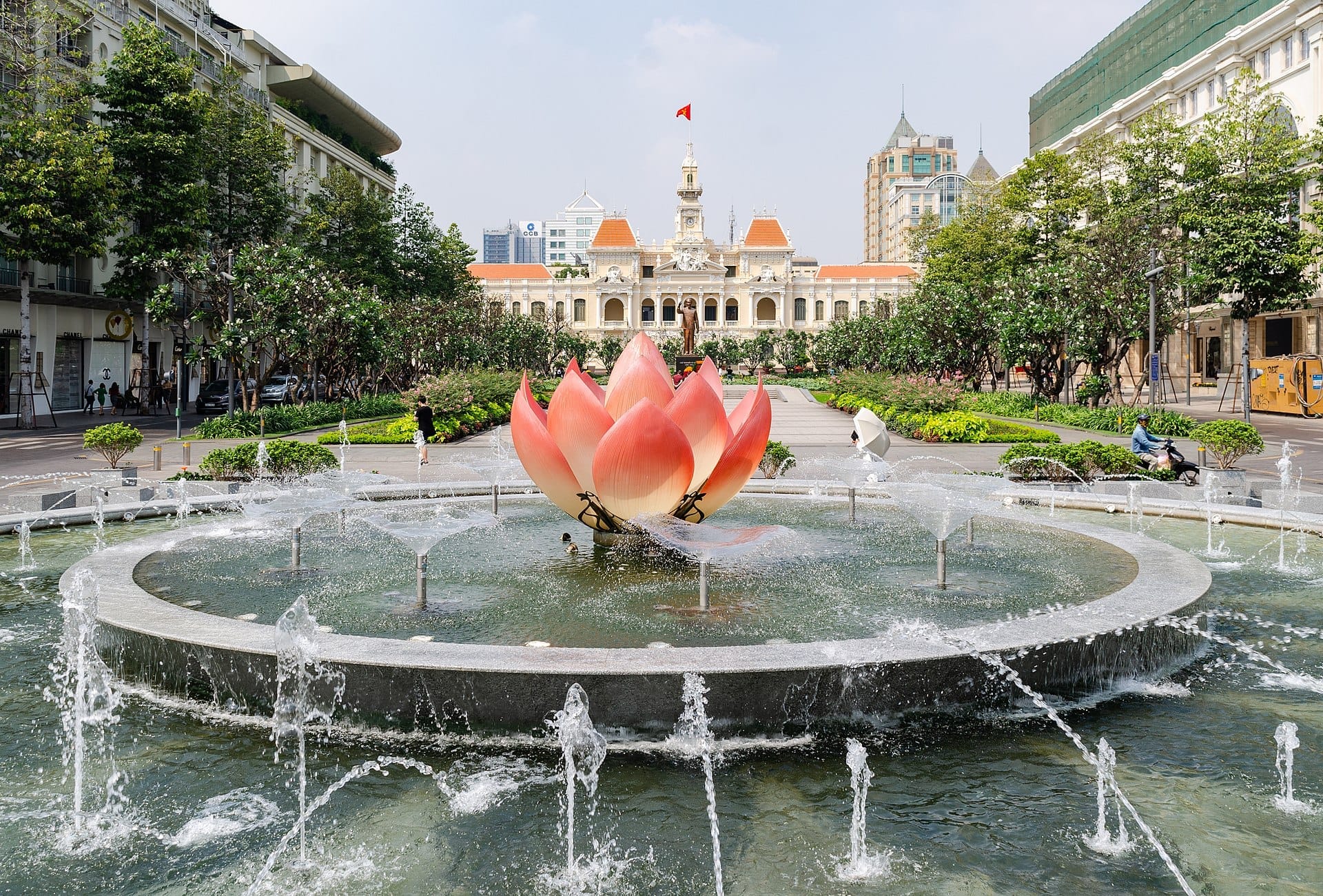
Nguyễn Huệ Walking Street is a 670-metre-long, 64-metre-wide pedestrian boulevard that cuts through the geographic and civic centre of District 1. At its northern end stands the People's Committee Building, a colonial-era landmark that anchors the view down the entire length of the street. At the southern end, the boulevard meets Bach Dang Wharf and the Saigon River. Between those two poles: smooth granite paving, more than 200 planted trees, a central fountain, and a cross-section of Saigon life playing out in real time.
The street was converted to pedestrian zone in late April 2015 (completed April 29), which gave it a completely different character from the traffic-heavy arteries surrounding it. Today, it functions simultaneously as a civic square, an outdoor event venue, a jogging route, and one of the most reliably pleasant places in the city to simply sit and observe.
ℹ️ Good to know
Nguyễn Huệ Walking Street is pedestrianized, with the full length closed to traffic on weekend evenings. No ticket, no registration, no dress code. Vehicles are restricted throughout most of the day, making it genuinely pedestrian-friendly at almost any hour.
A Street Built on a Canal: The History Beneath Your Feet
Few visitors realize they are walking over a filled-in waterway. In the 19th century, what is now Nguyễn Huệ was the Charner Canal, a navigable channel used for commerce during the French colonial period. The canal was filled in and paved over, and renamed Nguyễn Huệ in 1956, honouring the 18th-century Vietnamese Emperor Quang Trung, whose personal name it bears.
The People's Committee Building at the northern terminus was originally constructed between 1898 and 1908 as the Hôtel de Ville de Saïgon, the city hall of French Indochina. Its ornate Baroque-influenced facade, complete with a clock tower and decorative reliefs, was designed to project colonial authority. Today it serves as the seat of the Ho Chi Minh City People's Committee and, crucially for visitors, cannot be entered, but its exterior is the architectural centrepiece of the entire boulevard. The Ho Chi Minh statue in front of it, added after reunification, gives the building a distinctly different framing than its original designers intended.
The 2015 pedestrianization was part of a broader urban renewal effortDistrict 1 and fundamentally changed how residents use the space. Before that, Nguyễn Huệ was a trafficked road like any other. Now it functions more like a European city's main square, a civic living room that belongs to everyone.
Tickets & tours
Live prices and dates from our booking partner. If you book, we may earn a commission at no extra cost to you.
Private full-day trip from Ho Chi Minh City to Mekong Delta
From 52 €Instant confirmationFree cancellationLandmarks of Ho Chi Minh City half-day tour
From 33 €Instant confirmationFree cancellationCu Chi tunnels guided experience from Ho Chi Minh City
From 33 €Instant confirmationFree cancellationHalf-day Cu Chi Tunnels guided tour from Ho Chi Minh City
From 21 €Instant confirmationFree cancellation
The Street at Different Hours: How the Experience Changes
Early mornings, roughly 6 to 8 AM, belong to exercisers. Groups of older residents do tai chi near the fountain. Joggers loop the length of the street repeatedly. The air is noticeably cooler than midday, there is almost no noise from surrounding traffic, and the light hits the People's Committee Building at a low, warm angle that photographers find difficult to replicate at other times. This is also when the pavement is cleanest.
By mid-morning, office workers cut through on foot and food delivery cyclists stack up at the edges. The street becomes more transient, less leisurely. Midday heat, which in Ho Chi Minh City can be significant year-round given its tropical monsoon climate, empties the boulevard considerably. The trees provide partial shade, but the granite pavement radiates heat and there is limited shelter beyond the café terraces lining the sides.
Evenings are when the street earns its reputation. From around 5:30 PM onward, families arrive with children who immediately claim the fountain area. Young couples sit on the low stone seating near the trees. Street food vendors set up at the southern end near the river. By 8 PM on weekends, the crowd density is high enough that navigation requires patience, but the energy is genuinely festive without being chaotic. The People's Committee Building is illuminated at night and looks dramatically different under golden floodlights.
💡 Local tip
For photography: arrive at 6:30 AM for empty, golden-lit shots of the People's Committee Building facade. For atmosphere: arrive at 7 PM on a Friday or Saturday evening. For comfort: avoid 11 AM to 3 PM, when the heat on the open granite can be punishing.
What to See and Do Along the Boulevard
The street itself is the attraction. There are no exhibits, no ticket gates, and no curated route. What you do here is walk, sit, and watch the city move around you. The fountain at the centre is a natural gathering point, especially for families with young children in the evenings. The surrounding cafe terraces, operated by both international chains and local Vietnamese coffee shops, let you anchor yourself to a table and observe without committing to constant movement.
At the southern end of the street, Bach Dang Wharf opens onto the Saigon River, where river cruise operators and small ferry docks give you the option to extend the outing onto the water. The contrast between the manicured walking street and the working river just a few hundred metres away is striking.
A short detour east from the midpoint of the street leads to Đồng Khởi Street, which runs parallel and connects the boulevard to the Saigon Opera House and Notre Dame Cathedral district. The two streets complement each other: Nguyễn Huệ is open and civic in character, Đồng Khởi is narrower, shaded, and lined with boutiques and heritage hotels.
Looking north from anywhere on the street, the People's Committee Building dominates the view. Turn south and the Bitexco Financial Tower's distinctive helipad notch is visible above the roofline. It is one of the few spots in the city where colonial architecture and contemporary skyline share the same frame. The Bitexco Financial Tower Skydeck is roughly a five-minute walk from the southern end of the boulevard if you want to see the street from above.
Festival Seasons: When the Street Transforms
Nguyễn Huệ Walking Street becomes something entirely different during Tết, the Vietnamese Lunar New Year. In the weeks leading up to the holiday, the entire length of the boulevard is converted into the Tết Flower Street (Đường Hoa Nguyễn Huệ), one of the largest flower festivals in Vietnam. Elaborate floral installations, themed displays representing the zodiac animal of the incoming year, and brightly lit archways draw enormous crowds, sometimes in the hundreds of thousands over the festival period. If you are visiting Ho Chi Minh City during late January or early February, this is worth planning around, but also worth preparing for: crowds are intense, wait times to photograph certain installations can be long, and transport in the surrounding area becomes complicated.
Beyond Tết, the street hosts concerts, public art installations, national holiday celebrations, and seasonal markets throughout the year. The wide, flat space makes it a natural venue for large gatherings that would be difficult to stage elsewhere in the dense city centre.
⚠️ What to skip
During the Tết Flower Street festival, the boulevard is extremely crowded, especially after dark. Keep belongings secure, wear closed-toe shoes (foot traffic is heavy), and allow extra time to get in and out of the surrounding streets by any transport method.
Getting There and Getting Around
The street's central position in District 1 means it is reachable on foot from most major landmarks in the area. Bến Thành Market is roughly a 10-minute walk to the southwest. The Saigon Opera House is less than five minutes on foot via Đồng Khởi Street. Grab and Be (the dominant ride-hailing apps in Ho Chi Minh City) can drop you at either end of the boulevard, with drivers typically setting the southern Bach Dang Wharf end as the drop-off point since vehicles cannot access the street itself.
Public bus routes serve the surrounding streets, though the bus network in Ho Chi Minh City requires some navigation confidence. For first-time visitors, using ride-hailing for arrival and then exploring on foot is the most practical approach. If you are staying in Phạm Ngũ Lão, the backpacker district, the walk to Nguyễn Huệ takes about 15 to 20 minutes through the city centre and passes several worthwhile stops along the way.
The entire boulevard is flat and has no steps or significant obstacles, making it accessible for wheelchairs and pushchairs. The pavement is well maintained and well lit at night.
Honest Assessment: Is It Worth Your Time?
Nguyễn Huệ Walking Street is not a destination in the traditional sense. There is no collection to view, no performance to attend, no experience to unlock. What it offers is a rare thing in a city as kinetic as Saigon: open space, manageable scale, and a genuine cross-section of urban life from elderly couples on evening walks to teenagers taking selfies to street food vendors working the southern end.
Visitors who expect the concentrated stimulation of Bến Thành Market or the historical weight of the War Remnants Museum will find Nguyễn Huệ underwhelming if treated as a standalone destination. It works best as a route connector, a place you pass through deliberately rather than make a special journey to. Build it into an evening itinerary that also includes dinner on Đồng Khởi or a river walk to the south, and it earns its place easily.
Travelers who prefer immersive cultural encounters over civic strolls, or who find open pedestrian plazas bland by temperament, can reasonably skip it. There is no obscure cultural knowledge unlocked by being here, no story that requires physical presence to understand. It is simply Saigon's most graceful piece of public infrastructure, and that is enough for many visitors.
Insider Tips
- The best unobstructed photograph of the People's Committee Building is taken from a position about two-thirds of the way down the boulevard, slightly left of centre, using the tree-lined perspective as a natural frame. Arrive before 7 AM on a weekday for an empty foreground.
- The cafe terraces along the eastern side of the street (facing west) catch the afternoon shade first, making them marginally more comfortable than the western terraces in the hours before sunset.
- During the Tết Flower Street festival, visit on a weekday morning rather than a weekend evening. The displays are fully intact, crowds are manageable, and the floral installations are better lit by natural daylight for photography.
- The street connects directly south to Bach Dang Wharf, where river cruise operators offer evening cruises with views back toward the city skyline. Booking directly at the wharf (rather than through hotel desks) is typically cheaper.
- If you are visiting multiple landmarks in the area on a single day, Nguyễn Huệ is best placed at the end of the route, when the evening atmosphere is at its peak, rather than as a morning starting point when it is quietest and least atmospheric.
Who Is Nguyễn Huệ Walking Street For?
- First-time visitors to Ho Chi Minh City who want to orient themselves spatially in District 1
- Architecture and photography enthusiasts focused on the colonial-era People's Committee Building
- Families with young children looking for safe, flat, car-free space in the city centre
- Travelers visiting during Tết who want to experience the Flower Street festival
- Evening walkers building a route that connects the river to the Opera House district
Nearby Attractions
Other things to see while in District 1 (Colonial Quarter):
- Bến Nghé Canal & Riverside Walk
The Bến Nghé Canal cuts through the heart of District 1 as one of Ho Chi Minh City's oldest urban waterways, linking the Saigon River to the city's colonial core. Free to walk any hour of the day, the riverside path offers a grounded, unhurried perspective on a city that rarely slows down.
- Bến Thành Market
Bến Thành Market has anchored the heart of Saigon since 1912 and remains one of Ho Chi Minh City's most recognizable landmarks. With nearly 1,500 booths spread across 13,000 square meters, it sells everything from fresh produce and dried seafood to ao dai fabric, lacquerware, and street food. This guide covers the realities of visiting, including when it is worth your time and when it is not.
- Bitexco Financial Tower & Saigon Skydeck
The Bitexco Financial Tower is District 1's most recognizable skyscraper, its lotus-inspired silhouette rising 262 meters above the Saigon River. The Saigon Skydeck on the 49th floor offers a glass-enclosed, 360-degree panorama that takes in the whole city at once, from colonial rooftops to the river bends to the sprawling suburbs beyond.
- Saigon Central Post Office
Built between 1886 and 1891 and attributed to Gustave Eiffel's engineering office, the Saigon Central Post Office is one of the finest French colonial buildings in Southeast Asia. It functions as a working post office to this day, meaning you can mail a postcard home from inside a genuine architectural landmark. Free to enter and centrally located in District 1, it earns its place on most itineraries.
Planning a trip? Discover personalized activities with the Nomado app.