Saigon Opera House: Ho Chi Minh City's Grand Colonial Theatre
Built in 1900 and still in active use today, the Saigon Opera House is one of District 1's most recognizable landmarks. Whether you come for a performance or simply to admire the facade from Lam Son Square, the building tells a vivid story of colonial ambition and Vietnamese reinvention.
Quick Facts
- Location
- No. 7 Cong Truong Lam Son Street, Ben Nghe Ward, District 1, Ho Chi Minh City
- Getting There
- Walkable from most District 1 hotels; 5-10 min on foot from Ben Thanh Market. Grab and taxis stop along Dong Khoi Street directly outside.
- Time Needed
- 20-30 min for exterior and square; 1.5-2.5 hrs for an evening performance
- Cost
- Exterior free. Interior access tied to performances; ticket prices vary by show. Check schedules via Lune Production.
- Best for
- Architecture lovers, culture-seekers, evening entertainment, photography
- Official website
- saigonconcert.com (Lune Production manages events)
What Is the Saigon Opera House?
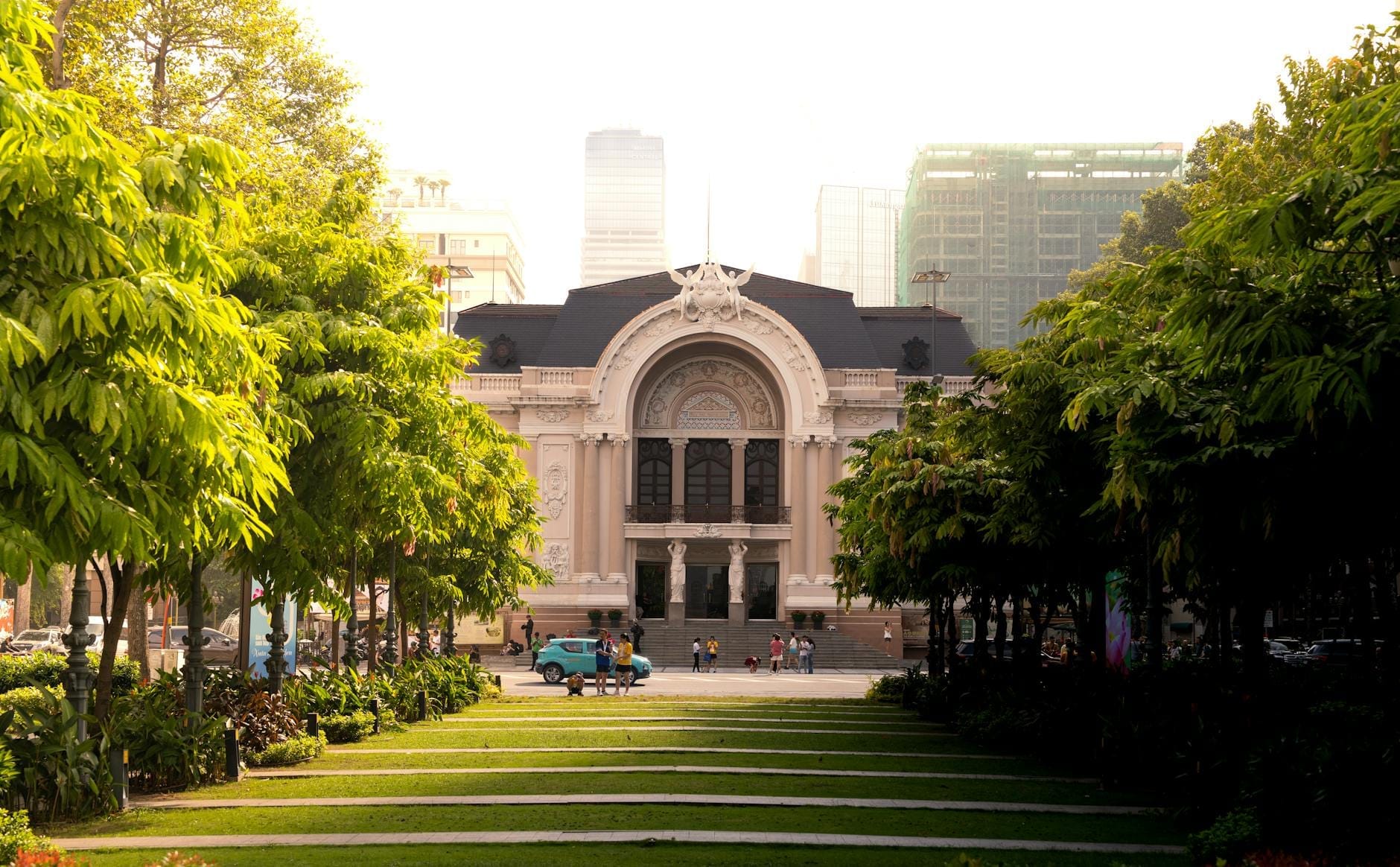
The Saigon Opera House, officially known as the Municipal Theatre of Ho Chi Minh City (Nhà Hát Thành Phố), stands at No. 7 Cong Truong Lam Son Street in the heart of District 1. Completed in 1900, it was built during French colonial rule as a prestige project to anchor the civic center of what was then Saigon. More than 120 years later, it continues to function as the city's primary venue for classical music, dance, and theatrical performances.
The building's pale yellow facade, ornamental ironwork, and sculpted pediment follow the French Beaux-Arts tradition typical of late 19th-century civic architecture. Its 500-seat auditorium is lined with velvet for acoustics, and the interior retains a theatrical grandeur that feels surprisingly intact given the building's turbulent history. It was renovated after 1975, and most significantly in 1998, when the structure was substantially restored. In 2012, it was formally designated a national relic.
ℹ️ Good to know
You don't need a ticket to appreciate the Opera House. The exterior and Lam Son Square are freely accessible at any hour, and the building is particularly photogenic in the early morning and after dark.
The Building and Its Architecture
The design is attributed to French architect Félix Olivier, with Ernest Guichard and Eugène Ferret involved in construction supervision, and modeled loosely on the Petit Palais style then fashionable in Paris. The two-story facade features arched windows, decorative bas-relief panels, and a balustraded terrace on the upper level. The roofline is capped with a sculpted group figure that was damaged over the years and partially reconstructed during the 1998 renovation.
Inside, the stage house follows a traditional horseshoe layout, with tiered balconies wrapping the stalls. The velvet seating and gilded detailing survive in a form that, while visibly restored rather than original, still creates a convincing period atmosphere. The acoustics are considered good for acoustic performances, though the space is relatively intimate by international concert hall standards.
The building sits on the western end of Dong Khoi Street, District 1's most historically layered boulevard. The view of the Opera House from the middle of Dong Khoi, framed by low-rise colonial shophouses, remains one of the more coherent urban compositions in the city.
Tickets & tours
Live prices and dates from our booking partner. If you book, we may earn a commission at no extra cost to you.
Ho Chi Minh Saigon River Dinner Cruise with Live Music
From 81 €Instant confirmationFree cancellationSaigon countryside guided bike tour with lunch
From 107 €Instant confirmationSaigon markets and streets seasonal walking tour
From 23 €Instant confirmationFree cancellationSaigon shopping tour of markets, malls and hidden gems
From 17 €Instant confirmation
How the Experience Changes by Time of Day
Early morning, between roughly 7:00 AM and 9:00 AM, Lam Son Square in front of the Opera House is calm. Office workers cut across the square, a few elderly residents do light exercise nearby, and the building's facade catches the soft eastern light cleanly. This is the best window for photography: minimal crowds, no harsh shadows, and the pale yellow plasterwork reads well against the morning sky.
By midday the square fills with motorbikes, tour groups, and street vendors. The surrounding hotels and cafes generate steady foot traffic, and the heat in this low-lying central district is significant from late morning onward. Visiting the exterior at this hour is fine for a quick look, but it is not a comfortable place to linger.
Evening is where the building fully comes into its own. From around 6:30 PM onward, floodlights illuminate the facade in warm amber tones, the pedestrian zone in front quiets slightly from daytime traffic, and pre-performance crowds gather on the steps in formal and semi-formal dress. If you happen to be in the area on a performance night, the 30 minutes before showtime creates an atmosphere unlike most other spots in the city.
💡 Local tip
For photography, arrive between 7:00 AM and 8:30 AM or return at dusk when the floodlights activate. The midday glare flattens the facade and the surrounding street traffic makes framing difficult.
Attending a Performance
The Opera House hosts a regular program that includes classical orchestra concerts, Vietnamese traditional music and dance productions, contemporary theater, and occasional international touring acts. The AO Show, a Vietnamese contemporary circus production that combines bamboo acrobatics and modern choreography, has been performed here and represents the type of curated cultural performance that draws significant tourist audiences.
Tickets are available through Lune Production and other authorized ticketing partners. Prices vary considerably by show and seat category. Booking in advance is strongly advisable for weekend performances and any show with a shorter run. The venue's 500-seat capacity means it sells out for popular productions.
Dress code is not strictly enforced but the local audience tends toward smart casual to formal. Shorts and flip-flops are technically permitted but will stand out. The auditorium is air-conditioned, which can feel cold compared to the heat outside, so a light layer is useful if you run cool.
⚠️ What to skip
The interior is only accessible during scheduled performances. If you arrive outside of show hours hoping to see the auditorium, you will not get in. Check the current schedule before your visit.
Historical and Cultural Context
The Opera House was completed in 1900, a date chosen deliberately to signal the French colonial administration's ambitions for Saigon as the capital of Cochinchina. It was designed as an instrument of cultural projection, a European high-culture institution transplanted into Southeast Asia.
After the 1954 Geneva Accords divided Vietnam, the building was repurposed from 1956 until 1967 and subsequently as the Lower House of the National Assembly of South Vietnam, a history that is rarely foregrounded in current tourism materials but is worth knowing. Following reunification in 1975, it was renovated and returned to use as a performance venue. The 1998 renovation, the most extensive in modern times, returned the building to something close to its original appearance while upgrading technical infrastructure.
The Opera House sits within a dense concentration of District 1 landmarks. The People's Committee Building is a short walk away, and the Saigon Central Post Office and Notre Dame Cathedral are reachable on foot within 10 minutes. Together these buildings form the core of what remains of the city's colonial-era civic architecture.
Practical Walkthrough and Getting There
The Opera House is easily reached on foot from most central District 1 accommodation. From Ben Thanh Market the walk takes around 10 minutes along Le Loi Boulevard. From the Dong Khoi Street hotel corridor it is closer to 5 minutes. Grab (ride-hailing) and taxis drop off conveniently on Le Loi or Dong Khoi itself.
Metro Line 1 (Ben Thanh–Suoi Tien), which opened in late 2024, has stops within walking distance, including the Opera House station and nearby Ben Thanh station. For broader transit context, the getting around Ho Chi Minh City guide covers current options in detail.
Opening hours for the building itself are generally listed as 9:00 AM to around 4:30-5:00 PM on days when the venue is in use, but this applies to administrative access rather than public touring. The exterior and Lam Son Square are accessible at all hours. If you are planning specifically around a performance, verify the schedule via Lune Production's website before arrival, as the program changes regularly.
For those building a full itinerary around District 1's landmarks, the Ho Chi Minh City itinerary guide includes a logical walking sequence that connects the Opera House with nearby sites.
Who This Attraction Is Not For
If your interest is purely in the building's interior, the Opera House can frustrate. Unlike the Central Post Office or the Reunification Palace, it does not function as a daytime tourist attraction you can walk through. The architecture is best appreciated from outside, and a quick stop at the square satisfies most architectural curiosity within 15-20 minutes.
Travelers who are not planning to attend a performance and have limited time will likely find the exterior impressive but not time-consuming. It fits well as a component of a walking route through District 1 rather than a standalone destination.
Insider Tips
- The best single photograph of the Opera House is taken from the middle of Dong Khoi Street looking west, ideally around 7:30 AM when the road is clear of heavy traffic. Stand near the fountain roundabout for the cleanest angle.
- If you want to attend a performance but have not pre-booked, check for remaining tickets at the box office on the day of the show, typically from around 9:00 AM. Midweek performances sell out less frequently than weekends.
- The cafe terraces on the northern side of Lam Son Square, inside the adjacent hotels, offer an elevated view of the Opera House facade at a comfortable remove and are worth a coffee stop on a hot afternoon.
- The AO Show and similar Lune Production performances at this venue are specifically designed with international visitors in mind and require no Vietnamese language comprehension, making them accessible for any traveler.
- Lam Son Square itself is a useful landmark for orientation in District 1. The Rex Hotel, the Caravelle, and several other historically significant addresses cluster around it, making this corner a useful base for a colonial-era walking tour.
Who Is Saigon Opera House For?
- Architecture and history enthusiasts who want to understand the colonial-era civic core of District 1
- Travelers seeking an evening cultural experience beyond street food and rooftop bars
- Photographers working on an early morning golden-hour route through the city center
- Couples or small groups looking for a formal performance night out
- First-time visitors building a comprehensive District 1 walking itinerary
Nearby Attractions
Other things to see while in District 1 (Colonial Quarter):
- Bến Nghé Canal & Riverside Walk
The Bến Nghé Canal cuts through the heart of District 1 as one of Ho Chi Minh City's oldest urban waterways, linking the Saigon River to the city's colonial core. Free to walk any hour of the day, the riverside path offers a grounded, unhurried perspective on a city that rarely slows down.
- Bến Thành Market
Bến Thành Market has anchored the heart of Saigon since 1912 and remains one of Ho Chi Minh City's most recognizable landmarks. With nearly 1,500 booths spread across 13,000 square meters, it sells everything from fresh produce and dried seafood to ao dai fabric, lacquerware, and street food. This guide covers the realities of visiting, including when it is worth your time and when it is not.
- Bitexco Financial Tower & Saigon Skydeck
The Bitexco Financial Tower is District 1's most recognizable skyscraper, its lotus-inspired silhouette rising 262 meters above the Saigon River. The Saigon Skydeck on the 49th floor offers a glass-enclosed, 360-degree panorama that takes in the whole city at once, from colonial rooftops to the river bends to the sprawling suburbs beyond.
- Saigon Central Post Office
Built between 1886 and 1891 and attributed to Gustave Eiffel's engineering office, the Saigon Central Post Office is one of the finest French colonial buildings in Southeast Asia. It functions as a working post office to this day, meaning you can mail a postcard home from inside a genuine architectural landmark. Free to enter and centrally located in District 1, it earns its place on most itineraries.
Planning a trip? Discover personalized activities with the Nomado app.