Bình Tây Market: Inside Cholon's Great Trading Hall
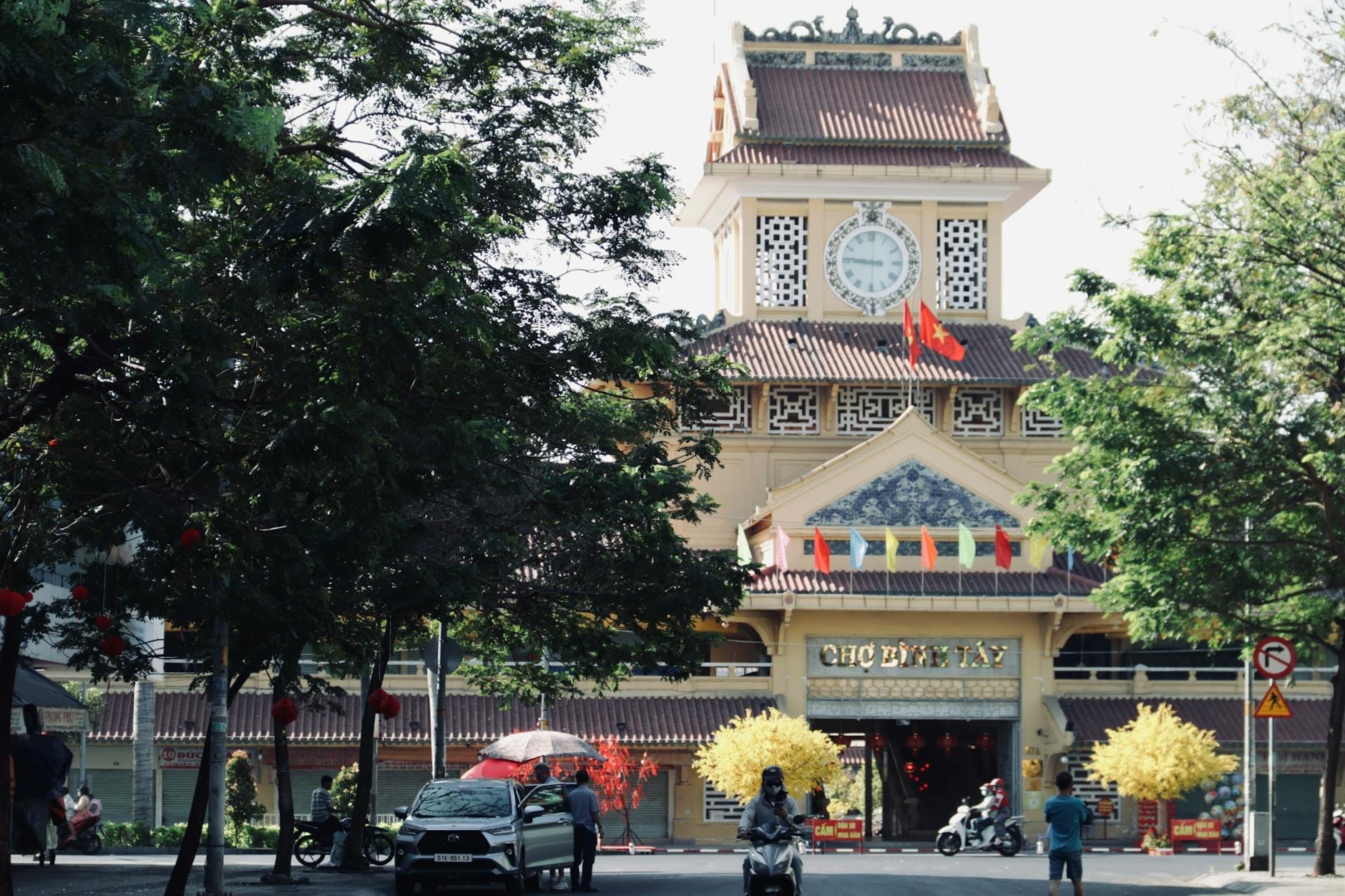
Bình Tây Market is the commercial engine of Cholon, Ho Chi Minh City's historic Chinese quarter. Completed in 1930 after being commissioned by merchant Quách Đàm, and spanning 17,000 square meters, it draws wholesale traders at dawn and curious travelers by mid-morning. The architecture alone — yellow facades, tiled roofs, a central clock tower — justifies the trip across the city.
Quick Facts
- Location
- 57A Tháp Mười, Phường 2, Quận 6, Hồ Chí Minh, Vietnam
- Getting There
- Grab or xe ôm from District 1 (~25 min); buses serve Cholon from Ben Thanh area
- Time Needed
- 1.5 to 2.5 hours
- Cost
- Free entry; bring cash in VND for purchases
- Best for
- Wholesale shopping, Chinese-Vietnamese culture, architectural photography
What Bình Tây Market Actually Is
Bình Tây Market — known formally as Chợ Bình Tây, though locals and traders often call it Chợ Lớn, meaning 'Big Market' — is not a tourist market. That distinction matters. The roughly 1,200 kiosks spread across 17,000 square meters are geared primarily toward wholesale buyers: restaurant owners stocking spices in bulk, textile traders selecting rolls of fabric, importers picking up cookware by the crate. Visitors are welcome, but the market operates on its own rhythm regardless of whether any tourists show up.
This is both the market's greatest strength and its main friction point for casual visitors. Prices are not always labeled. Vendors expect negotiation, not browsing. Product categories are organized loosely by zone: dried goods and spices in one corridor, plastic containers and kitchenware in another, garments and bolts of fabric further back, and cosmetics on the second floor. The layout takes time to decode, but once it clicks, you understand you're seeing a functioning supply chain rather than a curated shopping experience.
💡 Local tip
Arrive between 7 AM and 9 AM to catch peak wholesale activity. Delivery motorcycles pack the outer lanes, porters move stacked boxes on shoulder poles, and the main halls are at their most animated. The experience thins considerably after 3 PM.
The Building: Where the Architecture Earns Its Reputation
The market was commissioned by Quách Đàm, a Chaozhou-born merchant who arrived in Vietnam and built one of the most significant commercial fortunes in early 20th-century Saigon. Construction began in the late 1920s, and Quách Đàm did not live to see it open — he died in 1927. As a condition of gifting the market to the city, he requested that a statue of himself be placed in the central courtyard. That statue still stands today.
The structure blends French colonial planning with Chinese decorative sensibility. The exterior is painted a warm ochre-yellow and features sweeping tiled roofs with upturned eaves that borrow from southern Chinese architectural tradition. The central clock tower rises above the main entrance, visible from the surrounding streets. Inside, the building organizes around a central courtyard open to natural light, which keeps the interior from feeling oppressive despite its scale. The ironwork railings on the upper level, the carved decorative details around the archways, and the patina on the older tile work reward anyone who slows down to look rather than just shop.
Photography works best in the early morning when the light enters the courtyard from above and catches the colors of goods piled on display tables. Midday light flattens everything. If you want a clean shot of the clock tower facade without motorbikes and delivery trucks in frame, you'll need patience or luck, as the outer lanes stay busy most of the day.
Tickets & tours
Live prices and dates from our booking partner. If you book, we may earn a commission at no extra cost to you.
One-way private transfer from Ho Chi Minh City to Binh Duong
From 91 €Instant confirmationFree cancellationHo Chi Minh City one-way private transfer to or from Binh Duong
From 73 €Instant confirmationFree cancellationPrivate full-day trip from Ho Chi Minh City to Mekong Delta
From 52 €Instant confirmationFree cancellationLandmarks of Ho Chi Minh City half-day tour
From 33 €Instant confirmationFree cancellation
How the Market Changes Through the Day
The first hour after opening, around 7 AM, belongs to the trade. Wholesale buyers arrive with lists, move quickly, and load purchases directly onto waiting vehicles. The smell of the market at this hour is concentrated: dried chilies, star anise, dried shrimp, and the faint mineral edge of bulk cooking salt. The noise is sharp — metal on metal, rapid Cantonese and Teochew conversations, the beeping of delivery vehicles reversing through narrow lanes.
By 9 to 10 AM, the retail rhythm takes over alongside the wholesale activity. Individual shoppers appear, and vendors shift slightly toward smaller quantities. This window — roughly 9 AM to noon — is the most accessible for travelers. The market is active enough to be interesting but not so compressed that navigation becomes difficult. The spice section rewards slow walking; the variety of dried goods, from lily buds to black cardamom, reflects the deep Chinese culinary tradition that has shaped Cholon for more than a century.
The second floor is worth the trip upstairs. A ring of cosmetics shops runs the perimeter, stocked with international brands at prices that sometimes undercut downtown retailers. The view down into the central courtyard from the upper walkway also gives the best sense of the building's true scale.
⚠️ What to skip
The market is open Monday to Friday, 7 AM to 6 PM. Weekend hours may differ or some vendors may not open — plan accordingly if your visit falls on a Saturday or Sunday.
Cholon Context: Why the Neighborhood Matters
Bình Tây Market sits at the center of Cholon, Ho Chi Minh City's historically Chinese quarter, which developed as a separate commercial town before being absorbed into the broader city. The Chinese-Vietnamese community, with roots in Guangdong, Fujian, and Chaozhou, built Cholon into the commercial engine of southern Vietnam. That heritage is still visible in the street-level signage (often in both Vietnamese and Chinese characters), in the pagodas scattered throughout the neighborhood, and in the market culture that values relationship-based trade over transactional browsing.
The area around Bình Tây contains several pagodas worth visiting in the same half-day. Thiên Hậu Pagoda is the most famous, dedicated to the sea goddess Mazu and filled with the distinctive coil incense that hangs from its ceiling beams. Ông Bổn Pagoda and Phước An Hội Quán Pagoda are also within walking distance and receive far fewer visitors, giving a quieter look at active Cantonese Buddhist practice.
Spending a half-day in Cholon rather than just dropping into the market gives the whole experience more coherence. The food in the immediate vicinity of the market is notably good: small stalls and corner restaurants serve Teochew-inflected dishes and congee that you won't find in the same form in District 1.
What to Buy (and What to Manage Expectations On)
The market's wholesale orientation means it excels in categories where buying in quantity makes sense or where product variety is genuinely impressive. Dried spices and herbs are a particular strength — the range of dried goods, from individual spice blends to obscure dried mushroom varieties, is wider here than in most retail settings in the city. Even if you're not buying, the spice corridor is worth walking for the sensory density alone.
Kitchenware and cookware are also a strong category: traditional clay pots, woks, steamers, and utensils at prices aimed at working kitchens rather than tourist wallets. Textiles occupy their own zone, with fabrics sold by the bolt and garments sold in bulk runs — less useful for a single traveler, but interesting to observe.
Souvenirs exist but are not the market's focus. Visitors hoping for the kind of curated, packaged Vietnamese handicrafts found in District 1 shops will find the selection here sparse and repetitive. The souvenirs that do appear near the entrance feel like an afterthought grafted onto a commercial operation that has other priorities. Manage expectations accordingly.
ℹ️ Good to know
Bargaining is standard for retail purchases, but keep it measured. Vendors are trading with regular commercial buyers all day — aggressive bargaining over small amounts reads as more rude than clever. A polite ask for a better price on a genuine purchase is always appropriate.
Getting There and Practical Notes
The most reliable way to reach Bình Tây Market from central Ho Chi Minh City is via Grab (the dominant ride-hailing app in the region). From District 1, expect a journey of roughly 20 to 30 minutes depending on traffic, which along the corridor between the districts can slow significantly during morning peak hours (8 to 9:30 AM). Budget routes via local bus are available from the Ben Thanh area but require more navigation confidence. For a broader overview of moving around the city, see the guide to getting around Ho Chi Minh City.
Wear comfortable, closed-toe shoes. The market floors are tiled but uneven in places, and the outer loading areas where deliveries happen can be wet or dusty. Lightweight clothing is appropriate given the heat — the building has some natural ventilation through the courtyard design, but the enclosed corridors get warm by mid-morning. Bring small denomination VND banknotes; many vendors do not carry change for large bills, and card payment is not typical here.
Accessibility for visitors with limited mobility is limited. The main ground floor is navigable on a flat surface, but the second floor requires stairs, and the outer loading areas have uneven pavement and temporary obstacles from deliveries.
Travelers who want to compare the Cholon market experience with the city's most famous retail landmark should also visit Bến Thành Market in District 1 — a very different atmosphere, far more geared to tourists, but useful as a contrast point. For a broader look at what Ho Chi Minh City offers, the things to do in Ho Chi Minh City guide covers the full range of options.
Who Will Get the Most From This Visit
Bình Tây Market rewards travelers who are genuinely interested in how a city's commercial life actually functions. If you find yourself drawn to watching trade happen — the negotiation, the logistics, the category organization of a working wholesale floor — this is one of the most interesting places in Ho Chi Minh City to spend a morning. Food-focused travelers will find the spice and dried goods section particularly absorbing. Architecture and history travelers get a well-preserved Chinese-colonial building completed in 1930, with a real story attached to it.
Visitors who are primarily looking for air-conditioned retail, clear price tags, English-speaking vendors, or souvenir shopping will find the experience frustrating. This is not a place designed around visitor comfort. It is a place that will let you watch it work if you are willing to pay attention on its terms.
Insider Tips
- Stand on the upper floor walkway and look down into the central courtyard around 8 AM — the combination of morning light from above and the organized chaos of wholesale trade below makes for one of the better visual moments in Cholon.
- The spice vendors nearest the main entrance often quote higher prices to unfamiliar faces. Walk deeper into the corridor and compare before committing to a purchase.
- The statue of Quách Đàm in the central courtyard is easy to walk past without noticing. Stop and read the context: the story of a Chaozhou immigrant who built the entire market and donated it to the city on the condition his likeness remain inside is one of the more interesting founding stories of any market in Southeast Asia.
- Combine Bình Tây with a walk to Thiên Hậu Pagoda (about 10 minutes on foot) and lunch at one of the congee or noodle stalls on the surrounding streets for a coherent half-day in Cholon that costs almost nothing.
- If you are buying dried spices to take home, bring zip-lock bags or ask vendors for sealed packaging. Customs regulations in many countries restrict some dried goods, so check your home country's import rules before filling your bag with star anise and dried mushrooms.
Who Is Bình Tây Market For?
- Travelers interested in Chinese-Vietnamese commercial culture and how Cholon actually functions as a trading district
- Food enthusiasts looking to source dried spices, herbs, and pantry ingredients at wholesale variety
- Architecture and photography visitors drawn to the 1920s Chinese-French building and its central courtyard
- Curious travelers who want to experience a working wholesale market rather than a tourist-oriented shopping venue
- Anyone building a half-day Cholon itinerary around pagodas, food, and local street life
Nearby Attractions
Other things to see while in Chợ Lớn (Chinatown):
- Ông Bổn Pagoda
Founded in 1730 by Fujian Chinese immigrants and recognized as a National Cultural-Historic Site, Ông Bổn Pagoda is one of the most atmospheric and historically significant religious sites in Ho Chi Minh City. Free to enter and open daily from 6:00 to 17:00, it offers an unfiltered window into the living worship traditions of Cholon's Chinese community.
- Phước An Hội Quán Pagoda
Built in 1902 on the site of a much older shrine, Phước An Hội Quán is a masterpiece of Chinese decorative craft in the Fujian tradition, set in the heart of Cholon. Dedicated to Quan Công, the temple draws local worshippers daily and rewards patient visitors with some of the finest ceramic roofwork and gilded altar carvings in Ho Chi Minh City — all for free.
- Thiên Hậu Pagoda
Built by Cantonese immigrants around 1760, Thiên Hậu Pagoda in Cholon is one of Ho Chi Minh City's oldest and most spiritually charged temples. Free to enter, it draws worshippers and curious travelers alike with its coiling incense spirals, hand-carved wooden altars, and centuries of unbroken devotion to the Chinese sea goddess Mazu.
Planning a trip? Discover personalized activities with the Nomado app.