Phước An Hội Quán Pagoda: Cholon's Most Ornate Chinese Temple
Built in 1902 on the site of a much older shrine, Phước An Hội Quán is a masterpiece of Chinese decorative craft in the Fujian tradition, set in the heart of Cholon. Dedicated to Quan Công, the temple draws local worshippers daily and rewards patient visitors with some of the finest ceramic roofwork and gilded altar carvings in Ho Chi Minh City — all for free.
Quick Facts
- Location
- 184 Hồng Bàng, District 5 (Cholon), Ho Chi Minh City
- Getting There
- Bus routes along Hồng Bàng near Chợ Rẫy Hospital area
- Time Needed
- 30–60 minutes
- Cost
- Free entry
- Best for
- Architecture enthusiasts, cultural travelers, photography
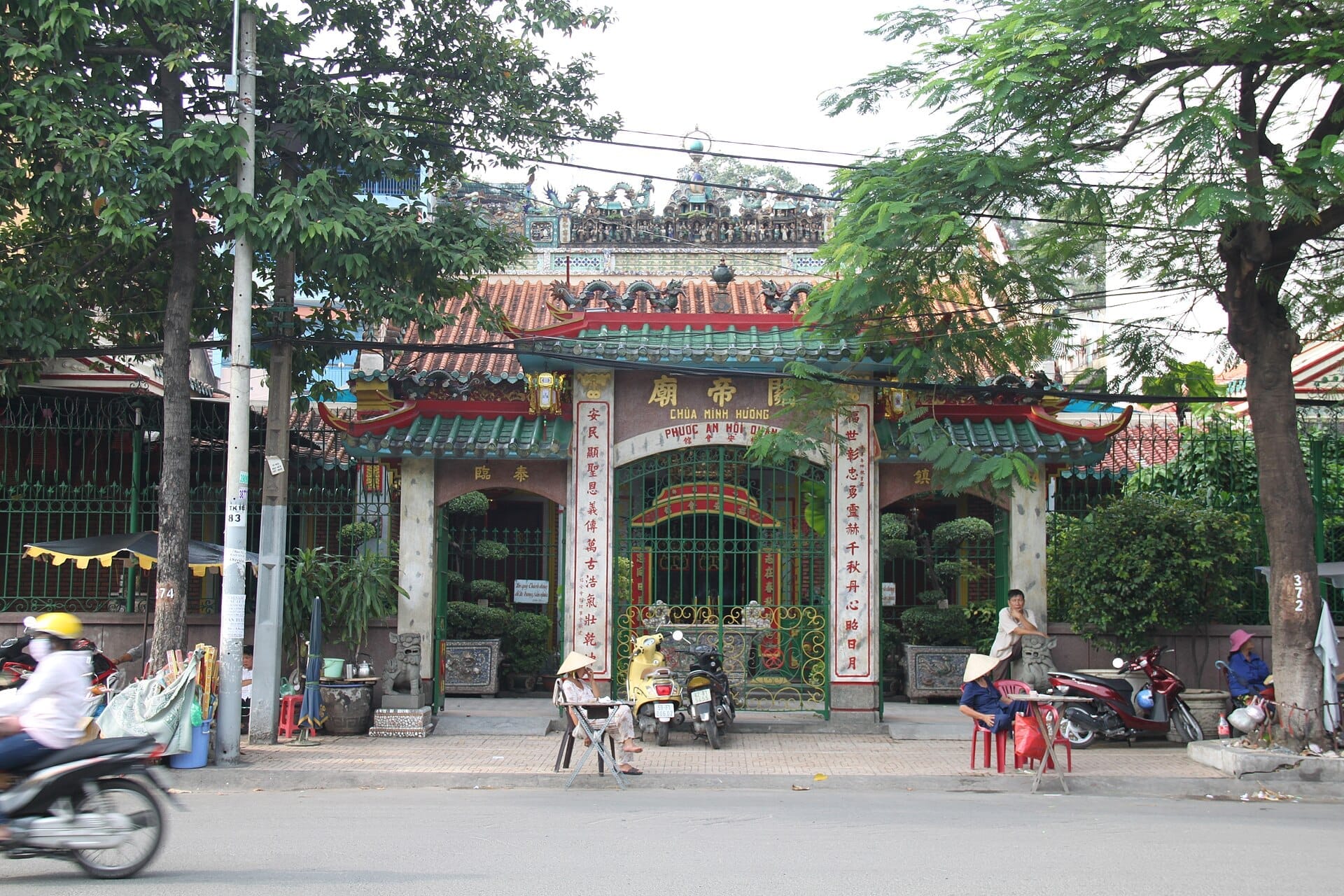
What Is Phước An Hội Quán?
Phước An Hội Quán Pagoda is not a Buddhist monastery in the conventional sense. It is a hội quán, a Chinese assembly hall temple built by immigrant communities from southern China to serve both as a place of worship and a communal gathering space. This particular hall was established by the Fujianese (Minh Huong) community on the site of the ancient An Hòa shrine, and the current structure dates to 1902. In 2009, the Ho Chi Minh City authorities formally recognized it as a city-level architectural and artistic relic, a designation that underscores its importance well beyond its modest street frontage.
The pagoda sits on Hồng Bàng, a broad commercial artery that cuts through Cholon, Ho Chi Minh City's historic Chinese quarter. This neighborhood has been a center of overseas Chinese merchant life since the 18th century, and the density of assembly hall temples here is unmatched anywhere else in southern Vietnam. Phước An Hội Quán is widely regarded as one of the most elaborately decorated among them.
💡 Local tip
Arrive between 8 AM and 10 AM on weekdays. You will find local worshippers going through morning rituals with incense coils, a genuinely atmospheric experience, without the weekend crowds.
Architecture and Decoration: What You Are Actually Looking At
The facade gives little away from the street. A relatively narrow entrance opens through heavy wooden doors framed by red-lacquered columns and stone lion guardians, but it is once you step through the threshold that the scale of the craftsmanship becomes apparent. The roof ridges are lined with intricate ceramic dioramas depicting scenes from Chinese opera and mythology, a technique known as shiwan ceramic craft, sourced historically from kilns in Guangdong province. Dragons, phoenixes, and armored warriors crowd the rooflines in glazed polychrome detail.
Inside, the air is thick with incense from coiled spirals hanging from the rafters, each one slowly burning over hours or days. The carvings on the altar screens and wooden panels show a level of craft that takes time to read properly: look for the layered relief work depicting historical narratives, the gilded lacquer columns, and the massive brass incense urns standing before each altar. The main altar is dedicated to Quan Công (also known as Guan Yu), the deified general from the Three Kingdoms period venerated across Chinese communities as a god of war, righteousness, and brotherhood.
A secondary altar honors Thiên Hậu, the sea goddess, reflecting the maritime origins of the Hokkien traders who built this hall. The coexistence of multiple deities within one structure is typical of southern Chinese folk religion, and it means there is far more to observe here than a single focal point.
Tickets & tours
Live prices and dates from our booking partner. If you book, we may earn a commission at no extra cost to you.
Half-day car hire with driver from Hoi An city center to Tam Ky
From 71 €Instant confirmationFree cancellationFull-day excursion to Mekong Delta and Vinh Trang Pagoda
From 19 €Instant confirmationFree cancellationPrivate full-day trip from Ho Chi Minh City to Mekong Delta
From 52 €Instant confirmationFree cancellationLandmarks of Ho Chi Minh City half-day tour
From 33 €Instant confirmationFree cancellation
The Experience at Different Times of Day
Early morning is the most rewarding time to visit. By 7 AM, the incense smoke has already been lit for the day's first offerings, and the amber light filtering through the front gates creates a haze that softens the gold and red of the interior. Local residents, many of them elderly, move methodically between altars with bundles of incense sticks and small paper offerings. The sounds are specific: the low hum of prayers, the occasional sharp crack of firecrackers from a nearby doorway, and the soft clatter of fortune sticks being shaken in bamboo cups.
By midday, activity quiets. The temple is still open and still atmospheric, but the worshippers thin out and the interior becomes easier to observe in detail without feeling intrusive. The overhead incense coils catch whatever light comes through the courtyard opening, and this is arguably the best hour for photography of the altar carvings without harsh directional shadows.
Weekend mornings bring more visitors, both local families and the occasional tour group stopping briefly. If you want quiet contemplation and space to photograph the roofline ceramics, a Tuesday or Wednesday morning is noticeably calmer.
⚠️ What to skip
The incense smoke inside can be intense, especially during religious festivals or morning prayer hours. Visitors with respiratory sensitivities should be aware before entering. The smoke is not a sign of neglect — it is central to the living worship practice here.
Historical and Cultural Context
The site's origins predate the 1902 structure. It was built over the earlier An Hòa shrine, suggesting this location held religious significance for Cholon's Chinese community well before the current building was constructed. The hội quán system was central to how overseas Chinese communities organized themselves in Vietnam: each hall served a specific dialect group, offering newcomers a place to find employment contacts, dispute mediation, and communal festivals centered on shared patron deities.
Phước An Hội Quán was constructed in 1902 by the Minh Huong community, Chinese immigrants from Fujian Province and gradually integrated into Vietnamese society while retaining distinct cultural practices. This community left a significant architectural legacy across Cholon, and Phước An Hội Quán stands alongside Thiên Hậu Pagoda and Ông Bổn Pagoda as one of the neighborhood's most historically layered religious sites.
The 2009 city-level relic designation means the pagoda is formally protected, but it remains an active place of worship rather than a museum. Restoration work visible on certain sections of the roof reflects ongoing stewardship by the community that still uses it.
Practical Walkthrough: Getting There and Getting Around
The pagoda is located at 184 Hồng Bàng in District 5, which is the administrative heart of Cholon. Bus 139 runs along this corridor and stops near Bệnh Viện Chợ Rẫy (Chợ Rẫy Hospital), a short walk from the pagoda. Grab and other ride-hailing apps are the most practical option from central District 1, with the trip taking roughly 15 to 20 minutes depending on traffic. The fare by motorbike taxi is low.
Most visitors combine Phước An Hội Quán with a broader Cholon temple circuit. Within easy walking or short ride distance you will find Thiên Hậu Pagoda on Nguyễn Trãi and the market energy of Bình Tây Market, the large covered market that serves as Cholon's commercial center. A half-day combining these sites gives a coherent picture of how the Chinese-Vietnamese community built both its spiritual and commercial life in the same concentrated area.
Dress modestly for entry: shoulders and knees covered is the standard expectation at active places of worship. Photography is generally permitted inside, but be respectful of worshippers, avoid using flash directly at people in prayer, and step back from altars to frame your shots rather than crowding the ritual space. There are no staff issuing formal guidelines, so visitor judgment matters here.
ℹ️ Good to know
Admission is free. There is no ticket counter and no donation box at the entrance, though leaving a small voluntary contribution in the offering box inside is considered appropriate. Hours are approximately daily from early morning, but no official schedule is posted — the temple follows the rhythm of its community.
Who Will Love It, and Who Might Not
For travelers who find Jade Emperor Pagoda in District 3 too crowded or too polished for tours, Phước An Hội Quán offers something more unmediated. There are no English information boards, no gift shop, and no queue. The experience rewards curiosity and a willingness to observe without being guided. Architecture enthusiasts will find the ceramic roofwork alone worth the detour, and photographers interested in incense smoke, candlelight, and layered gilt surfaces will have strong material to work with.
However, travelers looking for a quick photo opportunity with clear explanatory context may feel under-served. There is very little interpretive material on-site, and understanding what you are seeing requires some prior reading or a knowledgeable companion. Visitors who are sensitive to incense smoke, or who have mobility challenges, should also factor in that the interior is compact, partially uneven underfoot, and has no adapted facilities. Those with a very tight itinerary may prefer to fold this into a half-day Cholon exploration rather than visiting as a standalone stop.
Combining Phước An Hội Quán with the Wider Cholon Area
Cholon repays time. It is one of the few areas in Ho Chi Minh City where a slow walk through the streets — past herbalist shops, wholesale fabric traders, and narrow alley kitchens — feels genuinely distinct from the rest of the city. If you are building a day around this neighborhood, consider reading the full guide to things to do in Ho Chi Minh City to understand how Cholon fits into a broader itinerary. For a half-day dedicated to Chinese-Vietnamese heritage, a half-day starting at Phước An Hội Quán and finishing at Bình Tây Market gives a satisfying arc from spiritual to commercial life.
The street food around Cholon is also worth planning around. Hùng Vương and the side streets off Châu Văn Liêm have a density of Chinese-Vietnamese breakfast spots serving congee, steamed buns, and noodle soups that are noticeably different from the more familiar pho-and-bánh mì options in District 1. The Ho Chi Minh City street food guide has specific recommendations for this part of town.
Insider Tips
- Look up at the roof ridges from the courtyard rather than just scanning the altars. The ceramic dioramas on the roofline are some of the finest in the city and are often missed by visitors focused on the main altar.
- Visit on a weekday morning to see the temple functioning as a genuine community space, not a tourist attraction. You may witness communal rituals or informal gatherings that reflect the hội quán's original social purpose.
- The secondary altar dedicated to Thiên Hậu is often quieter than the main Quan Công altar. Spend time here — the carved altar screen behind it is exceptionally detailed and less photographed.
- If you want to photograph the incense coil ceiling, come before 10 AM when the smoke layer is densest and the ambient light from the entrance creates natural depth. A wide-angle lens or a phone in portrait mode at eye level captures the layered atmosphere well.
- Combine with Thiên Hậu Pagoda a few blocks away on Nguyễn Trãi for a comparative study of hội quán architecture. The two temples share a dedication to similar deities but represent different community patrons and decorative traditions.
Who Is Phước An Hội Quán Pagoda For?
- Architecture and decorative arts enthusiasts who want to study Fujian-style Chinese ceramic and woodcarving craft up close
- Cultural travelers interested in overseas Chinese community history and folk religion in Vietnam
- Photographers looking for atmospheric interiors with incense, candlelight, and gilded surfaces
- Travelers building a half-day Cholon temple and market circuit
- Repeat visitors to Ho Chi Minh City who have already covered the main District 1 highlights
Nearby Attractions
Other things to see while in Chợ Lớn (Chinatown):
- Bình Tây Market
Bình Tây Market is the commercial engine of Cholon, Ho Chi Minh City's historic Chinese quarter. Completed in 1930 after being commissioned by merchant Quách Đàm, and spanning 17,000 square meters, it draws wholesale traders at dawn and curious travelers by mid-morning. The architecture alone — yellow facades, tiled roofs, a central clock tower — justifies the trip across the city.
- Ông Bổn Pagoda
Founded in 1730 by Fujian Chinese immigrants and recognized as a National Cultural-Historic Site, Ông Bổn Pagoda is one of the most atmospheric and historically significant religious sites in Ho Chi Minh City. Free to enter and open daily from 6:00 to 17:00, it offers an unfiltered window into the living worship traditions of Cholon's Chinese community.
- Thiên Hậu Pagoda
Built by Cantonese immigrants around 1760, Thiên Hậu Pagoda in Cholon is one of Ho Chi Minh City's oldest and most spiritually charged temples. Free to enter, it draws worshippers and curious travelers alike with its coiling incense spirals, hand-carved wooden altars, and centuries of unbroken devotion to the Chinese sea goddess Mazu.
Planning a trip? Discover personalized activities with the Nomado app.