Jade Emperor Pagoda (Chùa Ngọc Hoàng): Saigon's Most Atmospheric Temple
Built in 1909 by a Cantonese community leader, the Jade Emperor Pagoda is one of Ho Chi Minh City's most richly decorated and spiritually active temples. Free to enter and open daily, it draws genuine worshippers alongside curious visitors, making it one of the few religious sites in the city where the ritual life on display is entirely real.
Quick Facts
- Location
- 73 Mai Thị Lựu Street, Đa Kao Ward, District 1, Ho Chi Minh City
- Getting There
- Taxi or ride-hail recommended; in District 1, approx. 4 km from Ben Thanh Market
- Time Needed
- 45 to 90 minutes
- Cost
- Free admission
- Best for
- Cultural immersion, religious architecture, photography
What Is the Jade Emperor Pagoda?
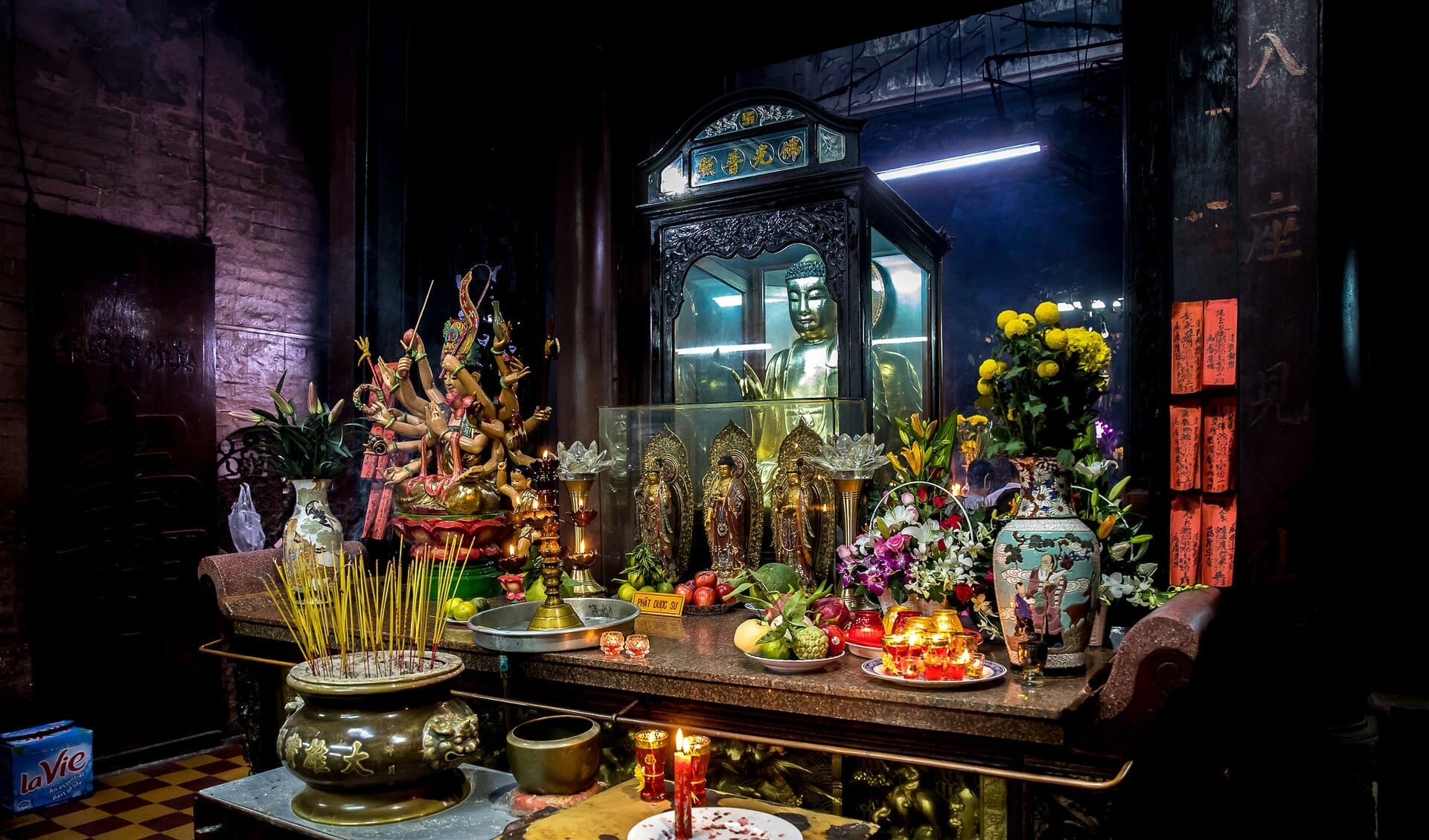
The Jade Emperor Pagoda, known in Vietnamese as Chùa Ngọc Hoàng and formally renamed Phước Hải Tự in 1984, is one of the most visually and spiritually compelling religious sites in Ho Chi Minh City. Completed in 1909, it was commissioned by Lưu Minh (also recorded as Lưu Đạo Nguyên), a leader within the city's Cantonese immigrant community. The pagoda blends Taoist and Buddhist traditions, a combination typical of Vietnamese-Chinese popular religion, and was officially recognized as a protected architectural site in 1994.
Unlike some temples that have been softened into tourist-friendly showpieces, this one remains a working place of worship. On any given morning you will find elderly women kneeling before incense burners, vendors selling paper offerings outside the gate, and the low murmur of prayer mixing with the hiss of burning joss sticks. It sits in a quieter stretch of the city, north of the main District 1 core, which means the surrounding streets have a genuinely local character rather than a tourist strip feel.
💡 Local tip
On the 1st and 15th days of the lunar calendar, the pagoda opens as early as 5:00 AM rather than the regular 7:00 AM, and stays open until around 6:00 PM. These days draw significantly larger crowds of worshippers and offer a more intense atmosphere, though photography becomes harder in the press of people.
Architecture and Interior: What You'll Actually See
From the street, the pagoda announces itself through a haze of incense smoke and the sound of temple bells. The exterior facade is detailed ceramic tilework and carved stone, built in a southern Chinese style that differs noticeably from the Vietnamese Buddhist temple aesthetic you'll find elsewhere in the city. The roofline features intricate figures of dragons, phoenixes, and mythological guardians, all hand-crafted in a style that has not been significantly altered since the original construction.
Inside, the main hall is dedicated to the Jade Emperor himself, the supreme deity of the Taoist pantheon, represented by a large gilded statue behind a cloud of incense smoke. The secondary halls to the left and right contain an astonishing density of sculptures: Kim Hoa Thanh Mau, the goddess of fertility and childbirth, is housed in a dedicated chamber and receives petitions from women hoping to conceive or give thanks for children born healthy. The Hall of Ten Hells, a narrow side room lined with bas-relief panels depicting the punishments awaiting sinners in the afterlife, is one of the most remarkable pieces of folk religious art in the entire city. The carvings are graphic and detailed, and they are not decorative in the tourist sense; they are meant to instruct.
Natural light enters the complex through a small open courtyard at the center, where a pond holds dozens of turtles. Releasing turtles here is considered an act of merit in both Taoist and Buddhist practice, and the pond has been a feature of the pagoda for generations. The turtles are slow-moving and apparently unbothered by visitors leaning over the low walls to watch them.
Tickets & tours
Live prices and dates from our booking partner. If you book, we may earn a commission at no extra cost to you.
Full-day excursion to Mekong Delta and Vinh Trang Pagoda
From 19 €Instant confirmationFree cancellationPrivate full-day trip from Ho Chi Minh City to Mekong Delta
From 52 €Instant confirmationFree cancellationLandmarks of Ho Chi Minh City half-day tour
From 33 €Instant confirmationFree cancellationCu Chi tunnels guided experience from Ho Chi Minh City
From 33 €Instant confirmationFree cancellation
How the Experience Changes Through the Day
Early morning, between 7:00 and 9:00, is when the pagoda feels most alive as a place of genuine worship. The incense is freshly lit, the prayer rituals are in full motion, and the light coming through the courtyard opening catches the smoke in a way that is practically cinematic. The noise is not silent reverence but the active, practical sounds of ritual: bells, chanting, the rustle of paper offerings being folded.
By mid-morning, tour groups begin arriving and the atmosphere shifts. The spiritual activity continues, but it competes for space with the click of cameras and tour guides explaining the iconography in several languages at once. If you are primarily interested in the religious atmosphere rather than a guided interpretation, arriving before 9:00 is the clear choice.
The late afternoon, from around 16:00 onward, brings a second wave of quieter visitors, mostly locals stopping in after work or errands. The light in the courtyard shifts to gold and the incense smoke thickens as the day's final offerings are made. This is arguably the best time for photography if you can tolerate the dimmer conditions in the interior halls.
⚠️ What to skip
This is an active place of worship, not a museum. Dress modestly: covered shoulders and knees are expected. Loud conversation, flash photography directed at worshippers, and stepping in front of people mid-prayer are all genuinely disrespectful here, regardless of what you observe other tourists doing.
Cultural and Historical Context
The pagoda's origins reflect a broader story about Saigon's multicultural history. The city's Cantonese, Hokkien, and Teochew communities each established their own temples, clan houses, and religious institutions during the late 19th and early 20th centuries. The Jade Emperor Pagoda was a Cantonese project, built at a time when ethnic Chinese communities in Saigon maintained distinct cultural identities while also integrating into the wider urban fabric. The religious syncretism on display inside, where Taoist, Mahayana Buddhist, and folk religious iconography coexist without apparent contradiction, is characteristic of this community's spiritual practice.
For a sharper understanding of Chinese-Vietnamese religious architecture in the city, the Thien Hau Pagoda in Cholon makes for a useful comparison. Both were built by immigrant communities, both remain active, and together they illustrate how different regional Chinese cultures shaped their religious spaces differently.
Getting There and Practical Logistics
The pagoda is located at 73 Mai Thị Lựu Street in Đa Kao Ward, District 1, approximately 4 kilometers north of Ben Thanh Market. The most practical way to get there is by grab (ride-hailing app) or taxi; the journey from central District 1 takes roughly 10 to 15 minutes depending on traffic. There is no direct metro connection at the time of writing, and the city's metro expansion is not projected to reach this area in the near term.
If you are planning a broader day of sightseeing in the area, the pagoda pairs naturally with Tan Dinh Church, the pink neo-Romanesque Catholic church a short walk south, and the neighborhood market stalls along the surrounding streets. A full itinerary suggestion is available in our Ho Chi Minh City itinerary guide.
Street parking for motorbikes exists directly outside the entrance. If you are walking from the Tan Dinh area, expect roughly 10 minutes on foot from the church. The street itself is narrow and has minimal footpath space, so arriving by vehicle is more comfortable than it might appear on a map.
ℹ️ Good to know
Regular opening hours are 7:00 AM to 5:30 PM daily. No admission fee is charged. Donations are welcomed but never solicited in an aggressive way.
Photography: What Works and What Doesn't
The interior of the pagoda is dim, incense-heavy, and spatially compressed, all of which make standard smartphone photography frustrating. The best images come from working with the existing light rather than against it: the courtyard opening provides diffuse natural light for the turtle pond and the surrounding walls, while the golden hour glow in the late afternoon illuminates the facade and roofline carvings well. A camera capable of performing in low light will serve you significantly better than phone auto-mode in the main halls.
Wide establishing shots of the interior are difficult because of the number of worshippers and the physical layout of the altars. Detail photography of the carved panels, ceramic roof figures, and incense coils suspended from the ceiling tends to yield more interesting results. Avoid using flash near the altars, both out of respect and because flash tends to flatten the texture and color that makes the carvings remarkable.
Is It Worth Your Time?
For travelers with even a moderate interest in religious culture, folk art, or the history of Saigon's Chinese communities, the Jade Emperor Pagoda is among the most rewarding single stops in the city. The fact that it is free, genuinely active as a place of worship, and compact enough to explore thoroughly in under an hour makes it an easy addition to any itinerary.
Travelers looking primarily for grand-scale spectacle or a polished museum-style experience may find it underwhelming. The space is small, the labels are in Vietnamese and Chinese with minimal English explanation, and the atmosphere rewards patience and observation rather than a quick walk-through. If your time in Ho Chi Minh City is limited, it pairs efficiently with other nearby sights rather than requiring a dedicated half-day. For a broader sense of what to prioritize, see our guide to things to do in Ho Chi Minh City.
Insider Tips
- Arrive before 9:00 on a weekday if you want to observe genuine ritual activity without competing for space with tour groups. The early morning session is when the incense is freshest and the light through the courtyard is sharpest.
- The Hall of Ten Hells is easy to miss because it is tucked to one side of the main hall with no prominent signage in English. Look for the room with the carved bas-relief panels on your left as you face the primary altar.
- The turtle pond in the central courtyard is a focal point for both locals and visitors. The turtles are best observed from the low wall surrounding the pond rather than trying to photograph them through the crowd from the main entrance.
- On lunar calendar dates, the 1st and 15th of each month, the pagoda opens as early as 5:00 in the morning. Arriving then gives you access to the most intense ritual activity of the entire month in near-solitude.
- Paper offerings, incense, and small items for donation are sold by vendors at the entrance gate. Purchasing these is entirely optional but is one way to participate meaningfully if you wish to observe the ritual practice more closely.
Who Is Jade Emperor Pagoda For?
- Travelers interested in Chinese-Vietnamese religious traditions and folk iconography
- Photographers looking for atmospheric, low-light interior subjects and ornate architectural detail
- Anyone wanting a genuinely active spiritual site rather than a restored or commercialized temple
- History-focused visitors exploring Saigon's multicultural immigrant heritage
- Travelers combining a morning of cultural sightseeing in the Đa Kao area
Nearby Attractions
Other things to see while in District 1 (Colonial Quarter):
- Bến Nghé Canal & Riverside Walk
The Bến Nghé Canal cuts through the heart of District 1 as one of Ho Chi Minh City's oldest urban waterways, linking the Saigon River to the city's colonial core. Free to walk any hour of the day, the riverside path offers a grounded, unhurried perspective on a city that rarely slows down.
- Bến Thành Market
Bến Thành Market has anchored the heart of Saigon since 1912 and remains one of Ho Chi Minh City's most recognizable landmarks. With nearly 1,500 booths spread across 13,000 square meters, it sells everything from fresh produce and dried seafood to ao dai fabric, lacquerware, and street food. This guide covers the realities of visiting, including when it is worth your time and when it is not.
- Bitexco Financial Tower & Saigon Skydeck
The Bitexco Financial Tower is District 1's most recognizable skyscraper, its lotus-inspired silhouette rising 262 meters above the Saigon River. The Saigon Skydeck on the 49th floor offers a glass-enclosed, 360-degree panorama that takes in the whole city at once, from colonial rooftops to the river bends to the sprawling suburbs beyond.
- Saigon Central Post Office
Built between 1886 and 1891 and attributed to Gustave Eiffel's engineering office, the Saigon Central Post Office is one of the finest French colonial buildings in Southeast Asia. It functions as a working post office to this day, meaning you can mail a postcard home from inside a genuine architectural landmark. Free to enter and centrally located in District 1, it earns its place on most itineraries.
Planning a trip? Discover personalized activities with the Nomado app.