Thiên Hậu Pagoda: Cholon's Ancient Sea Goddess Temple
Built by Cantonese immigrants around 1760, Thiên Hậu Pagoda in Cholon is one of Ho Chi Minh City's oldest and most spiritually charged temples. Free to enter, it draws worshippers and curious travelers alike with its coiling incense spirals, hand-carved wooden altars, and centuries of unbroken devotion to the Chinese sea goddess Mazu.
Quick Facts
- Location
- 710 Nguyễn Trãi Street, Ward 11, District 5 (Cholon), Ho Chi Minh City
- Getting There
- Taxi or ride-hail from District 1 (~20 min); buses run along Nguyễn Trãi Street
- Time Needed
- 45–90 minutes
- Cost
- Free entry
- Best for
- Cultural history, Chinese-Vietnamese heritage, architectural detail, quiet morning exploration
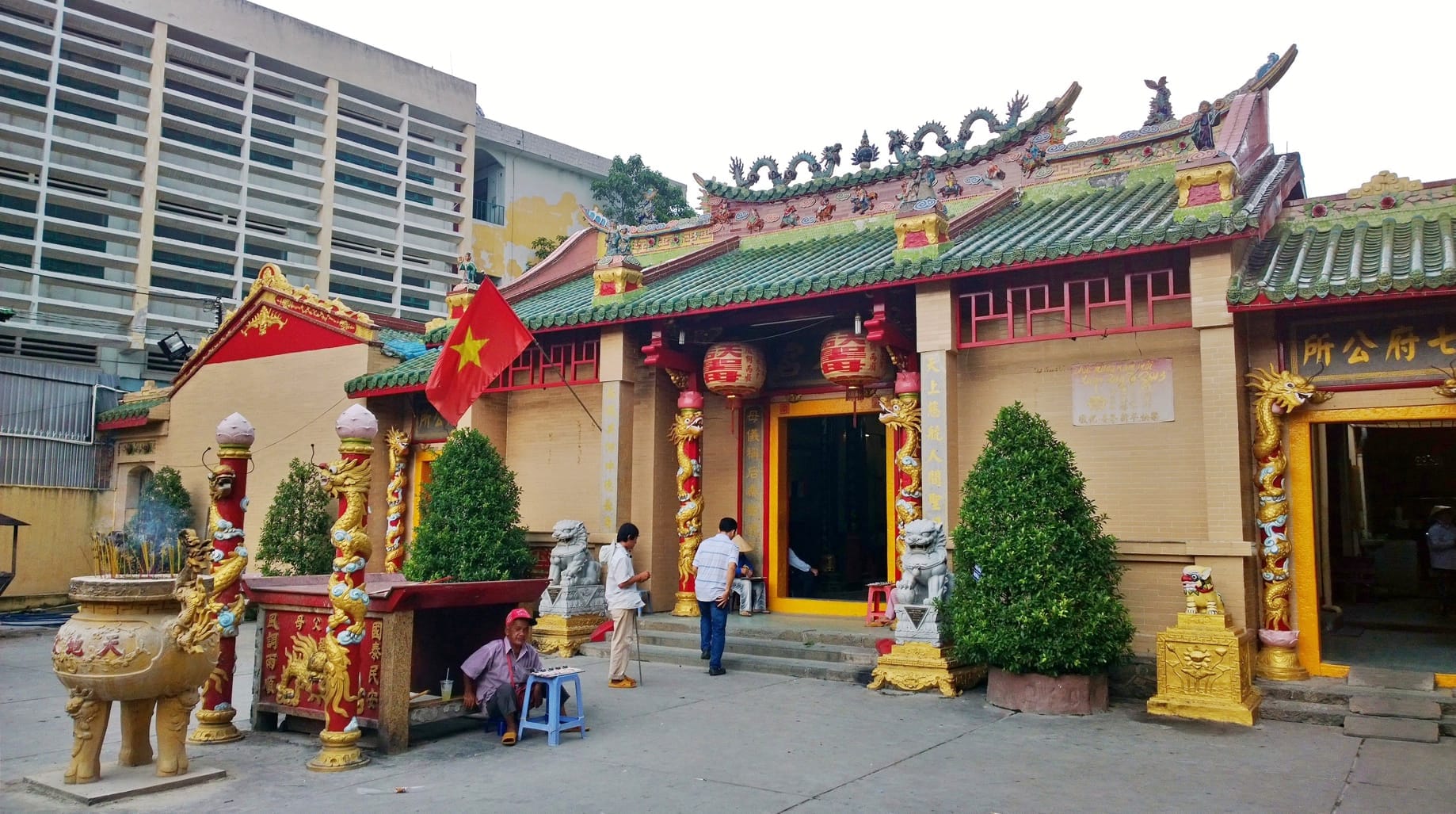
What Thiên Hậu Pagoda Actually Is
Thiên Hậu Pagoda, officially known as Hội Quán Tuệ Thành (Tue Thanh Guildhall), is a Cantonese Chinese assembly hall and place of worship dedicated to Mazu, the goddess of the sea and protector of sailors and fishermen. The temple sits on Nguyễn Trãi Street in the heart of Cholon, the historically Chinese district of Ho Chi Minh City, and has been in near-continuous use since it was established around 1760 by Cantonese immigrant communities who settled this part of southern Vietnam.
The name Thiên Hậu translates as 'Queen of Heaven' in Vietnamese, a direct rendering of the Cantonese title for Mazu. Mazu herself was first officially recognized by the Song Dynasty court in the twelfth century, following centuries of local veneration in Fujian, China, eventually becoming one of the most widely worshipped deities across the South Chinese Sea diaspora. When Cantonese migrants arrived in the Mekong Delta region in the 18th century, their devotion to Mazu came with them, and Thiên Hậu Pagoda became the spiritual anchor of their new community.
This is not a museum dressed up as a temple. Real incense burns here every day. Real offerings are made. Alongside the pagoda, you can explore the wider Cholon neighborhood for a fuller picture of how Chinese-Vietnamese culture has shaped this city over three centuries.
The Architecture: Three Courtyards and a Sky Open to Heaven
From the street, the pagoda's facade is narrow and easy to underestimate. Step through the entrance and the space opens into three interconnected blocks arranged around a central open-air atrium, a design that allows incense smoke to rise directly skyward rather than accumulate inside. This skylight design is both practical and symbolic: the courtyard acts as a threshold between the earthly and the divine.
The main hall houses the principal statue of Mazu, a carved wooden figure approximately one meter tall. The craftsmanship predates the pagoda itself, with the statue said to have been brought to the site before the structure was completed, and formally installed in its current position in 1836. Flanking altars are dedicated to additional deities, including the Goddess of Fertility and the God of Fortune, creating a layered devotional space where multiple prayers can be offered simultaneously.
Look up at the roof line: the ceramic figurine work along the eaves depicts traditional Chinese narrative scenes, with warriors, immortals, and mythological animals rendered in painted clay. These roof decorations are a hallmark of Cantonese temple architecture and remain among the best-preserved examples of the style in Ho Chi Minh City. The interior walls display large bas-relief panels and painted murals illustrating Mazu's legends, including her reputed ability to calm storms and guide ships safely to shore.
💡 Local tip
Bring a wide-angle lens or use portrait mode on your phone. The courtyard is compact, and natural light floods in best between 8 AM and 10 AM, when sunlight angles through the atrium and catches the incense smoke dramatically.
Tickets & tours
Live prices and dates from our booking partner. If you book, we may earn a commission at no extra cost to you.
Private transfer to Ho Chi Minh City center from Rach Gia or Chau Doc
From 246 €Instant confirmationFree cancellationFull-day excursion to Mekong Delta and Vinh Trang Pagoda
From 19 €Instant confirmationFree cancellationPrivate full-day trip from Ho Chi Minh City to Mekong Delta
From 52 €Instant confirmationFree cancellationLandmarks of Ho Chi Minh City half-day tour
From 33 €Instant confirmationFree cancellation
How It Feels to Visit: Morning Versus Afternoon
Morning is when Thiên Hậu Pagoda belongs entirely to its worshippers. Arrive before 9 AM and you will find older women kneeling at the altars with bundles of joss sticks, the air already thick with a layered smokiness that catches in your throat before your eyes adjust to the interior dimness. The smell of burning sandalwood and pressed incense coils is intense but not unpleasant: it is the smell of continuity, of a ritual observed every morning for over two hundred years.
By mid-morning, tour groups begin arriving, and the courtyard shifts from contemplative to crowded. If you are there with a group, that dynamic is fine. If you want quiet observation time with the altars and the architecture, arriving at or just after opening (6:00 AM) gives you a completely different experience. The temple opens around 6:00 AM and closes around 11:30 AM before a midday break, reopening from around 1:00 PM to 4:30 PM.
Afternoon visits are calmer than late morning but carry less of the atmospheric charge of the early hours. The light inside the halls is softer, the incense from the morning service has mellowed, and you can linger more easily at the detailed relief panels without feeling you are in anyone's way. The downside: some offerings may have been cleared, and the altars can look less theatrically lit than they do at dawn.
⚠️ What to skip
Dress respectfully: no shorts, sleeveless tops, or beachwear. This is an active house of worship, not a heritage site managed for tourism. Covering your shoulders and knees is expected and appreciated.
Historical Depth: Cantonese Immigration and Cholon's Chinese Quarter
Cholon, which translates roughly as 'large market,' developed as a distinct Chinese settlement from the late 18th century onward. Cantonese, Hokkien, Hakka, and Teochew communities each established their own assembly halls in the district, with Thiên Hậu Pagoda serving specifically the Cantonese (Guangdong) community. These guildhalls were not purely religious spaces: they functioned as mutual aid societies, dispute resolution centres, and community anchors for newly arrived migrants navigating an unfamiliar country.
The 1836 installation of the main Mazu statue is documented in the temple's own records. The statue is believed to have been carved before the pagoda was built, transported to Vietnam aboard one of the Cantonese trading ships that regularly crossed the South China Sea, and then stored until the hall was ready to receive it. This origin story mirrors that of dozens of Chinese immigrant temples across Southeast Asia, where the goddess was believed to have guided the ships carrying her own effigy.
The pagoda sits within walking distance of other significant Cholon temples, including the Phuoc An Hoi Quan Pagoda and the Ong Bon Pagoda. Visiting all three in a half-day creates a coherent picture of the layered Chinese religious traditions that still shape daily life in this part of the city.
Practical Walkthrough: Getting There and Moving Through
The pagoda is located at 710 Nguyễn Trãi Street, a major road running through District 5. From the tourist centre of District 1, a taxi or ride-hail app (Grab is the dominant platform) will take roughly 20 minutes depending on traffic and costs very little by Western standards. Buses also run along Nguyễn Trãi, though the bus network in Ho Chi Minh City requires some local knowledge to navigate effectively.
The most rewarding way to reach Thiên Hậu Pagoda is to walk or ride slowly through Cholon itself rather than going directly. The streets immediately around the pagoda are lined with incense sellers, dried goods shops, and the kind of covered market lanes that make Binh Tay Market (less than a kilometre away) worth adding to the same visit. Cholon rewards slow, exploratory movement.
Inside the pagoda, there is no formal guided tour and no audio guide. The layout is intuitive: enter the main gate, cross the open courtyard, and proceed through the three altar halls from front to back. There are no admission fees and no ticketing queue. Donation boxes are available if you wish to contribute to the temple's upkeep. Photography is generally permitted in common areas; use judgment near worshippers mid-prayer.
ℹ️ Good to know
The temple closes for a midday break (approximately 11:30 AM to 1:00 PM). Plan your visit to arrive before 10:30 AM or after 1:00 PM to avoid being turned away at the gate.
Who This Attracts and Who Might Find It Underwhelming
Thiên Hậu Pagoda is one of those places that rewards prior context. If you arrive knowing a little about Mazu, about Cantonese migration patterns, or about how Chinese guildhalls operated in colonial Southeast Asia, the space reads as deeply significant. Every carved panel, every altar arrangement, every coil of hanging incense tells a specific story.
If you are looking for a large-scale temple complex with manicured grounds, towering statues, and clear multilingual interpretation, this is not that. The pagoda is compact. The interior is smoky and dim. Signage is minimal and mostly in Chinese or Vietnamese. Travellers who prefer highly managed, tourist-facing heritage experiences may find it disorienting or underwhelming.
For context on how this fits into a broader city visit, the things to do in Ho Chi Minh City guide covers how to balance Cholon's temple circuit with the colonial-era landmarks of District 1 and the war history sites that many visitors also prioritise.
Insider Tips
- The large incense coils suspended from the ceiling are not decorative: each one has a small paper tag attached with a worshipper's prayer or dedication written on it. Look closely and you will see the tags curl and smoke along with the coil over days and weeks.
- The best photographs of the roof ceramic figurines are taken from just inside the main gate, looking up at an angle. Moving further inside reduces the angle needed to capture the eave detail clearly.
- Combine this visit with Binh Tay Market, about a 10-minute walk northwest, to use the morning hours efficiently before the midday heat sets in. Both are best explored before 11 AM when foot traffic is still manageable.
- If you visit on the 1st or 15th of the lunar calendar month, the temple is significantly more crowded and the offering ceremonies are more elaborate. This makes for compelling observation if you arrive early, but less comfortable if you want quiet.
- The street outside the main entrance has several vendors selling incense and paper offerings. Purchasing a small bundle and making an offering at the altar is welcomed and participatory, not performative, but observe how other visitors engage before deciding.
Who Is Thiên Hậu Pagoda For?
- Travelers interested in Chinese-Vietnamese cultural heritage and diaspora history
- Architecture enthusiasts focused on Cantonese temple craftsmanship and decorative traditions
- Early risers who want an atmospheric, crowd-light cultural experience before 9 AM
- Anyone spending a day in Cholon who wants the spiritual context behind the district's commercial energy
- Photographers drawn to interiors with natural light, smoke, and layered visual texture
Nearby Attractions
Other things to see while in Chợ Lớn (Chinatown):
- Bình Tây Market
Bình Tây Market is the commercial engine of Cholon, Ho Chi Minh City's historic Chinese quarter. Completed in 1930 after being commissioned by merchant Quách Đàm, and spanning 17,000 square meters, it draws wholesale traders at dawn and curious travelers by mid-morning. The architecture alone — yellow facades, tiled roofs, a central clock tower — justifies the trip across the city.
- Ông Bổn Pagoda
Founded in 1730 by Fujian Chinese immigrants and recognized as a National Cultural-Historic Site, Ông Bổn Pagoda is one of the most atmospheric and historically significant religious sites in Ho Chi Minh City. Free to enter and open daily from 6:00 to 17:00, it offers an unfiltered window into the living worship traditions of Cholon's Chinese community.
- Phước An Hội Quán Pagoda
Built in 1902 on the site of a much older shrine, Phước An Hội Quán is a masterpiece of Chinese decorative craft in the Fujian tradition, set in the heart of Cholon. Dedicated to Quan Công, the temple draws local worshippers daily and rewards patient visitors with some of the finest ceramic roofwork and gilded altar carvings in Ho Chi Minh City — all for free.
Planning a trip? Discover personalized activities with the Nomado app.