Ông Bổn Pagoda: Cholon's Oldest Chinese Temple
Founded in 1730 by Fujian Chinese immigrants and recognized as a National Cultural-Historic Site, Ông Bổn Pagoda is one of the most atmospheric and historically significant religious sites in Ho Chi Minh City. Free to enter and open daily from 6:00 to 17:00, it offers an unfiltered window into the living worship traditions of Cholon's Chinese community.
Quick Facts
- Location
- 264 Hai Thuong Lan Ong Street, Ward 14, District 5 (Cholon), Ho Chi Minh City
- Getting There
- ~20-min drive from District 1; accessible by taxi, Grab, or local bus to Cholon area
- Time Needed
- 30–60 minutes; allow extra time if combining with Cholon walking tour
- Cost
- Free entry
- Best for
- Cultural history, Chinese-Vietnamese heritage, architecture, quiet reflection
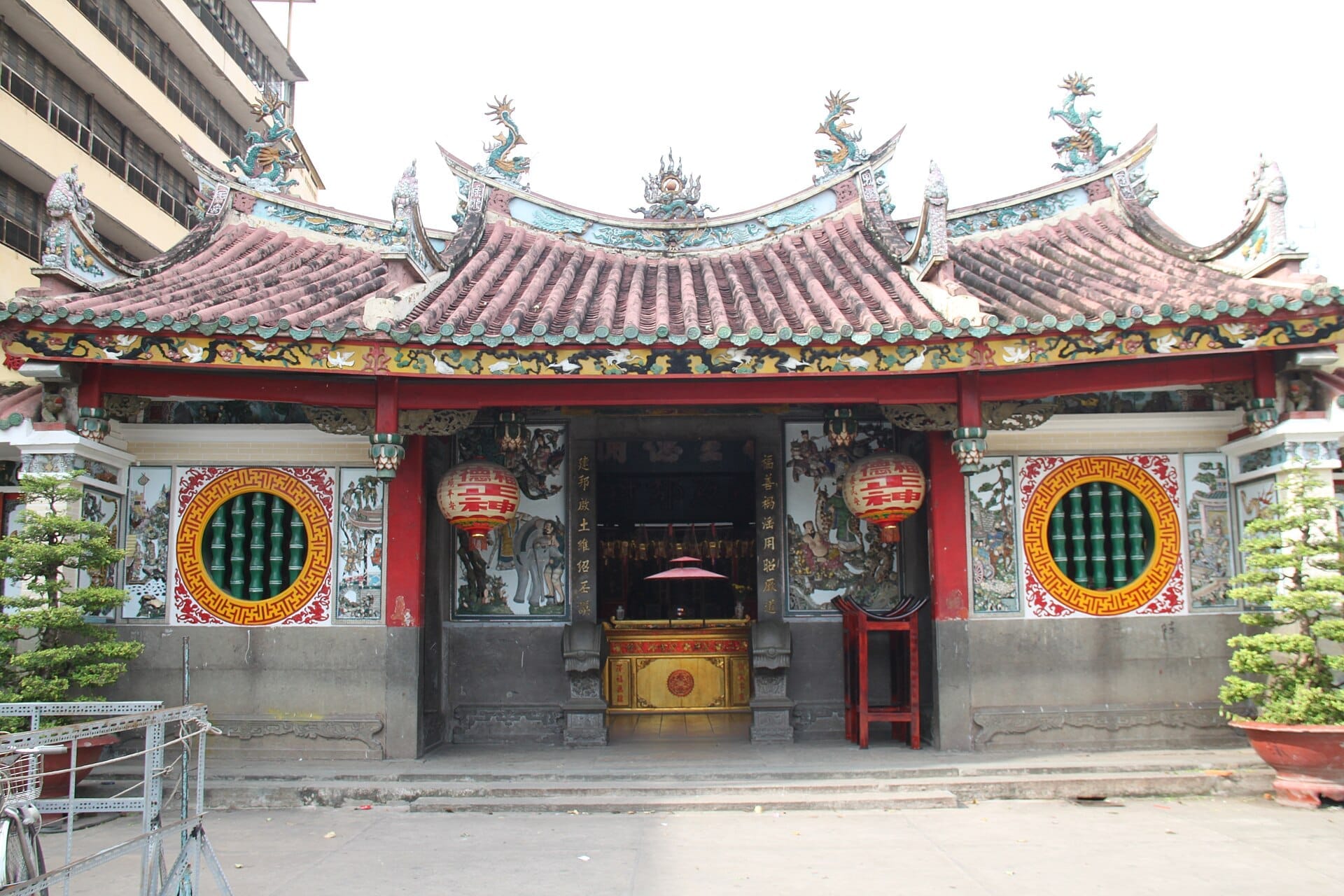
What Is Ông Bổn Pagoda?
Ông Bổn Pagoda, formally known as Chùa Ông Bổn or Nhi Phu Temple (Miếu Nhị Phủ), is the oldest Chinese pagoda in Ho Chi Minh City. It was established in 1730 by Chinese immigrants from Xuanzhou and Zhangzhou who had settled in the Cholon district, bringing with them the religious customs of southern China. The temple is dedicated to Ông Bổn, a deity associated with soil, happiness, and wealth, making it a focal point of devotion for merchants and families seeking prosperity.
The pagoda covers approximately 2,500 square meters and has survived nearly three centuries through a series of restorations: in 1875, 1901, and most recently in 1990. On August 30, 1998, the Vietnamese government formally recognized it as a National Cultural-Historic Site, cementing its status not just as a religious space but as an irreplaceable piece of the country's multicultural heritage.
It sits on Hai Thuong Lan Ong Street in Cholon, the historic Chinese quarter of Ho Chi Minh City. The street itself is lined with traditional medicine shops, dried goods vendors, and family-run hardware stores, giving the walk to the pagoda a texture that few tourist-facing streets in the city can replicate.
The Architecture: Fujian Style in the Tropics
The architectural style of Ông Bổn Pagoda follows the Fujian Chinese temple tradition, characterized by curved rooflines adorned with ceramic ridge decorations depicting dragons, phoenixes, and scenes from classical Chinese mythology. These are not decorative afterthoughts: in Fujian temple design, the roofline figures are believed to ward off malevolent spirits and attract divine protection.
Stepping through the entrance gate, visitors move through a series of increasingly intimate courtyards. The outer halls are relatively open to natural light, while the inner sanctuaries grow darker and more smoke-tinged as you move toward the main altar. The ceilings in the central hall are hung with coiled incense spirals, some the size of a ceiling fan, slowly releasing thin threads of smoke that drift upward and never quite dissipate. The effect is less mystical performance and more functional devotion: worshippers purchase these spirals to burn for days at a time as extended prayers.
The stonework and wood carvings throughout the complex show the quality of craftsmanship that early Fujian artisans brought to Vietnam. Columns carved with Chinese characters, altar tables of dark lacquered wood, and wall panels inlaid with porcelain fragments are all original features that survived the 20th-century restorations largely intact.
💡 Local tip
Look up when you enter the main hall. The hanging incense coils are one of the most photographed details in Cholon, and the soft backlighting from the courtyard behind you creates excellent natural light for photography in the morning hours.
Tickets & tours
Live prices and dates from our booking partner. If you book, we may earn a commission at no extra cost to you.
Full-day excursion to Mekong Delta and Vinh Trang Pagoda
From 19 €Instant confirmationFree cancellationPrivate full-day trip from Ho Chi Minh City to Mekong Delta
From 52 €Instant confirmationFree cancellationGuided tour of Cu Chi Tunnels and Mekong Delta in a small group
From 40 €Instant confirmationFull-Day Guided Tour to Cu Chi Tunnels and Mekong Delta
From 83 €Instant confirmation
The Experience at Different Times of Day
Mornings between 7:00 and 9:00 are when the pagoda feels most alive. Local worshippers, predominantly older women from the Cholon Chinese community, arrive with offerings of fruit, incense, and paper goods. The air fills with low murmured prayers and the crackle of burning paper in the courtyard braziers. This is also when the light entering from the front entrance cuts through the incense smoke at a low angle, creating a visual atmosphere that no artificial lighting could replicate.
Midday visits are quieter and somewhat hotter, especially in the dry season from November to April. The crowds thin significantly after 10:00, making it easier to linger at the altars and read the inscriptions without feeling like you are in the way of active worship. However, the thick incense smoke can feel more concentrated when the space is still, so visitors with respiratory sensitivities should keep this in mind.
Late afternoon, around 15:00 to 17:00, brings a second wave of worshippers and occasional school groups. The pagoda closes at 17:00 daily, and the light inside begins to shift toward warm amber tones that deepen the colors of the lacquered altars. Arriving at 16:00 gives you enough time to explore without rushing, and the surrounding street market outside begins to peak in activity as you leave.
⚠️ What to skip
During major Chinese festivals such as the Lunar New Year (Tet), the Hungry Ghost Festival, and Ong Bon's deity birthday celebrations, the pagoda becomes extremely crowded. The experience is more intense and culturally rich, but the space becomes physically cramped. Plan accordingly.
Cultural Significance: A Temple That Still Works
What separates Ông Bổn Pagoda from many historical religious sites is that it remains an active place of worship. It is not a museum with roped-off altars. Offerings are replenished daily. The incense is real and continuous. The people praying here are not performing for visitors: they are conducting genuine acts of devotion within a tradition that stretches back nearly 300 years in this city.
The Fujian Chinese community that built this pagoda was part of the broader wave of Chinese migration into southern Vietnam from the 17th century onward. These immigrants established Cholon as a commercial and cultural enclave that operated, in many respects, as a city within a city. Other surviving temples from this era, including Thien Hau Pagoda and Phuoc An Hoi Quan Pagoda, are clustered within walking distance, making Cholon one of the densest concentrations of Chinese temple architecture in Southeast Asia.
Ong Bon himself is a deity whose domain covers land, soil, and the prosperity that comes from working the earth and engaging in commerce. For a community of merchants and traders, this made him an especially important figure. His altar occupies the central position in the main hall, flanked by secondary altars dedicated to other deities in the Chinese folk religion pantheon.
Getting There and Getting Around Cholon
Ông Bổn Pagoda is located at 264 Hai Thuong Lan Ong Street in District 5, approximately 20 minutes by car or Grab from District 1. Local buses connect Cholon to the city center, though routes and schedules are better navigated with local help or a transit app. A Grab ride remains the most straightforward option for most visitors.
The pagoda is easily combined with a broader Cholon temple circuit. Nearby Binh Tay Market offers a completely different side of Cholon's commercial life, and Thien Hau Pagoda is a 10-minute walk away, making it a logical next stop for an equally immersive cultural experience.
Wear comfortable, breathable clothing. The interior is not air-conditioned and the incense smoke, while atmospheric, is pervasive. Shoes that slip on and off easily are useful if you choose to remove them at certain inner sanctuaries, though this is not always required. Dress modestly: bare shoulders and very short shorts are out of place in an active religious site.
ℹ️ Good to know
The pagoda is open from 6:00 to 17:00. Entry is free. No tickets, no booking required.
Photography and Practical Notes
Photography is generally tolerated inside Ông Bổn Pagoda, but discretion is expected. Do not position yourself directly between an active worshipper and an altar. Do not use flash near the altars. Wide-angle shots of the incense-filled ceiling, the courtyard braziers, and the ceramic roofline details are all fair game and produce striking results.
The incense smoke is thick enough indoors that phone cameras sometimes struggle with haze and exposure balance. A small mirrorless or DSLR camera with manual exposure control will give you far more usable images than a phone in the dark inner halls. Early morning light through the entrance creates the most photogenic conditions.
For visitors who may find smoke uncomfortable, the open courtyard areas within the complex offer a less intense experience while still conveying the architectural character of the site. The exterior roofline, visible from the street, is among the finest examples of Fujian decorative ceramics in the city and requires no entry at all to photograph.
Who This Attraction Is and Is Not For
Ông Bổn Pagoda rewards visitors who are genuinely curious about religious and cultural history, and who are comfortable in spaces where the purpose is devotion rather than tourism. If you are building a day around Cholon's heritage, check our guide to things to do in Ho Chi Minh City for context on how it fits into the broader itinerary.
Visitors who prefer large, well-labeled historical museums with English-language interpretation will find Ông Bổn Pagoda less legible. There is minimal signage in English, and the experience is primarily sensory and observational rather than educational in a conventional sense. If you want structured historical narrative, the Ho Chi Minh City Museum of History provides that format far better.
Visitors with significant sensitivity to smoke or incense should consider skipping the interior halls entirely, or visiting during midday when smoke dispersal is slightly better. The pagoda is not wheelchair accessible due to steps at the entrance and the tight layout of the interior.
Insider Tips
- Arrive before 8:30 on a weekday morning to witness the pagoda at its most active: local worshippers, freshly laid offerings, and incense smoke catching the low morning light through the entrance gate.
- The ceramic roofline figures are best photographed from the street before you enter, using the surrounding building facades as framing. Most visitors walk straight in and miss this detail entirely.
- A small donation to the donation box near the main altar is customary and appreciated, though never solicited. Even a few thousand Vietnamese Dong is a respectful gesture.
- Combine your visit with the nearby temple circuit: Thien Hau Pagoda and Phuoc An Hoi Quan Pagoda are both within a short walk and together give a fuller picture of Cholon's Fujian Chinese temple architecture than any single site alone.
- If you are visiting during a Chinese lunar festival, check the date against the Chinese calendar in advance. The atmosphere is dramatically heightened, but arrive early as space fills quickly and the incense intensity increases substantially.
Who Is Ông Bổn Pagoda For?
- Travelers interested in Chinese-Vietnamese cultural history and Fujian diaspora heritage
- Architecture enthusiasts drawn to traditional Chinese temple design outside of China
- Photographers looking for atmospheric interiors with natural incense light
- Visitors building a half-day Cholon temple and market circuit
- Anyone seeking a genuinely active religious site rather than a heritage attraction frozen in museum-mode
Nearby Attractions
Other things to see while in Chợ Lớn (Chinatown):
- Bình Tây Market
Bình Tây Market is the commercial engine of Cholon, Ho Chi Minh City's historic Chinese quarter. Completed in 1930 after being commissioned by merchant Quách Đàm, and spanning 17,000 square meters, it draws wholesale traders at dawn and curious travelers by mid-morning. The architecture alone — yellow facades, tiled roofs, a central clock tower — justifies the trip across the city.
- Phước An Hội Quán Pagoda
Built in 1902 on the site of a much older shrine, Phước An Hội Quán is a masterpiece of Chinese decorative craft in the Fujian tradition, set in the heart of Cholon. Dedicated to Quan Công, the temple draws local worshippers daily and rewards patient visitors with some of the finest ceramic roofwork and gilded altar carvings in Ho Chi Minh City — all for free.
- Thiên Hậu Pagoda
Built by Cantonese immigrants around 1760, Thiên Hậu Pagoda in Cholon is one of Ho Chi Minh City's oldest and most spiritually charged temples. Free to enter, it draws worshippers and curious travelers alike with its coiling incense spirals, hand-carved wooden altars, and centuries of unbroken devotion to the Chinese sea goddess Mazu.
Planning a trip? Discover personalized activities with the Nomado app.