Đồng Xuân Market: Hanoi's Oldest Covered Market Explained
Đồng Xuân Market is the largest and oldest covered market in Hanoi's Old Quarter, operating since 1889. A wholesale hub by day and a street food destination by night, it rewards visitors who know what they're looking for.
Quick Facts
- Location
- Đồng Xuân Street, Hoàn Kiếm District, Hanoi Old Quarter
- Getting There
- 10-minute walk north from Hoan Kiem Lake; Grab or cyclo from central Old Quarter
- Time Needed
- 1 to 2 hours for the market; add time for the surrounding street stalls
- Cost
- Free entry; prices vary by vendor — bargaining is expected
- Best for
- Textile shoppers, wholesale buyers, night food seekers, urban photographers
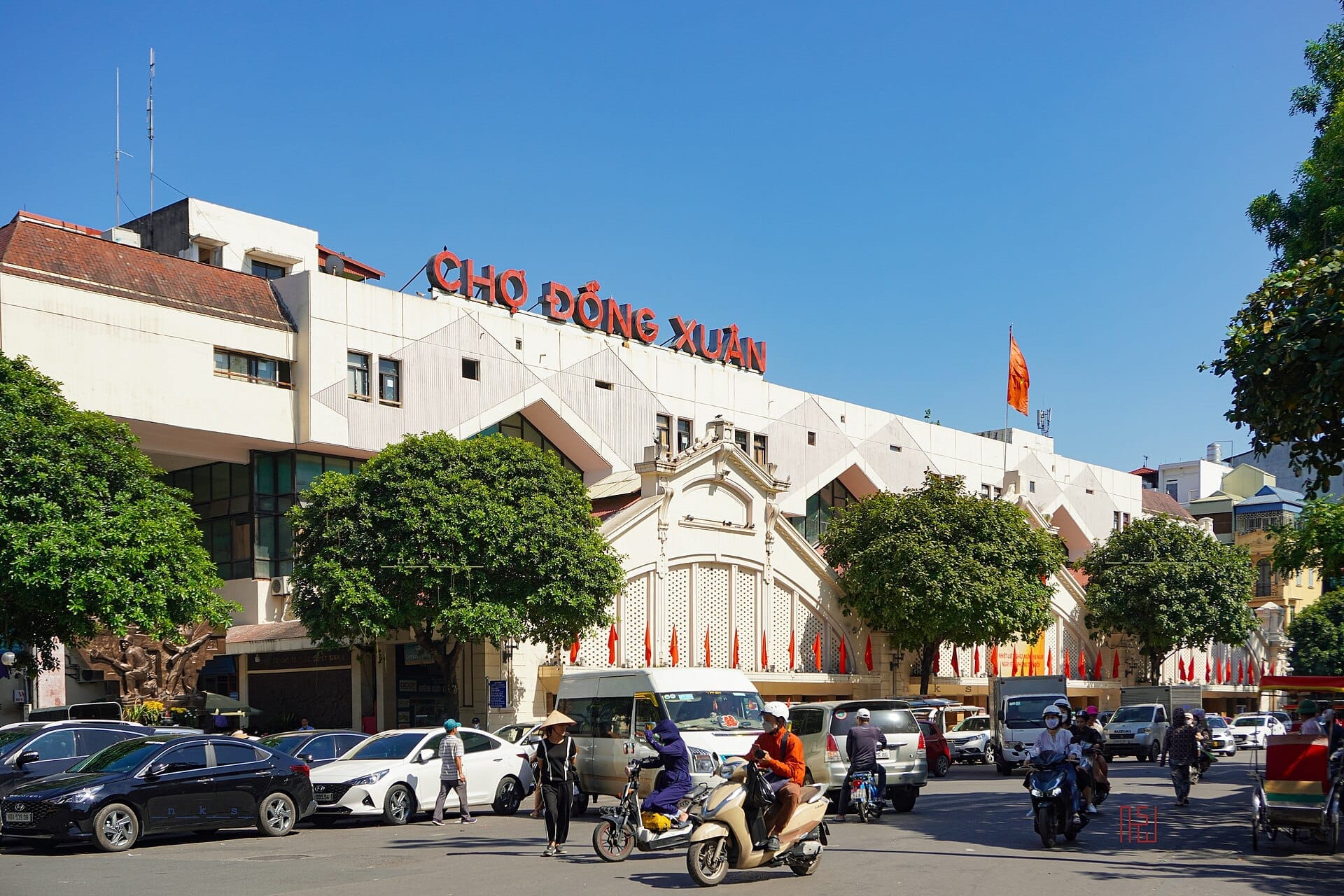
What Đồng Xuân Market Actually Is
Đồng Xuân Market is the largest indoor market in Hanoi, occupying a French-colonial hall that dates to 1889. The structure was built during the early colonial period and has been through fires, renovations, and decades of daily commerce. Today the main building is a five-arched hall spread across three trading floors, filled primarily with wholesale and semi-wholesale vendors selling fabrics, clothing, household goods, dried foods, and plastics. It is not a tourist souvenir market — most of what's sold here moves in bulk to smaller shops across the city.
ℹ️ Good to know
Đồng Xuân operates primarily as a wholesale market. Retail buyers are welcome, but some vendors set minimum quantities. If you want a single item, ask politely — most will accommodate individual buyers, especially outside peak morning hours.
The market sits at the northern edge of Hanoi's Old Quarter, a neighborhood whose streets have historically been organized by trade. Đồng Xuân has anchored the commercial north of that grid for over 130 years, making it one of the most historically continuous trading sites in the city.
Inside the Hall: What You'll Find on Each Floor
The ground floor is the most navigable for first-time visitors. Stalls cluster by category: fresh food and dried goods line one section, while textiles and apparel wholesale take up the larger portion. The smell shifts as you move through — dried shrimp and spices near the food section, synthetic fabrics and mothballs toward the clothing rows. Lighting inside is functional rather than flattering, and the aisles are narrow enough that two people walking opposite directions will need to angle past each other.
The upper floors stock household products, electronics accessories, and apparel in larger volumes. These levels attract primarily local traders restocking their own shops. Tourists rarely make it above the ground floor, which means the upper levels give a clearer picture of how the market actually functions as a supply network rather than a retail experience.
Textile buyers will find the most value here. Silk-blend fabrics, cotton bolts, and embroidered trims are available at prices significantly lower than those in retail fabric shops elsewhere in the Old Quarter. If you're looking to commission custom clothing or bring fabric home, this is where Hanoi's tailors source their material.
Tickets & tours
Live prices and dates from our booking partner. If you book, we may earn a commission at no extra cost to you.
Bat Trang, Dong Ho, But Thap handicraft full-day tour from Hanoi
From 75 €Instant confirmationFree cancellationDong Ho paint traditional village guided tour from Hanoi
From 86 €Instant confirmationFree cancellationNoi Bai International Airport Fast Track Service with SIM Card Option
From 25 €Instant confirmationFree cancellationPrivate full-day trip from Hanoi to Halong Bay with boat cruise
From 59 €Instant confirmationFree cancellation
How the Market Changes Through the Day
Early morning, roughly 6am to 8am, is when the market is most alive with genuine commerce. Wholesalers are receiving deliveries, traders are negotiating, and motorbikes pile high with goods weave through the surrounding alleys. The energy is purposeful and fast. This is not the ideal time for a casual browse — you'll be in the way — but it's worth walking the perimeter just to observe the scale of the operation.
Mid-morning to early afternoon is the most practical window for visitors. Vendors have settled, the rush has passed, and there's more willingness to engage with individual buyers asking questions or requesting single items. The market stays open through the afternoon but energy drops noticeably after 2pm, with some stalls closing early.
💡 Local tip
Come between 9am and 11am for the best balance of activity and accessibility. Avoid arriving at opening time unless you want to observe wholesale trading rather than shop.
At night, the market building closes, but the surrounding streets transform. The area around Đồng Xuân becomes one of Hanoi's more interesting after-dark food zones, with vendors setting up low plastic stools and grills along Hàng Khoai and adjacent streets. Grilled meats, bún bò Nam Bộ, and various snacks appear from around 6pm onward.
The Streets Around the Market: Often Better Than the Interior
The covered hall is only part of the picture. The blocks immediately surrounding Đồng Xuân — particularly Hàng Khoai, Hàng Chiếu, and the northern reaches of the Old QuarterOld Quarter night market — are arguably where the more interesting browsing happens. Vendors spill out of the building onto footpaths and into dedicated street sections, selling everything from fresh vegetables and live poultry to woven mats and cooking equipment.
Hàng Khoai, directly behind the market, is one of Hanoi's more atmospheric food streets. By evening, smoke from charcoal grills drifts low, and the footpath is almost entirely overtaken by eating. It's informal, cheap, and distinctly local. Visitors who skip the interior and simply walk this loop often come away with a more vivid impression of the area.
Historical and Cultural Context
The market's original structure was built by French colonial authorities in 1889 as part of an effort to consolidate and regulate trade in the growing city. The French design imposed order on what had been a more dispersed system of street trading organized by the Old Quarter's guild-street model, where each lane historically specialized in a single commodity.
That guild-street structure is still partially legible today across the Old Quarter. Street names like Hàng Chiếu (mat street), Hàng Thiếc (tin street), and Hàng Tre (bamboo street) reflect trades that once monopolized each lane. Đồng Xuân absorbed some of that trade into a single covered space, though the surrounding streets retained their own commercial identities.
A major fire damaged the market in 1994, destroying much of the original colonial structure. The building visible today is a post-fire reconstruction completed in 1996. It maintains the five-arch facade but lacks the architectural character of the original. Historical photographs displayed in some Hanoi museum collections show the contrast clearly.
Practical Notes for Visitors
Bring cash in Vietnamese Dong. No vendors accept cards, and the market's environment is not suited to stopping and managing a mobile payment app. Small bills are useful since vendors won't always have change for larger denominations. ATMs are available near Hoan Kiem Lake, about a 10-minute walk south.
Getting here on foot from Hoan Kiem Lake takes around 10 minutes walking north through the Old Quarter. The route along Hàng Đào and Đồng Xuân Street passes several of the Old Quarter's more photogenic shop-house blocks. Grab is a reliable option if you prefer not to navigate the tight alleys on foot.
Accessibility is limited. The main hall has a flat ground floor but the interior aisles are cramped and often partially blocked by stock. Upper floors require stairs with no elevator access. For visitors with mobility limitations, the surrounding street market is more navigable than the interior.
Photography is generally tolerated, but ask before pointing a camera at vendors or their stalls. Some sellers object, particularly those with busier operations. The exterior facade and surrounding streets are easier to photograph without friction.
⚠️ What to skip
Watch your pockets in the crowd, particularly during morning rush hours and on weekends. The market attracts a high volume of foot traffic and motorbikes moving through tight spaces — stay aware of your bags and valuables.
Honest Assessment: Who Should Skip This
Đồng Xuân is frequently listed in general Hanoi itineraries, but it's not the right fit for every visitor. If you're looking for curated handicrafts, silk scarves at boutique quality, or a photogenic souvenir experience, you'll find better options in the retail shops along Hàng Gai or at dedicated craft markets elsewhere in the city.
Visitors on a tight schedule who want to cover Hanoi's signature sights should prioritize other stops first. Attractions like the Temple of Literature or the Vietnam Museum of Ethnology offer richer context for understanding the city. Đồng Xuân works best as an addition to a deeper Old Quarter walk rather than a standalone destination.
That said, for anyone interested in how a city actually supplies itself — where the goods behind every street stall and small shop originate — Đồng Xuân is one of the most instructive places in Hanoi to spend an hour.
Insider Tips
- The textile section on the ground floor stocks fabric at roughly half the price of retail shops on Hàng Gai. If you plan to have anything made by a tailor, buy the fabric here first.
- The night food scene on Hàng Khoai street behind the market is consistently good and almost entirely local. Arrive after 6:30pm when the grills are running properly and the stalls are set up.
- If a vendor quotes a price and you counter-offer, expect to meet somewhere in the middle. Walking away mid-negotiation and returning later often results in the original counter-offer being accepted.
- The upper floors of the main hall are almost never mentioned in guidebooks — they give a clear view of the market's wholesale scale and are far less crowded than the ground floor.
- On weekends, the area connects with the northern end of the Old Quarter pedestrian night market zone. Arriving from this direction in the early evening gives you both experiences in one walk.
Who Is Đồng Xuân Market For?
- Travelers interested in local commerce and supply chains rather than tourist-facing retail
- Fabric and textile buyers looking for wholesale prices before visiting a tailor
- Food-focused visitors willing to explore the surrounding street food streets at night
- Urban photographers drawn to working markets and utilitarian architecture
- Repeat visitors to Hanoi who have already covered the main sights and want to go deeper
Nearby Attractions
Other things to see while in Old Quarter:
- Hanoi Ceramic Mosaic Mural
The Hanoi Ceramic Mosaic Mural runs for 3.85 kilometres along the embankment roads bordering the Old Quarter, recognised by Guinness World Records as the longest ceramic mosaic mural on earth. Created to mark Hanoi's 1,000th anniversary in 2010, it tells the city's history in fired clay and coloured tile — and it's completely free to experience on foot.
- Hanoi Old Quarter Night Market
Every Friday, Saturday, and Sunday evening, the streets around Hang Dao in Hanoi's Old Quarter close to traffic and fill with market stalls, street food vendors, and live folk performances. It's the most accessible snapshot of local weekend culture in the city center, though knowing what you're walking into makes the difference between an enjoyable evening and an overwhelming one.
- Long Bien Bridge
Long Bien Bridge is one of Hanoi's most historically loaded landmarks, a steel cantilever structure built by the French at the turn of the 20th century that has survived two wars, countless floods, and decades of daily use. Walking across it offers a perspective on Hanoi that few other spots can match: wide Red River views, the drone of motorbikes and bicycles, and a direct line into the city's layered past.
- Saint Joseph's Cathedral
Saint Joseph's Cathedral is Hanoi's oldest Catholic church and one of the city's most striking pieces of colonial-era architecture. Built in the 1880s on the southern edge of the Old Quarter, it draws visitors with its twin bell towers, French Gothic detailing, and the lively square that surrounds it morning to night.
Planning a trip? Discover personalized activities with the Nomado app.