Long Bien Bridge: Hanoi's Century-Old Span Over the Red River
Long Bien Bridge is one of Hanoi's most historically loaded landmarks, a steel cantilever structure built by the French at the turn of the 20th century that has survived two wars, countless floods, and decades of daily use. Walking across it offers a perspective on Hanoi that few other spots can match: wide Red River views, the drone of motorbikes and bicycles, and a direct line into the city's layered past.
Quick Facts
- Location
- Old Quarter, Hoan Kiem District, Hanoi — spanning the Red River toward Long Bien District
- Getting There
- Walk north from Hoan Kiem Lake (~20 min) or take buses 01, 32A, or 47 toward Long Bien; the bridge entrance is at the east end of Tran Nhat Duat Street
- Time Needed
- 30–60 minutes for a full crossing and back; longer if you linger at midpoint or explore the east bank
- Cost
- Free to walk or cycle across
- Best for
- Photography, history enthusiasts, sunrise/sunset views, off-the-beaten-path walkers
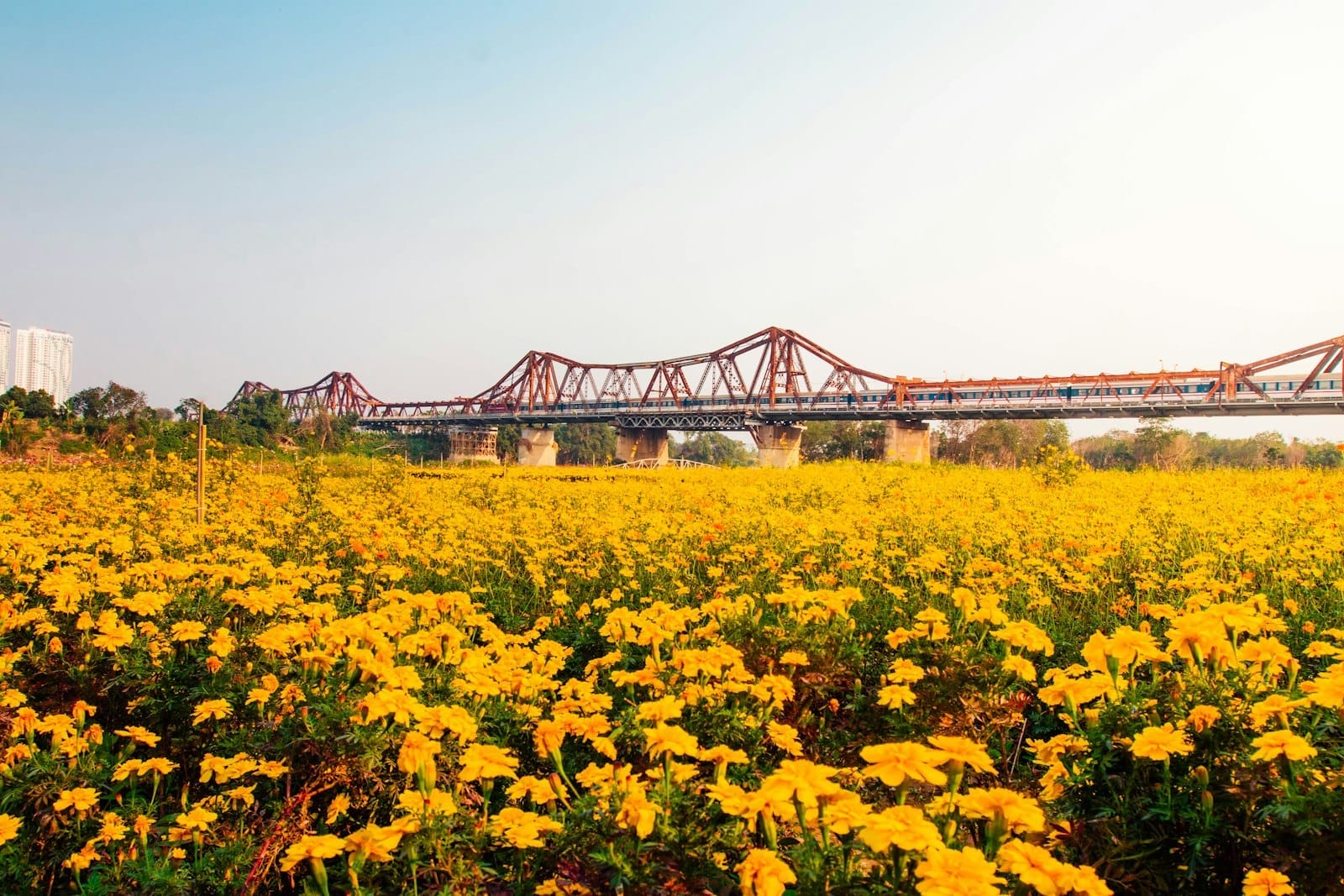
What Long Bien Bridge Actually Is
Long Bien Bridge is a steel cantilever rail and road bridge crossing the Red River, connecting Hanoi's Old Quarter side to Long Bien District on the east bank. Completed in 1902 after three years of construction, it was designed by the French colonial administration and built under the oversight of the Daydé & Pillé engineering firm. At the time of its opening, it was one of the longest bridges in Asia, stretching approximately 2,290 meters with 19 spans. It carried trains, cars, bicycles, and pedestrians for decades as the only fixed crossing over the Red River in the Hanoi area.
Today, Long Bien Bridge is no longer used by heavy rail traffic but remains open to motorbikes, bicycles, and pedestrians on narrow side lanes flanking the central rail track. The structure is visibly aged: sections of the metalwork are patched and uneven, the walkway surface is rough underfoot, and replacement spans from post-war repairs are noticeably simpler in design than the original French ironwork. That contrast is part of the point.
ℹ️ Good to know
The bridge is still used by some freight and occasional passenger trains. If you hear a horn or feel vibration underfoot, step aside onto the pedestrian walkway margins and wait for the train to pass — it happens more often in early morning and late afternoon.
The History Behind the Iron Spans
The bridge was constructed during the height of French Indochina, intended to support the colonial railway network connecting Hanoi to Haiphong and the broader region. It was named Paul Doumer Bridge after the Governor-General of French Indochina at the time, a name that persisted through the colonial era. After independence and the division of Vietnam, it was renamed Long Bien Bridge.
During the American War (known in the West as the Vietnam War), Long Bien Bridge became one of the most heavily bombed targets in North Vietnam. American aircraft struck it repeatedly between 1967 and 1972, destroying spans and putting it out of commission multiple times. Each time, Vietnamese engineers and workers repaired it under extraordinarily difficult conditions, often working at night to avoid air raids. The bridge became a symbol of resilience, and the patchwork repairs visible today are a direct physical record of that history. The replacement spans, built quickly from simpler materials, are shorter and less elegant than the original French ironwork, and the difference is obvious when you walk the full length.
For deeper context on how this history fits into the broader landscape of Hanoi's wartime sites, the Hoa Lo Prison museum covers the American War period in detail and pairs well with a visit to the bridge.
Tickets & tours
Live prices and dates from our booking partner. If you book, we may earn a commission at no extra cost to you.
Private full-day trip from Hanoi to Halong Bay with boat cruise
From 59 €Instant confirmationFree cancellationHalong Bay 3 days and 2 nights on boat cruise from Hanoi
From 438 €Instant confirmationFree cancellationHa Long Bay 1-day luxury cruise
From 62 €Instant confirmationFree cancellationHa Long Bay Luxury Day Cruise with Buffet Lunch From Hanoi
From 59 €Instant confirmationFree cancellation
The Walk: What to Expect Step by Step
The bridge entrance on the Old Quarter side is at the end of Tran Nhat Duat Street, where a ramp leads up to the bridge deck. The walkway is narrow — roughly 1.5 meters wide on each side — with motorbikes and bicycles sharing the space. There is no formal separation between pedestrians and two-wheelers, so stay alert and keep to the outer edge. The surface alternates between concrete sections and older metal grating, through which you can see the Red River below.
The midpoint of the bridge is the best stopping place. From here, the Red River spreads wide on both sides: upstream toward the northwest, you can see the skyline of central Hanoi including the high-rises of Ba Dinh and West Lake; downstream to the southeast, the river opens into flatter, more industrial landscape. In wet season (roughly May through September), the Red River runs brown and fast with sediment from upstream rains. In dry season (October through April), the river drops significantly, exposing sandbanks and small farming plots on the exposed riverbed below.
On the east bank, the bridge descends into Long Bien District, a quieter area with a fruit and vegetable wholesale market that operates from around 3am until mid-morning. If you cross early enough, the market activity adds another layer to the visit. The area around the east bridge entrance is also where local residents have built informal vegetable gardens on the riverbank land beneath the approach spans.
💡 Local tip
Bring a bicycle if you can. Many rental shops in the Old Quarter offer daily hire, and cycling the full length of the bridge is far more comfortable than walking on the uneven surface. It also gives you more freedom to stop midspan without blocking foot traffic.
Time of Day: How the Experience Changes
Sunrise is the most rewarding time to visit. Between 5:30am and 7am, the light over the Red River is soft and directional, casting long shadows through the ironwork and turning the water a pale orange. At this hour, the bridge carries mostly local commuters: delivery cyclists hauling large loads of produce from the east bank market, workers heading into the city on motorbikes, and a handful of older residents taking their morning walk. The crowd is local, purposeful, and largely indifferent to tourists.
By mid-morning, tourist numbers increase and the light becomes harsher. Midday visits in summer (June through August) can be genuinely uncomfortable due to heat and humidity with almost no shade on the bridge deck. Sunset visits, roughly 5:30pm to 7pm depending on season, are also atmospheric but can coincide with the evening commute, which means heavier motorbike traffic on the narrow lanes.
Weekday mornings are quieter than weekends. On weekend afternoons, young Hanoians often gather at the midpoint to take photographs and socialize, which gives the bridge a more festive but less historic atmosphere. If you want the experience of the bridge as a working crossing rather than a social spot, aim for a weekday before 8am.
Photography Notes
Long Bien Bridge is one of the most photographed structures in Hanoi, and for good reason: the repeating geometry of the iron spans, combined with the wide river and the city skyline, makes for strong compositions. The most popular shot is taken from the midpoint, looking back toward the Hanoi side, with the bridge receding into perspective. For this shot, a wide-angle lens or a phone in landscape mode works well. Early morning gives you warm light from the east, which falls directly onto the Hanoi skyline behind you.
For a different angle, photographers sometimes shoot from the riverbank below, looking up at the underside of the spans. Access to the riverbank varies by season and water level. In dry season, you can walk down the embankment on the Old Quarter side and position yourself beneath the first spans for a low perspective that emphasizes the scale of the original French engineering compared to the blunter replacement sections.
⚠️ What to skip
The walkway surface has uneven metal plates and gaps. Wearing sandals or flip-flops makes the walk harder and potentially risky underfoot. Closed shoes with a flat sole are strongly recommended.
Who This Is For — and Who Should Skip It
Long Bien Bridge suits travelers who find meaning in the visible layers of a place: the original colonial engineering, the wartime damage, the hasty repairs, and the daily life of ordinary commuters who still use it every morning. It is not a polished attraction. There is no visitor center, no interpretive signage in English, no cafe at the top. You are walking across a working bridge in a rough state of preservation, and the value is exactly that rawness.
Travelers who prefer curated, well-explained historical experiences will get more from a visit to the Imperial Citadel of Thang Long or the Vietnam Museum of Ethnology, where the historical context is presented clearly and the facilities are comfortable.
The bridge is not well suited to visitors with limited mobility. The ramp approach is steep, the walkway surface is uneven, and there are no rest areas with seating. It is also unsuitable for those sensitive to heights combined with open grating, since you can see directly through sections of the floor to the river below.
If you are planning a broader day in this part of Hanoi, the bridge pairs naturally with the Dong Xuan Market, which is a 10-minute walk south from the Old Quarter bridge entrance, and with an evening stroll around Hoan Kiem Lake. See the full Old Quarter walking guide for a logical route that includes all three.
Insider Tips
- The east bank of the bridge has informal garden plots tucked under the approach spans, tended by local families growing vegetables on the seasonal floodplain. In dry season (October through April), these are fully planted and make for an unexpected foreground in photographs.
- A train crosses the bridge several times daily. Locals near the entrance often know the rough schedule by habit, and you can ask them or simply listen for the horn. Watching a freight train cross while you stand on the narrow walkway is one of the more memorable moments the bridge offers.
- The best unobstructed view of the full bridge structure is from the riverside walking path below on the Hanoi side, not from the bridge itself. Walk down toward the riverbank from Tran Nhat Duat Street and look back northeast for the classic architectural shot.
- Most visitors only walk to the midpoint and return. If you cross fully to the Long Bien District side and turn right along the riverbank, there is a stretch of small local cafes and bia hoi (fresh beer) spots that see almost no foreign visitors.
- The bridge is included in discussions about potential UNESCO consideration for Hanoi's French colonial heritage infrastructure. The current patchwork state of the structure means it is not going to be pristine for long — the character of the repairs is itself historically significant and worth seeing before any future restoration changes the visual record.
Who Is Long Bien Bridge For?
- History and architecture travelers who appreciate unfiltered, unrenovated heritage
- Photographers seeking strong geometric compositions and documentary-style street scenes
- Early risers who want a genuinely local Hanoi experience before the city fully wakes
- Cyclists looking for a scenic and meaningful short route across the Red River
- Travelers combining a morning walk with a visit to the east bank produce market
Nearby Attractions
Other things to see while in Old Quarter:
- Đồng Xuân Market
Đồng Xuân Market is the largest and oldest covered market in Hanoi's Old Quarter, operating since 1889. A wholesale hub by day and a street food destination by night, it rewards visitors who know what they're looking for.
- Hanoi Ceramic Mosaic Mural
The Hanoi Ceramic Mosaic Mural runs for 3.85 kilometres along the embankment roads bordering the Old Quarter, recognised by Guinness World Records as the longest ceramic mosaic mural on earth. Created to mark Hanoi's 1,000th anniversary in 2010, it tells the city's history in fired clay and coloured tile — and it's completely free to experience on foot.
- Hanoi Old Quarter Night Market
Every Friday, Saturday, and Sunday evening, the streets around Hang Dao in Hanoi's Old Quarter close to traffic and fill with market stalls, street food vendors, and live folk performances. It's the most accessible snapshot of local weekend culture in the city center, though knowing what you're walking into makes the difference between an enjoyable evening and an overwhelming one.
- Saint Joseph's Cathedral
Saint Joseph's Cathedral is Hanoi's oldest Catholic church and one of the city's most striking pieces of colonial-era architecture. Built in the 1880s on the southern edge of the Old Quarter, it draws visitors with its twin bell towers, French Gothic detailing, and the lively square that surrounds it morning to night.
Planning a trip? Discover personalized activities with the Nomado app.