Hoàn Kiếm Lake: Hanoi's Sacred Centre, Hour by Hour
Hoàn Kiếm Lake sits at the geographical and spiritual heart of Hanoi, framed by willow trees, red-painted bridges, and centuries of legend. Free to visit any time, the lake rewards early risers with morning exercise rituals and evening walkers with lantern-lit reflections.
Quick Facts
- Location
- Hoan Kiem District, central Hanoi — bordered by Đinh Tiên Hoàng Street to the east and Lê Thái Tổ Street to the west
- Getting There
- No direct metro stop nearby; take a Grab or city bus to Bờ Hồ (Lakeside). A 10-15 min walk from most Old Quarter hotels.
- Time Needed
- 45 min for a full circuit on foot; 2-3 hours if visiting Ngọc Sơn Temple and sitting lakeside
- Cost
- Free to walk the lakeside path. Ngọc Sơn Temple entry: approximately 30,000 VND (verify current rates)
- Best for
- Morning walkers, photographers, history lovers, families, and anyone needing a calm break from the Old Quarter streets
What Hoàn Kiếm Lake Actually Is
Hoàn Kiếm Lake (Hồ Hoàn Kiếm, meaning 'Lake of the Returned Sword') is a natural freshwater lake in central Hanoi covering roughly 12 hectares. It is not a park, not a museum, and not a monument — it is a living urban space that locals use daily for exercise, socialising, and quiet reflection. For travellers, it also functions as Hanoi's most useful geographic anchor: almost everything worth seeing in the city centre is within 20 minutes of the lake on foot. The surrounding area is part of the Hoan Kiem district, and the lake sits right on the boundary between the French Quarter to the south and the Old Quarter to the north.
The lake draws its name from one of Vietnam's most enduring legends. King Lê Lợi, who drove out Ming Chinese forces in the 15th century, supposedly received a magical sword from a divine turtle in this very lake. After his victory, a giant golden turtle surfaced and reclaimed the sword, returning it to the heavens. The small stone tower on the southern islet — Tháp Rùa, or Turtle Tower — marks the spot where this is said to have happened. Whether or not you believe the legend, it explains why Hanoi residents treat this water with something closer to reverence than you might expect.
ℹ️ Good to know
The Hoàn Kiếm softshell turtle (Rafetus swinhoei) is one of the rarest turtle species on Earth. The last known individual died in 2016. A preserved specimen is displayed inside Ngọc Sơn Temple.
The Lake at Different Hours: What Changes
Arrive before 7am on any day and you will find the lakeshore path already crowded with residents doing tai chi, aerobics to tinny speakers, badminton on the pedestrian road, and a specific Vietnamese fitness ritual involving walking backwards in large circles. The air at this hour smells of dew and faint incense drifting from a nearby shop shrine. The light is soft and grey-green, filtered through willow branches. There are almost no tourists. This is the version of Hoàn Kiếm Lake most visitors never see.
By 9am, the exercise crowd has thinned and vendors have set up around the perimeter: sugarcane juice presses, baguette carts, and women carrying baskets of lotus flowers. Midday is the least interesting time to be here — direct sun flattens the lake's colour and most of the spontaneous activity pauses. If you arrive between noon and 3pm in summer, bring water and sunscreen; the shade is limited along the eastern bank.
Evenings are the lake's second peak. After 6pm, families spread out on the stone benches, couples photograph themselves against the red Thê Húc bridge, and the entire western bank becomes a casual promenade. On Friday, Saturday, and Sunday nights, the roads immediately around the lake close to traffic as part of Hanoi's pedestrian night zone, which connects the lake to the Old Quarter weekend market. The reflected lights on the water at this hour are worth the walk down.
Tickets & tours
Live prices and dates from our booking partner. If you book, we may earn a commission at no extra cost to you.
Self-guided Hanoi exploration tours with downloadable app
From 7 €Instant confirmationNoi Bai International Airport Fast Track Service with SIM Card Option
From 25 €Instant confirmationFree cancellationPrivate full-day trip from Hanoi to Halong Bay with boat cruise
From 59 €Instant confirmationFree cancellationNinh Binh day tour with Hoa Lu, Trang An and Hang Mua from Hanoi
From 39 €Instant confirmationFree cancellation
Ngọc Sơn Temple: The Island Shrine Worth Entering
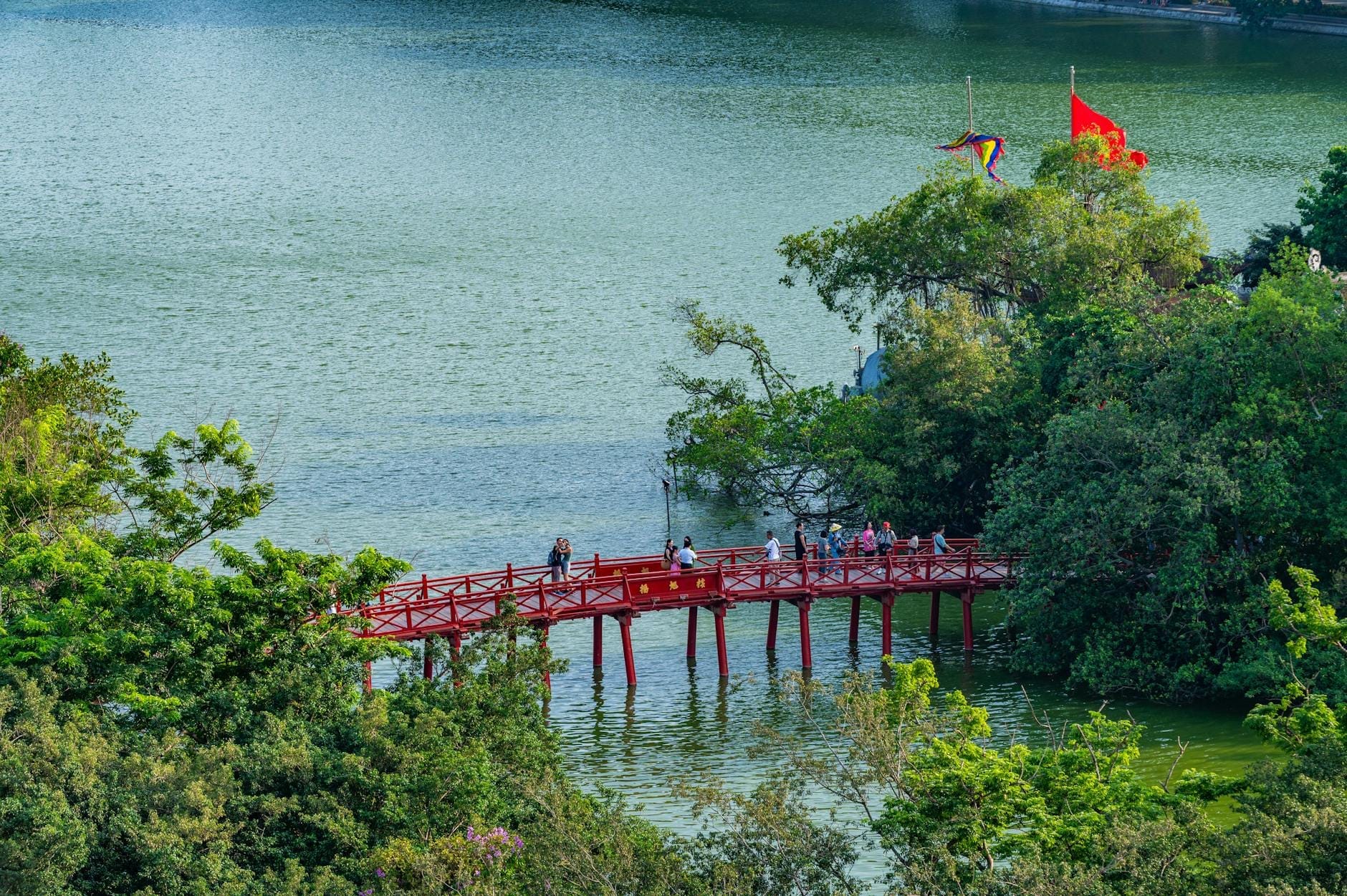
The most visited structure on the lake is Ngọc Sơn Temple (Temple of the Jade Mountain), reached by crossing the photogenic red Thê Húc bridge on the lake's northeastern side. The temple dates to the 18th and 19th centuries in its current form and is dedicated to several figures: the scholar Van Xuong, the military hero Tran Hung Dao who defeated Mongol invasions in the 13th century, and La To, a patron of physicians.
Inside, the preserved body of a large Hoàn Kiếm softshell turtle is displayed in a glass case, giving concrete weight to the legend. The displayed turtle, which died in 1968, measured over 2 metres in length. Incense smoke is dense inside the main hall and the light is dim, which makes photography difficult but gives the space genuine atmosphere. The courtyard behind the main hall offers a quieter moment and a different angle back toward the lake.
The entry fee is modest (approximately 30,000 VND, though prices are subject to change — confirm at the gate). The temple opens in the morning and closes in the early evening; exact hours shift seasonally, so check locally the day before. Modest dress is expected: shoulders and knees should be covered. Sarongs are sometimes available to borrow at the entrance.
Walking the Circuit: What You Pass
The full perimeter path is roughly 1.8 kilometres and takes about 25 minutes at a steady pace, longer if you stop. Heading clockwise from the Đinh Tiên Hoàng side, you pass the ink-green water with Turtle Tower in the middle distance, a small pagoda on the bank, and several stone benches that fill with elderly men playing chess in the mornings. The path is paved and mostly level, making it accessible for most mobility levels, though some sections have low kerbs.
On the western bank, the path borders a narrow park strip with large frangipani trees. This side is quieter than the eastern boulevard and smells noticeably different — less traffic, more earth. At the southwestern corner, you can see across to the flower market stalls on the far side of the road. On the northern end, the lake connects visually to the gateway of the Old Quarter night market zone on weekends, and the colour and noise shift abruptly as you step off the lakeshore path into those streets.
Photography Tips and Honest Expectations
The most photographed image of Hoàn Kiếm Lake is the red Thê Húc bridge with the green-roofed temple gateway beyond it, taken from the northeastern bank. This shot works best in the hour after sunrise when the light comes from the east and the bridge glows against the dark water. By midday, the scene is washed out. At dusk, artificial lighting on the bridge gives a different look, but the sky and water compete poorly if you want a clean composition.
Turtle Tower, the small stone pagoda on the southern islet, cannot be accessed by visitors — it sits in the middle of the water with no bridge. The best angle is from the southwestern bank using a longer focal length to isolate it against the tree line. On misty mornings in winter (November through February), the tower disappears halfway into the fog, which produces genuinely striking images and also makes the lake feel larger than it is.
💡 Local tip
For the classic Thê Húc bridge shot without crowds, arrive before 7am on a weekday. By 9am on weekends, the bridge entrance becomes a queue for selfies and forward movement slows significantly.
Practical Details and What to Know Before You Go
The lake is free to access at any hour. There are no gates or entry barriers to the path. The nearest concentration of accommodation is in the Old Quarter, a short walk north. Staying within this radius means you can visit the lake at dawn and again after dinner without planning — which is genuinely how most visitors end up using it.
Getting here from the airport: Nội Bài International Airport is approximately 45 kilometres away. A Grab car or metered taxi takes 45 to 60 minutes depending on traffic. There is no direct rail link. Once in the city, the lake is reachable by city bus (several routes pass Bờ Hồ, the lakeside stop), by Grab, or on foot from most central hotels. For broader context on getting around Hanoi, see the getting around Hanoi guide.
Weather affects the experience considerably. Hanoi's winters (December through February) bring a persistent cool mist, sometimes called 'drizzling fog' locally, which suits the lake's atmosphere well but requires a light jacket. Summer afternoons (June through August) can reach 38°C with high humidity; the lake offers almost no tree cover on the eastern side. October and November are widely considered the most comfortable months for outdoor exploration in Hanoi.
Accessibility: the main path is paved and flat, suitable for wheelchairs on most sections. The Thê Húc bridge has a slight arc and narrow width; navigating it with a large pushchair or wheelchair would be difficult. The temple courtyard itself has steps.
⚠️ What to skip
Watch for motorbikes on the lakeside road during weekday mornings and afternoons — even though parts of the perimeter feel like a pedestrian path, some sections are shared with light traffic until the weekend night-market closure comes into effect.
Is It Worth Your Time? An Honest Assessment
For most visitors to Hanoi, Hoàn Kiếm Lake is less a destination in itself and more the connective tissue of the city centre. You will almost certainly pass it multiple times during a stay, and each pass tends to show you something slightly different. It is not Hanoi's most dramatic attraction — that title belongs to places like the Temple of Literature or the Vietnam Museum of Ethnology for historical depth. What the lake offers instead is a rare kind of urban space: genuinely used by locals in ways that feel unchanged by tourism, and free to enter at any hour.
Travellers who want visible drama or structured information may feel underwhelmed by the lake itself. There are no signs explaining the history as you walk, no audio guides, and the main feature is simply water and trees. But travellers who slow down, arrive early, and spend time watching rather than photographing tend to leave with stronger memories of Hanoi from this spot than from many ticketed attractions.
Who might skip it: anyone travelling with very limited time who needs to prioritise and has already seen the surrounding area from street level. The lake view from a rooftop cafe on Đinh Tiên Hoàng gives you the visual without the circuit. That said, the circuit itself is the point.
Insider Tips
- The red Thê Húc bridge appears in tens of thousands of identical travel photos. For a less-replicated image, walk to the southern end of the western bank and shoot north along the water at dusk — the Turtle Tower silhouette against the city glow is rarely published.
- On weekend evenings when roads close to traffic, street food vendors move onto the pedestrian zone and prices are noticeably higher than a block away. For the same bún chả or bánh mì at fairer prices, walk two streets back into the Old Quarter.
- The willow trees on the western bank shed a fine layer of seed fluff in late spring (roughly April to May). It coats the path and the water surface and looks otherworldly in morning light — but it also irritates eyes and sinuses, so hay fever sufferers should plan accordingly.
- Several lakeside cafes on the upper floors of buildings along Đinh Tiên Hoàng offer aerial views of the lake at the cost of a coffee (around 50,000–80,000 VND). This is an underused option during midday heat when the path itself is uncomfortable.
- If you visit Ngọc Sơn Temple, allow an extra 10 minutes beyond the main hall to sit in the rear courtyard. Most visitors rush through the turtle exhibit and back out; the courtyard sees a fraction of the traffic and has a view of the water through old iron railings.
Who Is Hoàn Kiếm Lake For?
- Early risers who want to see how Hanoi actually starts its day
- Photographers working in the golden hour before tourist crowds build
- Families with young children who need open, walkable space with no entry fee
- Travellers using the lake as an orientation point for their first day in the city
- Anyone combining a visit with the nearby Old Quarter, Saint Joseph's Cathedral, or the weekend night market
Nearby Attractions
Other things to see while in Hoàn Kiếm:
- Hoa Lo Prison
Hoa Lo Prison is one of Hanoi's most historically layered sites, built by French colonial authorities in the 1880s and later used to hold American prisoners of war during the Vietnam War. A visit here is not comfortable — it is not supposed to be. But for travelers serious about understanding Vietnam's 20th century, it is essential.
- Ngoc Son Temple
Ngoc Son Temple occupies a small island at the northern end of Hoan Kiem Lake, connected to the shore by the iconic red The Huc Bridge. One of Hanoi's most visited religious sites, it blends Taoist and Confucian traditions in a setting that feels genuinely calm despite its central location. This guide covers what to expect inside, when crowds thin out, and how to make the visit count.
- Thang Long Water Puppet Theatre
Thang Long Water Puppet Theatre brings a folk art tradition dating back over 1,000 years to life on a waist-deep pool beside Hoan Kiem Lake. Performances run multiple times daily and combine puppetry, live traditional music, and Vietnamese mythology into a 50-minute show unlike anything else in the country.
Planning a trip? Discover personalized activities with the Nomado app.