Hanoi Old Quarter Night Market: What to Expect Before You Go
Every Friday, Saturday, and Sunday evening, the streets around Hang Dao in Hanoi's Old Quarter close to traffic and fill with market stalls, street food vendors, and live folk performances. It's the most accessible snapshot of local weekend culture in the city center, though knowing what you're walking into makes the difference between an enjoyable evening and an overwhelming one.
Quick Facts
- Location
- Hang Dao Street and surrounding Old Quarter lanes, Hoan Kiem District, Hanoi
- Getting There
- Walk from Hoan Kiem Lake (5 min north); Grab taxi or xe om to Hang Dao St; no metro currently serving the area
- Time Needed
- 1.5 to 3 hours depending on pace; longer if you eat along the way
- Cost
- Free entry; individual purchases vary — street snacks from 10,000–50,000 VND, souvenirs from 30,000 VND upward
- Best for
- First-time visitors to Hanoi, souvenir shoppers, street food explorers, weekend evening plans
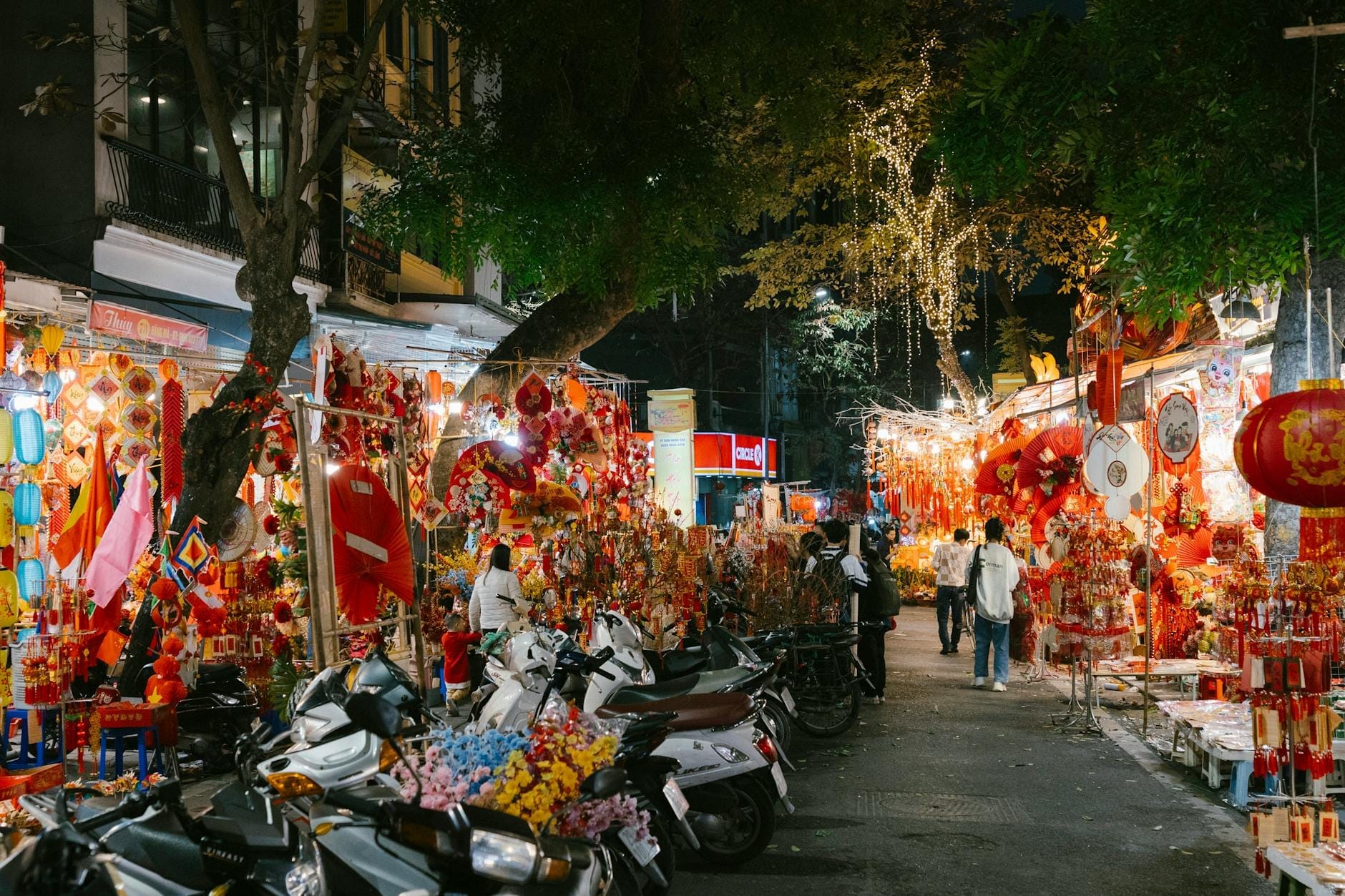
What the Night Market Actually Is
The Hanoi Old Quarter Night Market is a pedestrian street market that operates every Friday, Saturday, and Sunday evening along Hang Dao, Hang Duong, and Dong Xuan streets, stretching northward from the edge of Hoan Kiem Lake toward Dong Xuan Market. The core stretch covers roughly 800 meters of road that is closed entirely to motorbikes and cars once the market opens, which is a rare luxury in a city where traffic rarely pauses.
Stalls sell an enormous range of goods: lacquerware, embroidered textiles, silk scarves, painted fans, ceramic figurines, T-shirts, bamboo kitchenware, and a large quantity of low-cost clothing that targets the local youth market as much as tourists. Interspersed throughout are food carts selling grilled corn, banh mi, sweet soups, fresh fruit, and grilled skewers. On weekend evenings there are usually informal performances near the southern end of the market, including traditional music and occasional street theater organized by the district.
ℹ️ Good to know
Operating hours: Friday to Sunday, approximately 6:00 PM to midnight. The market does not operate on weeknights. Arrive after 6:30 PM when stalls are fully set up but before 9:30 PM when crowds peak.
How the Market Changes Through the Evening
Between 6:00 and 7:00 PM, the market is still assembling. Vendors are unfolding tables and arranging goods, the pedestrian zone is relatively open, and the light is still fading through the narrow street profiles of the Old Quarter's 19th-century shophouse facades. This is the best window for photography: warm light, less crowd, and the architectural backdrop still visible above the stalls.
By 8:00 PM the market is in full motion. The main street becomes genuinely slow-moving, not because of any bottleneck, but because of the sheer volume of people browsing. You'll hear a mix of Vietnamese conversation, bargaining exchanges, and recorded pop music drifting from individual stalls. The smell shifts block by block: sweet grilled corn gives way to savory pork skewers, then to incense near the doorways of small temples that remain open even during market hours.
After 9:30 PM, the outer edges thin out but the food section near Dong Xuan stays busy well past 10:00 PM. If your priority is browsing rather than eating, arriving between 6:30 and 7:30 PM gives you more space and better light. If the atmosphere itself is the goal, peak hours between 8:00 and 9:30 PM deliver the most energy.
Tickets & tours
Live prices and dates from our booking partner. If you book, we may earn a commission at no extra cost to you.
Halong Bay 3 days and 2 nights on boat cruise from Hanoi
From 438 €Instant confirmationFree cancellationHanoi street food guided night tour
From 30 €Instant confirmationFree cancellationHanoi Guided Bar Crawl With Drinks and Nightclub Entry
From 56 €Instant confirmationFree cancellationHalong Bay 2 days and 1 night on boat cruise from Hanoi
From 320 €Instant confirmationFree cancellation
The Old Quarter Context: Why This Street Makes Sense Here
The market doesn't exist in a vacuum. It runs through the heart of one of Southeast Asia's most intact medieval commercial districts. The Old Quarter dates its street-trade identity to at least the 14th century, when guilds organized by craft occupied individual lanes: Hang Bac for silver, Hang Gai for silk, Hang Dao (the market's starting point) for dyed cloth. That specialization has blurred over centuries, but the physical structure, narrow tube houses five meters wide and sometimes 40 meters deep, survives largely intact.
The weekend pedestrian market was introduced as a formal initiative to manage the Old Quarter's foot traffic, reduce congestion, and create a dedicated space for cultural commerce. It has become one of the district's most-attended regular events, drawing both Hanoians and visitors in roughly equal numbers on any given weekend. Watching how local families move through the market, stopping to share a corn cob or sit on plastic stools for a bowl of sweet soup, gives the experience a texture that pure tourist markets rarely have.
What to Buy and What to Skip
The most consistent quality items at the night market are hand-embroidered goods: small pouches, table runners, and fabric decorations made by vendors who often produce them on-site. Lacquerware boxes and painted silk are also broadly reliable, though quality varies between stalls. For ceramics, the night market is a preview rather than a destination: the range and quality at dedicated ceramic shops in the Old Quarter, or on a day trip to Bat Trang, will exceed what you find on a folding table.
T-shirts with regional humor, printed bags, and mass-produced souvenirs fill a large portion of the stalls and are essentially identical across vendors. These are priced for bargaining: a starting price of 150,000 VND often settles around 80,000–100,000 VND with polite negotiation. If you're serious about ceramics specifically, the Bat Trang Ceramic Village a half-hour from central Hanoi is the more authoritative destination.
💡 Local tip
Bargaining is expected but keep it light. A smile, a counter-offer of 60–70% of asking price, and willingness to walk away is the standard approach. Aggressive haggling is unusual here and tends to create friction more than savings.
Eating Your Way Through the Market
The food at the night market is consistent with what you'd find in the Old Quarter on any evening, which is to say it's good, fast, and cheap. Grilled corn with butter and scallion salt is the most photogenic option and costs around 15,000–20,000 VND. Banh my stalls clustered toward the northern end near Dong Xuan serve to-go sandwiches with various fillings for 30,000–50,000 VND. Che stalls sell sweet bean soups in cups, usually 10,000–20,000 VND, and are particularly popular with local families.
For a proper sit-down meal before or after the market, the side streets immediately east and west of Hang Dao have pho shops, bun cha restaurants, and bia hoi corners that are less crowded than the market's main lane. The Hanoi dining guide covers the best street food options across the Old Quarter and beyond.
Practical Details: Getting There, Getting Around
The easiest approach is on foot from Hoan Kiem Lake, which sits directly south of the market's starting point on Hang Dao. From the lake's north end, Hang Dao is a five-minute walk. Grab motorbike taxis are a faster option from hotels further afield, and drivers generally know the area well. Ask to be dropped at 'Hang Dao, cho dem' (night market on Hang Dao) and they will understand. Car-based rides should drop off on a surrounding street, as the central lanes are pedestrianized during market hours.
The market is almost entirely flat and navigable on foot, but the crowd density during peak hours means wheelchair users and people with limited mobility will find it difficult to move freely through the central stall rows. Side streets running parallel to Hang Dao remain open to traffic and are considerably less crowded, offering an easier route if the main lane becomes too packed.
⚠️ What to skip
Pickpocketing is a known risk in crowded markets across Hanoi. Keep bags zipped and worn in front. Avoid storing your phone in a back pocket in peak crowd conditions between 8:00 and 10:00 PM.
Honest Assessment: Is It Worth Your Evening?
For first-time visitors to Hanoi spending only a weekend in the city, the night market is a reasonable way to see the Old Quarter at its most accessible. The pedestrianized zone itself is genuinely pleasant compared to Hanoi's normal sidewalk conditions, and the concentration of local craft goods in one place is convenient. But if you've already spent a day walking the Old Quarter's daytime streets, you'll notice significant overlap with what's already available in the surrounding shops, many of which are open late regardless.
The market is not an undiscovered local experience: it's a managed, well-attended event that caters openly to tourists. That's not a flaw, but it means travelers seeking off-the-beaten-path authenticity should look elsewhere. What the market does well is deliver a festive, walkable evening with low financial commitment, good food options, and enough sensory variety to make two hours pass quickly.
Travelers who have already visited markets in Bangkok, Chiang Mai, or Hoi An may find the scale and variety modest by comparison. Those arriving fresh to Southeast Asian street markets will likely find it memorable and well-organized. Families with children handle the experience well: the pedestrian zone is safe, the food is approachable, and the performance area near the south end gives younger visitors something to anchor the evening around.
Insider Tips
- The most interesting stalls are often on the side streets branching east off Hang Dao rather than the main pedestrian lane itself. Hang Bac and Luong Van Can have smaller clusters of vendors with less foot traffic and occasionally better prices.
- If you want the folk music performances, position yourself near the Hoan Kiem end of Hang Dao between 7:30 and 8:30 PM. Performances are informal and short, but they draw a circle of seated onlookers and are easy to miss if you're deeper in the market.
- Plastic stools appear along the food section as the evening progresses. Sitting down to eat with locals rather than eating while walking dramatically changes the experience and gives you a better sense of how Hanoians actually use the space.
- The market gets noticeably thinner in rainy weather. If it's been raining since late afternoon, expect about 30–40% fewer stalls and crowds: some vendors simply don't set up. On a clear, warm evening the turnout is at its highest.
- Currency: all purchases are in Vietnamese Dong (VND). Very few stalls accept cards. Bring small bills, 10,000, 20,000, and 50,000 VND denominations, to make food purchases faster and avoid change disputes.
Who Is Hanoi Old Quarter Night Market For?
- First-time Hanoi visitors wanting a low-pressure introduction to Old Quarter street life
- Souvenir shoppers who want variety in one place without navigating motorbike traffic
- Families with children looking for a safe, walkable Friday or Saturday evening activity
- Travelers who want to combine a market visit with a post-dinner lakeside walk at Hoan Kiem
- Weekend evening planners who want something to do between dinner and a late-night bar
Nearby Attractions
Other things to see while in Old Quarter:
- Đồng Xuân Market
Đồng Xuân Market is the largest and oldest covered market in Hanoi's Old Quarter, operating since 1889. A wholesale hub by day and a street food destination by night, it rewards visitors who know what they're looking for.
- Hanoi Ceramic Mosaic Mural
The Hanoi Ceramic Mosaic Mural runs for 3.85 kilometres along the embankment roads bordering the Old Quarter, recognised by Guinness World Records as the longest ceramic mosaic mural on earth. Created to mark Hanoi's 1,000th anniversary in 2010, it tells the city's history in fired clay and coloured tile — and it's completely free to experience on foot.
- Long Bien Bridge
Long Bien Bridge is one of Hanoi's most historically loaded landmarks, a steel cantilever structure built by the French at the turn of the 20th century that has survived two wars, countless floods, and decades of daily use. Walking across it offers a perspective on Hanoi that few other spots can match: wide Red River views, the drone of motorbikes and bicycles, and a direct line into the city's layered past.
- Saint Joseph's Cathedral
Saint Joseph's Cathedral is Hanoi's oldest Catholic church and one of the city's most striking pieces of colonial-era architecture. Built in the 1880s on the southern edge of the Old Quarter, it draws visitors with its twin bell towers, French Gothic detailing, and the lively square that surrounds it morning to night.
Planning a trip? Discover personalized activities with the Nomado app.