Saint Joseph's Cathedral: Hanoi's Gothic Heart in the Old Quarter
Saint Joseph's Cathedral is Hanoi's oldest Catholic church and one of the city's most striking pieces of colonial-era architecture. Built in the 1880s on the southern edge of the Old Quarter, it draws visitors with its twin bell towers, French Gothic detailing, and the lively square that surrounds it morning to night.
Quick Facts
- Location
- 40 Nha Chung Street, Hoan Kiem District, Hanoi
- Getting There
- 10-min walk from Hoan Kiem Lake; Grab taxi from elsewhere in Old Quarter takes ~5 min
- Time Needed
- 30–60 minutes for the cathedral; add 30 min for the surrounding square
- Cost
- Free entry (interior access typically limited to Mass times)
- Best for
- Architecture lovers, photographers, early-morning walkers, cultural context
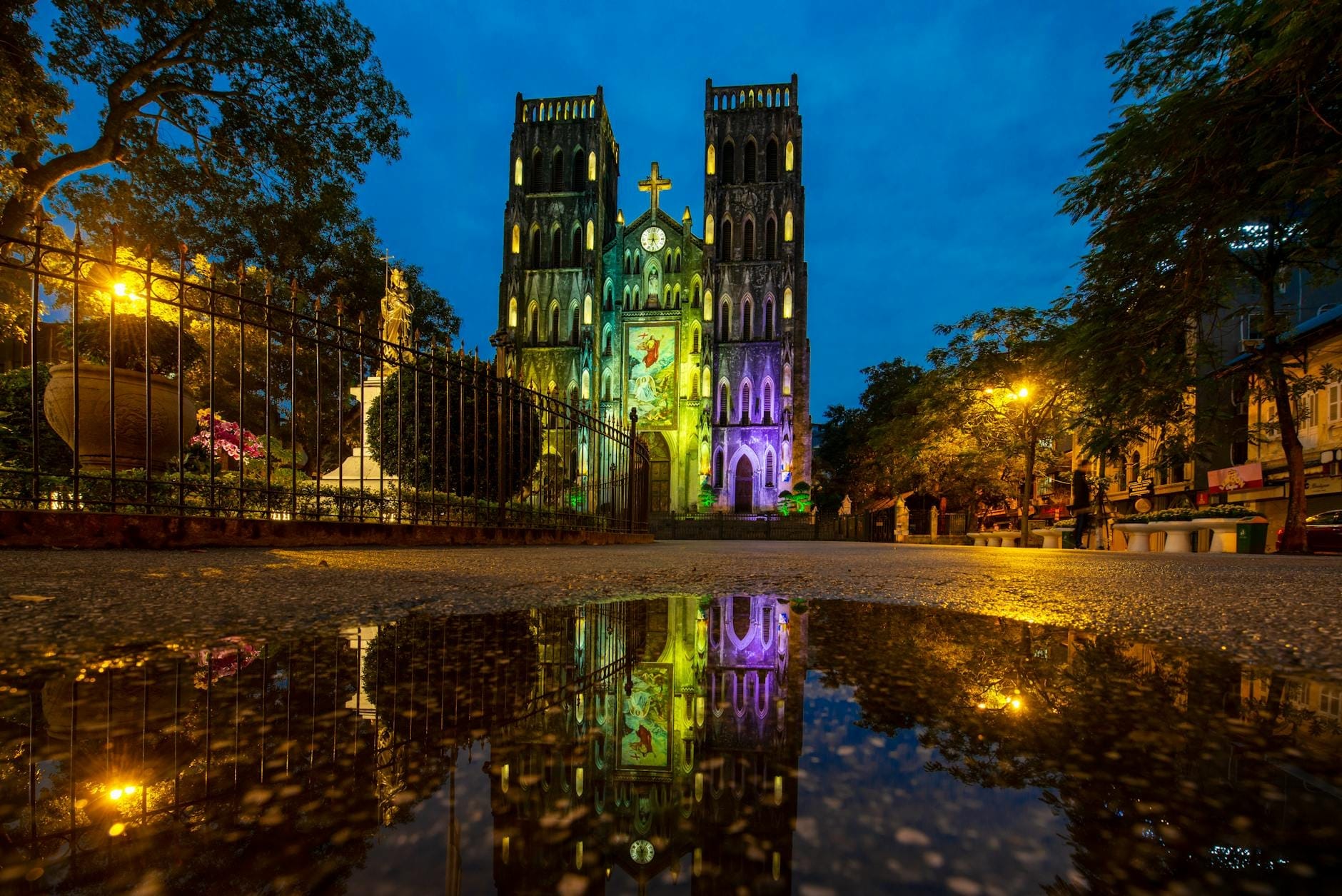
What Is Saint Joseph's Cathedral?
Saint Joseph's Cathedral (Nhà Thờ Lớn Hà Nội, meaning 'Big Church of Hanoi') was completed in 1886 under French colonial administration, making it one of the oldest surviving Catholic churches in northern Vietnam. The French authorities constructed it on the site of the Báo Thiên Pagoda, a revered Buddhist temple demolished to make way for the new structure. That history gives the cathedral a weight that goes beyond its architecture.
The building draws obvious inspiration from the Gothic Revival style fashionable in 19th-century France, with twin square bell towers rising roughly 31 meters, a stone facade finished in grey-green, and stained-glass windows filtering colored light into the nave. It is sometimes compared to Notre-Dame de Paris in form, though on a considerably smaller and rougher scale. The comparison is apt enough to be useful, but the cathedral earns attention on its own terms.
ℹ️ Good to know
Interior access is typically restricted to active Mass times. Regular Masses are generally held on weekday mornings and evenings and multiple times on Sundays, but schedules change around religious holidays. Check the board posted on the main gate before assuming you can walk in.
The Cathedral Square: Where the Real Action Is
Nha Chung Street and the small square directly in front of the cathedral function as a neighborhood anchor point at almost every hour of the day. Early morning, around 6 to 7 am, you will find a handful of local worshippers arriving for Mass, vendors setting up coffee carts, and the stone facade catching the soft northern light before haze thickens. The air carries roasted coffee and motorbike exhaust in roughly equal measure.
By mid-morning the square transitions into café territory. The streets immediately surrounding the cathedral, particularly Ly Quoc Su, are lined with coffee shops popular with both locals and visitors. Egg coffee, the Hanoi specialty made with whipped egg yolk and condensed milk, is available at several shops within a two-minute walk. This corner of the Old Quarter feels calmer than the northern craft streets, making it a useful place to sit down and recalibrate mid-itinerary.
Weekend evenings bring a different crowd entirely. Young Hanoians gather on the steps and surrounding pavements, particularly on Friday and Saturday nights, making the square one of the more photographed nighttime spots in the Old Quarter. String lights from nearby cafés spill onto the stone, and the towers are floodlit after dark. It reads as festive without being chaotic.
Tickets & tours
Live prices and dates from our booking partner. If you book, we may earn a commission at no extra cost to you.
Noi Bai International Airport Fast Track Service with SIM Card Option
From 25 €Instant confirmationFree cancellationPrivate full-day trip from Hanoi to Halong Bay with boat cruise
From 59 €Instant confirmationFree cancellationNinh Binh day tour with Hoa Lu, Trang An and Hang Mua from Hanoi
From 39 €Instant confirmationFree cancellationHalong Bay 3 days and 2 nights on boat cruise from Hanoi
From 438 €Instant confirmationFree cancellation
Architecture Up Close: What to Look For
The facade is the obvious starting point. Look at the twin towers carefully: the stonework is deliberately austere by French Gothic standards, reflecting both budget constraints and the tropical context. The green-grey patina on the walls has deepened over more than 130 years of Hanoi's humid climate, giving the building a gravitas that newer restorations in the region often lack.
When the interior is open, the nave is relatively modest in length but worth entering for the stained-glass windows and the carved wooden elements of the altar. The colors in the glass are richest in the late morning when sun angles cross the south-facing windows. The cathedral underwent notable restoration work in the early 2000s, and some of the interior decoration reflects that period's interpretation rather than strict historical restoration. Purists will notice the unevenness, but the overall effect remains coherent.
The side streets around the cathedral also reward slow walking. Nha Chung Street connects south toward Hoan Kiem Lake, and the blocks between the cathedral and the lake contain a mix of Catholic institutional buildings, small local restaurants, and a few surviving French-era shophouses. Understanding this cluster of buildings helps explain why the cathedral feels embedded in its neighborhood rather than dropped into it.
Historical and Cultural Context
Saint Joseph's was built during the early consolidation of French colonial power in Tonkin (northern Vietnam), and its location on the site of a Buddhist pagoda reflects the deliberate cultural displacement that characterized that period. For visitors also exploring Hoan Kiem Lake and Ngoc Son Temple nearby, the cathedral provides a useful counterpoint: two religious traditions, one colonial and one indigenous, both now woven into the same neighborhood fabric.
The Catholic community in Hanoi remains active, and Saint Joseph's functions as a working parish church, not a museum. This distinction matters. The space has an entirely different quality during Mass, when it fills with the sound of Vietnamese-language liturgy and incense smoke drifts toward the vaulted ceiling. Visiting during a Sunday Mass (while being respectful of the worshippers) gives the building a living context that a quiet weekday walkthrough cannot replicate.
For deeper historical context on the French colonial imprint on Hanoi, the French Quarter a short distance south offers the most concentrated example of colonial urban planning in the city, including the Hanoi Opera House and numerous government buildings from the same era.
Best Time to Visit and Photography
The cathedral photographs best in the hour after sunrise, when the stone takes on warmer tones and foot traffic is minimal. By 9 am on weekends, the square fills with visitors and the foreground of any wide shot becomes crowded. Overcast days, common in Hanoi's cool-dry season from November through February, produce even, diffused light that suits the grey-green facade well and eliminates the harsh shadows that midday sun creates on the recessed Gothic details.
Hanoi's climate means that a visit in the rainy season (roughly May through September) may catch you in an afternoon downpour. The square has limited shelter. Check the best time to visit Hanoi if you are planning around weather. October and November are generally the most reliable months for comfortable walking and clear light.
💡 Local tip
For the cleanest architectural shot, stand at the top of Nha Chung Street where it widens into the square and shoot straight on with a wide-angle lens early morning. The iron gate in the foreground adds depth without obscuring the towers.
Getting There and Practical Notes
The cathedral is at 40 Nha Chung Street in Hoan Kiem District, roughly a 10-minute walk southwest from Hoan Kiem Lake. The walk itself passes through the southern fringe of the Old Quarter and is straightforward. Motorbike taxis and Grab cars can reach Nha Chung Street directly, though the narrow surrounding streets mean you may be dropped a short distance away.
There is no dedicated parking area. Visitors arriving by motorbike will find informal parking on the adjacent streets for a small fee (typically a few thousand VND). The surrounding pavements can be crowded with parked motorbikes during weekend evenings, which narrows foot access but does not prevent entry.
Dress modestly if you plan to enter the church. Bare shoulders and shorts above the knee are inappropriate, as this is an active place of worship. The exterior and square are freely accessible at all hours. Entry to the interior without attending Mass is sometimes permitted outside service times, but this is at the discretion of the on-site staff and is not guaranteed.
⚠️ What to skip
Avoid arriving primarily to photograph the interior during Mass. The congregation deserves to worship without camera intrusion. If you attend respectfully and remain quiet, photography of the interior is sometimes tolerated, but ask permission and use no flash.
Who This Attraction Suits, and Who Might Pass
Saint Joseph's Cathedral rewards travelers with an interest in colonial history, religious architecture, or simply the texture of a neighborhood that layers different eras on top of each other. It fits naturally into a Hoan Kiem and Old Quarter walking itinerary without requiring significant extra time.
Travelers focused exclusively on Vietnamese cultural heritage (temples, pagodas, traditional architecture) may find the cathedral less relevant to their interests. In that case, the time is better directed toward sites like the Temple of Literature or the Vietnam Museum of Ethnology. The cathedral is also not a destination that justifies a long trip across the city on its own. It works best as part of a broader Hoan Kiem neighborhood walk.
Insider Tips
- Sunday morning Mass (around 7 am and 9 am) draws the largest local congregation and gives the building its most atmospheric quality. Arrive a few minutes early and take a seat near the back if you wish to observe respectfully.
- The café immediately to the left of the cathedral entrance (as you face it) has a second-floor terrace with a direct sightline to the towers. It fills up quickly on weekend mornings, but on a weekday you can often claim a window seat without waiting.
- The narrow street of Ly Quoc Su, running northwest from the cathedral square, has some of the better mid-range Vietnamese restaurants in this part of the Old Quarter, serving a local lunch crowd. It is noticeably cheaper than the tourist-facing streets closer to Hoan Kiem Lake.
- During Christmas and Easter, the cathedral square becomes one of the most visually striking places in Hanoi. Large crowds gather, decorations are elaborate, and the atmosphere is genuinely celebratory. Arrive early in the evening to get a position near the front; the square fills completely within an hour of dark.
- The iron gate at the main entrance is detailed enough to photograph on its own. Look for the carved stone inscription above the main arch, which is easy to miss when your eye goes straight to the towers.
Who Is Saint Joseph's Cathedral For?
- Architecture and history travelers interested in French colonial Hanoi
- Photographers seeking early-morning shots with minimal crowds
- Catholic travelers looking for an active parish church for Mass
- Old Quarter walkers building a half-day neighborhood itinerary
- Visitors who want a calm, walkable counterpoint to the noisier northern Old Quarter streets
Nearby Attractions
Other things to see while in Old Quarter:
- Đồng Xuân Market
Đồng Xuân Market is the largest and oldest covered market in Hanoi's Old Quarter, operating since 1889. A wholesale hub by day and a street food destination by night, it rewards visitors who know what they're looking for.
- Hanoi Ceramic Mosaic Mural
The Hanoi Ceramic Mosaic Mural runs for 3.85 kilometres along the embankment roads bordering the Old Quarter, recognised by Guinness World Records as the longest ceramic mosaic mural on earth. Created to mark Hanoi's 1,000th anniversary in 2010, it tells the city's history in fired clay and coloured tile — and it's completely free to experience on foot.
- Hanoi Old Quarter Night Market
Every Friday, Saturday, and Sunday evening, the streets around Hang Dao in Hanoi's Old Quarter close to traffic and fill with market stalls, street food vendors, and live folk performances. It's the most accessible snapshot of local weekend culture in the city center, though knowing what you're walking into makes the difference between an enjoyable evening and an overwhelming one.
- Long Bien Bridge
Long Bien Bridge is one of Hanoi's most historically loaded landmarks, a steel cantilever structure built by the French at the turn of the 20th century that has survived two wars, countless floods, and decades of daily use. Walking across it offers a perspective on Hanoi that few other spots can match: wide Red River views, the drone of motorbikes and bicycles, and a direct line into the city's layered past.
Planning a trip? Discover personalized activities with the Nomado app.