Hanoi Opera House: A Colonial Masterpiece at the Heart of the French Quarter
Built by the French colonial administration and completed in 1911, the Hanoi Opera House is one of Vietnam's most architecturally significant buildings. Whether you attend a live performance or simply admire the facade from Trang Tien Plaza, the Opera House anchors the French Quarter's grandest boulevard and rewards anyone who takes the time to understand what they're looking at.
Quick Facts
- Location
- 1 Trang Tien Street, Hoan Kiem District, Hanoi (French Quarter)
- Getting There
- 10-minute walk from Hoan Kiem Lake; Grab or taxi from Old Quarter takes 5-10 minutes depending on traffic
- Time Needed
- 30-45 minutes for exterior and plaza; 2-3 hours for a performance evening
- Cost
- Free to view exterior; performance tickets vary by show — check the official website for current listings
- Best for
- Architecture lovers, classical music and dance fans, evening strollers
- Official website
- www.hanoioperahouse.org.vn
What the Hanoi Opera House Actually Is
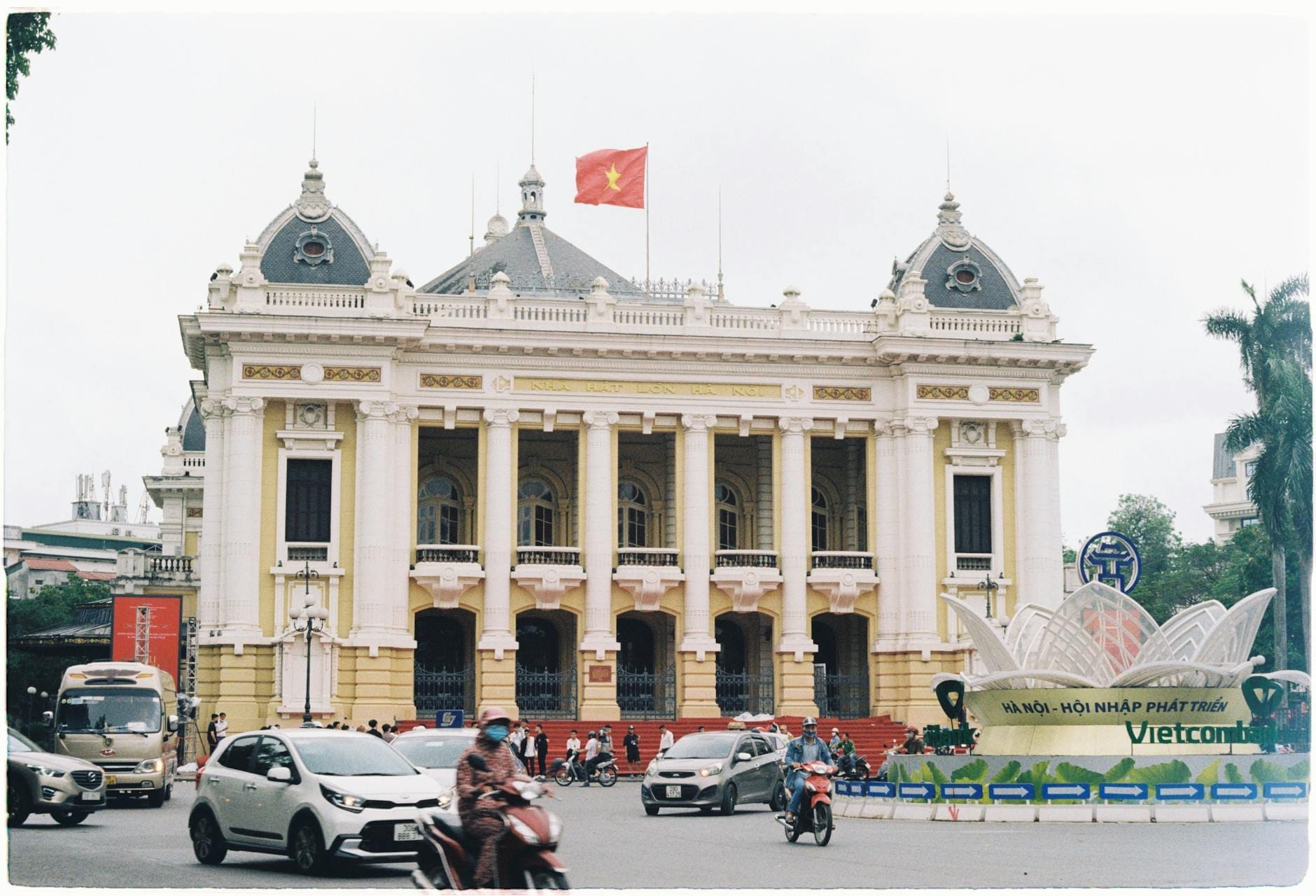
The Hanoi Opera House (Nha Hat Lon Ha Noi) is a functioning performance venue and a colonial-era architectural landmark, completed in 1911 after a decade of construction. It was modeled closely on the Palais Garnier in Paris, though on a more modest scale, and it remains one of the clearest examples of French Beaux-Arts architecture anywhere in Southeast Asia. The building sits at the top of Trang Tien Street, a broad tree-lined avenue that stretches toward Hoan Kiem Lake, and the location was deliberate: it was meant to project European cultural authority at the ceremonial heart of colonial Hanoi.
Today it functions as a premier venue for the Vietnam National Symphony Orchestra, the Hanoi Ballet and Opera, traditional Vietnamese folk performances, and visiting international productions. The interior, which underwent extensive restoration in the 1990s, can seat around 600 people across its main auditorium. It is not a museum in the conventional sense and is not routinely open for self-guided interior tours, but attending a performance is entirely accessible to foreign visitors and is one of the more rewarding evening options in the city.
ℹ️ Good to know
Interior access is generally limited to ticketed performance evenings. Occasional guided tours are offered but are not guaranteed on any given day. Check the official website before planning an interior visit.
The Architecture: What to Look For on the Exterior
Even if you never buy a ticket, the facade of the Hanoi Opera House deserves more than a passing glance. The structure is three stories tall with a symmetrical front elevation defined by a colonnade of Ionic and Corinthian columns, a triangular pediment at the roofline, and two flanking wings that frame a central entrance. The surface is painted in a warm cream-yellow that deepens in afternoon light and turns almost gold at dusk. Wrought-iron balconies run along the second floor, and the green copper roofing above the main dome has taken on the patina that only a century of tropical humidity can produce.
The wide forecourt steps are where most photographs are taken, and the geometry of the plaza in front gives the building its full proportional impact. Come early morning and you will find the area nearly empty, the stone steps still cool from the night, the whole composition clear and uncluttered. By midday the sun hits the facade directly and the glare is unforgiving for photography. Late afternoon, roughly between 4 and 6 pm, is when the light falls at an angle across the columns and the detail in the stonework becomes most visible.
Tickets & tours
Live prices and dates from our booking partner. If you book, we may earn a commission at no extra cost to you.
Private full-day trip from Hanoi to Halong Bay with boat cruise
From 59 €Instant confirmationFree cancellationNinh Binh day tour with Hoa Lu, Trang An and Hang Mua from Hanoi
From 39 €Instant confirmationFree cancellationHalong Bay 3 days and 2 nights on boat cruise from Hanoi
From 438 €Instant confirmationFree cancellationHanoi Walking Street Food Tour with Train-Street Visit
From 28 €Instant confirmationFree cancellation
A Brief History That Matters
Construction began in 1901 under the French colonial administration and was completed in 1911. Architects Harlay and Broyer oversaw the design, drawing directly from the 1875 Paris Opera as a stylistic reference. Materials including special tiles and ironwork were shipped from France, though Vietnamese craftsmen did much of the skilled construction work. The result was intended to make French colonists feel culturally at home while simultaneously signaling the permanence and prestige of French Indochina to Vietnamese observers.
The building's history is not purely aesthetic. In August 1945, during the general uprising that preceded the declaration of Vietnamese independence, the balcony of the Opera House was used as a public address platform by revolutionary groups. It was a symbolically loaded moment: the very structure built to project French cultural dominance became the stage for its undoing. After independence the building continued as a performance venue, eventually falling into significant disrepair before a major restoration project, completed in 1997, returned it to something close to its original appearance.
The Opera House sits within the broader French Quarter, a neighborhood of wide boulevards, colonial villas, and institutional buildings that collectively form one of the most coherent examples of French colonial urban planning in Asia. Walking the surrounding streets alongside a visit to the Opera House turns the building from an isolated attraction into part of a legible neighborhood narrative.
Attending a Performance: What to Expect
Attending a show here is a genuinely different experience from a typical tourist activity and is worth the extra planning. The Vietnam National Symphony Orchestra performs regularly, as does the Vietnam National Opera and Ballet. Programs range from Western classical repertoire to traditional Vietnamese chamber music. Ticket prices vary considerably depending on the production and seating tier, but performances can often be found at accessible price points by international standards.
The interior is formally elegant: red velvet seating, gilded detailing, a chandelier above the main auditorium, and sight lines that are generally good from most positions. Dress code is not strictly enforced but the atmosphere skews smart-casual to formal, and arriving in beach wear or very casual clothing will feel out of place. Performances typically start on time. Arrive at least 20-30 minutes early to find your seat and take in the lobby, which has its own architectural interest.
💡 Local tip
Book performance tickets at least a few days in advance during peak travel months (October-April). The official website lists the monthly program. Alternatively, your hotel concierge can often purchase tickets on your behalf.
If classical Western music is not your interest, look specifically for performances of ca tru (ancient chamber music), cheo (northern Vietnamese folk opera), or Quan Ho folk singing, which the venue occasionally hosts. These give the building an entirely different acoustic and cultural register.
How the Experience Changes by Time of Day
Morning, roughly 7 to 9 am, is the calmest time to photograph the exterior and walk the forecourt without crowds. The surrounding streets in the French Quarter are relatively quiet, which makes it easy to frame the building without tour groups or traffic in the foreground. A few locals do their morning exercise in the adjacent streets. The air still carries the faint smell of rain from overnight humidity, and the cream facade looks freshest in the soft morning light.
By midday the area fills with office workers, the plaza in front becomes a minor traffic bottleneck, and the direct overhead sun removes all shadow and relief from the facade. It is not a pleasant time to linger. The late afternoon is when the street comes alive again: coffee shops along Trang Tien fill up, street vendors position themselves near the plaza steps, and the building's classical profile becomes a backdrop for a very local mixture of commerce and leisure.
Performance evenings have a distinct atmosphere entirely their own. Hanoi residents dressed formally arrive by motorbike and taxi, the entrance is lit with warm spotlights, and there is a pre-show energy around the steps that is unlike the daytime calm. If you are not attending a show, simply being in the area around 7 to 7:30 pm on a performance night gives you a slice of Hanoi cultural life that most passing tourists never see.
Getting There and Practical Details
The Opera House is at 1 Trang Tien Street, a 10-minute walk from Hoan Kiem Lake heading southeast along Trang Tien Street. The walk itself is pleasant and passes several French-era buildings. From the Old Quarter, a Grab motorbike takes around 5-7 minutes and costs very little.
There is no dedicated parking for private vehicles, and the surrounding streets carry heavy motorbike traffic during peak hours. Hanoi does not yet have metro service directly serving this area, so foot, bicycle, or ride-hailing are the most practical options. The building is fully visible and accessible from the street at all hours; the surrounding plaza is open public space with no entry restrictions.
Accessibility for visitors with mobility limitations is limited by the exterior steps at the main entrance. If this is a concern, contact the venue directly in advance to ask about alternative access arrangements.
⚠️ What to skip
The Opera House does not offer daily public tours of the interior. Descriptions online of freely accessible interior visits are often outdated. Assume interior access requires a performance ticket unless confirmed directly with the venue.
Pairing the Opera House with the Surrounding Area
The French Quarter rewards an extended walk. From the Opera House, Trang Tien Street leads directly to Hoan Kiem Lake and the Ngoc Son Temple on its northern shore, a 10-minute stroll. In the opposite direction, the broad avenues of the French Quarter lead toward Hoa Lo Prison, a sobering historical site that provides a very different perspective on Hanoi's colonial and wartime history.
For an evening that combines architecture and performance culture, start with a walk along Trang Tien Street before dinner, then attend a show at the Opera House. The dining options around the French Quarter include everything from street food to sit-down Vietnamese restaurants, making a full evening in this neighborhood entirely manageable.
If you are planning a broader itinerary around Hanoi's cultural highlights, the Opera House fits naturally into a French Quarter afternoon that could also include the Vietnam Fine Arts Museum and a walk past the colonial ministry buildings on Ngo Quyen Street. See the suggested Hanoi itinerary for a logical sequence.
Who Will Not Enjoy This Attraction
Visitors expecting an interactive museum experience will be disappointed. The building is not set up for self-guided exploration, and the exterior, while genuinely impressive, is a facade rather than an experience. Travelers who want tactile engagement with Vietnamese history or culture will likely find the Temple of Literature, the Vietnam Museum of Ethnology, or the Old Quarter more rewarding as standalone daytime visits.
It is also worth setting expectations about the performance program: the repertoire leans toward Western classical music and ballet on many evenings, which may not reflect what visitors traveled to Vietnam to hear. Check the monthly schedule carefully if the goal is to experience specifically Vietnamese performing arts.
Insider Tips
- The best unobstructed photograph of the full facade is taken from the pavement directly in front of Trang Tien Plaza, using a wide-angle lens or stepping back to the opposite side of the street. Morning light before 9 am gives you the facade without crowds or harsh shadows.
- The Opera House website publishes the monthly program, but it sometimes lags by a week or two. For the most current schedule, check the Facebook page of the Vietnam National Symphony Orchestra or call the box office directly.
- If you are visiting during the Tet holiday period (late January to mid-February), note that many regular performances are suspended while special seasonal programs run. These can be particularly interesting but book out fast.
- The coffee shops along Trang Tien Street facing the Opera House offer a comfortable vantage point for watching the pre-show arrival on performance evenings without buying a ticket. The contrast between motorbike culture and formal concert dress is itself a very Hanoi spectacle.
- For the most affordable interior access, look for student-priced or standing-room tickets for symphony performances, which are sometimes available at the box office on the day of the show.
Who Is Hanoi Opera House For?
- Architecture enthusiasts interested in French colonial Beaux-Arts design in a Southeast Asian context
- Classical music and ballet fans seeking a high-quality live performance venue outside Europe
- Travelers on an extended French Quarter walking itinerary who want to anchor the route at a landmark building
- Evening visitors looking for a formal cultural experience distinct from the street food and nightlife circuit
- Photographers working on Hanoi's colonial architectural heritage
Planning a trip? Discover personalized activities with the Nomado app.