Vietnam Fine Arts Museum: Hanoi's Finest Collection of Vietnamese Art
The Vietnam Fine Arts Museum in Ba Dinh houses the country's most comprehensive collection of Vietnamese art, spanning centuries of sculpture, lacquerware, and contemporary painting. Housed in a graceful French colonial building, it rewards visitors who take time to look closely rather than rush through.
Quick Facts
- Location
- 66 Nguyen Thai Hoc Street, Ba Dinh District, Hanoi
- Getting There
- 10-minute walk from Hoan Kiem Lake; short Grab ride from Old Quarter or Ba Dinh Square area
- Time Needed
- 1.5 to 3 hours depending on interest level
- Cost
- around 40,000 VND for adults; reduced rates for students and children — verify current pricing at the door
- Best for
- Art enthusiasts, history seekers, those escaping midday heat
- Official website
- vnfam.vn
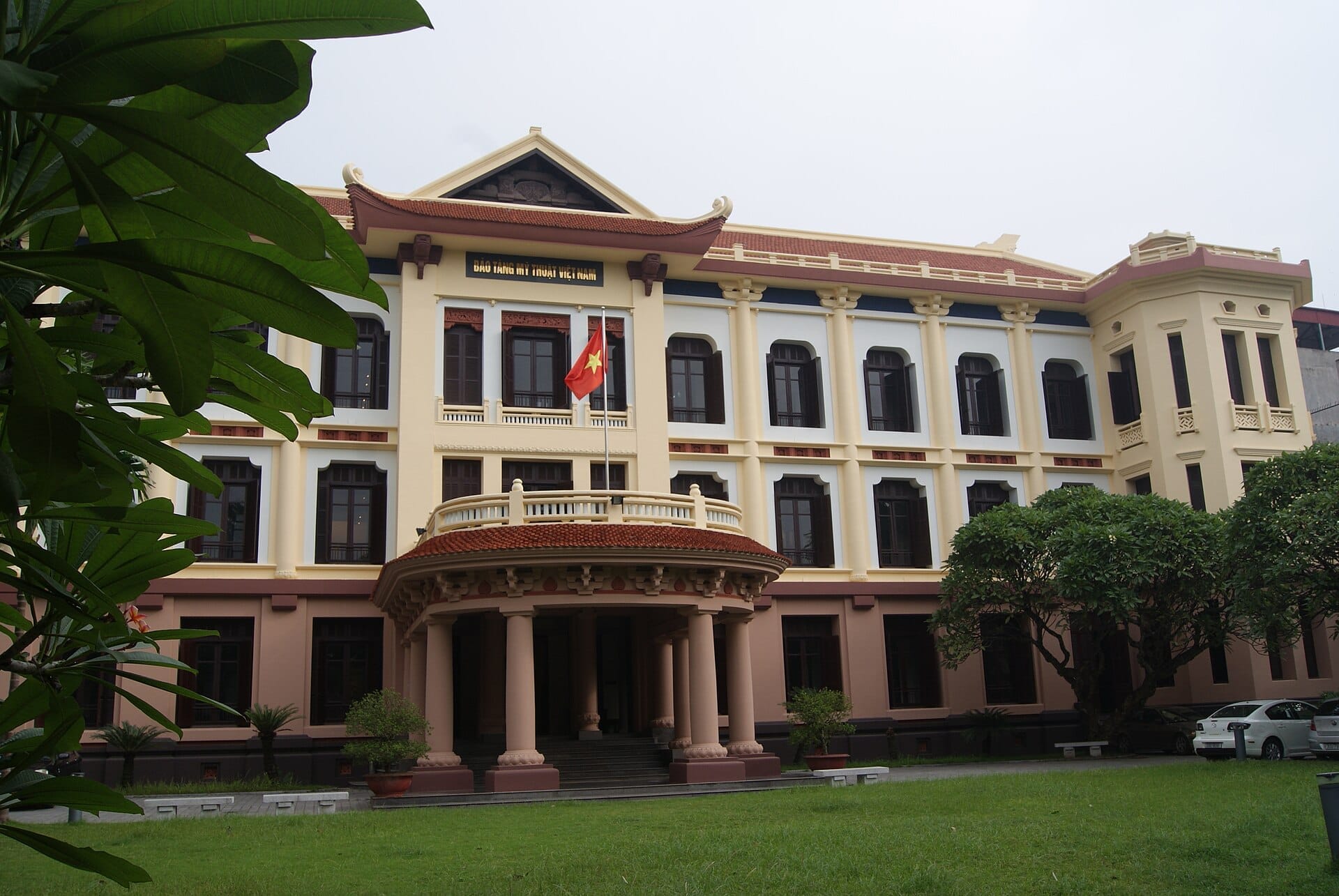
What the Vietnam Fine Arts Museum Actually Is
The Vietnam Fine Arts Museum (Bao Tang My Thuat Viet Nam) is the national home of Vietnamese visual art, and it is the best single building in Hanoi for understanding how the country sees itself through creative expression. The collection spans prehistoric bronze-age artefacts, Cham sculpture, Buddhist iconography from the 11th to 18th centuries, revolutionary propaganda painting from the war years, and contemporary works that grapple with modern Vietnamese identity. It is broad, sometimes uneven, and occasionally overwhelming, but there is nothing else like it in the city.
The museum occupies a three-storey French colonial building constructed in 1937, originally used as a boarding school for the daughters of colonial administrators. The architecture itself is worth pausing over: ochre-yellow facades, shuttered louvred windows, and internal staircases with iron balusters that creak softly underfoot. The building was converted into a museum in 1966 and has been expanded modestly over the decades without losing its period character.
💡 Local tip
Arrive before 9:30 AM on weekday mornings and you will often have entire galleries to yourself. Tour groups tend to arrive between 10 AM and noon, and the narrow stairwells can feel cramped when a group moves through.
The Permanent Collection: What to Prioritise
The ground floor focuses on ancient and folk art, including terracotta figures from the Dong Son culture, stone Cham reliefs, and wooden Buddhist sculptures of striking scale. The large Quan Am (Goddess of Mercy) statue from the Boc Hai Pagoda, dating to the 18th century, is one of the most reproduced images in Vietnamese art history and looks even more commanding in person. The gilded lacquer finish catches the light differently depending on where you stand.
The upper floors move through the modern period, covering the French-influenced Indochina Fine Arts School era of the 1920s-40s, wartime art from both the resistance against French colonialism and the American war period, and post-Doi Moi contemporary work from the 1990s onward. The propaganda paintings and wartime sketches made in the field by artist-soldiers are some of the most historically significant pieces in the building. They are small, raw, and done on whatever paper was available, and they carry a weight that polished gallery pieces rarely achieve.
The lacquerware and silk painting galleries are where many international visitors spend the most time, largely because these techniques are uniquely Vietnamese and produce effects that do not photograph well. Lacquer paintings layer up to 30 coats of resin with embedded eggshell, gold leaf, and pigment, creating surfaces with depth that shifts under different light angles. If you have no prior exposure to Vietnamese lacquerware, this collection will recalibrate your understanding of what the medium can do.
ℹ️ Good to know
Photography is permitted throughout most of the museum without flash. A few individual pieces have restrictions, marked with signage. The museum does not strictly enforce a no-tripod rule, but space in the galleries is limited.
Tickets & tours
Live prices and dates from our booking partner. If you book, we may earn a commission at no extra cost to you.
8-day all-inclusive trip in Vietnam from Hanoi
From 904 €Instant confirmationFree cancellation5 days-4 nights all-inclusive trip in Vietnam
From 493 €Instant confirmationFree cancellation12-day all-inclusive trip in Vietnam and Cambodia from Hanoi
From 1.195 €Instant confirmationFree cancellationHa Noi Vietnamese water puppet show and buffet dinner
From 72 €Instant confirmationFree cancellation
How the Experience Changes by Time of Day
Morning visits, especially on weekdays, offer the most contemplative experience. The building is cool in the early hours, which matters considerably in Hanoi's humid summers. Natural light enters the upper galleries through tall shuttered windows, and the quality of that diffuse light is genuinely flattering to the silk and lacquer works. By late morning, the entrance hall picks up noise from groups, and the acoustics of the tiled floors amplify conversation.
Afternoons are quieter again after around 2 PM, once tour groups have moved on to lunch. The late afternoon light, particularly in the western-facing rooms, shifts to a warmer tone that changes how the lacquerware reads. If you are a photographer or someone who responds strongly to light, an afternoon visit to those specific galleries is worth planning around.
The museum closes early by international standards, so afternoon visits need to be timed carefully. Do not arrive expecting to walk in at 4:30 PM and have a full experience. Plan for the last entry well before closing.
The Building and Its Surroundings
The museum sits on Nguyen Thai Hoc Street in Ba Dinh, a district that carries a different character from the compressed energy of the Old Quarter or Hoan Kiem. The streets here are wider, shaded by large tropical trees, and lined with walled compounds and French-era villas. Walking to the museum from the Temple of Literature, which is less than five minutes away on foot, gives a sense of this quieter, more composed side of Hanoi.
The neighbourhood context matters. Ba Dinh is the administrative and historical heart of the capital, home to the Ho Chi Minh Mausoleum, the One Pillar Pagoda, and the Imperial Citadel of Thang Long. Visitors who combine the Fine Arts Museum with one or two of these sites in a single half-day will get a layered picture of Vietnamese culture that no single attraction provides alone.
The courtyard garden at the museum's entrance is small but pleasant, with benches and a few ceramic planters. It is a useful spot to decompress before or after a long gallery session. On cooler days, visitors sit here to read the printed gallery maps, which are available in English and several other languages at the ticket desk.
Practical Walkthrough: Getting In and Getting Around
The main entrance is on Nguyen Thai Hoc Street. Tickets are purchased at a small counter just inside the gate. The staff at the entrance speak basic English and can provide a floor map. Audio guides in English are available for hire, though the quality is inconsistent and some rooms are not well covered. A printed label system accompanies most major works, with English descriptions that range from thorough to minimal.
The building has three main floors connected by staircases. There is limited elevator access, and the internal layout can feel maze-like on the upper floors where exhibition rooms branch off in multiple directions. Budget ten minutes at the start to orient yourself with the map rather than wandering and doubling back. The ground floor folk and ancient art rooms are the most logically sequenced. Upper floors require more self-direction.
The museum has a small gift shop near the exit selling reproduction prints, postcards, and a limited range of art books. The book selection skews toward Vietnamese-language titles, but a few English catalogues on lacquerware and Vietnamese silk painting are usually available and are worth picking up if you want to understand what you have seen more deeply.
⚠️ What to skip
The building is not fully air-conditioned. In July and August, upper floor galleries can become uncomfortably warm by midday. Wear lightweight clothing and bring water. The ground floor stays cooler due to thick colonial-era walls.
Who This Museum Is Not For
Visitors expecting the curatorial polish of large international museums may find some galleries feel dated, with inconsistent labelling and display cases that have not been updated in years. This is not a reflection of the quality of the works themselves, but the presentation does require more active engagement from the visitor than a hands-off stroll through. If you need context served up efficiently, the audio guide helps but does not fully compensate for the gaps.
Families with young children under age six will find little to hold their attention here unless they are unusually patient. The museum lacks interactive elements and the layout is not child-friendly in terms of flow. For a more engaging family option in the area, the Vietnam Museum of Ethnology offers outdoor exhibits and more tactile displays that work better for younger visitors.
Travellers on a one-day Hanoi schedule who are trying to cover multiple major landmarks may find this museum competes too heavily for time. It is not a 30-minute pass-through. The collection rewards attention, and rushing through it produces a less satisfying experience than skipping it entirely and returning on another day.
Photography and Accessibility Notes
The diffuse natural light in most galleries makes this a better photography location than many Hanoi museums, which rely on harsh overhead lighting. The lacquerware and silk paintings are the most challenging subjects to capture accurately, as their key qualities, the depth and sheen, require controlled conditions to photograph well. Smartphone cameras with computational photography modes tend to over-process the reflective surfaces. Manual exposure and a polarising filter, if you are shooting with a mirrorless camera, produce significantly better results.
Accessibility for visitors with mobility limitations is uneven. The ground floor is manageable with a wheelchair or mobility aid, but the upper floors require stair access. The narrow staircases are not equipped with lifts in the older sections of the building. Visitors with significant mobility challenges should contact the museum in advance to understand what sections are accessible on a given visit.
Insider Tips
- The ground floor folk art section contains some of the most overlooked works in the building. Most visitors move through it quickly on the way to the upper floors, but the collection of wooden communal house carvings and ceramic funeral figures from the 2nd century BC onward repays careful attention.
- Ask at the ticket desk whether any temporary exhibitions are running. The museum hosts rotating shows of contemporary Vietnamese artists that are often not listed on external booking sites and can be the most current work you will see in Hanoi.
- The museum is within a 5-minute walk of the Temple of Literature. Combine the two sites in a single morning, starting at the Fine Arts Museum when it opens and moving to the Temple of Literature as the museum crowd builds.
- If you are interested in purchasing Vietnamese lacquerware or silk painting as a souvenir, visiting the museum before shopping gives you a calibrated sense of quality. The contrast between what genuine craft looks like and what is sold in tourist shops becomes immediately clear.
- The museum's courtyard faces west, which makes it a surprisingly pleasant spot to sit in the late afternoon shade after 4 PM, even if you are not going inside. The street outside is also a good vantage point for photographing the colonial facade without crowds.
Who Is Vietnam Fine Arts Museum For?
- Art lovers who want to understand Vietnamese visual culture beyond what shops and street art reveal
- History-focused travellers interested in wartime documentation and the country's artistic response to conflict
- Visitors on a second or third trip to Hanoi who have covered the main historical sites and want more depth
- Photographers looking for interiors with strong natural light and complex textural subjects
- Anyone seeking a genuine break from the heat and noise of the Old Quarter in a calm, uncrowded setting
Nearby Attractions
Other things to see while in Ba Đình:
- Ba Đình Square
Ba Dinh Square is the largest public square in Vietnam and the site where Ho Chi Minh read the Declaration of Independence on September 2, 1945. Flanked by the Ho Chi Minh Mausoleum, the Presidential Palace, and One Pillar Pagoda, it remains the symbolic and political core of the nation. For visitors, it is a place of solemn atmosphere, grand scale, and layered history that rewards those who understand what they are looking at.
- Hanoi Botanical Garden
Tucked inside the Ba Dinh district, the Hanoi Botanical Garden is one of the city's oldest green spaces, offering a calm counterpoint to the surrounding monuments and government buildings. It draws early-morning joggers, families on weekends, and travelers who want a breather between major sights.
- Ho Chi Minh Mausoleum
The Ho Chi Minh Mausoleum in Hanoi's Ba Dinh district is one of the most significant political and historical sites in Vietnam. This guide covers the full visitor experience: the solemn atmosphere, strict entry rules, best visiting times, and the broader complex of monuments surrounding it.
- Ho Chi Minh Museum
The Ho Chi Minh Museum in Hanoi's Ba Dinh district is one of Vietnam's most significant political and cultural institutions, dedicated to the life and legacy of the country's founding leader. Housed in a striking modernist building near the Ho Chi Minh Mausoleum complex, it offers a dense, sometimes challenging, but genuinely illuminating window into 20th-century Vietnamese history. If you approach it with patience and curiosity, it rewards both.
Planning a trip? Discover personalized activities with the Nomado app.