Ba Dinh Square: The Heart of Vietnamese History in Hanoi
Ba Dinh Square is the largest public square in Vietnam and the site where Ho Chi Minh read the Declaration of Independence on September 2, 1945. Flanked by the Ho Chi Minh Mausoleum, the Presidential Palace, and One Pillar Pagoda, it remains the symbolic and political core of the nation. For visitors, it is a place of solemn atmosphere, grand scale, and layered history that rewards those who understand what they are looking at.
Quick Facts
- Location
- Ba Dinh District, Hanoi, Vietnam
- Getting There
- City bus lines serving Ba Dinh District; Grab taxi recommended from Old Quarter (approx. 10–15 min)
- Time Needed
- 1–3 hours (longer if visiting the Mausoleum and surrounding monuments)
- Cost
- Free to enter the square; Mausoleum and some adjacent sites have separate entry requirements
- Best for
- History, architecture, photography, cultural understanding
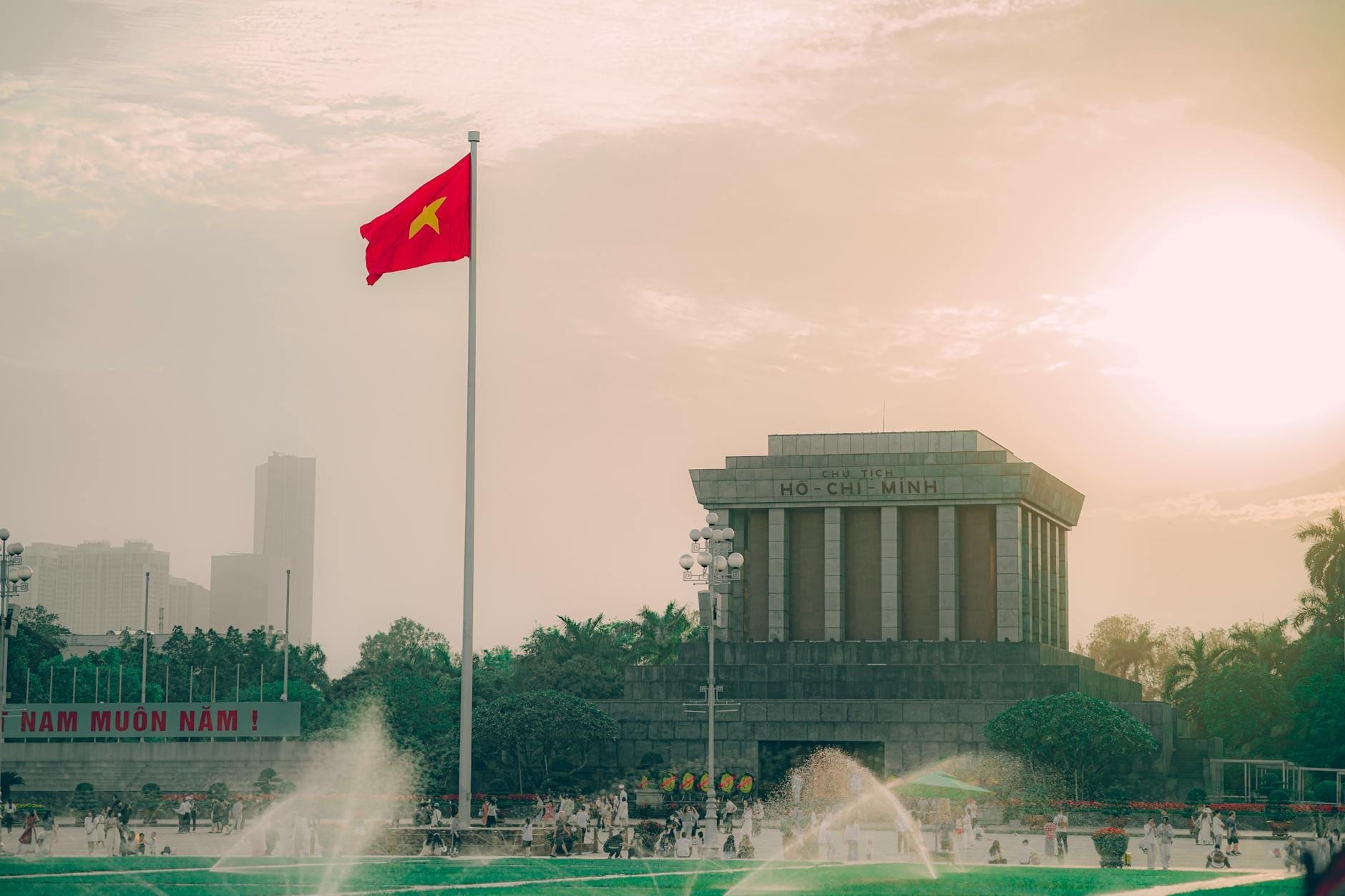
What Ba Dinh Square Actually Is
Ba Dinh Square is not a tourist attraction in the conventional sense. There are no ticket booths at the entrance, no audio guides for sale, and no souvenir stalls along the perimeter. What you find instead is a vast, carefully maintained open space covering roughly 320,000 square meters, framed by trimmed grass lawns, orderly flower beds, and the kind of institutional silence that comes from years of ceremonial use.
The square sits in the Ba Dinh District of Hanoi, the political heart of the country. On one side stands the Ho Chi Minh Mausoleum, a severe granite structure built in the Soviet monumental style, completed in 1975. Behind it is the Presidential Palace, a colonial-era yellow building originally constructed by the French in 1906. To the southwest, a short walk away, is the One Pillar Pagoda, one of Vietnam's most photographed religious structures. These are not merely nearby attractions: they are part of the same civic composition, and Ba Dinh Square is the anchoring center of it.
ℹ️ Good to know
The square is open to the public at all times, but the surrounding monuments have restricted hours. The Ho Chi Minh Mausoleum is closed on Mondays and Fridays, and for several months each year when Ho Chi Minh's remains are sent to Russia for preservation. Verify current schedules before planning your visit.
The Historical Weight of This Ground
On September 2, 1945, Ho Chi Minh stood at a wooden podium in this square and read Vietnam's Declaration of Independence to an estimated 500,000 people. The speech drew directly from the American Declaration of Independence, opening with the same assertion of universal human rights before turning to the specific case of Vietnam's liberation from French colonial rule. That moment is considered the founding act of the Democratic Republic of Vietnam, and the square has carried that symbolic weight ever since.
The name Ba Dinh itself predates 1945 by decades. It refers to three villages in the Thanh Hoa province that were sites of fierce anti-colonial resistance in the late 19th century, a reference chosen deliberately to connect the modern independence movement to earlier Vietnamese resistance. Understanding this adds a layer of meaning to the square that a casual walk across it would not reveal.
Today the square is the site of major national ceremonies, including National Day on September 2nd each year, when military parades and official gatherings draw large crowds and heavy security. The rest of the year it functions as a formal public space, with morning walkers, groups of schoolchildren on field trips, and international visitors making the circuit of the surrounding monuments. If you're planning the broader political and cultural zone, the nearby Ho Chi Minh Mausoleum and Ho Chi Minh Stilt House are best visited as part of the same half-day.
Tickets & tours
Live prices and dates from our booking partner. If you book, we may earn a commission at no extra cost to you.
Bai Dinh Pagoda and Trang an Eco-Tourism Full Day Tour
From 31 €Instant confirmationFree cancellationBai Dinh Pagoda, Mua Cave and Trang An Guided Tour with Buffet Lunch
From 36 €Instant confirmationFree cancellationNinh Binh day tour with Bai Dinh, Trang An and Hang Mua from Hanoi
From 41 €Instant confirmationFree cancellationBai Dinh Pagoda and Trang An Guided Tour with Buffet Lunch
From 48 €Instant confirmationFree cancellation
What the Square Looks and Feels Like at Different Times of Day
Early morning, roughly 6 to 8 a.m., is when Ba Dinh Square shows its most human side. Local residents walk the perimeter paths, some doing slow tai chi or stretching exercises on the grass margins. The light at this hour is soft and flat, coming in low from the east, and the granite facade of the Mausoleum takes on a warmer tone than it shows in midday photographs. The air still carries the coolness of the night, and the square feels genuinely quiet: a rarity this close to central Hanoi.
By mid-morning, tour groups begin arriving in organized clusters. The dynamic shifts: guides hold up small flags and count heads, and the lawns become dotted with visitors photographing the Mausoleum from the flagpole end of the square. The flag pole at the southern end of the square, standing 25 meters high, is a useful orientation point. Flags are raised and lowered here with formal ceremony, typically aligned with sunrise and sunset.
Midday is uncomfortable in the warmer months. The square has almost no shade, and the combination of open granite paving and direct sun can make the space feel harsh between 11 a.m. and 2 p.m. from May through August. Wear light, breathable clothing and bring water. In the cooler months between October and February, midday is actually the most pleasant time to linger.
💡 Local tip
October through early December offers the best combination of manageable temperatures and clear skies over the square. April and May are also good, though occasional brief showers are possible.
The Surrounding Monuments: How to Organize Your Visit
Most visitors approach the square complex from the southeastern corner, arriving via Hung Vuong Street or from the direction of the Old Quarter. The logical route is to cross the square toward the Mausoleum, then move around the back of it to access the Presidential Palace gardens, the Ho Chi Minh Stilt House, and the Ho Chi Minh Museum. Each of these has its own entry logistics and, in some cases, separate fees.
The One Pillar Pagoda sits just southwest of the Mausoleum and takes less than ten minutes to see. It is a small wooden pagoda constructed on a single stone pillar rising from a pond, originally built in 1049 during the Ly dynasty. The current structure is a 1955 reconstruction built after French forces destroyed the original on their withdrawal from Hanoi. It is easy to appreciate quickly but carries a disproportionate amount of historical and religious significance.
The Ho Chi Minh Museum nearby takes 45 to 60 minutes if you follow the exhibits properly. The interior is an unusual combination of documentary photography, revolutionary artifacts, and abstract art installations meant to represent historical periods. It is denser in content than many visitors expect.
Architecture and Physical Layout
The square itself is a formal rectangular space oriented roughly north to south. The grass sections are divided by straight paved paths, and the overall effect is of deliberate order: this is ceremonial landscape design, not a park. The trees along the edges are mostly mature and provide partial shade along the walking paths, though the central areas remain exposed.
The Mausoleum building dominates the northern edge. Its design, completed by Soviet architects, uses a tiered granite base topped by a colonnade of square pillars, all in grey stone. It is imposing rather than beautiful, which is precisely the point: it was designed to project permanence and state authority. The building houses Ho Chi Minh's embalmed body, which is displayed in a glass case in a darkened interior chamber. Visitors who enter must follow strict rules: no shorts, no sleeveless tops, no photography inside, no talking, and movement is kept to a slow, single-file pace.
For architectural contrast, the broader Ba Dinh District also contains the Imperial Citadel of Thang Long, a UNESCO World Heritage Site just a short walk to the south. The juxtaposition of a thousand-year-old citadel complex against the Soviet-era Mausoleum within the same neighborhood gives Ba Dinh a compressed historical range that few districts in any city can match.
Photography, Practical Notes, and Who Should Skip This
Photography is permitted throughout the open square. The Mausoleum is the obvious subject, and it photographs cleanly in the morning light from the flagpole end, with the full facade visible and no backlight. The surrounding lawns, flag, and symmetrical paths create a formal composition that works well in wide-angle shots. Inside the Mausoleum, cameras and phones must be fully stowed.
Dress code is enforced at the Mausoleum and strongly advisable across the entire complex as a matter of respect. Covered shoulders and knees are the minimum requirement. The square itself has no dress enforcement, but visitors arriving in beachwear or very casual clothing sometimes receive redirecting comments from guards near the Mausoleum entrance.
Accessibility to the open square is generally straightforward, with flat paved paths throughout. The Mausoleum interior involves some steps and narrow corridors; verify current accessibility provisions before visiting if this is a concern.
⚠️ What to skip
If you are visiting specifically to enter the Mausoleum, check closure dates in advance. It is open mornings only, Tuesday-Thursday and Saturday-Sunday; closed on Mondays and Fridays, and for several months each year when Ho Chi Minh's remains are sent abroad for preservation. Arriving without checking can mean finding the main building closed.
Travelers looking purely for street life, food markets, or sensory energy will find Ba Dinh Square austere. The atmosphere here is formal and quiet, not lively. If you want the more kinetic side of Hanoi, the Dong Xuan Market or the Old Quarter offer a completely different register. Ba Dinh Square suits those who come prepared with some historical context; without it, the scale can feel empty rather than significant.
Insider Tips
- Arrive at the square by 7 a.m. on a weekday to see the flag-raising ceremony and experience the space at its calmest, with local residents rather than tour groups.
- The Presidential Palace grounds are often overlooked. The colonnaded yellow building, built by the French as the Governor-General's residence, is not open to the interior, but the garden path alongside it is one of the more peaceful walks in this part of Hanoi.
- If you plan to enter the Mausoleum, bring a small bag you can seal completely. Guards require all items to be stowed and checked, and loose items like open bags or dangling accessories can cause delays at the security checkpoint.
- The square is at its most dramatic photographically from the southern flagpole end in early morning light, looking north toward the Mausoleum. This angle is also the least crowded before 9 a.m.
- National Day on September 2nd transforms the square entirely, with ceremonies, crowds, and security perimeters that restrict normal access. Unless you are specifically interested in the official commemoration, avoid visiting on this date — come a few days before or after instead.
Who Is Ba Đình Square For?
- History travelers who want to understand the political foundations of modern Vietnam
- Architecture enthusiasts interested in Soviet monumental design and French colonial buildings in close proximity
- First-time visitors to Hanoi building a foundational understanding of the country's 20th-century history
- Photographers working in the early morning hours before tour groups arrive
- Travelers combining the square with the broader Ba Dinh cultural zone in a single half-day itinerary
Nearby Attractions
Other things to see while in Ba Đình:
- Hanoi Botanical Garden
Tucked inside the Ba Dinh district, the Hanoi Botanical Garden is one of the city's oldest green spaces, offering a calm counterpoint to the surrounding monuments and government buildings. It draws early-morning joggers, families on weekends, and travelers who want a breather between major sights.
- Ho Chi Minh Mausoleum
The Ho Chi Minh Mausoleum in Hanoi's Ba Dinh district is one of the most significant political and historical sites in Vietnam. This guide covers the full visitor experience: the solemn atmosphere, strict entry rules, best visiting times, and the broader complex of monuments surrounding it.
- Ho Chi Minh Museum
The Ho Chi Minh Museum in Hanoi's Ba Dinh district is one of Vietnam's most significant political and cultural institutions, dedicated to the life and legacy of the country's founding leader. Housed in a striking modernist building near the Ho Chi Minh Mausoleum complex, it offers a dense, sometimes challenging, but genuinely illuminating window into 20th-century Vietnamese history. If you approach it with patience and curiosity, it rewards both.
- Ho Chi Minh's Stilt House
Tucked within the Presidential Palace compound in Hanoi's Ba Dinh district, Ho Chi Minh's Stilt House is a two-story wooden structure where Vietnam's founding leader chose to live and work from 1958 until his death in 1969. Deliberately modest against the backdrop of a French colonial palace, it offers a rare, intimate look at the man behind the nation.
Planning a trip? Discover personalized activities with the Nomado app.