Hoa Lo Prison, Hanoi: The Full Visitor Guide to the 'Hanoi Hilton'
Hoa Lo Prison is one of Hanoi's most historically layered sites, built by French colonial authorities in the 1880s and later used to hold American prisoners of war during the Vietnam War. A visit here is not comfortable — it is not supposed to be. But for travelers serious about understanding Vietnam's 20th century, it is essential.
Quick Facts
- Location
- 1 Hoa Lo Street, Hoan Kiem District, Hanoi
- Getting There
- 10-15 min walk from Hoan Kiem Lake; Grab taxi or xe om from Old Quarter
- Time Needed
- 1.5 to 2.5 hours
- Cost
- Verify current admission price at the entrance; reduced rate for children — verify current prices at the gate
- Best for
- History travelers, those interested in colonial and Cold War-era Vietnam, independent visitors
- Official website
- hoalo.vn
What Is Hoa Lo Prison and Why Does It Matter?
Hoa Lo Prison sits on a short street in the Hoan Kiem district, a few blocks southwest of Hoan Kiem Lake, surrounded by modern office towers and a glass-fronted skyscraper that now occupies most of its original footprint. What remains is roughly one-third of the original complex. The site's history spans two distinct chapters: French colonial control from the late 19th century through 1954, and the Vietnam War era when American pilots — including Senator John McCain — were held here. The facility's sardonic nickname, the 'Hanoi Hilton,' was coined by American POWs.
The French colonial administration built the prison beginning in 1886 and completed it in 1896, designed to house political prisoners and Vietnamese independence activists. Its walls, originally over four meters high, enclosed a compound intended for around 450 detainees. At its peak during the First Indochina War, the prison reportedly held well over 2,000 people. That story of overcrowding, resistance, and eventual Vietnamese revolution occupies the majority of the current museum space.
ℹ️ Good to know
Hoa Lo Prison Museum is open daily; confirm current hours at the entrance or via hoalo.vn. The site closes for a midday break in some sections — arriving before 11:00 AM gives you the most unhurried experience. Confirm current hours and admission fees at the entrance or via hoalo.vn before your visit.
Walking the Grounds: What You Will Actually See
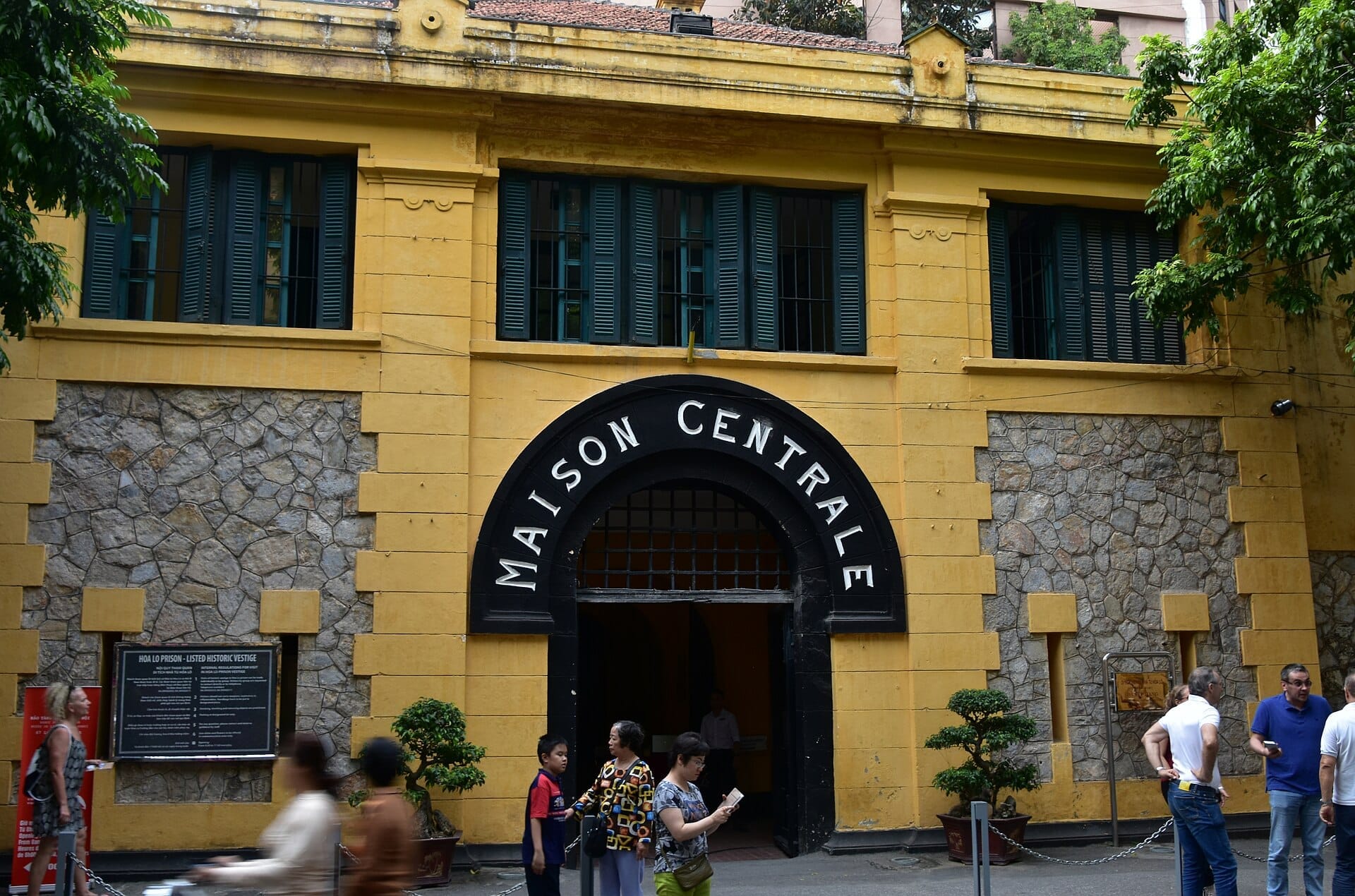
The entrance is understated. You pass through a narrow gate beneath a French-era archway and immediately enter a courtyard with thick stone walls on all sides. The air inside is noticeably cooler, partly from the stone mass and partly from the shade cast by the old perimeter wall. The sounds of Hanoi traffic fade within the first minute.
The ground floor holds the bulk of the French colonial era exhibits. You move through original cell blocks, some restored with period mannequins in prisoner poses, and display cases with leg irons, transport shackles, and documents from the colonial administration. The guillotine in the central hall, original and preserved in full, is the exhibit that stops most visitors mid-step. The placard beside it is factual and precise: it was used by the French colonial authorities to execute Vietnamese prisoners. Nothing about that exhibit is dramatized, and it does not need to be.
A separate wing covers the American POW period from the 1960s to 1973. The framing here is unambiguously from the Vietnamese government's perspective, presenting the period as humane treatment in contrast to claimed American aggression. Photographs show prisoners playing basketball, celebrating Christmas, and meeting with delegations. The tone is celebratory rather than neutral. Visitors familiar with POW accounts from American sources will notice the gap between those narratives and what the museum presents. Both sets of accounts exist, and neither should be uncritically accepted — but this is the version on display here, and it is worth engaging with rather than dismissing.
A display about John McCain includes his flight suit and personal items recovered after his capture. Whatever your political perspective, standing in front of those objects in the actual building where he was held carries weight.
Tickets & tours
Live prices and dates from our booking partner. If you book, we may earn a commission at no extra cost to you.
Time of Day and Crowd Patterns
The museum is busiest between 9:30 AM and 11:30 AM when tour groups arrive from Old Quarter hotels. If you visit during that window, the smaller cell corridors become genuinely cramped, which is partly fitting given the context, but it does make reading exhibit text difficult. Afternoons between 2:00 PM and 4:00 PM tend to be quieter, with fewer organized tour groups and more independent visitors.
Weekends see noticeably more local Vietnamese visitors, particularly families and school groups. This actually adds to the experience: watching Vietnamese teenagers engage with exhibits about their grandparents' generation, in a space that carries that much political and emotional weight, tells you something you won't find in any guidebook.
💡 Local tip
Arrive before 9:00 AM if you want near-empty corridors. The low morning light that filters through the barred upper windows in the original cell blocks is also the best natural light for photography.
Historical and Architectural Context
The prison was constructed using Vietnamese labor under French authority, designed by French architects to mirror the Maison Centrale prison typology common in French colonial territories. The original compound covered about 12,908 square meters. What you visit today is the northwest corner, preserved after most of the structure was demolished in the 1990s to make way for Hanoi Towers, the commercial complex now adjacent to the site.
Among the Vietnamese prisoners held here were key figures in the independence movement, including several who later held prominent roles in the Democratic Republic of Vietnam government. The museum covers this with evident national pride, though the individual biographies of prisoners are presented with less granular detail than the colonial-era atrocities framing.
The prison's history connects directly to the broader story of Hanoi's transformation through the 20th century. If you want to understand the city's political geography before or after your visit, the Hanoi Old Quarter guide provides essential street-level context, while the Imperial Citadel of Thang Long covers a longer arc of Hanoi's history as a seat of power.
Practical Walkthrough: What to Prepare
The museum is fully covered and requires no particular physical fitness. Shoes with grip are useful because some corridor floors are uneven stone, worn smooth over a century. There is no dress code requirement, but a modest cover-up is respectful given the gravity of the space. The site is partially wheelchair accessible in its main corridors, though some narrower cell areas are not.
Exhibit text is in Vietnamese and English throughout. Audio guides may be available for rent at the entrance — confirm availability on site. Photography is permitted in most areas. Flash is frowned upon near textile and paper artifacts but is not formally restricted.
Hoa Lo Prison is in the Hoan Kiem district, roughly 800 meters from Hoan Kiem Lake. You can walk from the lake in about 10 to 12 minutes. The prison is also close to several French Quarter landmarks, making it an easy addition to a half-day circuit covering colonial-era Hanoi. For a full picture of getting around the city without a guide, see the getting around Hanoi guide.
⚠️ What to skip
The museum presents Vietnamese government-curated history. The American POW section in particular reflects an official narrative that diverges significantly from Western historical accounts. Come informed, engage critically, and treat the exhibits as one important layer of a complex story rather than a complete picture.
Who Should Visit — and Who Might Skip It
Hoa Lo Prison is not a feel-good attraction. There is no scenic courtyard, no pleasant garden, and no moment where the subject matter lightens. The guillotine, the leg irons, the cramped cell reconstructions, and the weight of knowing what happened in these rooms — all of it accumulates. For travelers who engage seriously with history, particularly colonial history and Cold War geopolitics, this is among the most affecting sites in Hanoi.
Travelers with young children may want to consider carefully. The exhibits are graphic in places, and the emotional register of the space is heavy. Older children who have some context about colonial history or the Vietnam War may find it a meaningful experience, but it is not suited to very young visitors.
If you are building a broader itinerary that includes Hanoi's significant political and historical sites, pair Hoa Lo with the Ho Chi Minh Mausoleum in Ba Dinh district and the Vietnam Museum of Ethnology for a layered understanding of how Vietnam presents its own history. For a full itinerary plan, the Hanoi itinerary guide can help you sequence these sites efficiently.
Insider Tips
- The underground escape tunnel exhibit is easy to miss — it is behind a door that most visitors walk past without noticing. Ask staff to point it out, or look for the low-lit corridor near the back of the colonial section.
- The guillotine room can feel rushed when tour groups are moving through. If you arrive independently, you can stand there for five minutes without being hurried. Do.
- The gift shop sells reproductions of colonial-era propaganda posters and documentary books in English. The books are reasonably priced and add context you won't absorb in a single visit.
- Bring water. There is no café or refreshment stand inside the compound, and Hanoi's heat and humidity make even a covered site tiring by midday.
- If you read French, some of the original colonial administration documents on display are partially legible through the glass cases and offer details the English translation boards summarize only briefly.
Who Is Hoa Lo Prison For?
- History travelers interested in colonial-era Southeast Asia and the Vietnam War
- Independent visitors who want to engage critically with political narratives
- Photographers working on documentary or travel editorial projects
- Travelers building a full-day itinerary around Hanoi's French colonial heritage
- Anyone who has read American POW accounts and wants to see the physical counterpart
Nearby Attractions
Other things to see while in Hoàn Kiếm:
- Hoàn Kiếm Lake
Hoàn Kiếm Lake sits at the geographical and spiritual heart of Hanoi, framed by willow trees, red-painted bridges, and centuries of legend. Free to visit any time, the lake rewards early risers with morning exercise rituals and evening walkers with lantern-lit reflections.
- Ngoc Son Temple
Ngoc Son Temple occupies a small island at the northern end of Hoan Kiem Lake, connected to the shore by the iconic red The Huc Bridge. One of Hanoi's most visited religious sites, it blends Taoist and Confucian traditions in a setting that feels genuinely calm despite its central location. This guide covers what to expect inside, when crowds thin out, and how to make the visit count.
- Thang Long Water Puppet Theatre
Thang Long Water Puppet Theatre brings a folk art tradition dating back over 1,000 years to life on a waist-deep pool beside Hoan Kiem Lake. Performances run multiple times daily and combine puppetry, live traditional music, and Vietnamese mythology into a 50-minute show unlike anything else in the country.
Planning a trip? Discover personalized activities with the Nomado app.