Ngoc Son Temple: Hanoi's Island Shrine on Hoan Kiem Lake
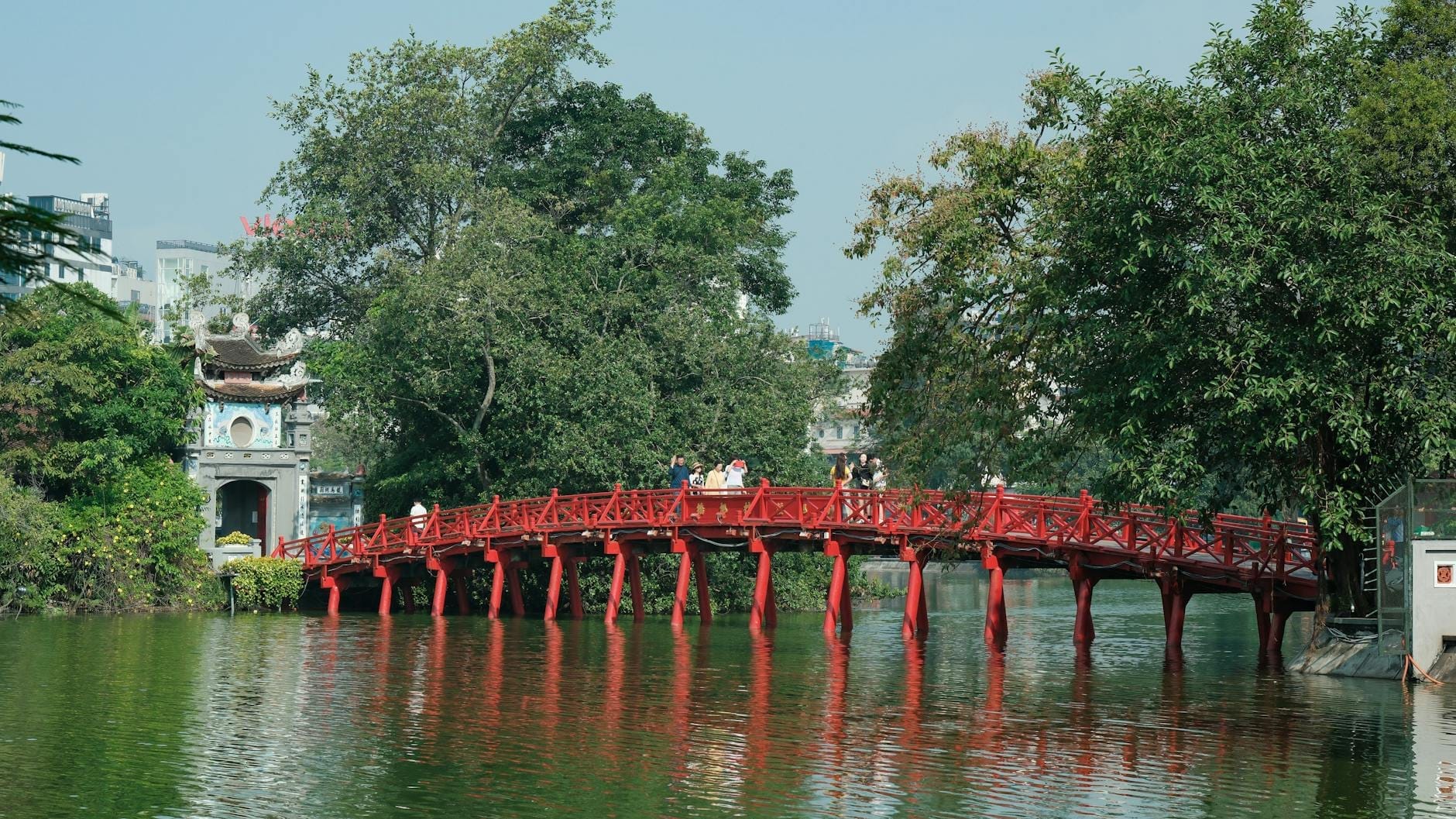
Ngoc Son Temple occupies a small island at the northern end of Hoan Kiem Lake, connected to the shore by the iconic red The Huc Bridge. One of Hanoi's most visited religious sites, it blends Taoist and Confucian traditions in a setting that feels genuinely calm despite its central location. This guide covers what to expect inside, when crowds thin out, and how to make the visit count.
Quick Facts
- Location
- Dinh Tien Hoang Street, Hoan Kiem District, Hanoi
- Getting There
- 10-minute walk from the Old Quarter; Grab or taxi to Hoan Kiem Lake is quickest from further out
- Time Needed
- 45 minutes to 1.5 hours
- Cost
- 30,000 VND per adult; verify current rate at the gate
- Best for
- History lovers, photography, early morning lakeside walks, cultural immersion
What Ngoc Son Temple Actually Is
Ngoc Son Temple, whose name translates to Temple of the Jade Mountain, stands on a small island called Jade Island in the northern section of Hoan Kiem Lake. The red wooden bridge that leads to it, called The Huc (meaning where morning sunlight rests), curves slightly over the water and has become one of the most photographed structures in Hanoi. The temple itself is relatively compact, but what it lacks in size it makes up for in atmosphere and historical layering.
The site honors several figures: Van Xuong, the Taoist god of literature; Quan Vu, a general deified in Chinese folk religion; and La To, patron saint of physicians. But the most culturally significant dedication is to Tran Hung Dao, the 13th-century Vietnamese military commander who repelled Mongol invasions three times. His presence here is not ceremonial. For Vietnamese visitors, especially older generations, paying respects at Ngoc Son carries real weight.
ℹ️ Good to know
The temple is an active place of worship, not a museum set piece. You will often encounter locals burning incense, leaving offerings, or praying quietly. Move respectfully and keep voices low inside the main halls.
The Bridge, the Gate Tower, and First Impressions
Before you reach the bridge, you pass through a small ceremonial area with the Pen Tower (Thap But) and Ink Slab (Dai Nghien), stone structures built in the 19th century to symbolize the importance of scholarship. The Pen Tower is a stone obelisk topped with a brush pointed skyward. It is easy to walk past quickly, but pausing here gives you a sense of the intellectual aspirations layered into this site from the beginning.
The Huc Bridge, painted a deep vermillion red, was originally built in 1865 and has been reconstructed since. It arches gently over the lake water and is wide enough for people to pass in both directions without feeling crowded, except at peak times. In the early morning, when mist sometimes sits low over Hoan Kiem Lake and the light is soft, the bridge genuinely looks the way it does in photographs. By midday, the combination of harsh sunlight and tourist foot traffic changes the mood considerably.
💡 Local tip
Arrive before 8:00 AM if you want the bridge and lake views to yourself. The surrounding lakeside path fills with joggers, elderly residents doing tai chi, and families from around 6:30 AM onward, giving the whole area a quiet, communal energy that disappears once tour groups arrive.
Tickets & tours
Live prices and dates from our booking partner. If you book, we may earn a commission at no extra cost to you.
Noi Bai International Airport Fast Track Service with SIM Card Option
From 25 €Instant confirmationFree cancellationPrivate full-day trip from Hanoi to Halong Bay with boat cruise
From 59 €Instant confirmationFree cancellationNinh Binh day tour with Hoa Lu, Trang An and Hang Mua from Hanoi
From 39 €Instant confirmationFree cancellationHalong Bay 3 days and 2 nights on boat cruise from Hanoi
From 438 €Instant confirmationFree cancellation
Inside the Temple Grounds
The temple complex is made up of several interconnected halls and courtyards. After crossing The Huc Bridge, you enter through the Dac Nguyet (Catch the Moonlight) gate and move into the first courtyard. The air inside is thick with incense smoke, and the smell clings to your clothes. It is not unpleasant, but it is persistent. The courtyards are narrow and shaded by old trees, which keeps the temperature noticeably lower than the open lakeside.
The main altar halls are decorated with lacquered wooden panels, gilded statues, and offerings of fruit and flowers. The lighting inside is dim, supplemented by candles and incense sticks. You are allowed to photograph inside most areas, but flash photography near the altars is inappropriate and will draw disapproving looks. The statuary is detailed and worth examining closely: the figure of Tran Hung Dao, housed in the rear hall, is particularly striking in scale.
One of the unexpected highlights is the preserved specimen of a giant softshell turtle on display in a glass case. Hoan Kiem Lake is famous for the legend of the restored sword, in which a divine turtle reclaimed a magical sword from the 15th-century king Le Loi. The last known living specimen of this species in the lake died in 2016, and the preserved turtle on display weighs over 200 kilograms. It is a genuinely remarkable object, and many visitors who come expecting a standard temple tour are startled to find it.
Historical and Cultural Context
Ngoc Son Temple was established in the 18th century, though the site has older roots. The current layout and structures date largely to an 1865 renovation commissioned by the scholar Nguyen Van Sieu, who also added The Huc Bridge. The temple's hybrid Taoist-Confucian character reflects the religious syncretism common in northern Vietnamese urban worship. It sits within the broader cultural geography of Hoan Kiem District, the historical and administrative heart of Hanoi, where temples, colonial architecture, and street commerce have coexisted for centuries.
Understanding the temple means understanding Hoan Kiem Lake. The lake itself, whose name means Lake of the Restored Sword, is tied to the foundational myth of the Le dynasty's legitimacy. For Hanoians, the lake and temple are not tourist infrastructure. They are civic and spiritual landmarks. The Hoan Kiem Lake shoreline on weekends becomes a pedestrian zone, and the area around Ngoc Son transforms into something closer to a public commons than a heritage site.
How the Experience Changes by Time of Day
Early morning, between 7:00 and 9:00 AM, is when the temple draws mostly local worshippers. The incense smoke is freshest, the light through the courtyard trees is golden-green, and the overall mood is meditative. If you attend on a weekend, the lakeside road is closed to traffic from Friday evening through Sunday night, so you approach entirely on foot across a quiet, open promenade.
By 10:00 AM, tour groups begin arriving. The bridge becomes a bottleneck, and the courtyard fills up quickly. The experience does not become unpleasant, but the contemplative quality evaporates. Midday visits in summer are also hot: the stone surfaces absorb heat, and there is limited shade inside the compound. Bringing water is advisable.
Late afternoon, around 4:00 to 5:30 PM, offers a second window of relative calm. The light becomes warmer and more flattering for photography. Fewer tour groups operate at this hour, though individual visitors are still present. The temple closes in the early evening, so confirm closing time at the entrance, as hours can shift slightly by season.
⚠️ What to skip
Avoid visiting during Lunar New Year (Tet) unless you specifically want to experience the festival atmosphere. The temple and surrounding lake area become extremely crowded, and lines to cross The Huc Bridge can stretch back significantly. It is meaningful to witness, but not a comfortable visit.
Practical Information: Getting There, Dress Code, and Accessibility
Ngoc Son Temple is located on the eastern side of Hoan Kiem Lake, a short walk from the southern edge of the Old Quarter. Most visitors on foot from Hoan Kiem Street or Dinh Tien Hoang Street will see the Pen Tower and entrance gate without needing directions. Grab motorcycle taxis are the fastest option from further away and cost very little for a short hop.
Dress modestly: covered shoulders and knees are appropriate and expected. The temple is an active religious site, and while enforcement is not strict at the entrance, entering the inner halls in beachwear or very short shorts is disrespectful. Lightweight trousers or a sarong work well and are practical given the incense smoke.
The bridge and temple grounds involve some uneven stone surfaces and a few steps. There is no elevator or ramp access. For visitors with significant mobility limitations, the exterior view of the bridge and island from the lakeside path is itself a worthy experience and requires no entry fee.
Is It Worth Your Time?
Ngoc Son Temple is one of the most visited sites in Hanoi for good reason. It is compact, historically rich, and set in a location, Hoan Kiem Lake, that merits a visit regardless. The entry fee is modest, the walk is easy, and the preserved turtle alone is genuinely surprising. If you are building a day around the lake area, combining the temple with a walk along the lakeside, a stop at a nearby café, and a look at the Old Quarter Night Market in the evening makes for a coherent and rewarding itinerary.
Those who may not get much from the visit include travelers with very limited time who need to prioritize larger or more immersive sites, such as the Vietnam Museum of Ethnology or the Imperial Citadel of Thang Long. The temple is small, and if religious architecture is not a particular interest, forty minutes is probably the ceiling before you have seen everything. It is not overhyped, but it is also not a half-day destination on its own.
Insider Tips
- The pedestrian weekend zone around Hoan Kiem Lake runs Friday evening to Sunday night. If your visit falls on a weekend, come in the evening when street performers, food vendors, and local families fill the lakeside. The temple itself will be closed by then, but the atmosphere around it is entirely different from a weekday morning.
- Look up at the roofline inside the courtyards. The carved wooden beams and decorative ridge tiles are among the most detailed elements of the complex, and most visitors walk past without noticing them.
- The preserved giant softshell turtle is in a side hall that some visitors miss entirely. Ask at the entrance if you are unsure where it is located; it is part of the standard included visit.
- Photography from the lakeside opposite the island, especially from the southern end of the lake near Dinh Tien Hoang Street, gives you the clearest full view of the temple, bridge, and Tortoise Tower together. This angle is better for photographs than anything taken on the bridge itself.
- If you plan to combine the temple with other sites in the Ba Dinh area, such as the Ho Chi Minh Mausoleum, note that those sites have stricter dress requirements and earlier closing times. Plan Ngoc Son first and head west afterward.
Who Is Ngoc Son Temple For?
- First-time visitors to Hanoi wanting an accessible introduction to Vietnamese religious architecture
- Photographers looking for iconic Hanoi imagery in a compact, walkable setting
- History and mythology enthusiasts interested in the Le dynasty and the legend of the restored sword
- Travelers who enjoy observing everyday local life alongside heritage sites
- Anyone building a half-day loop around Hoan Kiem Lake and the Old Quarter
Nearby Attractions
Other things to see while in Hoàn Kiếm:
- Hoa Lo Prison
Hoa Lo Prison is one of Hanoi's most historically layered sites, built by French colonial authorities in the 1880s and later used to hold American prisoners of war during the Vietnam War. A visit here is not comfortable — it is not supposed to be. But for travelers serious about understanding Vietnam's 20th century, it is essential.
- Hoàn Kiếm Lake
Hoàn Kiếm Lake sits at the geographical and spiritual heart of Hanoi, framed by willow trees, red-painted bridges, and centuries of legend. Free to visit any time, the lake rewards early risers with morning exercise rituals and evening walkers with lantern-lit reflections.
- Thang Long Water Puppet Theatre
Thang Long Water Puppet Theatre brings a folk art tradition dating back over 1,000 years to life on a waist-deep pool beside Hoan Kiem Lake. Performances run multiple times daily and combine puppetry, live traditional music, and Vietnamese mythology into a 50-minute show unlike anything else in the country.
Planning a trip? Discover personalized activities with the Nomado app.