Hanoi Ceramic Mosaic Mural: Walking the World's Longest Ceramic Artwork
The Hanoi Ceramic Mosaic Mural runs for 3.85 kilometres along the embankment roads bordering the Old Quarter, recognised by Guinness World Records as the longest ceramic mosaic mural on earth. Created to mark Hanoi's 1,000th anniversary in 2010, it tells the city's history in fired clay and coloured tile — and it's completely free to experience on foot.
Quick Facts
- Location
- Red River dyke from Van Kiep to Nghi Tam streets, Old Quarter, Hanoi
- Getting There
- Closest bus stops on Tran Nhat Duat St; Hoan Kiem Lake is a 5-10 min walk from the southern end
- Time Needed
- 45 minutes (highlights) to 2.5 hours (full length)
- Cost
- Free — no ticket required
- Best for
- Art lovers, photographers, history enthusiasts, and slow walkers who want Old Quarter context without museum crowds
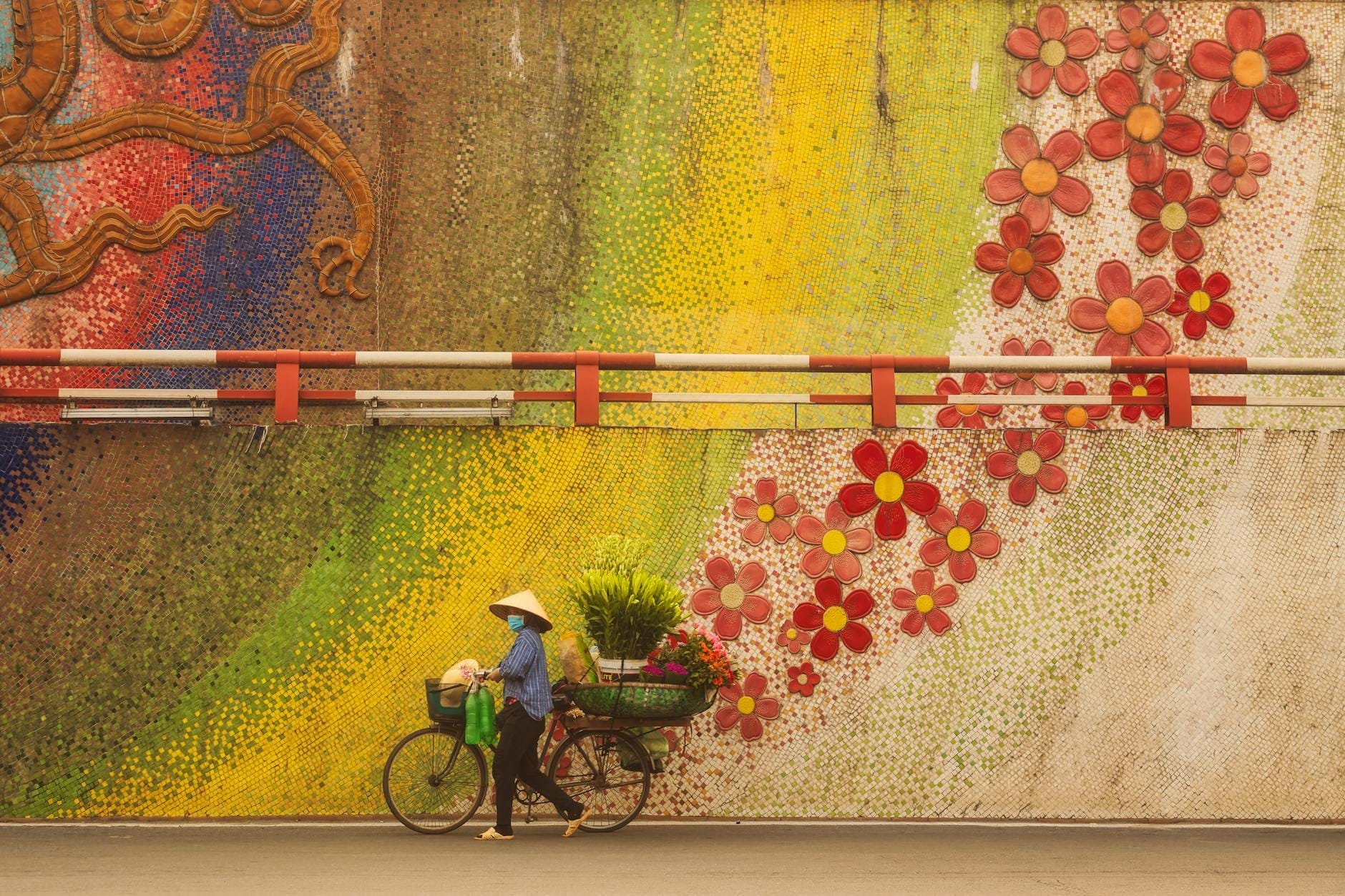
What the Hanoi Ceramic Mosaic Mural Actually Is
The Hanoi Ceramic Mosaic Mural is a continuous outdoor artwork that stretches 3.85 kilometres along the outer face of the flood-defence dyke walls running parallel to the Red River. Completed in 2010 to celebrate the 1,000th anniversary of Thang Long, Hanoi's ancient founding name, it was recognised by Guinness World Records as the longest ceramic mosaic mural in the world at the time of its completion. The project brought together Vietnamese artists, international collaborators, and local schoolchildren, all contributing panels across a series of distinct thematic sections.
Unlike a gallery installation, this is street-level public art. The mural sits directly alongside one of the city's busiest commuter roads, so you experience it with motorbikes threading past, vendors selling fruit from bicycle baskets, and the particular low-hanging morning haze that settles over this part of the city near the river. It is not precious. It was built to be part of Hanoi's daily life — and for the most part, it has become exactly that.
💡 Local tip
Start at the Tran Nhat Duat end near Hoan Kiem Lake and walk north toward Yen Phu. The panels become progressively older in theme as you walk away from the lake, finishing near Tay Ho district with prehistoric and ancient Vietnamese imagery.
The Art Itself: Themes, Styles, and What to Look For
The mural is divided into several thematic sections, each handled by a different group of artists or institutions. The sections closest to Hoan Kiem Lake tend to depict Hanoi's 20th-century urban history, including French colonial streetscapes, wartime imagery, and scenes of post-reunification daily life. The ceramic fragments here are tightly packed, with detailed facial expressions and architectural line work pressed into smooth tile.
Further north, the imagery shifts to older Vietnamese folklore and rural life. You'll find rice paddies, water buffalo, village festivals, and Dong Son-era bronze drum motifs rendered in earth tones. These panels have a rougher texture — deliberately so. The ceramic pieces are larger and less uniform, which gives the surface a tactile quality quite different from the polished southern sections.
Several panels were contributed by foreign embassies and diplomatic missions, adding unexpected stylistic variety: some sections carry a distinctly East European mosaic sensibility, while others reference Japanese lacquer painting techniques. This is one of the mural's genuine strengths as an artwork: you are reading a conversation between different hands across a single wall.
The section near Long Bien Bridge is worth specific attention. The imagery here includes the bridge itself during the wartime bombing campaigns, depicted in dark blues and fractured tiles — an unusually raw piece of visual history in an otherwise celebratory project.
Tickets & tours
Live prices and dates from our booking partner. If you book, we may earn a commission at no extra cost to you.
Private full-day trip from Hanoi to Halong Bay with boat cruise
From 59 €Instant confirmationFree cancellationNinh Binh day tour with Hoa Lu, Trang An and Hang Mua from Hanoi
From 39 €Instant confirmationFree cancellationHalong Bay 3 days and 2 nights on boat cruise from Hanoi
From 438 €Instant confirmationFree cancellationHanoi Walking Street Food Tour with Train-Street Visit
From 28 €Instant confirmationFree cancellation
How the Experience Changes by Time of Day
Early morning, from around 6am to 8am, is the most atmospheric time to walk this stretch. The dyke road fills with Hanoi residents doing morning exercises: badminton games played without nets, groups of older women doing synchronised tai chi, and joggers looping back and forth. The mural becomes a backdrop to actual daily life rather than a tourist spectacle. The light at this hour is soft and flat, which actually helps photography — the ceramic colours read more accurately without harsh midday shadows.
By mid-morning, tour groups begin appearing at the southern end. They tend to cluster near the most photogenic panels close to Hoan Kiem and rarely walk the full length, so the northern sections remain calm throughout the day. Midday sun creates harsh reflections off glazed tile surfaces, which makes detailed photography difficult and the walk itself quite hot from April through September.
In the late afternoon, especially after 4pm, the road gains a different energy. School children pass by on bicycles. Street food carts set up near the wider pavement sections. The light becomes warm and directional, picking out the relief texture of the ceramic pieces in ways that flat midday light completely misses. This is the best time for photography if you can tolerate the increased foot and motorbike traffic.
⚠️ What to skip
Sections of the mural have suffered vandalism, weathering, and incomplete repairs over the years. Some panels near the northern end show missing tiles, faded grout, or replacement sections in noticeably different ceramic colours. Manage expectations: this is a working public wall, not a museum-preserved installation.
Historical and Cultural Context
The mural project was conceived as a civic statement for Hanoi's millennium celebrations in 2010. The city of Thang Long, which evolved into the modern capital of Ha Noi, was officially established in 1010 under Emperor Ly Thai To when he moved the Vietnamese capital from Hoa Lu. The mural's thematic arc was designed to tell that entire span of history: from pre-historic settlements along the Red River delta through the Ly, Tran, and Le dynasties, across the French colonial period, through independence and war, and into the contemporary city.
This historical sweep gives the mural a kind of compressed educational function. Walking it in full is roughly comparable to skimming an illustrated history of Vietnam, though visitors with deeper interest in the dynastic period will get more from a visit to the Imperial Citadel of Thang Long or the Vietnam Museum of Ethnology, both of which provide scholarly context that the mural's format cannot.
The use of ceramics as a medium is culturally deliberate. Hanoi has deep historical ties to ceramic production: the nearby village of Bat Trang, just a few kilometres down the Red River, has been producing fired pottery and decorative ceramics for over 600 years. Incorporating ceramic tile into a monumental public artwork places the mural within that tradition, even as its scale and ambition are thoroughly modern.
If the ceramics tradition interests you, a half-day trip to Bat Trang Ceramic Village pairs naturally with a mural walk.
Practical Walkthrough: How to Do This Right
The mural runs along the outer dyke wall, which means it faces away from the river. The road between you and the wall carries steady two-way motorbike and car traffic, with pavement widths that vary considerably. Some sections have a wide, comfortable footpath directly in front of the panels. Others narrow to barely a metre, with motorbikes passing uncomfortably close. Comfortable shoes are essential; the pavement surface is uneven in places.
There is no single entrance point. You can join the mural at any point along Tran Nhat Duat, Tran Quang Khai, or Yen Phu streets. If you want to walk the full route without backtracking, the most logical approach is to take a Grab ride or taxi to the Yen Phu end near Tay Ho district and walk south toward Hoan Kiem Lake, finishing with coffee or a meal in the Old Quarter. This direction also means you end near more amenities.
The southern terminus near Hoan Kiem is the natural connection to the rest of the Old Quarter. From the end of the mural, Hoan Kiem Lake is a short walk west, and the Dong Xuan Market area is easily reachable on foot.
ℹ️ Good to know
Wheelchair and pushchair access is limited. The pavement is uneven in several sections, and there are no dedicated crossing points along much of the route. Those with mobility concerns should focus on the wider, better-maintained stretch between Tran Nhat Duat and Tran Quang Khai.
Photography Tips and Honest Limitations
The mural is one of Hanoi's more photographable public spaces, but it requires thought. The main challenge is that the wall is long and linear, running parallel to the road. Standard wide-angle shots from directly in front of a panel are flat and lose the scale. For better results, look for sections where the mural curves slightly, use a moderate telephoto to compress the depth of the wall, or find panels where a strong vertical subject (a tree, a lamppost, a local resident) can anchor the foreground.
Macro photography works exceptionally well here. Individual ceramic fragments, the grout lines between pieces, and the play of shadow over relief surfaces produce images that communicate texture far better than wide establishing shots. If you are shooting on a smartphone, portrait mode against a panel can isolate colour and detail in ways that standard mode misses.
Be honest with yourself about what the mural does not offer: there is no dramatic single viewpoint, no iconic framing that compresses the entire piece into one image. Its power is cumulative, felt over the full distance of the walk. Visitors who expect a single Instagram-ready scene will find it underwhelming. Those willing to spend an hour paying attention will find considerably more.
Insider Tips
- The Long Bien Bridge section (roughly mid-mural) contains some of the most historically charged imagery. Look for the panel depicting the 1972 bombing, rendered in cracked dark blue tile. It is easy to walk past — stop and read it.
- On weekend mornings between roughly 6am and 8am, the dyke road hosts informal badminton and exercise groups. The mural essentially becomes a community park backdrop. This is the most authentically Hanoian version of the experience.
- Several panels near the Yen Phu northern end show water damage and tile loss that has not been fully repaired. If condition matters to you, concentrate on the Tran Nhat Duat and Tran Quang Khai sections, which have been better maintained.
- There are no food or drink stalls directly along most of the mural. Carry water, especially if walking during warmer months between April and September. The walk generates more sun exposure than most Old Quarter itineraries.
- The mural is best understood as a companion to, not a replacement for, Hanoi's history museums. Use it to orient yourself visually before visiting the Imperial Citadel or Museum of Ethnology — the recurring dynastic symbols will start to feel familiar.
Who Is Hanoi Ceramic Mosaic Mural For?
- Architecture and public art enthusiasts who want to understand how cities use space to narrate history
- Photographers looking for textured, colour-rich subjects away from the more crowded central tourist sites
- Slow travellers with a half-day to fill who want exercise, fresh air, and cultural content in one route
- History-curious visitors who want a visual introduction to Vietnamese history before visiting formal museums
- Families with older children who can engage with the narrative panels and handle a longer walk
Nearby Attractions
Other things to see while in Old Quarter:
- Đồng Xuân Market
Đồng Xuân Market is the largest and oldest covered market in Hanoi's Old Quarter, operating since 1889. A wholesale hub by day and a street food destination by night, it rewards visitors who know what they're looking for.
- Hanoi Old Quarter Night Market
Every Friday, Saturday, and Sunday evening, the streets around Hang Dao in Hanoi's Old Quarter close to traffic and fill with market stalls, street food vendors, and live folk performances. It's the most accessible snapshot of local weekend culture in the city center, though knowing what you're walking into makes the difference between an enjoyable evening and an overwhelming one.
- Long Bien Bridge
Long Bien Bridge is one of Hanoi's most historically loaded landmarks, a steel cantilever structure built by the French at the turn of the 20th century that has survived two wars, countless floods, and decades of daily use. Walking across it offers a perspective on Hanoi that few other spots can match: wide Red River views, the drone of motorbikes and bicycles, and a direct line into the city's layered past.
- Saint Joseph's Cathedral
Saint Joseph's Cathedral is Hanoi's oldest Catholic church and one of the city's most striking pieces of colonial-era architecture. Built in the 1880s on the southern edge of the Old Quarter, it draws visitors with its twin bell towers, French Gothic detailing, and the lively square that surrounds it morning to night.
Planning a trip? Discover personalized activities with the Nomado app.