Temple of Literature, Hanoi: What to See, Know, and Expect
Built in 1070 and functioning as Vietnam's first national university for nearly 700 years, the Temple of Literature is one of Hanoi's most historically significant sites. Five walled courtyards of classical Vietnamese architecture hold centuries of scholarly tradition, stone doctoral stelae, and gardens that reward slow exploration.
Quick Facts
- Location
- Quoc Tu Giam Street, Dong Da District, Hanoi
- Getting There
- Grab or taxi from the Old Quarter (10-15 min). No metro stop; bus routes 02, 23, and 41 stop nearby.
- Time Needed
- 1.5 to 2.5 hours for a thorough visit
- Cost
- Approximately 30,000 VND for adults; reduced rate for children. Verify current pricing at the gate.
- Best for
- History enthusiasts, architecture lovers, photographers, families with older children
What the Temple of Literature Actually Is
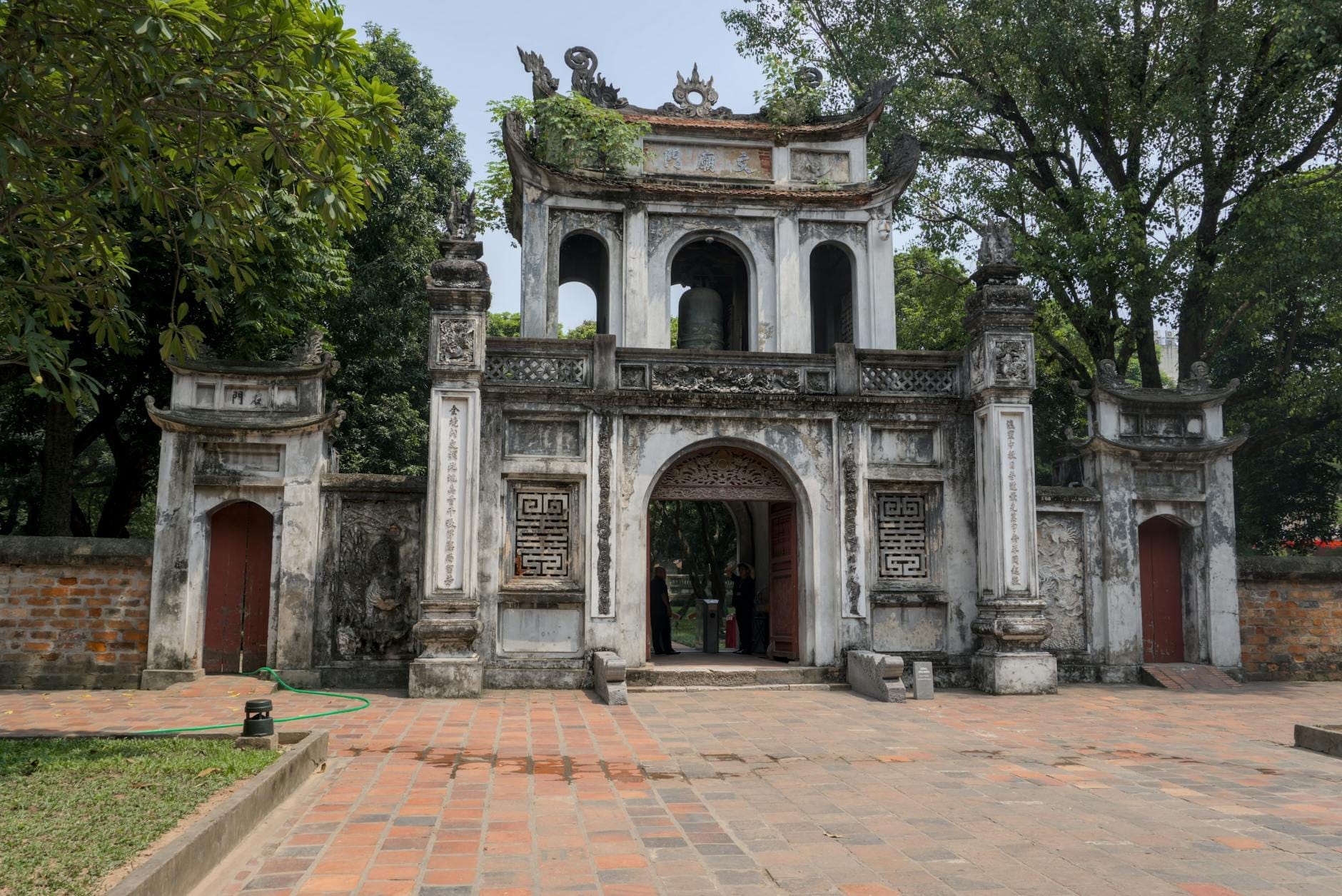
The Temple of Literature (Van Mieu – Quoc Tu Giam) is not a functioning religious site in the conventional sense. It operates today as a museum and heritage complex, but its original purpose was academic: founded in 1070 under Emperor Ly Thanh Tong, it was dedicated first to Confucius and later became the site of Vietnam's first national university, the Imperial Academy, established in 1076. For approximately 700 years, the academy trained Vietnam's mandarins, scholars, and court officials.
The compound covers roughly 54,000 square meters and is organized into five successive walled courtyards, each more restricted than the last during its operating years. What visitors experience now is a layered site: part Confucian temple, part scholarly monument, and part quiet garden in the middle of a capital city.
ℹ️ Good to know
The Temple of Literature is one of the few major Hanoi attractions that requires no loud caveats about crowds or disappointment. The site is genuinely well-maintained, historically substantial, and large enough that it rarely feels overwhelmed, even during peak tourism hours.
Moving Through the Five Courtyards
Entry is through the Great Portico gate on Quoc Tu Giam Street. The first two courtyards are essentially formal gardens, planted with frangipani and old banyan trees whose roots have buckled the stone paths in places. These areas feel transitional: you hear street traffic fade, the light shifts under the canopy, and the temperature drops a degree or two. It is a deliberate architectural decompression.
The third courtyard centers on the Well of Heavenly Clarity, a square reflecting pond flanked by two pavilions. This is the most-photographed section of the complex and for good reason: the pond surface mirrors the surrounding gates and tile rooftops, especially in morning light when the water is still. Arrive before 9am and the reflection is near-perfect. By mid-morning, tour groups are active and the calm dissipates.
The fourth courtyard holds the Temple of Confucius and the Great House of Ceremonies. The architecture here is distinctly Vietnamese rather than imitative of Chinese models: curved rooflines with ceramic ridge decorations, dark lacquered wooden interiors, and incense smoke threading through carved lattice screens. Visitors can look inside but typically cannot enter the inner sanctum. The smell of incense is constant and noticeably stronger in this section.
The fifth and final courtyard contains the Imperial Academy buildings, reconstructed after French colonial-era demolition. The reconstruction is acknowledged on-site; the buildings are new but built using traditional techniques, and the courtyard functions now as a small interpretive museum about the academy's history and the examination system that governed Vietnamese intellectual life for centuries.
Tickets & tours
Live prices and dates from our booking partner. If you book, we may earn a commission at no extra cost to you.
Noi Bai International Airport Fast Track Service with SIM Card Option
From 25 €Instant confirmationFree cancellationPrivate full-day trip from Hanoi to Halong Bay with boat cruise
From 59 €Instant confirmationFree cancellationNinh Binh day tour with Hoa Lu, Trang An and Hang Mua from Hanoi
From 39 €Instant confirmationFree cancellationHalong Bay 3 days and 2 nights on boat cruise from Hanoi
From 438 €Instant confirmationFree cancellation
The Doctoral Stelae: The Most Important Detail Most Visitors Rush Past
Flanking the third courtyard are 82 stone stelae, each mounted on a stone tortoise. These record the names, places of origin, and results of royal examinations held between 1442 and 1779, covering over 1,000 doctoral graduates. They are among the most significant historical documents in Vietnam and were inscribed on UNESCO's Memory of the World Register in 2010.
Most visitors photograph the turtles and move on. Slowing down here pays off. The inscriptions are in classical Chinese characters, but the information boards in English and Vietnamese give enough context to make the stelae meaningful rather than decorative. Notice that some turtles show significant wear on the heads: for generations, students rubbed them before examinations for luck, a practice that was eventually restricted to protect the stones.
💡 Local tip
The stelae are listed under UNESCO's Memory of the World, not UNESCO World Heritage. The distinction matters: the site itself does not have World Heritage status, though it is a candidate. Avoid repeating the common inaccuracy that the whole complex is a UNESCO World Heritage Site.
How the Experience Changes by Time of Day
Early morning visits, particularly between 8am and 9:30am, offer the compound at its most atmospheric. The gardens are damp, birds are audible, and the handful of visitors present tend to be local or slow-traveling. Incense from the morning offering in the fourth courtyard is freshest at this hour.
Between 10am and noon, school groups arrive in significant numbers, particularly on weekdays. Vietnamese students visit on organized excursions, which creates a lively atmosphere but can make the stelae area and temple interiors congested. If you are visiting primarily for photography or quiet reflection, avoid this window.
Late afternoon, roughly 3:30pm to closing, is an underrated window. Crowds thin, the light turns golden and rakes across the courtyard tiles at a low angle, and the staff begin preparations for closing in a routine that itself feels like part of the site's daily rhythm. The gardens are at their most tranquil.
⚠️ What to skip
The Temple of Literature is a popular venue for Vietnamese graduation photoshoots, especially between May and July. On weekends during this period, expect large groups in formal dress throughout the courtyards. It is photogenic in its own way but does affect the contemplative atmosphere.
Practical Notes for Visiting
The complex is located in the Dong Da area of Hanoi, southwest of the Ba Dinh district, and is straightforward to reach by ride-hailing app from anywhere in the center. Walking from Hoan Kiem takes roughly 25-30 minutes through interesting residential streets, which is worth doing once if the weather cooperates.
Dress codes are not strictly enforced at the entrance but the fourth courtyard, housing the temple to Confucius, is an active place of reverence for many Vietnamese visitors. Covering shoulders and knees is appropriate and respectful. The site is outdoors for the most part; in Hanoi's summer heat (June to August), the tree canopy provides partial shade but the stone courtyards radiate heat by late morning. Carry water.
Accessibility is limited. The courtyards are connected by raised stone thresholds and the paths are uneven in places. Wheelchair access is partial, and the narrow gates between courtyards present obstacles. The site does not advertise full accessibility and the physical layout of a 1,000-year-old monument makes retrofitting difficult.
Audio guides are available for rent at the entrance and provide substantially more detail than the on-site English signage. For travelers combining the Temple with the broader area, the Ho Chi Minh Mausoleum and One Pillar Pagoda are within a 15-minute ride and make a logical half-day pairing.
Photography at the Temple of Literature
The site is extremely photogenic but rewards patience over speed. The third courtyard's reflecting pond works best in still morning conditions. The carved wooden architecture of the fourth courtyard needs a fast lens or a raised ISO: the interiors are dim and flash photography feels intrusive and is generally discouraged near the altar areas.
The stelae in late afternoon light develop strong shadows that make the inscriptions visually dramatic. Wide-angle lenses handle the courtyard scales well; a short telephoto is useful for isolating architectural details in the roof ridges and carved eave brackets. Tripods are not prohibited but are cumbersome in crowded sections.
Honest Assessment: Is It Worth the Time?
For most visitors with a genuine interest in history, architecture, or Vietnamese culture, yes, without qualification. The Temple of Literature is one of the few sites in Hanoi that delivers on both intellectual and visual terms. It does not require specialist knowledge to appreciate. That said, travelers seeking kinetic urban energy or commercial experiences will find it slow. The Dong Xuan Market or the Old Quarter will serve that appetite better.
The site is sometimes criticized for the volume of tour groups, which is a fair complaint during peak hours. The criticism is less fair when applied to early morning or late afternoon visits, when the compound genuinely offers something rare in a capital city: sustained quiet and a legible connection to deep history.
If your schedule allows, combine the visit with a walk to the Imperial Citadel of Thang Long to build a fuller picture of Hanoi's millennium of political and intellectual history. The two sites together take a full morning and cover complementary ground.
Insider Tips
- The ticket office opens at 8am. Arriving at opening gives you 30-40 minutes before the first tour buses arrive, which transforms the experience in the stelae courtyard and around the reflecting pond.
- The on-site bookshop near the fifth courtyard sells scholarly publications about the stelae and Vietnamese examination history. The English selections are limited but the illustrated editions on Van Mieu architecture are worth a look and make more meaningful souvenirs than the trinkets sold outside the main gate.
- Vietnamese families bring children here during Tet and before major school examinations to pray at the Confucius shrine. If your visit coincides with the pre-exam season (typically April to May), expect incense smoke to be heavier and the atmosphere noticeably more solemn.
- The exterior wall along Van Mieu Street is itself worth examining: the long ochre facade, broken by carved gates, gives a sense of the compound's scale from outside and provides good street-level photography without paying admission.
- Free Wi-Fi is available inside the compound, which is useful if you want to cross-reference historical information on the go rather than rely solely on the sometimes sparse English signage.
Who Is Temple of Literature For?
- Travelers with an interest in East Asian history, Confucian philosophy, or Vietnamese intellectual heritage
- Architecture enthusiasts drawn to classical Vietnamese construction techniques and ornamental detail
- Photographers looking for reflective surfaces, carved woodwork, and layered courtyard compositions
- Families with teenagers or older children who can engage with the examination history narrative
- Anyone visiting Hanoi for more than two days who wants depth beyond the Old Quarter circuit
Nearby Attractions
Other things to see while in Ba Đình:
- Ba Đình Square
Ba Dinh Square is the largest public square in Vietnam and the site where Ho Chi Minh read the Declaration of Independence on September 2, 1945. Flanked by the Ho Chi Minh Mausoleum, the Presidential Palace, and One Pillar Pagoda, it remains the symbolic and political core of the nation. For visitors, it is a place of solemn atmosphere, grand scale, and layered history that rewards those who understand what they are looking at.
- Hanoi Botanical Garden
Tucked inside the Ba Dinh district, the Hanoi Botanical Garden is one of the city's oldest green spaces, offering a calm counterpoint to the surrounding monuments and government buildings. It draws early-morning joggers, families on weekends, and travelers who want a breather between major sights.
- Ho Chi Minh Mausoleum
The Ho Chi Minh Mausoleum in Hanoi's Ba Dinh district is one of the most significant political and historical sites in Vietnam. This guide covers the full visitor experience: the solemn atmosphere, strict entry rules, best visiting times, and the broader complex of monuments surrounding it.
- Ho Chi Minh Museum
The Ho Chi Minh Museum in Hanoi's Ba Dinh district is one of Vietnam's most significant political and cultural institutions, dedicated to the life and legacy of the country's founding leader. Housed in a striking modernist building near the Ho Chi Minh Mausoleum complex, it offers a dense, sometimes challenging, but genuinely illuminating window into 20th-century Vietnamese history. If you approach it with patience and curiosity, it rewards both.
Planning a trip? Discover personalized activities with the Nomado app.