Linh Ung Pagoda (Marble Mountains): History, Access, and What to Expect
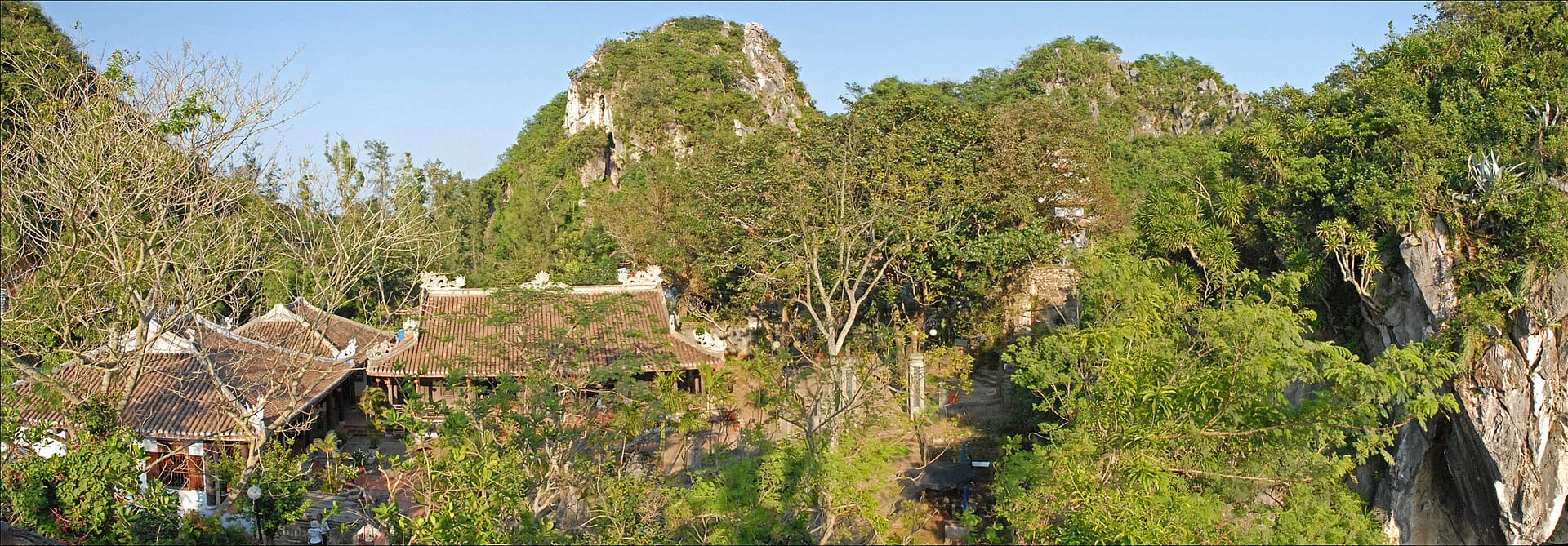
Founded in 1825–1826 during the Nguyen Dynasty and designated a national historical and cultural site, Linh Ung Pagoda sits on the eastern slope of Thuy Son (Water Mountain) within the Marble Mountains complex. It is older than its more famous namesake on Son Tra Peninsula and rewarding for anyone who has made the climb to explore the caves and terraces above.
Quick Facts
- Location
- Thuy Son (Water Mountain), 81 Huyen Tran Cong Chua St, Hoa Hai Ward, Ngu Hanh Son District, Da Nang
- Getting There
- Taxi or ride-hailing app from Da Nang city centre (~20–25 min); motorbike rental also common. Public buses run along Huyen Tran Cong Chua Street near the complex, but most visitors still arrive by taxi or motorbike.
- Time Needed
- 45–90 minutes for the pagoda and immediate surroundings; 2–3 hours if exploring all of Thuy Son
- Cost
- 40,000 VND/adult, free for children under 6 (Marble Mountains entrance covers the pagoda). Optional elevator: 15,000 VND one-way.
- Best for
- History enthusiasts, architecture lovers, travelers combining culture with the Marble Mountains cave circuit
What Is Linh Ung Pagoda at Marble Mountains?
Chùa Linh Ứng Ngũ Hành Sơn, known in English as Linh Ung Pagoda (Marble Mountains), occupies the eastern face of Thuy Son, the largest and most visited of the five marble-and-limestone outcrops that make up the Marble Mountains complex south of Da Nang. This is not the same pagoda as the celebrated Linh Ung on Son Tra Peninsula. The two share a name and the same Buddhist patronage, but this one is considerably older and carries the weight of imperial history.
The pagoda was first established in 1825–1826 under Emperor Minh Mang, a ruler of the Nguyen Dynasty, and was originally called Ung Chan. It was renamed Linh Ung by imperial edict in the mid-19th century during the reign of Emperor Thieu Tri, and gilded boards from both periods confirming its status as a national pagoda are still preserved on site. Vietnam's Ministry of Culture, Sports and Tourism has designated it a national historical and cultural site, placing it alongside a small number of religious structures in Da Nang with formal state recognition.
First-time visitors often underestimate how much there is to see at Marble Mountains before reaching the pagoda. If you are planning a full morning there, the Marble Mountains complex includes cave shrines, panoramic terraces, and stone-carving demonstrations at the base. Build the pagoda into a broader loop rather than treating it as a standalone stop.
Getting There and Getting In
The official entrance to Marble Mountains is at 81 Huyen Tran Cong Chua Street, Hoa Hai Ward, Ngu Hanh Son District. From central Da Nang, the drive takes roughly 20 to 25 minutes by taxi or ride-hailing app. Grab is the most reliable app-based option. Motorbike rental is popular with travelers who want flexibility for the surrounding area, including Non Nuoc Beach immediately to the east.
The Marble Mountains entrance ticket, priced at 40,000 VND for adults, covers access to the entire Thuy Son site including Linh Ung Pagoda. There is no separate charge for the pagoda. An elevator on the western side of the mountain costs 15,000 VND one way and deposits visitors partway up, saving the initial steep staircase climb. The elevator operates on the same hours as the general site. From the elevator exit, a network of paved and stone paths leads to the pagoda's main gate. Expect additional stair sections regardless of whether you use the elevator.
💡 Local tip
The elevator gets long queues in mid-morning, particularly when tour groups arrive. Use the stairs on the way up and the elevator on the way down, or arrive before 8:30 to avoid both issues.
Accessibility is limited. The combination of mountain terrain, irregular stone steps, cave passages, and steep descents makes the site unsuitable for wheelchair users and genuinely difficult for visitors with mobility issues. The elevator removes the main climb but does not resolve the internal path network. Comfortable closed-toe shoes with grip are strongly recommended; sandals are manageable for flat temple courtyards but problematic on the exposed stone approaches.
Tickets & tours
Live prices and dates from our booking partner. If you book, we may earn a commission at no extra cost to you.
Marble Mountains and Linh Ung Pagoda half-day tour
From 40 €Instant confirmationFree cancellationMarble Mountains and Linh Ung Pagoda guided tour
From 40 €Instant confirmationFree cancellationSpiritual Odyssey Tour to Linh Ung Pagoda, Marble Mountain and Hoi An
From 27 €Instant confirmationFree cancellationMarble Mountains and My Son sanctuary full-day tour with lunch
From 86 €Instant confirmationFree cancellation
The Pagoda Itself: Architecture and Atmosphere
Linh Ung Pagoda's main hall is positioned on a natural stone terrace on the eastern slope of Thuy Son, partially sheltered by the mountain's overhanging limestone face. The building follows traditional Vietnamese Buddhist temple architecture: a layered tiled roof with upturned eaves, heavy lacquered doors, and an interior organized around a central altar. The smell of incense is constant and thick, especially around the altar area where devotees leave offerings of fruit and flowers throughout the day.
The surrounding courtyard is compact but carefully arranged. Stone figurines, small auxiliary shrines, and potted ornamental trees fill the space between the main hall and the cliff face behind it. Looking up from the courtyard, the grey limestone of Thuy Son rises directly overhead, giving the pagoda an unusual quality of being simultaneously roofed by a building and by geology. The contrast between the refined lacquered woodwork inside and the rough, ancient stone outside is the defining visual of the site.
The pagoda is an active place of worship, not a museum. Morning visits between 7:00 and 9:00 are when Vietnamese Buddhist practitioners come to pray, and the atmosphere at those hours is markedly different from mid-morning when tour groups dominate. If you arrive early, you may hear chanting and bells from inside the main hall. The sound carries against the stone and adds a dimension that photographs cannot replicate.
ℹ️ Good to know
Modest dress is required. Shoulders and knees should be covered before entering the main hall. Sarongs are not provided at the entrance, so come prepared. Shoes are removed at the door.
How Conditions Change Through the Day
Early morning (7:00–9:00) is the most atmospheric window. Light enters the Marble Mountains complex at a low angle, catching the texture of the limestone and creating strong shadows across the stone paths. The pagoda courtyard is quiet, the incense smoke rises undisturbed, and you share the space with a small number of local worshippers rather than tour groups. The air is cooler, which matters considerably in the summer months when midday temperatures on exposed stone surfaces become punishing.
By 10:00 to 11:30, the site fills noticeably. Tour buses from Da Nang and Hoi An deliver groups in sequence, and the paths between the cave entrances and the pagoda become congested. The elevator queue extends significantly. This is still a functional time to visit, but the contemplative quality disappears. Afternoons see a second wave of independent travelers, and the light angle from the west can produce good photographic conditions on the pagoda's main facade from around 14:30 onward.
Weather is a material consideration. Da Nang's wet season runs broadly from September through February, with the heaviest rainfall in October and November. Wet stone paths on a hillside site are a genuine safety concern. The site remains open in rain, but visibility from the upper terraces is reduced and some paths become slippery. For the optimal combination of clear skies and manageable crowds, late March through May and September to early October are generally the most reliable windows.
Historical and Cultural Context
The Marble Mountains (Ngu Hanh Son, meaning Five Elements Mountains) have been a site of religious activity for centuries before the Nguyen Dynasty. The Cham people, who controlled central Vietnam before Vietnamese southward expansion, used the caves as Hindu sanctuaries. Some cave altars on Thuy Son show evidence of both Cham stone carving and later Vietnamese Buddhist additions, layers that speak to a complicated regional history compressed into a small area of marble and limestone.
The Nguyen Dynasty, which ruled from Hue and treated the Marble Mountains as a site of imperial significance, constructed and patronized Linh Ung alongside other religious structures on Thuy Son during the first half of the 19th century. The imperial boards preserved inside the pagoda are among the more tangible links to that period remaining in Da Nang. The site's national designation formalizes what local Buddhist communities have long recognized: this is one of the oldest continuously active religious sites in the city.
The Marble Mountains area is also the origin of Da Nang's stone-carving tradition. The village immediately adjacent to the complex, Non Nuoc Stone Carving Village, has been producing marble sculpture for generations and remains active. The sound of chisels on stone can occasionally be heard from the lower approaches to Thuy Son, a detail that connects the ancient sacred use of the site to a living craft industry.
Photography and Practical Walkthrough
The pagoda's main facade photographs well in morning light. The eastern orientation means direct sunlight hits the front of the building in the first two to three hours after opening. By mid-morning the facade falls into partial shade, which can work well for detail shots of the roof carvings and doorway. The courtyard is compact, so wide-angle lenses are more useful than telephoto for capturing the full architectural context with the cliff face behind it.
Inside the main hall, photography is generally tolerated but use judgment. During active worship or ceremonies, pointing a camera at devotees is inappropriate. The interior is dim and incense smoke diffuses light, which can produce interesting atmospheric images but requires some patience with exposure settings. Flash photography is best avoided.
Most visitors combine the pagoda with the cave circuit on Thuy Son, which includes Huyen Khong Cave and Tang Chon Cave, both of which contain Buddhist shrines and, in the case of Huyen Khong, a remarkable natural skylight opening in the cave ceiling. This broader circuit is well documented in the Da Nang mountains guide. เผื่อ at least two hours if you intend to do both the pagoda and the main caves without rushing.
⚠️ What to skip
The site closes around 17:30 (hours may vary by season). The elevator typically stops earlier than the gate. Do not underestimate the time needed to descend on foot; the stone stairs require care, particularly in the afternoon when surfaces warm and visitors are tired.
Practical Assessment: Is It Worth the Climb?
Linh Ung Pagoda at Marble Mountains is not the most visually spectacular temple in central Vietnam. The building itself is modest in scale compared to the large ceremonial pagodas in Hue. What makes it worth the effort is the combination of factors: a genuinely old building with documented imperial history, an unusual setting against the limestone cliff face, and the context of the broader Marble Mountains site that surrounds it.
Travelers who come specifically to see a grand temple will leave underwhelmed. Travelers who understand the site as one component of a half-day at Marble Mountains, integrated with the caves, the terraces, and the views over Non Nuoc Beach to the east, are almost always satisfied. The pagoda adds cultural depth to what would otherwise be a purely geological attraction.
If you are traveling with children, the cave circuit holds more immediate appeal than the pagoda, but the two are easily combined. The broader Da Nang with kids guide covers how to pace this kind of mixed cultural and adventure itinerary.
Insider Tips
- Arrive at the Marble Mountains entrance at or just after 7:00 on weekdays. The pagoda courtyard is often empty for the first hour, and you can observe morning prayers undisturbed before the tour groups arrive.
- The elevator deposits you near the western cave entrances, not directly at the pagoda. From the elevator exit, follow the internal path signs to the eastern slope. เผื่อ 10 to 15 minutes of walking on the upper level to reach Linh Ung.
- There is a secondary, less-signed staircase near the pagoda that descends toward the eastern base of Thuy Son. Using this exit gives you a different perspective of the mountain's face and drops you near Non Nuoc Beach, which makes for a logical next stop.
- The gilt imperial boards inside the main hall are easy to miss if you simply glance at the altar. Look for them mounted high on the interior walls, flanking the central shrine. These are among the oldest surviving Nguyen Dynasty artifacts still in their original location in Da Nang.
- Combine the visit with Non Nuoc Stone Carving Village at the mountain's base. Studios are generally open during Marble Mountains hours and you can watch craftspeople working marble into sculpture, a direct continuation of the site's long history of stone use.
Who Is Linh Ung Pagoda (Marble Mountains) For?
- History and culture travelers who want Nguyen Dynasty context without making the trip to Hue
- Photographers looking for architectural subjects integrated with natural rock formations
- Half-day itinerary builders combining caves, pagoda, and a beach at Non Nuoc in one loop
- Visitors already planning to see Marble Mountains who want to understand the full scope of the site beyond the caves
- Travelers interested in comparing Da Nang's three Linh Ung Pagodas, each with a distinct setting and character
Nearby Attractions
Other things to see while in Marble Mountains (Ngu Hanh Son):
- Marble Mountains (Ngu Hanh Son)
The Marble Mountains, or Ngu Hanh Son, are a cluster of five marble and limestone hills rising from the coastal plain between Da Nang and Hoi An. Each peak holds caves, temples, and carved shrines layered across centuries of Cham, Vietnamese, and Buddhist history. This guide covers what you will actually find there, how long to spend, and how to get the most out of the visit.
- Non Nuoc Beach
Non Nuoc Beach (Bãi biển Non Nước) runs for roughly 5–8 kilometres along the Ngu Hanh Son coastline in southern Da Nang, backed by the stone formations of the Marble Mountains. Free to enter and open around the clock, it offers cleaner sightlines, softer crowds, and a more contemplative atmosphere than the city's more famous strips of sand.
- Non Nuoc Stone Carving Village
Non Nuoc Stone Carving Village sits at the base of the Marble Mountains in Da Nang's Ngu Hanh Son District, where artisans have shaped marble, granite, and sandstone into sculpture for nearly four centuries. Entry is free, the workshops are open to visitors, and the scale of production — hundreds of open-fronted studios lining the streets — is unlike anything you'll find in a gallery or market.
Planning a trip? Discover personalized activities with the Nomado app.