Non Nuoc Stone Carving Village: Where Marble Mountains Meet Living Craft
Non Nuoc Stone Carving Village sits at the base of the Marble Mountains in Da Nang's Ngu Hanh Son District, where artisans have shaped marble, granite, and sandstone into sculpture for nearly four centuries. Entry is free, the workshops are open to visitors, and the scale of production — hundreds of open-fronted studios lining the streets — is unlike anything you'll find in a gallery or market.
Quick Facts
- Location
- Huyen Tran Cong Chua St., Hoa Hai Ward, Ngu Hanh Son District, Da Nang
- Getting There
- City bus route 1 from central Da Nang; taxi or ride-hail app takes roughly 15 minutes from downtown
- Time Needed
- 1 to 2 hours for a thorough walk; allow longer if you want to commission or shop
- Cost
- Free to enter the village; individual studios sell pieces at widely varying prices
- Best for
- Craft lovers, photographers, curious travelers, souvenir hunters with space in their luggage
What Non Nuoc Stone Carving Village Actually Is
Non Nuoc Stone Carving Village — known in Vietnamese as Làng đá mỹ nghệ Non Nước — is a working craft district, not a museum or heritage park. Hundreds of family-run workshops operate side by side along streets radiating from the base of the Marble Mountains. There are no entrance gates, no ticketing booths, and no curated path to follow. You walk in, the sound of grinders and chisels fills the air immediately, and the workshops are simply open at the front, inviting anyone to step in and watch.
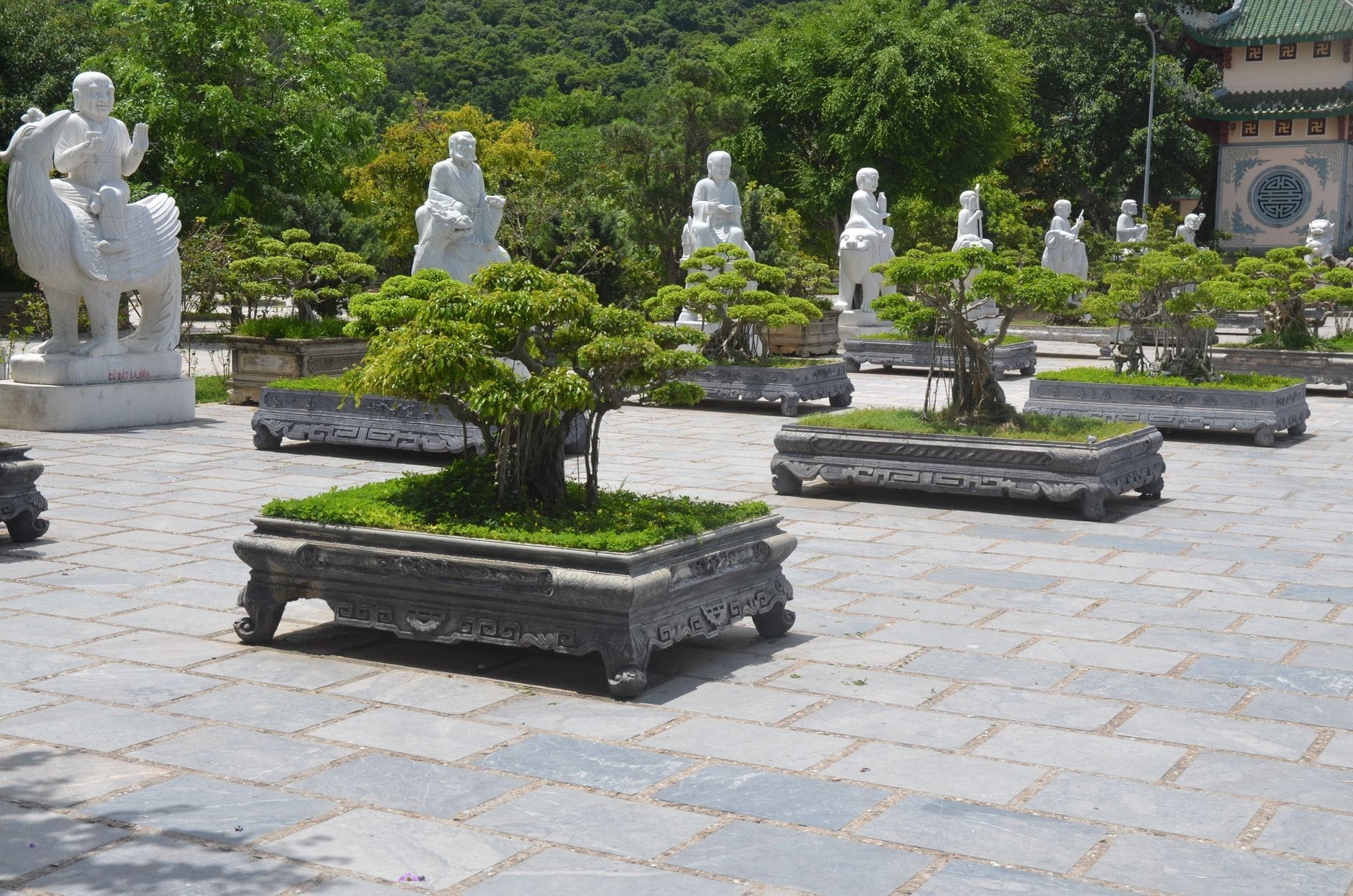
The sheer density of the place catches most visitors off guard. Finished pieces line the pavements in rows: Buddhas ranging from palm-sized to taller than a person, ornate dragons, abstract forms, replicas of Cham sculpture, and garden pieces cut from pale white marble, grey granite, and warm-toned sandstone. Dust from cutting tools settles on everything in a fine layer, and the smell of stone — cool, mineral, faintly chalky — is distinct from anything else in Da Nang.
💡 Local tip
The village is free to enter and there is no obligation to buy anything. Artisans are generally accustomed to observers and won't pressure visitors who are simply watching the work. That said, haggling is standard if you do decide to purchase.
Four Centuries of Stone Craft
Stone carving at Non Nuoc traces its origins to at least the mid-17th century, when craftsmen began quarrying and shaping the marble outcrops of the Ngu Hanh Son mountains nearby. The raw material gave the village its identity: five distinct marble peaks known collectively as the Marble Mountains provided limestone, marble, and other stone types close enough to work with by hand tools. Generations of families passed down specific techniques — how to read grain, how to cut without cracking, how to polish to different sheens — and those techniques are still visible in the work today.
Over time, the village expanded from religious commissions (Cham temple ornaments, Buddhist statues for pagodas) into decorative and export work. Today it supplies sculpture to buyers across Vietnam and internationally, while also catering to day-trippers visiting the Marble Mountains just a few hundred metres away. The craft village and the mountains are functionally inseparable — one is the source of the material, the other is where it gets made.
Note that quarrying directly from the Marble Mountains was restricted and eventually banned to protect the geological and cultural site. Workshops now source stone from other regions of Vietnam, but the carving traditions established here remain place-specific and recognisable.
Tickets & tours
Live prices and dates from our booking partner. If you book, we may earn a commission at no extra cost to you.
5-Hours Cooking Class Tour in Cam Thanh village with Market Shopping
From 85 €Instant confirmationBa Na Hills, Fantasy Park, French village and Golden Bridge tour
From 112 €Instant confirmationFree cancellationHalf-Day Tour to Cam Thanh Eco Water Coconut Village with Fishing
From 67 €Instant confirmationSunset tour in the Cam Thanh Coconut Village
From 33 €Instant confirmation
Walking the Village: What You Will See and Hear
The workshop streets run roughly parallel to the Marble Mountains massif, with Huyen Tran Cong Chua Street forming the main artery. Open-fronted studios — some family operations with two or three artisans, others larger commercial operations with dozens of workers — face the road with their finished inventory displayed at the front and active carving happening further back. Morning hours, roughly 7am to 10am, are when production is most intense: grinders run continuously, chisels tap in overlapping rhythms, and workers crouch over pieces at various stages of completion.
By midday the noise levels drop slightly as some workshops break, and the heat — particularly between May and August — makes the stone hot to touch and the street uncomfortable for slow browsing. The better strategy in summer is to visit early morning or late afternoon, when the light is also more useful for photography: angled sun picks out the texture of rough-cut stone and creates depth in the polished surfaces.
Larger workshops often have a showroom space where finished and near-finished pieces are displayed with rough prices. Smaller ones function more like open studios where the work being carved is also the work being sold. In both cases, interaction is possible: point at a piece, gesture a question, and most artisans will demonstrate a technique or explain the stone type, even through minimal shared language.
ℹ️ Good to know
The village stretches across multiple streets and can take longer than expected to cover fully. If your time is limited, focus on the workshops closest to the Marble Mountains base, where the concentration of active carving (rather than retail display) tends to be higher.
Buying and Shipping: The Practical Reality
Prices vary significantly between workshops and depend on stone type, size, and how polished the final piece is. Small carved items — decorative figurines, incense holders, small Buddhas — are sold for modest amounts and can fit in carry-on luggage if wrapped carefully. Medium and large pieces are a different proposition entirely. Many workshops have experience arranging international shipping and will provide quotes, but this adds considerable cost and complexity. If you are seriously interested in a larger piece, ask the workshop directly about their export process.
For those who want to combine shopping with an understanding of the craft's historical arc, the Non Nuoc Stone Craft Village Museum is worth a visit. It documents the development of the tradition and displays historical pieces alongside contemporary work. If the Marble Mountains are already on your itinerary — and they should be, given they are directly adjacent — combining both into a single half-day is straightforward. Read more about planning that visit in the Marble Mountains attraction guide.
Getting There and Finding Your Bearings
The village sits roughly 8 to 10 kilometres southeast of Da Nang's central districts, in Hoa Hai Ward, Ngu Hanh Son District. By taxi or ride-hailing app, the journey from downtown takes around 15 minutes depending on traffic. City bus routes 1 and 4 connect central Da Nang to the Ngu Hanh Son area via Truong Sa Street and Ngu Hanh Son Street, making the village accessible without a private vehicle — though bus frequency and journey time vary.
Most visitors combine the stone carving village with the Marble Mountains in a single trip, since the two sit side by side. The Marble Mountains area also has a cluster of cafes and small restaurants that serve as a logical refuelling stop between the mountains and the craft workshops. If you are planning a broader day in this part of Da Nang, Non Nuoc Beach is only a short distance east and makes for a natural second stop after the village.
⚠️ What to skip
Footwear matters here. Workshop floors are uneven, covered in stone dust and offcuts, and some carving areas are wet from cooling water used in cutting. Closed-toe shoes are more practical than sandals, and light-coloured clothing will pick up fine stone dust easily.
Photography and Sensory Notes
Non Nuoc Stone Carving Village is exceptionally photogenic under the right conditions. The contrast between rough unworked stone, mid-process carving, and polished finished pieces creates visual variety across a short distance. Workshops with natural light from open frontages photograph well in the morning, when sunlight cuts in at an angle. The interior of working studios is darker and requires either a fast lens or permission to use flash — most artisans do not object to being photographed while working, but it is courteous to ask.
The soundscape is worth noting for anyone with noise sensitivity: grinders, angle cutters, and pneumatic chisels are loud, continuous, and impossible to tune out during peak production hours. This is part of the authentic character of the place but can be fatiguing over a long visit. The smell of freshly cut stone, faintly dusty and cool even in warm weather, is one of the more distinctive sensory signatures of the village.
Practical Assessment: What Works and What Doesn't
Non Nuoc Stone Carving Village rewards curiosity but can feel chaotic to visitors expecting a curated experience. There are no signboards explaining the craft, no guided tours built into the village structure, and no central orientation point. If you arrive without context, it can feel like walking through a large, noisy outdoor warehouse. Taking the time to read about the history first — or combining the visit with the museum — significantly improves the experience. For broader context on what Da Nang's cultural sites offer, the Museum of Cham Sculpture provides important historical background on the artistic traditions that influenced the work produced here.
The village is genuinely worth the journey for anyone interested in traditional craft, material culture, or Vietnamese artisan traditions. It is not, however, a destination for travelers who need shade, seating, or a relaxed pace. Those looking for a broader overview of Da Nang's best experiences can start with the things to do in Da Nang guide to plan around it effectively.
Insider Tips
- Visit on a weekday morning for the most active production. Many workshops reduce carving activity on Sunday afternoons or during Vietnamese holidays, which means less to observe even if retail display remains open.
- If you want to commission a custom piece — a name carved in stone, a specific figure, or a reproduction of a design you bring on your phone — this is genuinely possible at several workshops. Bring a clear image and budget extra time for discussion. Completed commissions can usually be collected the same day for small items.
- The workshops closest to the Marble Mountains base tend to focus more on traditional and religious subjects (Buddhas, Bodhisattvas, Cham-inspired forms), while studios further along the street lean toward decorative garden pieces and contemporary export work. Both are worth seeing for different reasons.
- Stone dust is pervasive. If you wear contact lenses, bring glasses as an alternative for this visit. Even a short walk through the active carving areas will expose your eyes to fine airborne particles.
- Prices displayed in showrooms are almost always negotiable, particularly for larger items or if you are buying multiple pieces from the same workshop. Approach it as a conversation rather than a transaction and the process is generally pleasant.
Who Is Non Nuoc Stone Carving Village For?
- Travelers interested in traditional craft and hands-on artisan culture
- Photographers looking for industrial texture, dust-light interplay, and candid craft portraits
- Shoppers who want a genuine local product with clear provenance rather than factory-made souvenirs
- Anyone combining a visit to the Marble Mountains who wants more than a single attraction in the area
- Slow travelers who enjoy watching skilled work being done without any particular agenda
Nearby Attractions
Other things to see while in Marble Mountains (Ngu Hanh Son):
- Linh Ung Pagoda (Marble Mountains)
Founded in 1825–1826 during the Nguyen Dynasty and designated a national historical and cultural site, Linh Ung Pagoda sits on the eastern slope of Thuy Son (Water Mountain) within the Marble Mountains complex. It is older than its more famous namesake on Son Tra Peninsula and rewarding for anyone who has made the climb to explore the caves and terraces above.
- Marble Mountains (Ngu Hanh Son)
The Marble Mountains, or Ngu Hanh Son, are a cluster of five marble and limestone hills rising from the coastal plain between Da Nang and Hoi An. Each peak holds caves, temples, and carved shrines layered across centuries of Cham, Vietnamese, and Buddhist history. This guide covers what you will actually find there, how long to spend, and how to get the most out of the visit.
- Non Nuoc Beach
Non Nuoc Beach (Bãi biển Non Nước) runs for roughly 5–8 kilometres along the Ngu Hanh Son coastline in southern Da Nang, backed by the stone formations of the Marble Mountains. Free to enter and open around the clock, it offers cleaner sightlines, softer crowds, and a more contemplative atmosphere than the city's more famous strips of sand.
Planning a trip? Discover personalized activities with the Nomado app.