San Diego
San Diego sits in the northeastern corner of Cartagena's Walled City, occupying roughly 16 blocks of colonial streets, shaded plazas, and well-preserved architecture. It draws a mix of travelers, boutique hotel guests, and locals who come for the calmer atmosphere compared to the commercial heart of El Centro. For anyone planning a stay inside the historic walls, San Diego deserves serious consideration.
Located in Cartagena, Colombia
Overview
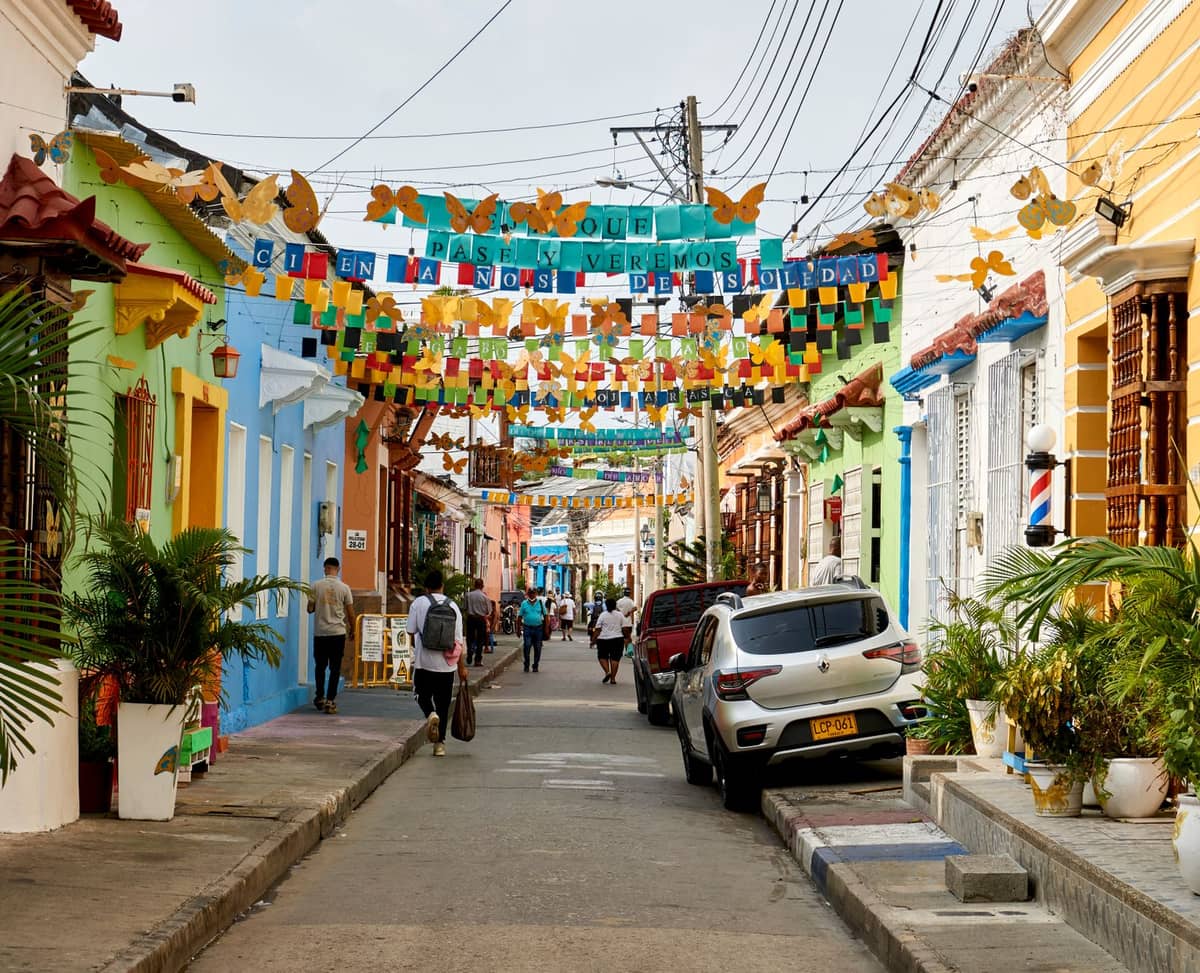
San Diego is Cartagena de Indias' quietest and most atmospheric quarter inside the Walled City: a compact grid of pastel-painted houses, artisan shops, and cobblestone streets that feel several degrees removed from the tourist crowds pressing through El Centro just a few blocks south. It is where the colonial city slows down, and where the relationship between architecture, street life, and the Caribbean light is at its most readable.
Orientation
San Diego occupies the northeastern section of Cartagena's historic Walled City, covering approximately 16 city blocks between the commercial core of El Centro to the south and the city walls to the north and east. The neighborhood is entirely contained within the colonial fortifications, which means its boundaries are defined as much by stone ramparts as by any administrative line.
The clearest way to orient yourself is to walk toward the India Catalina statue at the northern entrance of the Walled City on Avenida Venezuela. That monument marks the informal gateway between the world outside the walls and the San Diego quarter. From there, Calle 30 (Avenida Daniel Lemaitre) runs along the neighborhood's southern edge, separating it from El Centro, while Carrera 11 (Avenida del Pedregal) forms a rough western boundary. The city walls themselves wrap around the northern and eastern perimeter.
In practical terms, San Diego is within easy walking distance of almost everything inside the Walled City. El Centro and Plaza de los Coches are roughly a 10-minute walk south. The neighborhood of Getsemaní lies just outside the walls to the southwest, reachable in about 15 minutes on foot through the clock tower gate. Bocagrande, Cartagena's beach and hotel peninsula, is a 10-minute taxi ride to the south.
ℹ️ Good to know
San Diego has vehicle access restrictions in effect for parts of the old city. Taxis can reach many streets, but some interior lanes are pedestrian-only or restricted during certain hours. Walking is consistently the most practical way to move within the neighborhood.
Character & Atmosphere
The first thing you notice walking into San Diego from El Centro is the drop in ambient noise. The vendors, tour groups, and dense foot traffic of the main commercial streets give way to narrower calles where the loudest sound is often a fan turning in an open window or a dog asleep across a doorstep. The architecture is consistent: two-story colonial houses with heavy wooden balconies, thick whitewashed walls, and interior courtyards glimpsed through half-open doors.
Mornings are the best time to understand what San Diego actually is. Between roughly 7 and 9 a.m., before the tour groups arrive from their hotels, local residents are out: women carrying market bags, men drinking tinto from small plastic cups outside corner tiendas, schoolchildren in uniform cutting across Plaza de San Diego. The plaza itself is ringed by colonial facades and a few café tables that fill slowly as the morning heats up. The quality of light at this hour, bouncing off yellow and ochre walls, is what photographers and painters have been chasing in Cartagena for decades.
By midday the heat is serious, temperatures commonly reaching 30 to 32 degrees Celsius, and the streets empty somewhat as both locals and visitors retreat indoors or to shaded restaurants. This is when San Diego's role as a boutique hotel and restaurant neighborhood becomes most visible: terraces fill, ceiling fans turn, and the pace drops to something approaching the siesta rhythm of an older Caribbean city.
Evenings bring a different energy. The streets fill again from around 6 p.m., when the light softens and the temperature becomes genuinely pleasant. Restaurant tables spill onto sidewalks, costeño vallenato drifts from somewhere nearby, and the walls themselves glow amber in the last sun. It is not the charged nightlife energy of Getsemaní, which runs harder and later, but San Diego after dark has its own appeal: convivial, well-lit, and with a high concentration of good places to eat and drink within a short walk of each other.
Tourist traffic is real and worth acknowledging. San Diego is not a local neighborhood in the way that Getsemaní still partially is. During high season, December through March, and around major holidays, the streets fill with visitors and the prices at restaurants reflect the clientele. That said, the neighborhood is large enough and the side streets quiet enough that solitude is easy to find if you move half a block off the main pedestrian routes.
What to See & Do
Plaza de San Diego is the neighborhood's social and spatial center. The square is smaller and less choreographed than Plaza de Bolívar in El Centro, which makes it more pleasant to spend time in. There are benches, shade trees, and a church facade on one side. On weekend evenings, it functions as an informal gathering point for both locals and visitors.
The city walls running along the northern and eastern edges of the neighborhood are among the best-preserved sections of the entire fortification system. Walking the ramparts here, particularly toward the Baluarte de San Pedro Mártir, gives elevated views over the Caribbean to the north and over the red-tiled rooftops of the old city to the south. The full wall circuit connects to other sections described in more detail on the Cartagena city walls page.
The India Catalina monument on the eastern approach to the Walled City is Cartagena's most recognizable civic symbol: a bronze figure of an indigenous woman who gives her name to the Premios India Catalina television awards. It marks the boundary between San Diego and the road that leads out of the Walled City toward Crespo and the airport.
San Diego sits within easy walking distance of several major attractions in the broader Centro Histórico. The Teatro Heredia, Cartagena's neoclassical theater, is on the southern edge of the neighborhood. The Museo de Arte Moderno de Cartagena is also close by, housed in a colonial building near Plaza de San Pedro Claver, and well worth an hour of your time. The permanent collection focuses on Colombian modern and contemporary work, with rotating exhibitions that regularly feature regional Caribbean artists.
- Plaza de San Diego: the neighborhood's central square, best visited early morning or at dusk
- Baluarte de San Pedro Mártir: one of the best wall sections for views over the Caribbean
- India Catalina statue: Cartagena's civic symbol, at the northern gate of the Walled City
- Teatro Heredia: neoclassical theater on the southern boundary of San Diego
- Museo de Arte Moderno de Cartagena: Colombian modern art in a colonial building
- City wall walks: the ramparts along the northeastern perimeter offer uncrowded, elevated strolls
💡 Local tip
The wall sections in San Diego tend to be less crowded than the stretch near Las Bóvedas or the Baluarte del Reducto. Early morning, before 8 a.m., you can often walk these ramparts in near-solitude with the Caribbean light coming in low from the east.
Eating & Drinking
San Diego has one of the higher concentrations of restaurants per block anywhere in Cartagena's Walled City, and the quality is generally strong. The neighborhood caters heavily to international visitors, which means menus lean toward Colombian-Caribbean fusion, fresh seafood, and dishes adapted for travelers nervous about street food. For a deeper dive into what and where to eat across the city, the Cartagena street food guide covers the full spectrum from sidewalk fritanga to sit-down ceviches.
The streets radiating off Plaza de San Diego and the blocks running toward the walls have the widest range of options. You will find everything from open-air courtyard restaurants serving whole grilled fish and coconut rice to rooftop bars with views over the colonial skyline. Price points vary: a full meal with a beer at a mid-range restaurant runs roughly 40,000 to 80,000 COP per person; the higher-end terrace restaurants can push significantly above that, particularly at dinner.
Street food is present but less dominant here than in El Centro or Getsemaní. Around the plaza and near the wall entrances you will find vendors selling fresh fruit, arepas de huevo, and cold coconut water from carts. These are worth stopping for, both for the price and the taste. Mornings also bring women carrying baskets of fresh bread and empanadas through the streets, a remnant of the neighborhood's more residential past.
For drinking, San Diego has a handful of rooftop bars that draw evening crowds for the views as much as the drinks. Cocktails built around local rum and fresh tropical fruit are standard. The bars here tend to close earlier than those in Getsemaní, with things winding down around midnight on weekdays and somewhat later on weekends. If you are looking for late-night energy, the streets around Plaza de la Trinidad in Getsemaní run much harder.
💡 Local tip
Lunch is the most economical meal in San Diego. Several restaurants offer a set menu (almuerzo del día) for 15,000 to 25,000 COP that includes soup, a main course, juice, and sometimes dessert. These are typically only available until around 3 p.m.
Getting There & Around
Cartagena de Indias is served by Rafael Núñez International Airport (IATA: CTG), located in the Crespo neighborhood approximately 6 km northeast of the Walled City. A taxi from the airport to San Diego typically takes 15 to 25 minutes and costs in the range of 16,000 to 25,000 COP, though fares should be confirmed at the time of travel as prices change. Ride-hailing apps including Uber and inDrive also operate in Cartagena. For a full breakdown of airport transfer options, see the getting around Cartagena guide.
Cartagena does not have a metro or urban rail system. Public buses, including the Transcaribe network, serve the city's main corridors. For San Diego, the most practical bus option is to take a route heading toward Centro Histórico or La Matuna and walk from there. The C1 route is referenced as providing access near Plaza de San Diego. Bus fares are very low, roughly 2,500 to 3,000 COP per journey.
Within San Diego itself, walking is how you move. The neighborhood covers a compact grid and the streets are designed for pedestrian traffic, with vehicle access restricted in several sections. Taxis and ride-hailing cars can reach the main arteries but cannot always access the interior lanes. Plan to walk the last block or two to any specific address.
From San Diego, El Centro is a 10-minute walk south along the main pedestrian corridor. Getsemaní is about 15 minutes on foot through the Torre del Reloj gate. The bus terminal for long-distance travel, Terminal de Transportes de Cartagena, is outside the Walled City and best reached by taxi (roughly 15 minutes). Bocagrande is a 10 to 15 minute taxi ride from San Diego.
Where to Stay
San Diego is one of the best-positioned neighborhoods in Cartagena for accommodation inside the Walled City. The options lean toward boutique hotels and small guesthouses occupying converted colonial mansions, with interior courtyards, thick walls that keep rooms cooler than the outside air, and a level of character that no modern hotel can replicate. For a full comparison of all accommodation zones across the city, the where to stay in Cartagena guide is the most useful reference.
The streets closest to Plaza de San Diego and running toward the city walls have the highest concentration of boutique properties. These tend to be quieter than accommodation near El Centro's main plazas, which makes them better suited to travelers who want colonial atmosphere without the noise of street vendors and late-night bars directly outside. The tradeoff is that the best restaurants and nightlife require a short walk.
San Diego suits couples, solo travelers, and anyone prioritizing walking access to historic sites over beach access. Families with young children may find the cobblestones and heat more manageable from a base here than from Bocagrande, though Bocagrande's broader range of family-oriented hotels and easier beach access makes it the more practical choice for trips centered on the water. Budget travelers should know that even the more affordable guesthouses in San Diego tend to price above what equivalent accommodation costs in Getsemaní.
⚠️ What to skip
High season in Cartagena runs December through March and again in July. During these periods, boutique hotels in San Diego book up weeks in advance and prices increase significantly. If you are traveling during these months, reserve accommodation at least 4 to 6 weeks ahead.
Safety & Practical Notes
San Diego is generally considered one of the safer neighborhoods in Cartagena, with a visible police presence throughout the Walled City and high levels of foot traffic during the day and early evening. Standard urban caution applies at all hours: keep phones out of sight on quieter streets at night, use vetted transport rather than unmarked taxis after dark, and be aware of your surroundings. The is Cartagena safe guide covers city-wide safety considerations in more depth.
The heat is a practical consideration in San Diego as it is everywhere in Cartagena. Daytime temperatures regularly reach 30 to 32 degrees Celsius with high humidity year-round. Lightweight clothing, sun protection, and consistent hydration are not optional. The dry season, December through April, brings the most reliable weather; the rainy season from May through November brings afternoon and evening downpours, often heavy, that pass relatively quickly but can make the cobblestone streets slippery.
Travelers planning to use San Diego as a base for day trips should know that several popular excursions, including visits to the Castillo San Felipe de Barajas and boat trips to the Islas del Rosario, depart from points accessible by short taxi rides from the neighborhood. The castle is about 2 km east of the Walled City; island boat tours typically leave from the Muelle de la Bodeguita or the Muelle Turístico. Both are easily reached from San Diego in under 15 minutes.
TL;DR
- San Diego is the northeastern quarter of Cartagena's Walled City: colonial architecture, quieter streets, and some of the best boutique hotel options inside the historic walls.
- Best for: couples, architecture enthusiasts, travelers who want Walled City access with a calmer base than El Centro.
- The neighborhood is walkable to almost all major historic-center attractions and 15 minutes on foot from Getsemaní.
- Honest drawbacks: higher accommodation prices than Getsemaní, obvious tourist infrastructure, and serious daytime heat with limited shade on narrower streets.
- Skip San Diego as a base if your priority is beach access, budget accommodation, or late-night nightlife — Bocagrande, Getsemaní, or the main El Centro hotels will serve those needs better.
Related Travel Guides
- 3 Days in Cartagena: The Perfect Itinerary
Three days is enough time to experience the best of Cartagena de Indias: the UNESCO-listed walled city, a boat trip to the Rosario Islands, the street art and nightlife of Getsemaní, and a memorable day trip beyond the city. This itinerary is built for first-time visitors who want depth, not just highlights.
- Best Time to Visit Cartagena, Colombia: A Month-by-Month Guide
Cartagena de Indias is a year-round destination, but when you go shapes everything from hotel rates to beach conditions. This guide breaks down the dry season, rainy season realities, peak holiday crowds, and the sweet-spot months that most travelers overlook.
- Afro-Colombian Culture in Cartagena: History, Heritage & Experiences
Cartagena de Indias sits at the heart of Afro-Colombian history. From the UNESCO-recognized Cultural Space of San Basilio de Palenque to the living traditions embedded in Getsemaní and beyond, this guide covers the history, the neighborhoods, and the practical details for experiencing this heritage authentically.
- Best All-Inclusive Resorts in Cartagena, Colombia: What's Actually Available (and Worth It)
Cartagena, Colombia has a small but well-defined selection of true all-inclusive resorts. This guide breaks down every major option, where they sit geographically, what's included, current price ranges, and the real trade-offs so you can book with confidence.
- Best Beaches in & Near Cartagena, Colombia: From City Shores to Caribbean Islands
Cartagena's beach scene spans gritty urban strips, local fishing villages, and some of the most spectacular Caribbean coastline in South America. This guide covers every option, from the accessible shores minutes from the old city to the powdery white sands of Isla Barú and the coral-fringed Rosario Islands.
- Cartagena's Colonial Architecture: A Complete Guide to the Historic Buildings
Cartagena de Indias holds one of the best-preserved colonial ensembles in the Americas, recognized as a UNESCO World Heritage Site. This guide covers every major building, practical entry details, the best times to visit, and what most travelers get wrong about exploring the historic center.
- Cartagena for Couples: Romantic Things to Do & Honeymoon Tips
Cartagena de Indias delivers one of the Caribbean's most genuinely romantic settings: a UNESCO-listed walled city, warm turquoise waters, and a sunset that turns the stone ramparts gold every evening. This guide covers the best romantic activities, where to stay, when to visit, and how to avoid the tourist traps that can flatten an otherwise exceptional trip.
- Cartagena Cruise Port: What to Do on a Day in Port
Docking at Cartagena de Indias gives you one of the Caribbean's great port days — colonial forts, walled-city streets, and beach escapes all within reach. This guide covers exactly how to get from the pier to the good stuff, what to prioritize with limited time, and what to skip.
- Cartagena in December: Weather, Events & What to Expect
December is one of Cartagena de Indias' busiest and most expensive months, but also one of its best for weather. This guide covers the climate, seasonal events, booking realities, and practical tips to make the most of a December visit to Colombia's Caribbean coast.
- Cartagena Islands Guide: Rosario Islands, Barú, Tierra Bomba & the Best Beaches Near the City
Cartagena sits at the gateway to some of the Caribbean's most rewarding island destinations. This guide covers the coral reefs of the Rosario Islands, the white sands of Playa Blanca on Barú, the quieter shores of Tierra Bomba, and the best beaches and nature trips you can reach by boat or road from the city.
- Cartagena Nightlife: Best Bars, Clubs & After-Dark Experiences
From rooftop cocktails above the Walled City to salsa-soaked plazas in Getsemaní, Cartagena de Indias comes alive after dark. This guide covers every major nightlife zone, realistic price ranges, what to skip, and how to plan a great night out in Colombia's most atmospheric Caribbean city.
- Cartagena on a Budget: How to Visit Without Overspending
Cartagena de Indias has a reputation as an expensive Caribbean destination, but the reality is more nuanced. With the right neighborhoods, transport choices, and food strategy, a week in Colombia's most photogenic city is well within reach of budget travelers. Here is exactly how to do it.
- Cartagena Street Food Guide: Best Snacks, Local Markets & Where to Eat Like a Local
Cartagena de Indias has one of the most rewarding street food scenes on the Caribbean coast of Colombia. This guide covers the essential snacks, the best neighborhoods and markets to find them, realistic price ranges, and clear advice on what to skip.
- Cartagena with Kids: The Complete Family Travel Guide
Cartagena de Indias works surprisingly well as a family destination, but it rewards planning. From the Oceanario at Islas del Rosario to the hop-on hop-off city bus, this guide covers the best kid-friendly activities, practical logistics, and the seasonal factors every parent needs to know before booking.
- Best Day Trips from Cartagena: Islands, Beaches, Villages & More
Cartagena de Indias is one of the Caribbean's great base camps. Within a few hours by boat or road, you can reach pristine coral islands, an Afro-Colombian UNESCO heritage village, a one-of-a-kind mud volcano, and mangrove lagoons barely touched by tourism. These are the best day trips to plan from the city.
- Getting Around Cartagena: Transport & Airport Guide
Everything you need to navigate Cartagena de Indias, from landing at Rafael Núñez International Airport (CTG) to hopping between neighborhoods. Real fare ranges, TransCaribe basics, ride-hailing realities, and seasonal advice included.
- Is Cartagena Safe? An Honest Safety Guide for Travelers
Cartagena, Colombia draws millions of visitors each year, but the safety question deserves a straight answer. This guide breaks down neighborhood-by-neighborhood risk, the most common threats tourists actually face, and practical steps to stay safe without missing the city.
- Is Cartagena Worth Visiting? A Clear Assessment
Cartagena de Indias is one of the Caribbean's most photogenic cities, but it comes with real trade-offs: heat, crowds, and tourist pricing. This guide cuts through the hype to help you decide if Cartagena Colombia deserves a spot on your itinerary.
- Luxury Cartagena: Best Hotels, Experiences & Fine Dining
Cartagena de Indias delivers a rare combination of UNESCO-listed colonial architecture, Caribbean waterfront, and a genuine luxury infrastructure that rivals any Latin American city. This guide covers where to stay, where to eat, what to do, and when to book to get the most out of a high-end visit to Colombia's crown jewel.
- Things to Do in Cartagena, Colombia: The Definitive 2026 Guide
Cartagena de Indias packs colonial fortresses, Caribbean islands, street art, and serious food into one compact city on Colombia's northern coast. This guide cuts through the tourist noise with specific prices, opening hours, seasonal advice, and specific rankings to help you spend your time well.
- Where to Stay in Cartagena, Colombia: Best Areas & Hotels Guide
Choosing where to stay in Cartagena de Indias shapes your entire trip. This guide covers every major neighborhood, from the colonial Centro Histórico to the beach hotels of Bocagrande, with clear trade-offs, practical price context, and seasonal tips to help you book with confidence.