India Catalina Statue: Cartagena's Most Iconic Monument
Standing at the entrance to Cartagena de Indias, the bronze India Catalina Statue has marked the city's identity since 1974. Free, open around the clock, and loaded with historical weight, it is the first landmark many visitors encounter and the last symbol they remember.
Quick Facts
- Location
- Av. Venezuela at Av. Pedro de Heredia, La Matuna, Cartagena de Indias
- Getting There
- 10–15 min walk from Torre del Reloj; Transcaribe routes stopping at Chambacú or Centro Uno stations
- Time Needed
- 15–30 minutes
- Cost
- Free, open 24 hours
- Best for
- First-time visitors, photography, history enthusiasts, quick orientation stop
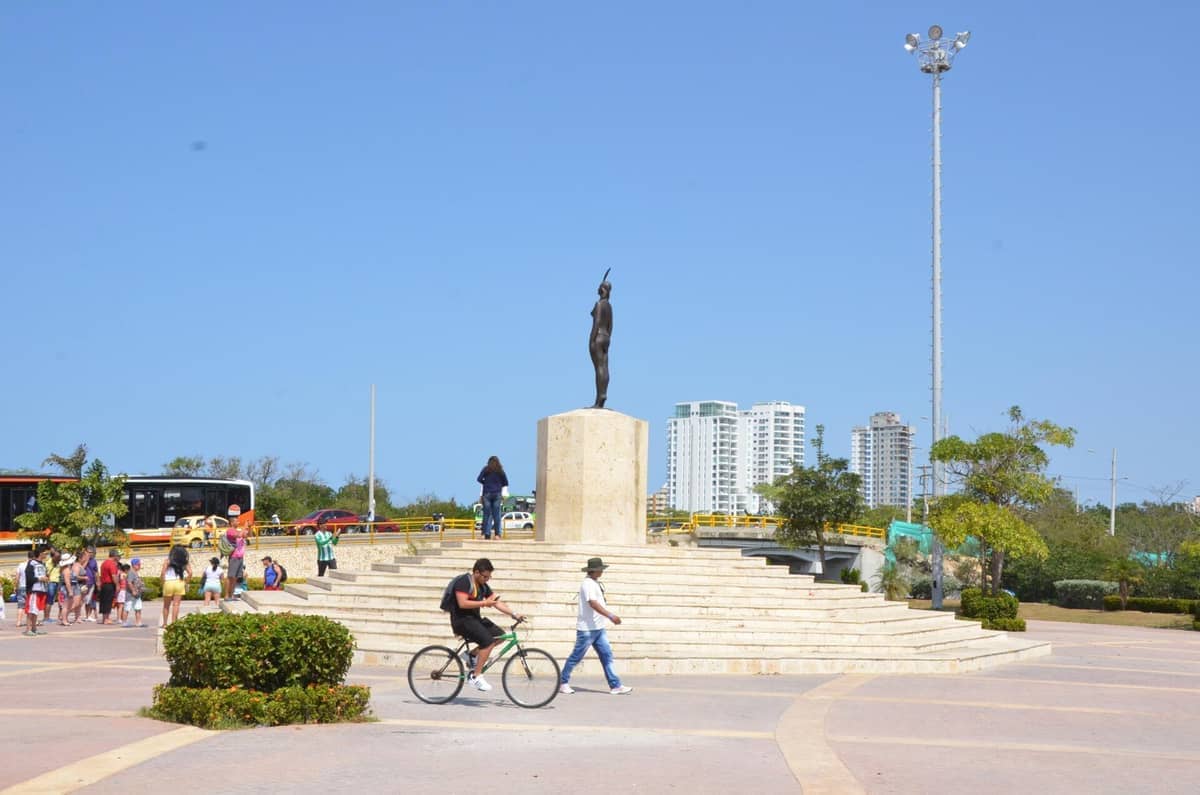
What Is the India Catalina Statue?
The Monumento a la India Catalina is a bronze statue standing at the intersection of Avenida Pedro de Heredia and Avenida Venezuela in the La Matuna sector of Cartagena de Indias. Positioned at what feels like the formal threshold between the modern city and the colonial historic center, it functions as the city's most immediately recognizable landmark. Arriving from the airport or from the newer commercial districts, this is typically the first major monument visitors encounter, and for many Cartageneros, it is simply the symbol that defines their city.
The statue depicts a young Indigenous woman with her right arm extended and her gaze directed toward the sea. She stands with an upright posture that reads as both welcome and vigilance. She stands on a raised plinth, visible from a considerable distance down the avenue, especially in the late afternoon when low Caribbean light catches the darkened bronze and sharpens her silhouette against the sky.
💡 Local tip
The statue sits in Parque India Catalina, a small plaza slightly set back from the main road. It was moved 12 meters from its original roadside position during Transcaribe construction works, and the park setting now allows for a cleaner view and a safer stopping point than before.
The Historical Figure Behind the Monument
Catalina was a real person, though the historical record around her is fragmented. Born into the Calamari Indigenous group in the region of what is now Cartagena, she was taken by Spanish colonizers as a child in the early 1500s, transported to Hispaniola (present-day Dominican Republic and Haiti), and raised in a Spanish household where she acquired fluency in Spanish. When Spanish conquistador Pedro de Heredia arrived in the region in 1533, Catalina is believed to have served as his interpreter, a role that placed her at a decisive and deeply uncomfortable hinge point in colonial history. She was an intermediary between two worlds, valued by the colonizers for her linguistic skill and cultural knowledge, while her relationship to her own people was necessarily complicated by that position.
Historians have debated her legacy for decades. She is neither a straightforward hero nor a straightforward collaborator. For many Cartageneros, the statue represents something broader: the Indigenous roots of the city, the resilience of people who were displaced and yet remained central to the story of this place, and the long, layered history of a Caribbean port that was simultaneously a seat of colonial power and a crossroads of African, Indigenous, and European cultures. The monument invites that complexity rather than resolving it.
Catalina's story is inseparable from the wider history of Cartagena's founding. To understand that context more fully, the Palacio de la Inquisición and the Museo del Oro Zenú both offer deeper dives into the region's pre-colonial and colonial-era history.
Tickets & tours
Hand-picked options from our booking partner. Prices are indicative; availability and final rates are confirmed when you complete your booking.
Night tour of Cartagena de Indias aboard a Limo Chiva
From 10 €Instant confirmationFree cancellationTotumo Volcano and lunch at a VIP hotel from Cartagena
From 34 €Instant confirmationFree cancellationCity tour of Cartagena with entry to San Felipe castle
From 25 €Instant confirmationFree cancellationSan Andres Islands pontoon tour through the inner bay
From 26 €Instant confirmationFree cancellation
The Sculpture: Artist and Craftsmanship
The statue was created by Eladio Gil Zambrana (1929–2011), a Spanish sculptor. The work was delivered to the city on 9 March 1974 and inaugurated later that year. Gil Zambrana was known for figurative bronze work, and the India Catalina piece reflects that tradition: the anatomy is naturalistic, the gesture expressive, and the surface texture of the bronze, which has developed a deep patina over five decades of Caribbean humidity and heat, gives the figure a weight and presence that reproduction photographs rarely capture.
Up close, the details reward attention. The sculptor rendered the figure's clothing and jewelry with care, including elements meant to evoke pre-Columbian adornment. The plinth is simple and vertical, which keeps the visual focus entirely on the figure rather than on architectural framing. At night, when the surrounding streetlights catch the bronze at low angles, the texture of the surface becomes more pronounced and the overall effect is considerably more dramatic than during the midday glare.
How the Experience Changes by Time of Day
At midday, the plaza around India Catalina is busy with pedestrian traffic. The intersection of two major avenues means constant movement: commuters, vendors, students, and tourists all pass through. The light is harsh and flat, good for quick snapshots but not for photography that captures atmosphere. The ambient noise is a mix of traffic, cumbia drifting from a passing car, and the calls of fruit sellers working the nearby sidewalks. The heat is direct and unrelenting.
Early morning, particularly between 6:30 and 8:00 AM, the plaza is noticeably calmer. The light comes in low from the east, angling across the figure's extended arm. This is the best window for photography. The air is still relatively cool by Cartagena standards, humidity is manageable, and the plaza has a reflective, unhurried quality before the city fully wakes. A handful of locals cut through the park on their way to work, but the statue itself is often unoccupied.
Evenings after 7:00 PM bring a different character. The avenues remain active but the frenetic midday energy drops away. The statue is lit, and the warm tone of the lighting suits the bronze well. This is when the monument reads most clearly as a civic symbol rather than a tourist stop: couples sit on nearby benches, a vendor sells raspados (shaved ice drinks) from a cart, and the statue presides over an ordinary Cartagena evening with a quiet authority.
ℹ️ Good to know
During the Cartagena Film Festival (Festival Internacional de Cine de Cartagena de Indias, FICCI), the golden statuette awarded to winners is modeled on the India Catalina figure. If you visit during the festival period, often scheduled in the first half of the year, the statue becomes a focal point for promotional materials and events across the city.
Getting There and Practical Walkthrough
The easiest approach from the historic center is on foot. Leave the Torre del Reloj (Clock Tower) heading east along Avenida Venezuela, and the statue appears after roughly 10 to 15 minutes of flat, shaded walking through the La Matuna commercial district. The route is simple and the avenue is well-oriented, so navigation requires no map once you are on it.
By Transcaribe bus, the Chambacú or Centro Uno stations are the closest stops, followed by a short walk to the monument. Taxis are universally familiar with the location; ask for 'Monumento India Catalina en la Avenida Venezuela, La Matuna' and you will be understood immediately. There is no parking area specifically associated with the monument, so driving and stopping is not practical.
The plaza itself is fully accessible at street level, with no steps or barriers into the viewing area. The surrounding sidewalks follow standard Cartagena urban conditions: mostly flat, occasionally uneven at curb cuts, and crowded during peak hours. There is no visitor center, no signage explaining the history in English, and no facilities. Bring water, particularly if you are visiting midday.
⚠️ What to skip
The monument sits adjacent to two high-traffic avenues. Exercise the usual urban awareness about personal belongings, particularly at busy midday hours when the intersection sees heavy pedestrian and vehicle flow. Cartagena's historic center is generally manageable for tourists, but this particular spot is a transit crossroads rather than a quiet courtyard.
Photography Tips
The optimal shooting position is from the southwest side of the plaza, where you can frame the statue against sky rather than the commercial buildings behind it. A low shooting angle from ground level emphasizes the upward reach of the extended arm and gives the figure scale and authority. A wide-angle lens works well here; a telephoto compresses too much and loses the sense of the figure's relationship to the surrounding urban space.
If you want to include the city's broader character in the frame, late afternoon gives you the warm Caribbean light from the west and makes the bronze glow in a way that is difficult to replicate at other times. Avoid the midday hours unless your goal is documentary rather than atmospheric photography.
Fitting India Catalina Into Your Cartagena Itinerary
Most visitors see India Catalina as part of a broader walk through the historic center and its surroundings. The statue is a natural starting or ending point for that loop. From here, you are a short walk from the Las Bóvedas and the city walls, and only slightly further from Getsemaní, which offers a completely different urban character. The statue itself merits 15 to 30 minutes at most, including time to read the historical context, take photographs, and sit briefly in the plaza.
If you are planning a fuller day in the area, the Santuario de San Pedro Claver is one of the most historically significant stops in the colonial core and makes a natural companion visit. Both sites deal, from different angles, with the colonial experience and its human cost. For those trying to structure a multi-day itinerary, the 3 days in Cartagena guide incorporates India Catalina as a walkable first-morning stop.
Is It Worth Your Time?
Honestly, India Catalina is not a destination in itself. You will not spend an hour here, and if you have only two days in Cartagena and need to prioritize, there are more immersive experiences available. What the statue does offer is something different: a moment of orientation, both geographic and historical. Standing in front of it, you are at the entrance to one of the most significant colonial-era cities in the Americas, and the figure looking out toward the sea is a reminder that this city's history predates the Spanish walls and the colonial plazas, and involves people whose stories are still being recovered and debated.
Travelers who arrive in Cartagena with no interest in the colonial history or urban culture, and who are primarily here for the beaches or nightlife, will likely walk past without stopping. That is reasonable. But for anyone trying to understand what Cartagena de Indias actually is, India Catalina is a useful, free, and accessible starting point.
Insider Tips
- The India Catalina statuette awarded at the FICCI film festival (typically held in March) is modeled on this monument. Visiting during festival week adds a layer of meaning to the stop, and you may see film-related installations or events in the immediate area.
- For the cleanest photograph with open sky in the background, position yourself on the southwest side of the plaza in the early morning. Within an hour of sunrise, the light is directional, the shadows are long, and the avenue is quiet enough to compose the shot without pedestrians constantly entering the frame.
- Ask local taxi drivers about the statue and you will almost always get an opinion on Catalina herself. Cartageneros have genuinely divided views on her legacy, and the conversation is a better introduction to local history than most guidebooks offer.
- The small plaza has benches that are almost always occupied by locals in the early evening. If you sit down and take your time, the place reveals a dimension that passing tourists rarely see: it functions as an informal meeting point for people from the surrounding La Matuna neighborhood.
- Combine this stop with a walk along the adjacent city walls section nearby. The contrast between the colonial fortifications and this monument at the city's modern entrance reinforces how layered Cartagena's historical geography actually is.
Who Is India Catalina Statue For?
- First-time visitors to Cartagena wanting a geographic and historical orientation point
- History and culture travelers interested in colonial-era Latin America and Indigenous history
- Photographers working in early morning light who want an iconic subject without crowds
- Travelers combining a walking route from the historic center toward La Matuna
- Anyone visiting during the FICCI film festival who wants to see the inspiration for the award statuette in person
Nearby Attractions
Other things to see while in Centro Histórico (Ciudad Amurallada):
- Cartagena City Walls (Murallas)
The Murallas de Cartagena de Indias are the best-preserved colonial defensive walls in the Americas, ringing the historic center with roughly 3 kilometers of coral-stone ramparts, cannons, and Caribbean sea views within an 11-kilometer defensive system overall. Entry is free, the walk takes 1 to 3 hours depending on your pace, and the experience changes dramatically depending on the time of day you show up.
- Catedral Santa Catalina de Alejandría
Standing at the east corner of Parque de Bolívar in Cartagena de Indias, the Catedral Basílica Metropolitana de Santa Catalina de Alejandría is one of the oldest episcopal sees in the Americas. Construction began in the 16th century, and the building remains the seat of the Archbishop of Cartagena de Indias today. Entry is free, the doors open daily, and the surrounding plaza makes this one of the most rewarding stops in the entire Centro Histórico.
- Iglesia de Santo Domingo
The Iglesia de Santo Domingo is widely considered the oldest surviving church in Cartagena de Indias, anchoring a plaza that doubles as one of the historic center's most lively gathering points. The building itself rewards close inspection, while the square around it offers a completely different experience depending on the hour you arrive.
- Las Bóvedas
Built in the late 1790s as military storerooms and later used as dungeons, Las Bóvedas are the last major colonial construction inside Cartagena's fortified perimeter. Today, 23 arched vaults house craft shops and galleries. Entry is free, and the structure sits at the northern end of the walled city in the San Diego district.