Torre del Reloj: Cartagena's Clock Tower Gateway Explained
The Torre del Reloj is the primary ceremonial entrance to Cartagena de Indias' walled historic center, standing at the threshold between the colonial city and the neighborhood of Getsemaní. Built between 1601 and 1631, free to visit at any hour, and surrounded by two of the city's liveliest plazas, it is the single most recognizable landmark in northern Colombia.
Quick Facts
- Location
- Boca del Puente, El Centro, Cartagena de Indias, Bolívar, Colombia
- Getting There
- 10-min walk from Getsemaní; taxis drop off on Avenida Venezuela directly in front
- Time Needed
- 15–30 minutes at the tower itself; allow 1–2 hours if exploring both adjacent plazas
- Cost
- Free. No ticket required for the exterior and public archway
- Best for
- First-time visitors orienting themselves, photographers, history enthusiasts, evening strollers
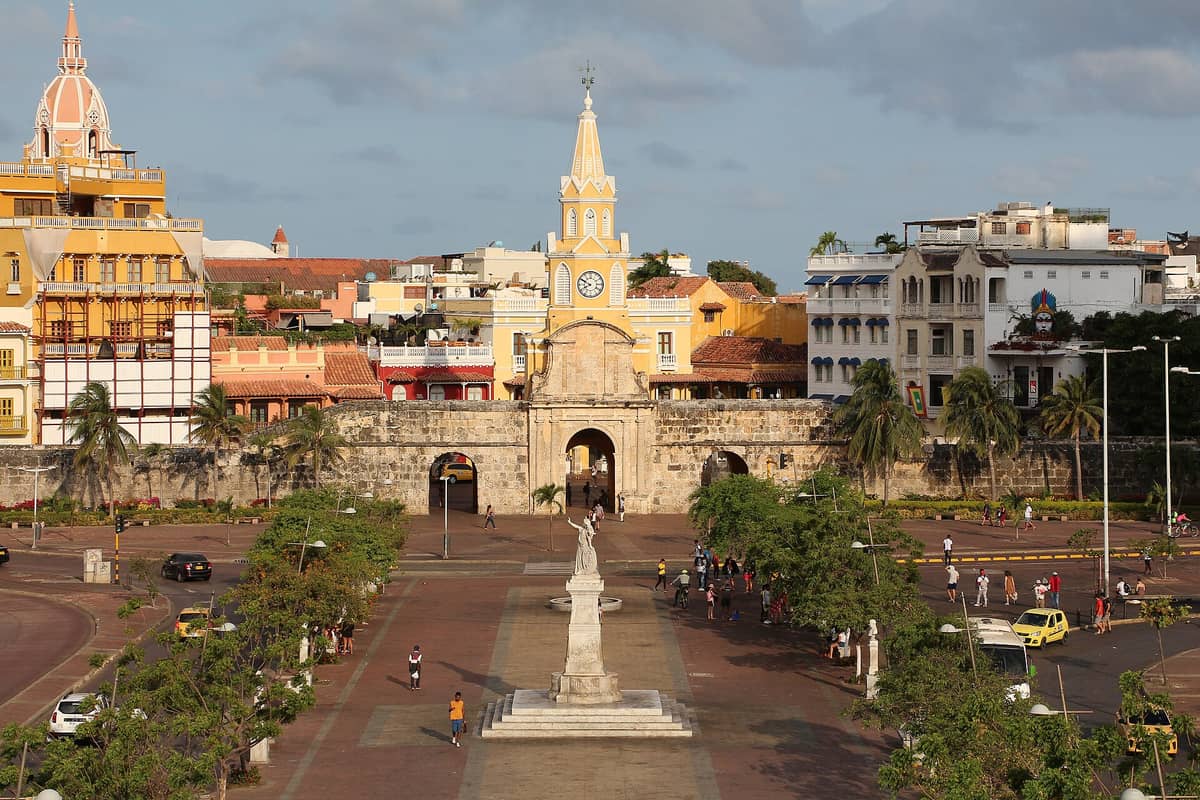
What the Torre del Reloj Actually Is
The Torre del Reloj is not simply a clock tower. It is the principal gateway through Cartagena's colonial walls, a structure that has functioned for over four centuries as the threshold between the fortified city and the world outside. Officially called Puerta del Reloj, it sits at the southern edge of the Centro Histórico, where Avenida Venezuela meets the old moat, and it connects Plaza de los Coches on the walled-city side with Plaza de la Independencia on the outer side of the walls.
Most visitors encounter the Torre del Reloj almost by accident. You step out of a taxi on Avenida Venezuela, look up, and there it is: a cream-and-ochre baroque facade topped by a four-faced clock. Walk through the central arch and you have crossed from the 21st-century port city into one of the best-preserved colonial centers in Latin America. For practical orientation when navigating the Centro Histórico, the Torre del Reloj is the single most useful reference point in the entire walled city.
💡 Local tip
The tower is free to pass through at any hour. The clock faces are illuminated after dark, making it one of the few landmarks in Cartagena that photographs well both at midday and at night.
400 Years of History in One Structure
Construction on the gate began in 1601 and the main initial phase was completed around 1631, making it a product of early Spanish colonial fortification planning. At that time, Cartagena de Indias was one of the most strategically important ports in the Spanish empire, shipping gold and silver from the interior of the continent to Seville. The gate was functional before it was decorative: it controlled movement in and out of the walled city and could be defended if attackers breached the outer walls.
The clock mechanism itself was added much later. A pendulum clock was installed in 1874, and beginning in 1888 the tower was rebuilt in its octagonal form; the current Swiss clock and upper section were finalized by the 1930s, giving the structure the appearance visitors see today. The result is a structure that layers early-17th-century military architecture with 19th-century civic embellishment.
That layered history mirrors Cartagena as a whole. The walls, the gate, and the surrounding plazas are all part of the same UNESCO World Heritage designation that protects the Cartagena city walls and the colonial urban fabric they enclose. The Torre del Reloj is not a standalone monument; it is the face of an entire defensive system that once stretched several kilometers around the city.
Tickets & tours
Hand-picked options from our booking partner. Prices are indicative; availability and final rates are confirmed when you complete your booking.
Baru Terrestre and Islas Del Rosario Pasadia full day tour
From 40 €Instant confirmationFree cancellationTotumo Volcano and lunch at a VIP hotel from Cartagena
From 34 €Instant confirmationFree cancellationCity tour of Cartagena with entry to San Felipe castle
From 25 €Instant confirmationFree cancellationSan Andres Islands pontoon tour through the inner bay
From 26 €Instant confirmationFree cancellation
How the Experience Changes by Time of Day
Early morning, between 6:00 and 8:00, the Torre del Reloj belongs mostly to locals. Street vendors are setting up along the base of the walls, the light comes in low and golden from the east, and the temperature is as comfortable as Cartagena ever gets, typically around 26–28°C. The archway smells faintly of salt air from the bay a few blocks north. Photographers will find the soft morning light ideal for capturing the cream-colored facade without harsh shadows.
By mid-morning, tour groups begin flowing through the arch in both directions. The Plaza de los Coches, immediately inside the walls, fills quickly with horse-drawn carriages waiting for fares, and the ambient noise level rises sharply. From around 10:00 to 16:00, the area around the tower is at its most crowded. Midday heat in Cartagena is serious, regularly reaching 32°C with high humidity, and the archway itself offers only momentary shade as you pass through. This is not the time to linger.
Late afternoon is arguably the most rewarding window. As the sun drops toward the bay, the western facade of the tower catches warm directional light, and the temperature eases slightly. The Plaza de la Independencia fills with vendors selling fresh fruit, cold drinks, and handicrafts. The energy here is social rather than transactional: families, couples, and small groups of travelers converge before heading into the old city for dinner. After dark, the clock faces glow against the night sky, and the surrounding plazas remain busy into the late evening, particularly on weekends.
⚠️ What to skip
The area around Plaza de la Independencia, on the Getsemaní side of the tower, draws large crowds at all hours and requires the same street awareness you would apply anywhere in a busy urban center. Keep bags in front of you and avoid displaying expensive camera equipment carelessly.
The Two Plazas: What Surrounds the Tower
The Torre del Reloj sits between two distinct public spaces, and understanding both is essential to understanding why this landmark matters beyond its architecture. On the inner, walled-city side sits Plaza de los Coches, a square that served historically as a slave market during the colonial period. Today it is lined with covered porticoes, small cafes, and the Portal de los Dulces on its northern edge, where vendors sell traditional Colombian sweets from wooden stalls.
On the outer side, Plaza de la Independencia is larger, more open, and directly connected to the Getsemaní neighborhood. It functions as a transit hub and social gathering point. Buses and taxis run along Avenida Venezuela at its edge. If you are arriving from Getsemaní on foot, you will cross this plaza before passing through the tower arch into the walled city. The transition is abrupt and unmistakable: cobblestones replace paved sidewalks, the streets narrow, and the scale of the buildings shifts from the utilitarian to the ornate.
Practical Walkthrough: What to Expect
The tower has three archways at ground level: one large central passage and two smaller flanking arches. All are open at all times; there are no barriers, no ticket booths, and no guided entry. You simply walk through. The interior of the passage, maybe eight meters deep, is cool relative to the street outside and acoustically distinct: the sound of the city drops and then returns on the other side.
Interior access to the tower's upper levels is not available as a standard tourist option based on available information. The value of a visit is entirely external: the architecture of the facade, the passage through the arch, and the contrast between the two plazas on either side. Plan your time accordingly. Thirty minutes is plenty to observe the structure from multiple angles and walk through the arch in both directions.
From the Torre del Reloj, the rest of the walled city radiates outward and upward. A short walk north leads to the waterfront along Avenida Blas de Lezo. Heading east takes you deeper into the historic center toward the Cathedral of Santa Catalina de Alejandría and the Palacio de la Inquisición. The tower makes the most logical starting point for any walking tour of the walled city.
Photography and Practical Notes
For photos of the tower facade, position yourself in Plaza de la Independencia, stepping back toward the central fountain or the tree line for a full-frame shot. The western face is best lit in the late afternoon; morning shooters should work the inner, Plaza de los Coches side instead, where the eastern light works in your favor before 9:00.
Cartagena's heat and humidity are consistent year-round, but the dry season from December through April brings lower rainfall and clearer skies, which makes a real difference for photography and general comfort. During the rainy season, May through November, brief afternoon downpours can soak the plazas in minutes. The tower itself makes a useful shelter during these passing showers, which rarely last more than 30 to 45 minutes.
Lightweight, breathable clothing is non-negotiable in Cartagena's climate. Sunscreen and water matter here more than at most urban landmarks. For a broader picture of how to plan your trip around weather patterns, the best time to visit Cartagena guide breaks down the dry and wet seasons in detail.
Is It Worth the Visit?
The honest answer is that the Torre del Reloj is not a destination in the way that a museum or a beach is a destination. It is a threshold. Its value is contextual: you pass through it to get somewhere else, and in doing so you understand something about the city's geography, its history, and the physical reality of what a walled colonial city means. For first-time visitors to Cartagena, walking through the arch is a genuinely orienting moment.
Those expecting an interior experience, a viewpoint from the top, or an interpretive exhibition will be disappointed. The tower offers none of those things. What it offers is architectural presence, a strong sense of historical layering, and two active plazas that are worth time on their own terms. If you are already in the walled city, you will pass the Torre del Reloj repeatedly without trying. If you are based in Getsemaní or Bocagrande, making a specific trip just to photograph the exterior takes under an hour and costs nothing.
Insider Tips
- Walk through the arch from the Getsemaní side toward Plaza de los Coches rather than the reverse. The transition from the wider outer plaza to the narrow colonial streets is far more dramatic in that direction, and it mirrors the experience of arriving at the city by sea as historical travelers would have.
- The Portal de los Dulces, just inside the walls off Plaza de los Coches, is a row of candy stalls selling traditional Colombian sweets including cocadas and manjar blanco. It is easy to miss if you walk straight through the arch without turning right. Prices are low and cash is expected.
- Horse-drawn carriage tours depart from Plaza de los Coches and loop through the walled city. If you are considering one, negotiate the price before getting in, not after. The Torre del Reloj end of the plaza is where you will find the most options.
- The four clock faces are synchronized and clearly visible from both plazas. If you are meeting someone in the area, 'at the clock tower' is a functional and unambiguous meeting point that every local and driver will understand immediately.
- Avoid the area immediately around the tower between 11:00 and 14:00 on weekends during high season (December to March). Cruise ship day-trippers move through in large organized groups during this window, and both plazas become very congested.
Who Is Torre del Reloj For?
- First-time visitors to Cartagena who want a strong geographic and historical orientation before exploring the walled city
- Photographers looking for an iconic colonial facade with flexible lighting conditions across different times of day
- Travelers combining a walking route through Getsemaní and the historic center, for whom the tower is a natural midpoint
- History enthusiasts interested in Spanish colonial military architecture and UNESCO-listed heritage sites
- Budget travelers: the tower is free, the surrounding plazas are free, and the nearby Portal de los Dulces offers some of the cheapest local snacks in the city center
Nearby Attractions
Other things to see while in Centro Histórico (Ciudad Amurallada):
- Cartagena City Walls (Murallas)
The Murallas de Cartagena de Indias are the best-preserved colonial defensive walls in the Americas, ringing the historic center with roughly 3 kilometers of coral-stone ramparts, cannons, and Caribbean sea views within an 11-kilometer defensive system overall. Entry is free, the walk takes 1 to 3 hours depending on your pace, and the experience changes dramatically depending on the time of day you show up.
- Catedral Santa Catalina de Alejandría
Standing at the east corner of Parque de Bolívar in Cartagena de Indias, the Catedral Basílica Metropolitana de Santa Catalina de Alejandría is one of the oldest episcopal sees in the Americas. Construction began in the 16th century, and the building remains the seat of the Archbishop of Cartagena de Indias today. Entry is free, the doors open daily, and the surrounding plaza makes this one of the most rewarding stops in the entire Centro Histórico.
- Iglesia de Santo Domingo
The Iglesia de Santo Domingo is widely considered the oldest surviving church in Cartagena de Indias, anchoring a plaza that doubles as one of the historic center's most lively gathering points. The building itself rewards close inspection, while the square around it offers a completely different experience depending on the hour you arrive.
- India Catalina Statue
Standing at the entrance to Cartagena de Indias, the bronze India Catalina Statue has marked the city's identity since 1974. Free, open around the clock, and loaded with historical weight, it is the first landmark many visitors encounter and the last symbol they remember.