Catedral Basílica Metropolitana de Santa Catalina de Alejandría: Cartagena's Oldest Cathedral
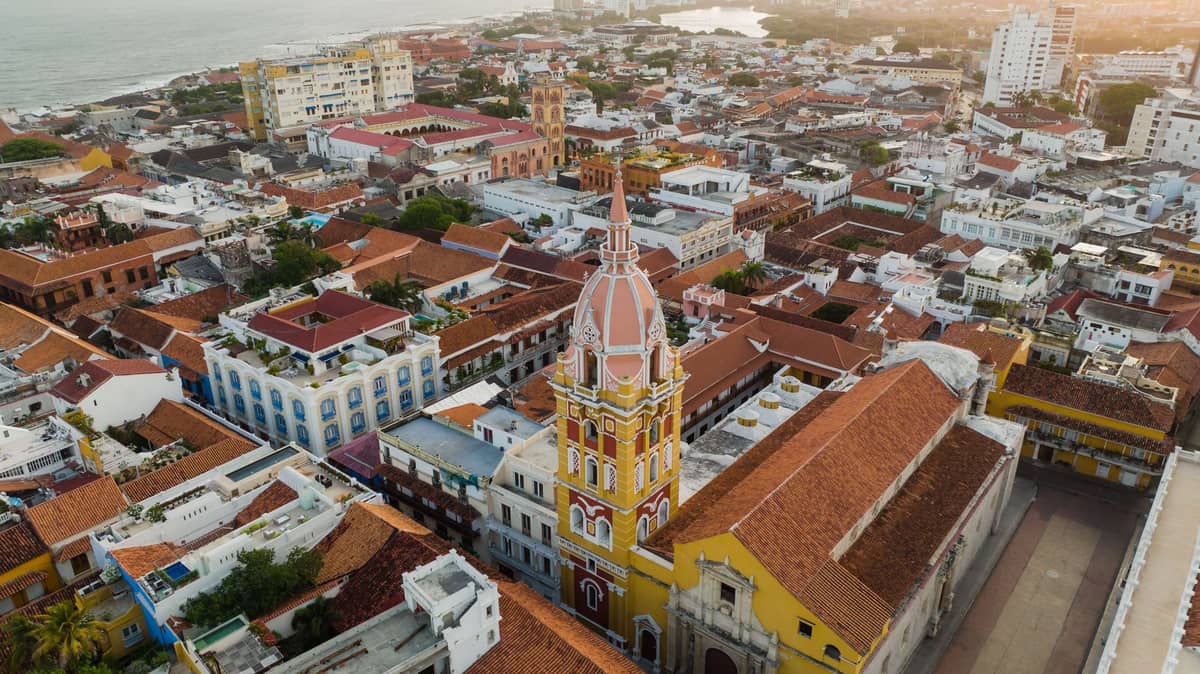
Standing at the east corner of Parque de Bolívar in Cartagena de Indias, the Catedral Basílica Metropolitana de Santa Catalina de Alejandría is one of the oldest episcopal sees in the Americas. Construction began in the 16th century, and the building remains the seat of the Archbishop of Cartagena de Indias today. Entry is free, the doors open daily, and the surrounding plaza makes this one of the most rewarding stops in the entire Centro Histórico.
Quick Facts
- Location
- Calle de los Santos de Piedra, Carrera 4, Parque de Bolívar, Centro Histórico, Cartagena de Indias
- Getting There
- Walkable from anywhere inside the walled city; taxis and ride-hailing drop-off on surrounding streets
- Time Needed
- 30–60 minutes for the interior; allow extra time to linger in Parque de Bolívar
- Cost
- Small admission fee for general entry; verify the current amount and any optional fees on site
- Best for
- Colonial history, architecture, quiet reflection, photography
Why This Cathedral Matters
The Catedral Basílica Metropolitana de Santa Catalina de Alejandría is not simply another colonial church on a walking tour itinerary. It is one of the oldest episcopal sees in the New World, and it still functions today as the seat of the Archbishop of Cartagena de Indias. Construction began in the 16th century, making this building a contemporary of the walls, forts, and convents that collectively earned Cartagena de Indias its UNESCO World Heritage status. For context on what the city's colonial-era architecture looks like as a whole, the Cartagena colonial architecture guide provides useful background before you visit.
The building's full official name in Spanish is Catedral Basílica Metropolitana de Santa Catalina de Alejandría, dedicated to Saint Catherine of Alexandria. That dedication is worth knowing because it shapes the interior iconography: look for imagery of the saint's wheel, a symbol of her martyrdom, in the decorative details. Most visitors walk in, glance upward, take a photo, and leave. Those who slow down and look at the specific details of the nave, the altar arrangements, and the lateral chapels get considerably more from the visit.
ℹ️ Good to know
Opening hours: Daily 07:00–20:00 (7 am–8 pm). A small admission fee is typically charged for tourist entry; verify the current amount, any optional fees, or restricted-access areas on arrival, as these are not officially published.
The Setting: Parque de Bolívar and the East Façade
The cathedral occupies the east side of Parque de Bolívar, the most formally composed public square inside the walled city. The park itself is shaded by large trees and anchored by a statue of Simón Bolívar at its center. In the morning, the square fills with pigeons, school groups, and vendors arranging their carts. By midday the heat empties it of casual strollers, and only the shade-seekers on the benches and tourists crossing toward the cathedral remain. Late afternoon brings the best light for photography: the warm sun rakes across the cathedral's pale stone façade from the west, sharpening every carved detail.
The façade itself is restrained compared to more ornate Spanish colonial churches in Latin America. The tower is the dominant feature: tall, relatively slender, and visible from several streets approaching the plaza. At street level, the main entrance is framed by stone columns and a rounded arch. The scale only becomes apparent when you stand at the base of the tower and look up, the stonework rising well above the surrounding colonial rooftops. In the early evening, when the light softens to orange and the streets begin to fill with people heading out for dinner, the façade takes on a warm glow that makes this one of the most photographed corners of the Centro Histórico.
Tickets & tours
Hand-picked options from our booking partner. Prices are indicative; availability and final rates are confirmed when you complete your booking.
Totumo Volcano and lunch at a VIP hotel from Cartagena
From 34 €Instant confirmationFree cancellationCity tour of Cartagena with entry to San Felipe castle
From 25 €Instant confirmationFree cancellationSan Andres Islands pontoon tour through the inner bay
From 26 €Instant confirmationFree cancellationGlass-bottom boat tour to San Andres aquarium and mangroves
From 21 €Instant confirmationFree cancellation
Inside the Cathedral: What You'll Actually See
The interior is cooler than the street by several degrees, a fact that is not trivial in a city where midday temperatures regularly reach 32°C (90°F). That immediate drop in temperature as you step through the doors is one of the sensory details that stays with visitors. The nave is high-ceilinged, with natural light entering through upper windows and casting long rectangles of light across the stone floor. The smell is the characteristic mix of old stone, candle wax, and the faint sweetness of incense that lingers even when no Mass is in progress.
The altar area is richly decorated relative to the plain exterior. Gold-toned ornamentation frames the main retable, and the lateral chapels each contain devotional images that locals have been visiting for generations. This is not a dead monument: candles are lit, flowers are changed, and the faithful come and go throughout the day. Visitors should be aware that the cathedral is an active place of worship. Masses are held at regular intervals, and during these times tourist movement within the nave is restricted out of respect. If you arrive and find a service in progress, either wait quietly near the entrance or return during off-peak hours.
💡 Local tip
Dress modestly for entry: shoulders and knees should be covered. The heat makes this easy to forget, but the cathedral is an active church and the dress standard is observed.
Historical Context: Five Centuries at the Heart of the City
Construction on the cathedral began in the 16th century, placing it among the earliest permanent ecclesiastical structures built by Spanish colonizers on the South American mainland. Cartagena de Indias was founded in 1533 and quickly became one of the most strategically important ports in the Spanish colonial empire. The presence of a cathedral of this scale reflected the city's administrative and religious prominence: this was not a frontier outpost but a seat of imperial power, trade, and Catholic authority.
The cathedral has endured sieges, earthquakes, and the kind of slow architectural revision that comes with five centuries of continuous use. Each era left marks on the building, and the structure visible today represents accumulated layers of construction, repair, and renovation rather than a single unified design moment. The wider context of Cartagena de Indias as a UNESCO World Heritage Site encompasses the cathedral along with the city walls, fortifications, and colonial streetscape. For travelers wanting to understand how the cathedral fits into the full story of the walled city, the Centro Histórico neighborhood guide explains the district's layout and significance.
When to Visit and How the Experience Changes by Hour
Early morning, between 7 and 9 am, is when the cathedral operates closest to its original purpose: morning Mass, quiet prayer, and a near-absence of tourist foot traffic. The light inside is soft and directional, and the plaza outside is still cool enough to be pleasant. This is the best time for anyone who wants a contemplative experience or unobstructed interior photographs.
By 10 am the guided tour groups begin to arrive, and by midday the plaza is at full tourist capacity. The interior remains accessible but feels more transient during these hours: the shuffle of feet, the murmur of multiple languages, and the intermittent flash of phone cameras change the atmosphere considerably. If your schedule only allows a midday visit, go anyway, but set expectations accordingly.
Late afternoon, from around 4 pm to 6 pm, offers a second good window. The heat begins to ease, the tour group rhythm winds down, and the evening light on the exterior façade is exceptional for photography. The plaza starts to fill with a different crowd: families, couples, and vendors selling artisan goods and cold drinks. Staying to watch the transition from afternoon to evening from a bench in Parque de Bolívar, with the cathedral's tower framed by the darkening sky, is genuinely one of the finer free experiences in the city.
💡 Local tip
Photography tip: For façade shots, come in the late afternoon when the sun is to the west and illuminates the front of the building. Early morning light hits the rear and side walls instead. Interior photography is generally permitted outside of Mass hours, but ask before raising your camera near the altar.
Practical Walkthrough: Getting There and Around
The cathedral is in the geographic heart of the walled city, and every major landmark in the Centro Histórico is within walking distance. From the Torre del Reloj (the historic clock tower and main gateway to the walled city), the walk to Parque de Bolívar is roughly five to seven minutes on foot through the central streets. If you are arriving from outside the walls, taxis and ride-hailing services can drop you at the perimeter of the historic center, but vehicular access inside the walled city is restricted. From Getsemaní, the adjacent neighborhood just outside the walls, the walk is under ten minutes through the city gates.
The cathedral is a natural anchor for a half-day walk that takes in several nearby monuments. The Palacio de la Inquisición faces the same plaza on the south side, making it an easy pairing. The Museo del Oro Zenú is also within a short walk, and the combination of cathedral, inquisition palace, and gold museum covers a substantial arc of the region's colonial and pre-Columbian history in a single morning.
There is no dedicated parking for the cathedral, and the narrow streets immediately around Parque de Bolívar do not accommodate independent vehicles easily. Arriving on foot or by taxi drop-off is the practical approach for almost every visitor. For those with reduced mobility, the plaza approach is flat and at ground level, but the interior may present uneven stone floors. No official accessibility information is published, so visitors who require specific provisions should verify conditions directly or through a local tour operator before visiting.
Practical Assessment: What This Attraction Is and Is Not
The Catedral Santa Catalina de Alejandría is not the most visually dramatic cathedral you will encounter if you have traveled widely in Latin America. The interior, while genuinely historic and atmospherically compelling, is not as ornate as major cathedrals in Bogotá, Mexico City, or Lima. The exterior, while handsome, is relatively restrained. What the cathedral offers that no other structure in Cartagena can match is continuity: it has been the spiritual center of this city since the 16th century, and that unbroken presence gives it a weight that more recently renovated or reconstructed sites do not have.
Visitors who come expecting a spectacle comparable to European Gothic cathedrals will be underwhelmed. Visitors who come with an understanding of what it means for a building of this age to survive intact in a Caribbean port city, and who take time to look carefully at the details, will find it rewarding. It is also worth noting that entry is free, the location in Parque de Bolívar is one of the most pleasant public spaces in the city, and the surrounding streets offer some of the best food and artisan shopping in Cartagena. The street food scene around the historic center makes it easy to turn a cathedral visit into a full morning out.
Insider Tips
- Arrive at or just after 7 am on a weekday for the quietest interior experience. Morning Mass attracts local worshippers rather than tourists, and the atmosphere is markedly different from midday.
- The best single photograph of the cathedral is taken from the northwest corner of Parque de Bolívar in the late afternoon, with the tower framed against the sky and the park's trees in the foreground. Get low to eliminate passing pedestrians.
- The plaza benches under the large trees on the west side of the park are shaded from mid-morning onward. This is one of the few genuinely comfortable places to sit outdoors in the Centro Histórico during midday heat, and it faces the cathedral directly.
- If the cathedral doors appear closed, walk to the side entrance rather than assuming it is shut for the day. The main façade entrance is sometimes restricted during preparation for services while side access remains open.
- Combine the cathedral with the Palacio de la Inquisición directly across the plaza for a two-hour morning that covers the full span of colonial-era civic and religious power in Cartagena without requiring any transport between sites.
Who Is Catedral Santa Catalina de Alejandría For?
- Architecture and history travelers who want to understand Cartagena de Indias beyond its beaches and nightlife
- Photographers working in the golden hour who want the most iconic corner of the walled city
- Travelers on a budget, given that entry is free and the surrounding plaza costs nothing to enjoy
- Visitors making a first trip to the Centro Histórico who want a geographic and cultural anchor point for the walled city
- Those interested in Latin American religious history and the role of the Catholic Church in the Spanish colonial empire
Nearby Attractions
Other things to see while in Centro Histórico (Ciudad Amurallada):
- Cartagena City Walls (Murallas)
The Murallas de Cartagena de Indias are the best-preserved colonial defensive walls in the Americas, ringing the historic center with roughly 3 kilometers of coral-stone ramparts, cannons, and Caribbean sea views within an 11-kilometer defensive system overall. Entry is free, the walk takes 1 to 3 hours depending on your pace, and the experience changes dramatically depending on the time of day you show up.
- Iglesia de Santo Domingo
The Iglesia de Santo Domingo is widely considered the oldest surviving church in Cartagena de Indias, anchoring a plaza that doubles as one of the historic center's most lively gathering points. The building itself rewards close inspection, while the square around it offers a completely different experience depending on the hour you arrive.
- India Catalina Statue
Standing at the entrance to Cartagena de Indias, the bronze India Catalina Statue has marked the city's identity since 1974. Free, open around the clock, and loaded with historical weight, it is the first landmark many visitors encounter and the last symbol they remember.
- Las Bóvedas
Built in the late 1790s as military storerooms and later used as dungeons, Las Bóvedas are the last major colonial construction inside Cartagena's fortified perimeter. Today, 23 arched vaults house craft shops and galleries. Entry is free, and the structure sits at the northern end of the walled city in the San Diego district.