Las Bóvedas (The Vaults): Cartagena's Colonial Craft Arcade Inside the City Walls
Built in the late 1790s as military storerooms and later used as dungeons, Las Bóvedas are the last major colonial construction inside Cartagena's fortified perimeter. Today, 23 arched vaults house craft shops and galleries. Entry is free, and the structure sits at the northern end of the walled city in the San Diego district.
Quick Facts
- Location
- San Diego district, northern end of the walled city, Centro Histórico, Cartagena de Indias
- Getting There
- Walk from Plaza de San Diego (5 min) or Torre del Reloj (15–20 min on foot along the walls). Taxis from Bocagrande: approx. 10–15 min.
- Time Needed
- 30–60 minutes to browse; 90 minutes if you walk the wall section above
- Cost
- Free entry. Craft prices range from approx. COP 1,000 (small souvenirs) to COP 500,000+ (handmade jewelry and art).
- Best for
- History buffs, souvenir shoppers, architecture lovers, cruise day-trippers
- Official website
- colombia.travel/es/cartagena/conoce-las-bovedas
What Las Bóvedas Actually Is
Las Bóvedas is a row of 23 barrel-vaulted chambers cut into the inner face of Cartagena's colonial city walls, between the bastions of Santa Clara and Santa Catalina at the northern edge of the San Diego district. Construction dates to the late 1790s, making these vaults one of the last significant colonial-era building projects completed within the fortified perimeter. The walls here are approximately 15 meters thick, and the vaults themselves were designed as military storerooms, capable of holding weapons, ammunition, and supplies against siege conditions. Later, under different regimes, they served as a prison.
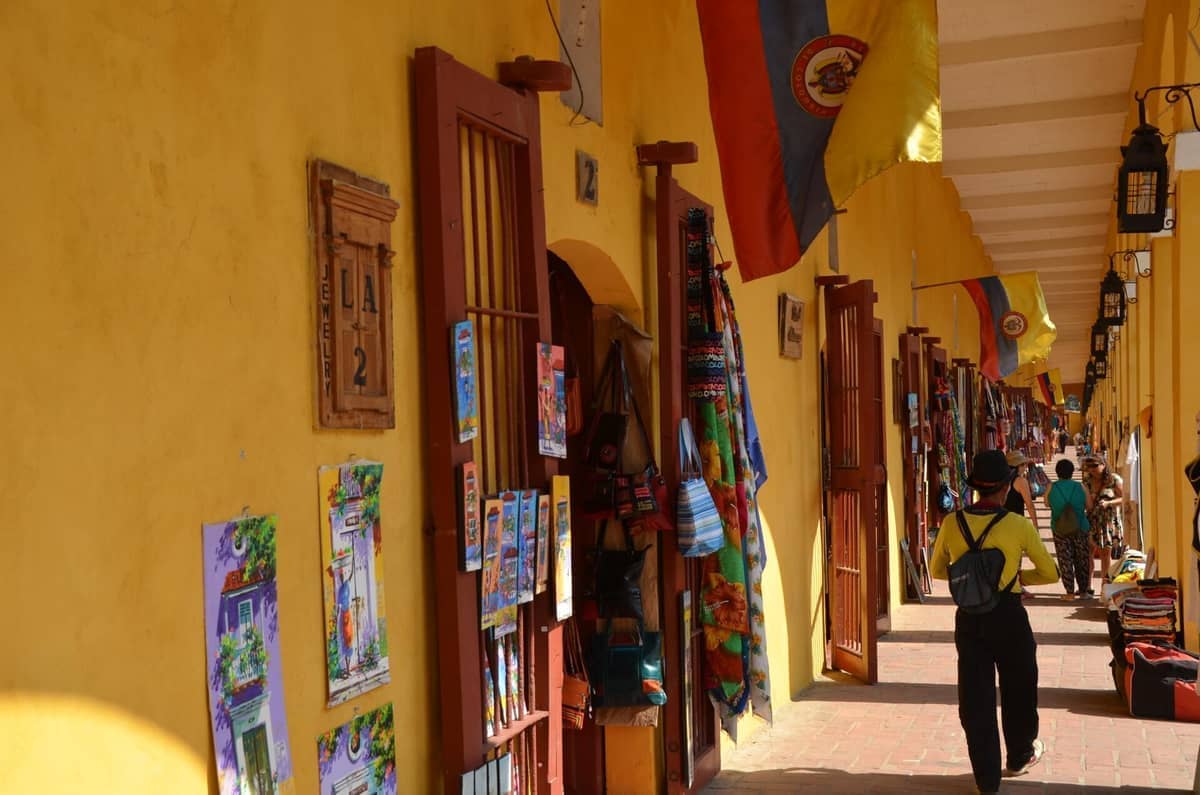
Today, each vault has been converted into a small shop or gallery. The arcade runs along a covered walkway parallel to the sea, shaded by the mass of the wall above. The 47 arches that frame the corridor give the space its distinctive rhythm: each arch frames the next, and on a bright afternoon the contrast between the cool stone interior and the sharp Caribbean light outside is one of the more striking visual details you'll encounter inside the old city.
ℹ️ Good to know
Opening hours are generally daily around 8:00 AM to 6:30 PM, though individual shops set their own schedules. A handful of vendors may close earlier or open later than the general window. There is no admission fee to walk the arcade.
The Architecture: Reading the Walls
The vaults are part of the broader fortification system that encircles Cartagena's historic center, the same walls you can walk along for views over the Caribbean. If you want context before arriving, the Cartagena city walls page covers the full circuit and history of the defensive perimeter. Las Bóvedas sits at the northern tip of that circuit, where the wall turns toward the Caribbean Sea.
What distinguishes the architecture here from other sections of the fortifications is the density and regularity of the chambers. The builders used brick and lime mortar in a series of identical barrel vaults, each vault roughly the size of a large room. The walls absorb sound, which means the arcade is noticeably quieter than the streets outside even when shoppers are present. You can feel the thermal mass of the stone: it stays several degrees cooler inside the vaults than on the sunny plaza just outside, which matters considerably in Cartagena's heat.
The exterior face of this wall section overlooks a narrow strip of waterfront. From the top of the wall directly above the vaults, you get a clear view across the water toward the Manga peninsula. The walkway up to this section of wall is accessible from the ramp near the Baluarte de Santa Clara. Bring sunscreen if you plan to spend time on the wall itself: there is minimal shade once you are on the upper parapet.
Tickets & tours
Hand-picked options from our booking partner. Prices are indicative; availability and final rates are confirmed when you complete your booking.
Glass-bottom boat tour to San Andres aquarium and mangroves
From 21 €Instant confirmationFree cancellationBaru Terrestre and Islas Del Rosario Pasadia full day tour
From 40 €Instant confirmationFree cancellationTotumo Volcano and lunch at a VIP hotel from Cartagena
From 34 €Instant confirmationFree cancellationCity tour of Cartagena with entry to San Felipe castle
From 25 €Instant confirmationFree cancellation
What You Will Find in the Shops
The 23 vaults now operate as a concentrated souvenir and craft market. Stock varies by vendor, but common offerings include hand-painted ceramics, woven bags and accessories made from fique fiber (a native plant material), carved wood pieces, hammocks, Panama-style hats, emerald and silver jewelry, and reproductions of pre-Columbian goldwork designs. The quality range is wide: some vendors sell mass-produced items almost identical to what you'd find at any tourist market in Colombia, while others stock genuinely handmade pieces with a corresponding price difference.
Bargaining is practiced here, though not as aggressively as at some open-air markets. If you are buying multiple items from one vendor, asking for a combined price is reasonable and usually expected. Prices are quoted in Colombian pesos (COP). Smaller craft items start around COP 1,000; quality artisan pieces and jewelry can run well above COP 500,000. Vendors generally accept cash; card acceptance varies and should not be assumed.
💡 Local tip
For a broader sense of what artisan goods look like before prices are quoted at you, walk the full length of the arcade once without stopping. It takes about five minutes and lets you compare what's available across all 23 vaults before committing to any negotiation.
How the Experience Changes Through the Day
Early morning, roughly 8:00 to 10:00 AM, is when the arcade is at its quietest. Vendors are setting up, the light is still soft, and you can examine the architecture without navigating around tour groups. The stone smells faintly of salt and old lime mortar at this hour, before the foot traffic and vendor activity produce the mix of incense, leather, and fresh varnish that characterizes the middle of the day.
From around 10:30 AM onward, organized tours begin arriving, many of them cruise passengers who have a limited window in the city. By midday the corridor can feel crowded, particularly in the December to March dry season when tourist numbers peak. If you are visiting during this high period, arriving before 10:00 AM or after 4:00 PM will give you a substantially different, calmer experience.
The late afternoon light, particularly in the hour before 6:00 PM, is when the waterfront side of the wall catches the best angle for photography. The orange-gold tone of the light on the coral stone and brick is one of those details that makes Cartagena's colonial architecture look genuinely exceptional rather than just old. This is also when the temperature drops slightly, making it a more comfortable time to walk the wall section above the vaults.
Getting There and Practical Logistics
Las Bóvedas is located in the Centro Histórico, at the northern end of the San Diego neighborhood. The most straightforward approach on foot is from Plaza de San Diego, a five-minute walk northeast along Calle del Tablón. From the Torre del Reloj (the main gate to the walled city), the walk along the interior streets takes 15 to 20 minutes. You can also reach it by walking along the top of the city walls from the Baluarte de San Francisco Javier section.
If you are arriving by taxi from Bocagrande or the airport area, ask to be dropped at the Playa del Tejadillo side or near the Baluarte de Santa Catalina. Cartagena does not have a metro; the Transcaribe bus system serves parts of the city, but most visitors reach the walled city on foot or by taxi. Rideshare apps including Uber operate in Cartagena and can drop you close to the historic walls.
Wear comfortable, flat-soled shoes. The historic streets around Las Bóvedas are uneven cobblestone, and if you plan to walk the wall above, the ramps and parapets are also irregular. The arcade itself is at street level, which makes it physically accessible to most visitors, but the age of the structure means there are no formal accessibility provisions that can be confirmed in advance. Anyone with significant mobility concerns should check conditions locally before planning a visit.
⚠️ What to skip
Cartagena's heat and humidity are not trivial. Between 11:00 AM and 3:00 PM, temperatures regularly reach 30–33°C (86–91°F) with high humidity. Bring water, wear sunscreen, and plan shaded rest breaks if you are combining Las Bóvedas with a longer wall walk or broader city exploration.
Historical Context: From Dungeon to Market
The construction of Las Bóvedas in the 1790s came at a point when Cartagena de Indias was still a critical Spanish colonial port, one of the primary embarkation points for silver and gold leaving South America for Spain. The city's defensive infrastructure had been reinforced repeatedly over two and a half centuries, and these final vaults represented a late investment in a fortification system that was soon to become historically redundant. Colombia's independence in the early 19th century effectively ended the military purpose of the vaults.
During and after the independence period, the chambers were repurposed as a prison, a use that continued into the early Republican era. The transition to a craft market came in the latter half of the 20th century as part of broader efforts to activate the heritage structures of the San Diego district for tourism. The entire walled city was designated a UNESCO World Heritage Site in 1984, which brought international attention and investment to the conservation of structures including Las Bóvedas.
The 47 arches and 23 vaults figure cited in official Colombian tourism sources gives a specific structural identity to the complex that most visitors don't register when simply browsing the shops. It is worth pausing at either end of the arcade to look down the full length of the corridor and recognize what you are standing inside: a military engineering project from the final decade of colonial rule, now filled with handmade goods and Caribbean afternoon light.
Practical Assessment: Is It Worth Your Time?
Las Bóvedas is genuinely interesting architecturally. As a shopping experience, it is competent but not exceptional: the same types of items are available throughout the Centro Histórico, often at similar prices. If your primary goal is souvenir shopping, you are not missing anything by spending time at other markets. If your goal is to understand what Cartagena's fortifications actually look and feel like from the inside, this is one of the more accessible and visually coherent spots to do that.
Cruise passengers with a half-day in port often treat Las Bóvedas as a primary stop, which is why midday crowds can be significant during peak season. If you are staying in Cartagena for multiple days, you have the advantage of visiting at off-peak hours and combining it with a walk along the walls or a stop at the nearby Museo Naval del Caribe, which provides direct historical context for the colonial port and its defenses. That combination of the naval museum and the vaults makes for a coherent half-day itinerary that most visitors don't plan but find rewarding.
Travelers who find open-air markets or craft arcades generally uninteresting should skip Las Bóvedas unless architecture is independently motivating for them. The historical significance is real, but it requires some active engagement with context to appreciate; the site does not explain itself particularly well from within the shops themselves.
Insider Tips
- Walk the full length of the arcade before entering any shop. It takes five minutes and you'll immediately see which vendors have genuinely handmade work versus mass-produced items, which makes your time and bargaining energy more focused.
- The wall walkway directly above the vaults connects to the broader city wall circuit. If you climb up from the Baluarte de Santa Clara ramp, you can walk above the vaults and look down at the rooftops of San Diego on one side and the Caribbean on the other. Most visitors never make this short detour.
- Light inside the vaults is dim and slightly blue in tone. If you are photographing ceramics, textiles, or jewelry to remember before you buy, use your phone's portrait mode or step to the threshold of the vault opening for natural light.
- Vendors at the far ends of the arcade (furthest from the main approach from Plaza de San Diego) tend to have slightly less foot traffic and are sometimes more willing to negotiate, simply because fewer buyers pass through.
- If you are visiting in December or during Cartagena's festival season, note that the plaza adjacent to the vaults near the waterfront occasionally hosts evening events. Checking local listings for what's on near Las Bóvedas can add an unexpected dimension to an evening walk in this part of the walled city.
Who Is Las Bóvedas For?
- Architecture and history travelers who want to see colonial military engineering repurposed rather than just preserved behind glass
- First-time visitors to Cartagena doing an orientation walk through the walled city
- Cruise day-trippers with limited time who want a compact, free-entry site with shopping and historical interest combined
- Shoppers looking for Colombian craft souvenirs in a single concentrated location with multiple vendors to compare
- Photographers working the late-afternoon light on colonial stonework
Nearby Attractions
Other things to see while in Centro Histórico (Ciudad Amurallada):
- Cartagena City Walls (Murallas)
The Murallas de Cartagena de Indias are the best-preserved colonial defensive walls in the Americas, ringing the historic center with roughly 3 kilometers of coral-stone ramparts, cannons, and Caribbean sea views within an 11-kilometer defensive system overall. Entry is free, the walk takes 1 to 3 hours depending on your pace, and the experience changes dramatically depending on the time of day you show up.
- Catedral Santa Catalina de Alejandría
Standing at the east corner of Parque de Bolívar in Cartagena de Indias, the Catedral Basílica Metropolitana de Santa Catalina de Alejandría is one of the oldest episcopal sees in the Americas. Construction began in the 16th century, and the building remains the seat of the Archbishop of Cartagena de Indias today. Entry is free, the doors open daily, and the surrounding plaza makes this one of the most rewarding stops in the entire Centro Histórico.
- Iglesia de Santo Domingo
The Iglesia de Santo Domingo is widely considered the oldest surviving church in Cartagena de Indias, anchoring a plaza that doubles as one of the historic center's most lively gathering points. The building itself rewards close inspection, while the square around it offers a completely different experience depending on the hour you arrive.
- India Catalina Statue
Standing at the entrance to Cartagena de Indias, the bronze India Catalina Statue has marked the city's identity since 1974. Free, open around the clock, and loaded with historical weight, it is the first landmark many visitors encounter and the last symbol they remember.