Museo Naval del Caribe: Cartagena's Window into Caribbean Naval History
Housed in a restored colonial building in the Centro Histórico, the Museo Naval del Caribe traces Cartagena's role as the Spanish Empire's most fortified Caribbean port. With exhibits spanning colonial warships, naval battles, and the modern Colombian Navy, it offers genuine historical depth at a modest price.
Quick Facts
- Location
- Calle San Juan de Dios (Calle 31) #3–26, Plaza Santa Teresa, Centro Histórico, Cartagena de Indias
- Getting There
- Walkable from the Torre del Reloj gate and Plaza de la Aduana; 10–15 min taxi from Bocagrande or Getsemaní
- Time Needed
- 1 to 1.5 hours for a thorough visit; allow extra time if you read exhibit panels in full
- Cost
- Adults approx. 23,000 COP; students/seniors 10,000 COP; military 5,000 COP; children approx. 2,000 COP. Verify locally as prices are updated periodically.
- Best for
- History enthusiasts, families with older children, visitors seeking air-conditioned relief from the midday heat
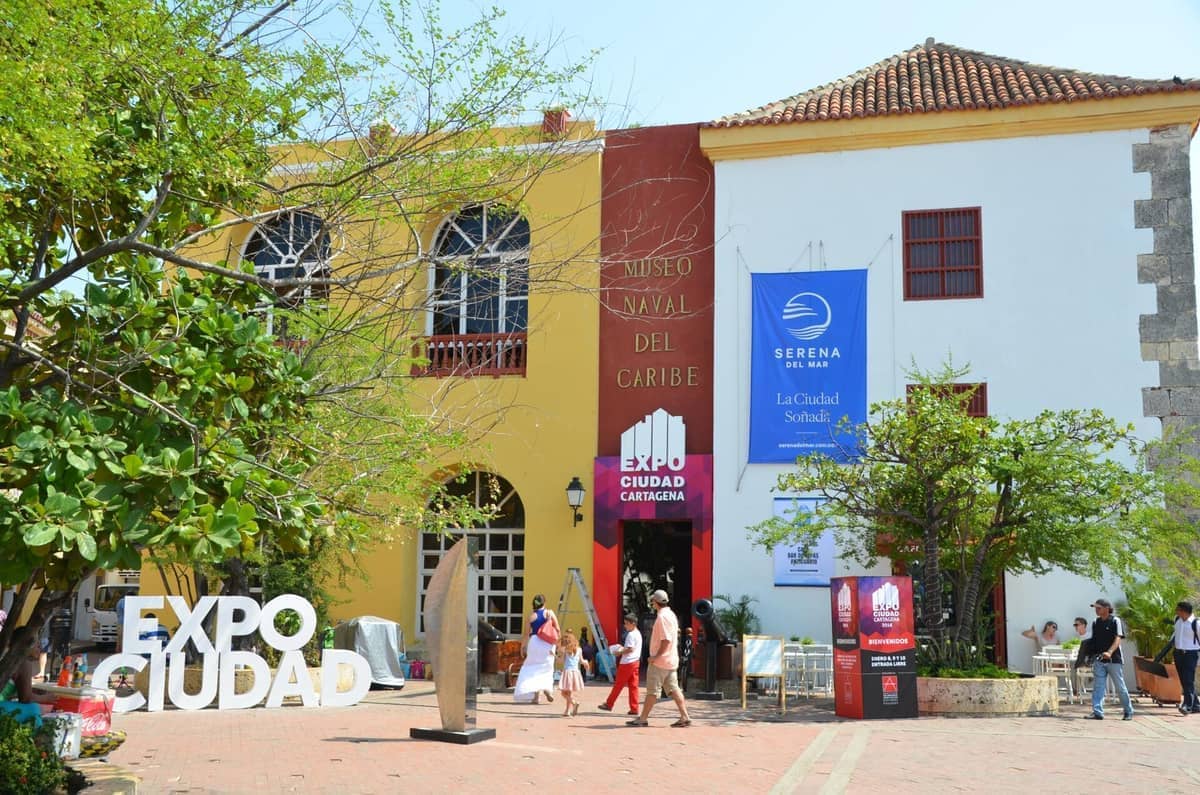
What the Museo Naval del Caribe Actually Is
The Museo Naval del Caribe, also known in English as the Caribbean Naval Museum, occupies a carefully restored colonial structure on Calle San Juan de Dios, just off Plaza Santa Teresa in Cartagena's walled historic center. It is open daily from 10:00 a.m. to 6:00 p.m., with extended hours from 9:00 a.m. to 6:00 p.m. during vacation periods. Entry is straightforward, affordable by any standard, and the museum is rarely crowded enough to feel overwhelming.
The subject matter is specific: this is a museum about Cartagena's naval identity, covering the Spanish colonial fleet, Caribbean maritime battles, the fortification of the port city, and the evolution of the Colombian Navy. It does not try to be a broad history museum for the entire country. That focus is actually its strength. Visitors who engage with the exhibits come away understanding why Cartagena de Indias was considered the most strategically valuable port on the Spanish Main, and how that status shaped every wall, castle, and cannon emplacement still visible across the city today.
💡 Local tip
Visit between 10:00 a.m. and noon on weekdays for the lightest crowds. The interior is air-conditioned, making this an ideal stop during the hottest part of the day, when Cartagena's heat and humidity peak.
The Building: Colonial Architecture With a Naval Past
The museum's setting amplifies its content. The building is a colonial-era structure in the heart of the old town, with thick plastered walls, inner courtyards, and the kind of architectural permanence that signals centuries of institutional use. It connects visually and historically to the wider fabric of the Centro Histórico, where colonial military and administrative buildings dominate the streetscape.
Standing in the courtyard, you can sense the relationship between the building's scale and Cartagena's original function as a fortified port. The city's colonial city walls and the massive Castillo San Felipe de Barajas were all part of the same defensive ecosystem that the museum documents. Seeing the maps and models inside gives those landmarks a sharper context when you walk past them afterward.
One practical note on the architecture: the museum spreads across two levels connected by stairs. There is limited elevator access, and some sections may be difficult for visitors with mobility constraints. If this applies to you or someone in your group, contact the museum directly before your visit to confirm which areas are accessible.
Tickets & tours
Hand-picked options from our booking partner. Prices are indicative; availability and final rates are confirmed when you complete your booking.
Baru Terrestre and Islas Del Rosario Pasadia full day tour
From 40 €Instant confirmationFree cancellationTotumo Volcano and lunch at a VIP hotel from Cartagena
From 34 €Instant confirmationFree cancellationCity tour of Cartagena with entry to San Felipe castle
From 25 €Instant confirmationFree cancellationSan Andres Islands pontoon tour through the inner bay
From 26 €Instant confirmationFree cancellation
What You'll Find Inside: The Exhibits
The collection covers several interlocking themes. The colonial naval history section deals with the Spanish Empire's use of Cartagena as a treasure fleet staging point, the fortification strategies employed against English and Dutch privateers, and the major naval engagements that took place in Caribbean waters. Scale models of period vessels are among the most visually engaging elements, giving non-specialists an immediate sense of the ships involved.
A second core area covers the development of the Colombian Navy after independence in the 19th century, tracing how the institution evolved from the remnants of the Spanish colonial fleet. There are uniforms, navigational instruments, charts, and artifacts related to specific vessels and campaigns. The level of curatorial detail rewards those who read the panels carefully, and most labels are available in both Spanish and English.
Cartographic exhibits showing the Caribbean Sea as it was mapped by colonial powers are particularly worth pausing over. They reveal how European empires understood and contested this region, and why Cartagena's position on the northern coast of what is now Colombia made it the linchpin of Spanish maritime commerce.
ℹ️ Good to know
Exhibit labels are provided in Spanish and English, so non-Spanish speakers can follow the narrative without a guide. That said, a guided tour or audio commentary, if available on your visit date, adds significant depth to the colonial military history sections.
How the Visit Changes Through the Day
Morning visits, particularly on weekdays, are the quietest. School groups occasionally arrive mid-morning, but they tend to move quickly through the space. By early afternoon, when outdoor heat in Cartagena typically reaches its peak between 28 and 32 degrees Celsius, the museum attracts a secondary wave of tourists seeking shade and cool air. It does not become uncomfortably crowded even then, but if you prefer the space nearly to yourself, aim for opening time.
Late afternoon, in the hour before closing, the light changes in the courtyard and the street outside grows more active with the city's late-day rhythm. If you time your exit around 5:00 p.m., the surrounding streets of the Centro Histórico are at their most photogenic and sociable, with vendors setting up near Plaza de la Aduana and the sound of cumbia occasionally drifting from nearby cafes.
Getting There and Getting In
The museum is located at Calle San Juan de Dios (Calle 31) #3–26, adjacent to Plaza Santa Teresa. It is a short walk from the Torre del Reloj, the main gate into the walled city, and within easy reach of the Palacio de la Inquisición and the Plaza de Bolívar. Most visitors staying in the Centro Histórico can walk here in under ten minutes from anywhere within the walled city.
From Getsemaní or Bocagrande, a taxi is the most practical option and will cost well under 20,000 COP for a short ride. Rafael Núñez International Airport (IATA: CTG) is roughly 3 to 7 kilometers away depending on route; a taxi from the airport to the Centro Histórico typically runs around 16,000 to 20,000 COP, though fares should be confirmed locally as prices are subject to change.
Admission as of 2026 is approximately 23,000 COP for adults (around US$5.70), with reduced rates of 10,000 COP for students and seniors, 5,000 COP for military personnel, and a nominal fee of 2,000 COP for children. A 2026 local guide reported slight price adjustments, so verify the current rate at the door. Cash in Colombian pesos is the safest assumption, though practices vary.
Photography, Practicalities, and What to Bring
Photography is generally permitted in the public exhibit areas, though flash may be restricted around fragile documents and maps. The interior is well-lit, so a phone camera performs adequately. The courtyard offers the best natural light and functions as a good compositional backdrop against the colonial facade.
Dress comfortably for the heat outside, but carry a light layer if you are sensitive to air conditioning. Comfortable walking shoes are sensible, both for the museum's tiled floors and for the cobblestone streets you will navigate getting there and afterward. There is no formal dress code.
If you are building a half-day route through the historic center, the museum pairs naturally with a visit to the Catedral Santa Catalina de Alejandría and the Santuario San Pedro Claver, both within a few minutes' walk. Consider the colonial architecture guide for a structured route connecting these sites.
Practical Assessment: Who Benefits and Who Might Skip It
The Museo Naval del Caribe is a well-maintained, substantive museum that delivers genuine historical insight at a very low cost. It is not a spectacle. There are no interactive multimedia installations, no dramatic recreations, and no gift shop that will detain you for twenty minutes. What it offers is a coherent, carefully curated account of Cartagena's maritime significance over four centuries.
Visitors primarily interested in beaches, nightlife, or a quick Instagram tour of the colonial streets will find little reason to spend ninety minutes here. Young children may lose interest in exhibit panels relatively quickly, though the ship models hold attention better than text-heavy displays. For travelers curious about why Cartagena looks the way it does, why every hilltop has a cannon, and why the Spanish invested extraordinary resources in fortifying this particular city, the museum provides the clearest and most accessible answers available in the city.
⚠️ What to skip
The building has multiple floors connected by stairs with limited elevator access. Visitors with significant mobility limitations should contact the museum directly at museonavaldelcaribe.org before visiting to confirm which sections are accessible.
Insider Tips
- Arrive at opening time on a weekday morning. The museum is nearly empty before 11:00 a.m., and the lack of ambient noise makes reading the cartographic panels far more rewarding.
- The scale models of colonial warships are concentrated in one gallery and are the most immediately engaging part of the collection for visitors who do not read every label. Do not rush through that room.
- Combine your visit with the Palacio de la Inquisición a few blocks away on the same morning. Both museums are low-key, air-conditioned, and genuinely informative, and together they fill a comfortable two-to-three-hour history block without physical strain.
- Bring exact change in Colombian pesos for the entry fee. While payment practices vary, smaller institutions in the Centro Histórico often prefer cash and may not always have change for large bills.
- The courtyard of the museum building is worth a few minutes of quiet observation before you start moving through the exhibits. The architecture itself is part of the story, and pausing there grounds you in the colonial-era setting before the content hits.
Who Is Museo Naval del Caribe For?
- History and military history enthusiasts who want context for Cartagena's fortifications
- Travelers visiting on a tight budget who want substance over spectacle
- Anyone needing a cool, quiet midday break from the heat of the Centro Histórico
- Families with older children and teenagers who engage with naval and colonial history
- First-time visitors to Cartagena who want to understand the city's strategic and architectural logic before exploring its streets
Nearby Attractions
Other things to see while in Centro Histórico (Ciudad Amurallada):
- Cartagena City Walls (Murallas)
The Murallas de Cartagena de Indias are the best-preserved colonial defensive walls in the Americas, ringing the historic center with roughly 3 kilometers of coral-stone ramparts, cannons, and Caribbean sea views within an 11-kilometer defensive system overall. Entry is free, the walk takes 1 to 3 hours depending on your pace, and the experience changes dramatically depending on the time of day you show up.
- Catedral Santa Catalina de Alejandría
Standing at the east corner of Parque de Bolívar in Cartagena de Indias, the Catedral Basílica Metropolitana de Santa Catalina de Alejandría is one of the oldest episcopal sees in the Americas. Construction began in the 16th century, and the building remains the seat of the Archbishop of Cartagena de Indias today. Entry is free, the doors open daily, and the surrounding plaza makes this one of the most rewarding stops in the entire Centro Histórico.
- Iglesia de Santo Domingo
The Iglesia de Santo Domingo is widely considered the oldest surviving church in Cartagena de Indias, anchoring a plaza that doubles as one of the historic center's most lively gathering points. The building itself rewards close inspection, while the square around it offers a completely different experience depending on the hour you arrive.
- India Catalina Statue
Standing at the entrance to Cartagena de Indias, the bronze India Catalina Statue has marked the city's identity since 1974. Free, open around the clock, and loaded with historical weight, it is the first landmark many visitors encounter and the last symbol they remember.