Palacio de la Inquisición: Cartagena's Most Sobering Colonial Landmark
The Palacio de la Inquisición, completed in 1770 and now home to the Museo Histórico de Cartagena de Indias (MUHCA), stands on Plaza de Bolívar at the heart of the Centro Histórico. Behind one of the finest Baroque facades in the Americas lies a frank reckoning with the Spanish Inquisition and three centuries of colonial power. Allow at least 90 minutes to do it justice.
Quick Facts
- Location
- Plaza de Bolívar, Centro Histórico, Cartagena de Indias, Colombia
- Getting There
- Walk from anywhere in the Walled City; no metro exists in Cartagena. Taxis from Rafael Núñez Airport (CTG) to Centro Histórico cost roughly COP 16,000–20,000 (verify before travel).
- Time Needed
- 90–120 minutes for a thorough visit
- Cost
- COP 24,000 adults / COP 20,000 children, students, professors, older adults (as of 2026 — verify before visiting)
- Best for
- History enthusiasts, architecture lovers, travelers who want colonial context beyond the pretty streets
- Official website
- www.muhca.gov.co
What the Palacio de la Inquisición Actually Is
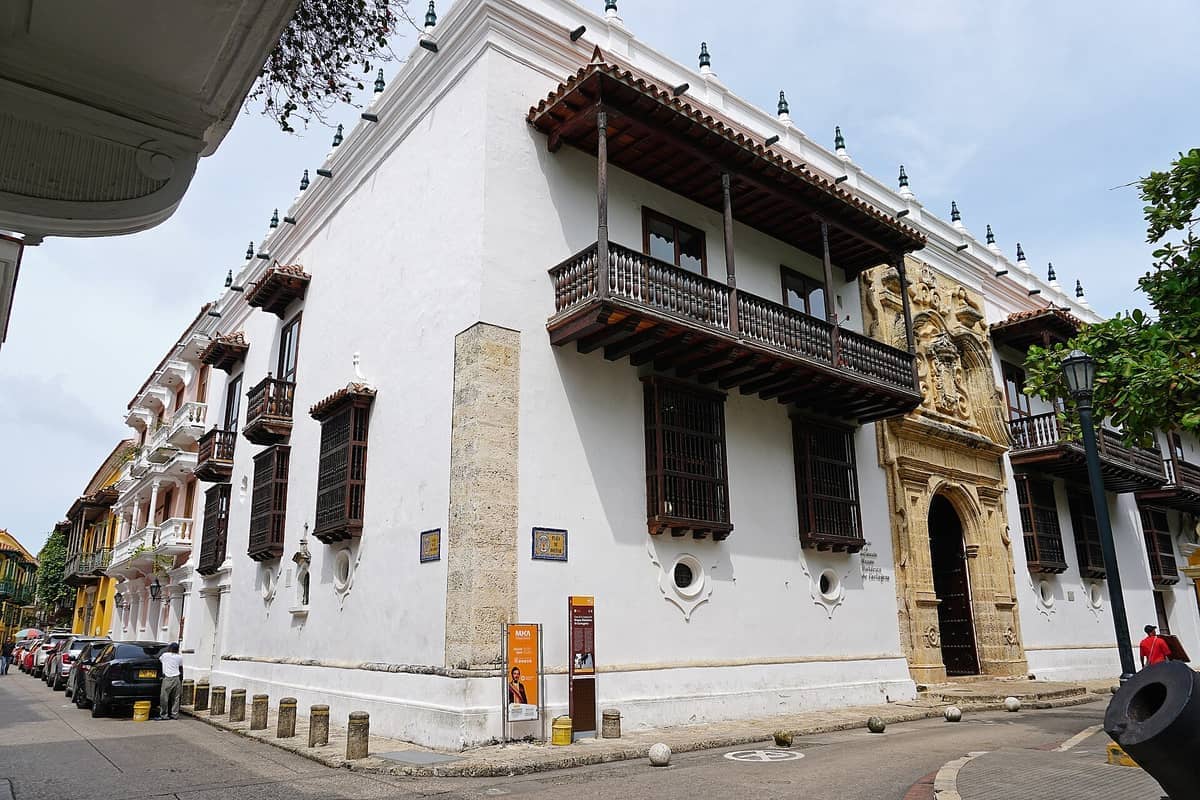
The Palacio de la Inquisición — officially the Museo Histórico de Cartagena de Indias, or MUHCA — occupies the entire western flank of Plaza de Bolívar, the colonial heart of Cartagena's Centro Histórico. The building was completed in 1770 after decades of construction, making it a late but definitive example of New Granada Baroque. Its most recognizable feature is the main portal: a layered stone doorway with carved heraldic shields, undulating pilasters, and an arched window above that frames the street below like a stage set. Spend a moment studying it before you enter — the craftsmanship is genuinely rare.
From 1610 onward, this site served as the seat of the Tribunal del Santo Oficio, the Spanish Inquisition's branch in New Granada. That tribunal had jurisdiction over a vast territory and prosecuted cases of heresy, blasphemy, bigamy, and witchcraft across what is now Colombia, Venezuela, Panama, and Ecuador. In 1953, the building was repurposed as a public museum. Today it holds permanent collections on the Inquisition itself, pre-Columbian cultures of the Caribbean coast, the colonial city's political history, and the independence era.
💡 Local tip
Opening hours: Monday–Saturday 9:00 a.m.–6:00 p.m.; Sundays and holidays 10:00 a.m.–4:00 p.m. Arrive before 10:00 a.m. on weekdays if you want to move through the rooms without crowds pressing behind you.
The Architecture: Reading the Facade Before You Go In
The building's exterior is worth at least ten minutes of attention before you cross the threshold. The main portal belongs to the Churrigueresque tradition — a heavily ornamented Spanish Baroque style that arrived late to the colonies and was adapted by local stonemasons using coral limestone, the same material found throughout the Walled City. The texture is rough to the touch and warm in color, catching the Caribbean sun differently at each hour of the day.
In the early morning, when the plaza is relatively quiet and the light comes in low from the east, the carved relief of the doorway casts deep shadows that make the sculptural detail far more legible than at midday, when harsh overhead light flattens everything. Photographers should note this. The second-floor balconies of wrought iron are original colonial ironwork — a detail easy to miss when you are focused on the portal. This architectural tradition is explored further in the guide to Cartagena's colonial architecture, which places MUHCA in the broader context of the Walled City's built heritage.
Tickets & tours
Hand-picked options from our booking partner. Prices are indicative; availability and final rates are confirmed when you complete your booking.
Totumo Volcano and lunch at a VIP hotel from Cartagena
From 34 €Instant confirmationFree cancellationCity tour of Cartagena with entry to San Felipe castle
From 25 €Instant confirmationFree cancellationSan Andres Islands pontoon tour through the inner bay
From 26 €Instant confirmationFree cancellationGlass-bottom boat tour to San Andres aquarium and mangroves
From 21 €Instant confirmationFree cancellation
Inside: What the Collections Show You
The ground floor and courtyard deal most directly with the Inquisition's procedures. Display cases hold instruments associated with interrogation and punishment, presented alongside explanatory panels that contextualize their use within the legal framework of the period. The museum does not sensationalize, which is both its strength and, for some visitors, a source of mild frustration: the narrative is academic rather than visceral. What you gain is a clearer sense of how the Inquisition functioned bureaucratically — the paperwork, the legal categories, the social hierarchies it reinforced — rather than a horror-show parade of torture devices.
The upper floors shift to wider historical themes. Pre-Columbian ceramic and gold pieces from the Caribbean coast cultures are displayed in cases that feel slightly undersized for the significance of the objects, but the artifacts themselves reward close attention. A separate section covers Cartagena's role in the independence movement and the figures who shaped the early republic. The building's internal courtyard, with its two-tiered arcaded gallery, is among the most architecturally intact colonial courtyards in the city — cool, shaded, and genuinely quiet once you are away from the entrance.
ℹ️ Good to know
Accessibility note: At least one visitor source flags the building as not fully accessible for people with mobility limitations. The colonial structure has uneven stone floors and steps between levels. Confirm directly with the museum at +57 5 6606025 before visiting if this is a concern.
How the Experience Changes by Time of Day
The museum's position on Plaza de Bolívar means the surrounding context shapes the visit as much as the interior does. The plaza itself is one of the busiest pedestrian spaces in the city. By mid-morning, tour groups from cruise ships arrive in numbers, and the ground-floor Inquisition rooms can feel congested. The ambient noise — Spanish, English, Italian, all mixing — works against the reflective mood the subject matter calls for.
Weekday mornings between 9:00 and 10:30 a.m. are consistently the quietest window. The air inside is noticeably cooler than the street, which matters in a city where midday temperatures regularly reach 31–32°C. By early afternoon, the heat outside drives people indoors and the museum fills again. Sunday afternoons, when the reduced hours apply (closing at 4:00 p.m.), can be surprisingly calm after about 2:00 p.m. as morning visitors have cycled through.
Placing MUHCA in the Context of the Historic Center
The plaza immediately in front of the museum is anchored by a statue of Simón Bolívar and lined with horse-drawn carriages and street vendors selling cold drinks and local sweets. The contrast between the solemn interior and the animated square outside is part of what makes the visit interesting. Two minutes' walk in any direction takes you to other significant colonial structures: the Catedral Santa Catalina de Alejandría faces the plaza directly, and the Santuario de San Pedro Claver is a short walk southwest, offering a very different moral lens on the same colonial period.
For travelers building a full day in the historic center, MUHCA pairs well with a morning at the Museo del Oro Zenú and an afternoon walk along the Cartagena city walls. The three sites together cover pre-Columbian culture, the colonial period, and the urban structure that defined the city — a logical arc if you are trying to build genuine understanding rather than just collect photographs.
Practical Details for Your Visit
The museum is fully walkable from any point in the Walled City. There is no dedicated parking for private vehicles in the immediate vicinity of Plaza de Bolívar; taxis and ride-hailing apps (Uber and inDrive both operate in Cartagena) can drop you at the plaza perimeter. The entrance is on the plaza-facing facade — straightforward to find.
Admission prices as of 2026 were COP 24,000 for adults and COP 20,000 for children, students, professors, and older adults. Some older web pages still list lower legacy prices; always confirm at the door or via the official MUHCA website before budgeting. Signage inside the museum is primarily in Spanish, with some English translations in the main Inquisition rooms. If your Spanish is limited and the subject matter matters to you, a guided tour is worth arranging in advance.
⚠️ What to skip
Weather consideration: Cartagena's rainy season runs May through November, with heaviest rain in September and October. The museum itself is unaffected by rain, which makes it a sensible option on a wet afternoon. However, the plaza outside floods in heavy downpours and can make arrival messy — wear closed shoes rather than sandals if visiting during this period.
Travelers planning a broader itinerary can find useful context in the 3-day Cartagena itinerary, which positions MUHCA alongside the city's other key stops. If you are traveling in the dry season and weighing whether this fits your schedule, the full list of things to do in Cartagena gives a broader picture of what competes for your time.
Who Should Skip This
If your primary interest in Cartagena is beaches, nightlife, or colonial ambiance at a surface level, the Palacio de la Inquisición may not be the best use of your limited time. The museum requires genuine engagement with dense historical material presented in a relatively austere environment. Young children will likely find the experience slow and the displays difficult to interpret without adult guidance. Visitors with mobility limitations should call ahead, as the building's colonial structure presents real access challenges.
It is also worth saying plainly: the building's reputation sometimes draws visitors who expect a chamber of horrors. The museum is more nuanced and more educational than that, which is the right call historically, but it does mean the experience can feel underwhelming if you came for shock value rather than substance.
Insider Tips
- The interior courtyard is freely accessible once you have paid admission and is one of the quietest spots in the entire historic center at midday. Bring a notebook or just sit on one of the stone benches — the two-tiered arcade is remarkably intact and worth more time than most visitors give it.
- Museum staff at the ticket desk sometimes have English-speaking guides available on an informal basis. Ask directly when you arrive rather than assuming. The difference in comprehension for non-Spanish readers is significant given that most room signage defaults to Spanish.
- The view from the upper balcony looking across Plaza de Bolívar toward the cathedral is one of the better vantage points in the Centro Histórico for understanding the spatial logic of the colonial city — all the institutional buildings of Church and State arranged around a single civic square.
- Admission prices have changed more than once in recent years. The COP 24,000 / COP 20,000 split was current as of 2026, but check the official MUHCA website (muhca.gov.co) or call +57 5 6606025 before you arrive to avoid surprises.
- If you visit during the rainy season (May through November), the museum makes an excellent first stop of the morning before rain typically arrives in the afternoon. Plan outdoor activities — the city walls, plazas, street art in Getsemaní — for the morning hours instead.
Who Is Palacio de la Inquisición For?
- History travelers who want to understand Cartagena's colonial period beyond its photogenic streets
- Architecture enthusiasts drawn to New Granada Baroque stonework and intact colonial courtyards
- Travelers on a full day in the historic center combining museums with the city walls and nearby churches
- Independent visitors who prefer self-guided, quiet exploration over high-energy tourist experiences
- Anyone arriving during the rainy season who needs a substantive indoor option
Nearby Attractions
Other things to see while in Centro Histórico (Ciudad Amurallada):
- Cartagena City Walls (Murallas)
The Murallas de Cartagena de Indias are the best-preserved colonial defensive walls in the Americas, ringing the historic center with roughly 3 kilometers of coral-stone ramparts, cannons, and Caribbean sea views within an 11-kilometer defensive system overall. Entry is free, the walk takes 1 to 3 hours depending on your pace, and the experience changes dramatically depending on the time of day you show up.
- Catedral Santa Catalina de Alejandría
Standing at the east corner of Parque de Bolívar in Cartagena de Indias, the Catedral Basílica Metropolitana de Santa Catalina de Alejandría is one of the oldest episcopal sees in the Americas. Construction began in the 16th century, and the building remains the seat of the Archbishop of Cartagena de Indias today. Entry is free, the doors open daily, and the surrounding plaza makes this one of the most rewarding stops in the entire Centro Histórico.
- Iglesia de Santo Domingo
The Iglesia de Santo Domingo is widely considered the oldest surviving church in Cartagena de Indias, anchoring a plaza that doubles as one of the historic center's most lively gathering points. The building itself rewards close inspection, while the square around it offers a completely different experience depending on the hour you arrive.
- India Catalina Statue
Standing at the entrance to Cartagena de Indias, the bronze India Catalina Statue has marked the city's identity since 1974. Free, open around the clock, and loaded with historical weight, it is the first landmark many visitors encounter and the last symbol they remember.