Museo del Oro Zenú: Cartagena's Pre-Columbian Gold Museum Explained
Operated by the Banco de la República and housed in the Centro Histórico, the Museo del Oro Zenú holds more than 600 gold, silver, and ceramic artifacts from the Zenú civilization. Entry is free, the visit takes about an hour, and the museum sits next to Parque de Bolívar — one of the most walkable spots in Cartagena's walled city.
Quick Facts
- Location
- Carrera 4 #33-26, Parque de Bolívar, Centro Histórico, Cartagena de Indias
- Getting There
- Walk from any hotel inside the walled city. Taxis drop off at Parque de Bolívar. Transcaribe buses serve the Centro Histórico perimeter.
- Time Needed
- 30–60 minutes
- Cost
- Free admission
- Best for
- History enthusiasts, first-time visitors to Cartagena, travelers seeking air-conditioned refuge from midday heat
- Official website
- www.banrepcultural.org
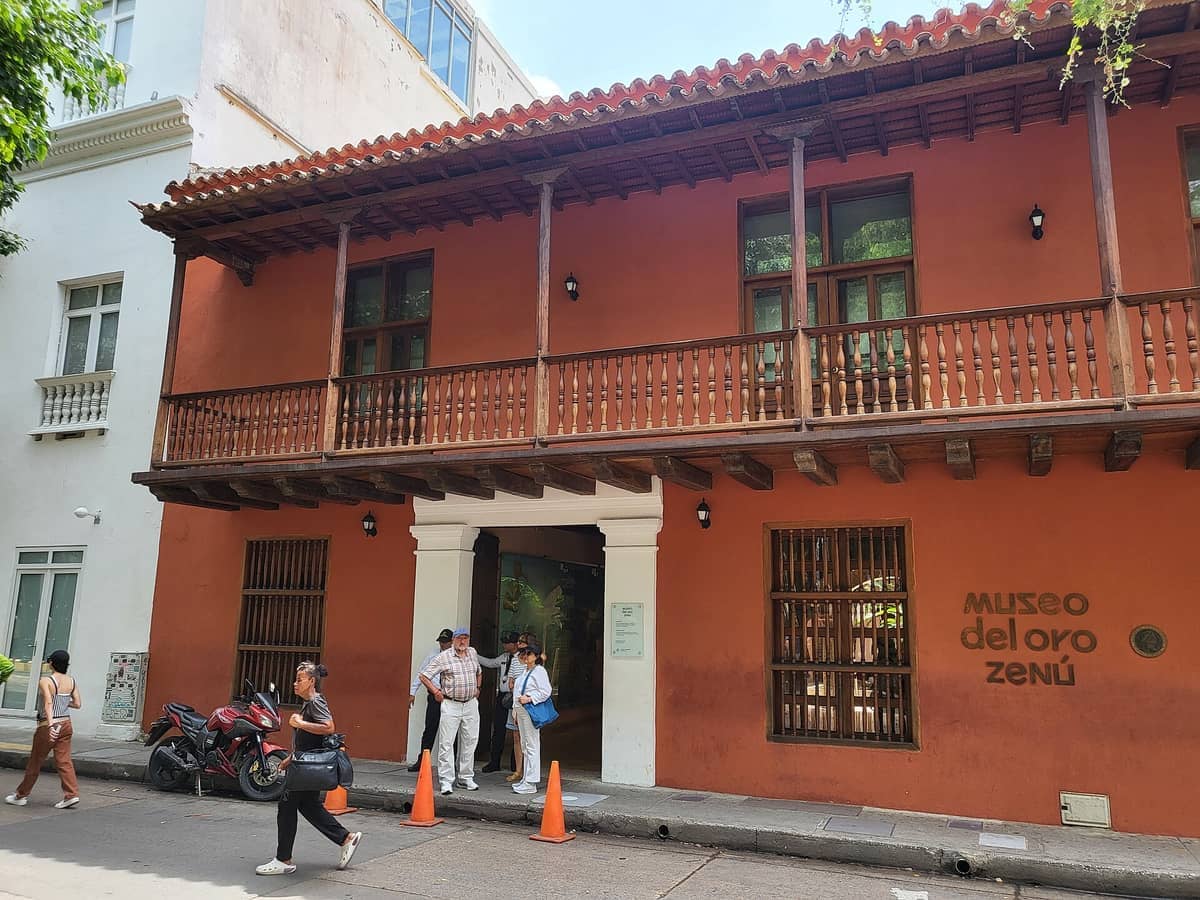
What Is the Museo del Oro Zenú?
The Museo del Oro Zenú del Banco de la República — commonly called the Zenú Gold Museum — is a free public museum dedicated to the pre-Columbian Zenú civilization, located inside Cartagena's walled city at Parque de Bolívar. Inaugurated in 1982 and administered by Colombia's central bank cultural network, it holds more than 600 pieces: cast and hammered gold ornaments, silver objects, and ceramics that the Zenú people used as adornments and ritual objects across what is now the Caribbean lowlands of northern Colombia.
This is not a large sprawling institution. It is a focused, well-curated single-building collection that can be absorbed in under 90 minutes. The fact that it is free, air-conditioned, and positioned next to one of the city's central squares makes it an easy addition to any morning in the historic center, but do not mistake compact for superficial. The objects on display represent sophisticated metallurgical traditions that predate European contact by centuries.
💡 Local tip
Tuesday to Saturday mornings, especially around opening time, the museum is often at its quietest. Arrive early if you want the galleries to yourself before organized tours and school groups arrive.
The Zenú Civilization: Why This Collection Matters
The Zenú were a pre-Hispanic indigenous people who inhabited the floodplains of the Sinú, San Jorge, and Cauca river systems in what is now northern Colombia. They are recognized by archaeologists for two remarkable achievements: an extensive hydraulic engineering system of raised-field agriculture and canals that covered vast areas of floodplain, and a goldworking tradition of exceptional technical refinement.
The gold pieces in this museum are not simply decorative. Filigree nose rings, elaborate pectoral discs, and zoomorphic figurines — many depicting birds, reptiles, and fish native to the Caribbean wetlands — functioned as markers of social rank, offerings to the dead, and objects of spiritual communication. Looking closely at the filigree work under the display lighting, the level of precision achieved without modern tools is genuinely striking. The wire-like threads of gold were drawn and twisted into geometric patterns that regional artisans still replicate today in the traditional weaving craft of the vueltiao hat, itself a symbol of Colombian Caribbean identity.
Understanding the Zenú helps contextualize the broader Caribbean region that Cartagena sits within. For deeper context on the Afro-Caribbean and Indigenous cultural layers still present in this part of Colombia, the Afro-Colombian culture guide covers related traditions, including the heritage community of San Basilio de Palenque.
Tickets & tours
Hand-picked options from our booking partner. Prices are indicative; availability and final rates are confirmed when you complete your booking.
Baru Terrestre and Islas Del Rosario Pasadia full day tour
From 40 €Instant confirmationFree cancellationTotumo Volcano and lunch at a VIP hotel from Cartagena
From 34 €Instant confirmationFree cancellationCity tour of Cartagena with entry to San Felipe castle
From 25 €Instant confirmationFree cancellationSan Andres Islands pontoon tour through the inner bay
From 26 €Instant confirmationFree cancellation
Inside the Museum: What You Will Actually See
The museum occupies a colonial-era building on the eastern edge of Parque de Bolívar. The interior is cool and relatively dim by design, the lighting calibrated to highlight the metalwork rather than illuminate the rooms broadly. On warmer days — which in Cartagena means most days, with temperatures typically between 29 and 32°C — the contrast between the outdoor heat and the museum's interior is immediate and welcome.
The collection is organized thematically rather than strictly chronologically, covering daily life, ritual practice, funerary customs, and the technical processes of goldworking. Bilingual labels in Spanish and English accompany most pieces, which makes independent visits genuinely workable for non-Spanish speakers. The ceramic pieces, sometimes overlooked in favor of the gold, are worth slowing down for: painted urns and anthropomorphic vessels reveal details about dress, body modification, and social hierarchy that the gold objects alone cannot communicate.
Photography is generally permitted in the permanent collection without flash, though visitors should verify current policy at the entrance desk. The building itself is worth a moment of attention: the thick colonial masonry, interior courtyard proportions, and tiled floors are characteristic of the civil architecture that defines the historic center.
When to Visit and How the Experience Changes
The museum is generally open Tuesday through Saturday from 9:00 to 17:00, and on Sunday from 9:00 to 14:00, and is closed on Mondays, though you should confirm current hours before your visit.
Midday, between roughly 12:00 and 14:30, is both the hottest part of the day outside and the busiest inside the museum, as visitors retreat from the sun. If you prefer a quieter experience, the 9:00 opening slot on a weekday gives you the galleries largely to yourself for the first hour. By late morning, tour groups from cruise ships and organized excursions tend to arrive — something worth knowing if you are visiting during peak season between December and April.
ℹ️ Good to know
Cartagena's dry season runs December through April, coinciding with higher tourist volumes across the historic center. The museum sees more traffic during these months. The rainy season (May through November) brings fewer visitors and a more relaxed atmosphere inside, though afternoon showers are common outside.
If you are building a full day around the Centro Histórico, the Museo del Oro Zenú pairs naturally with the Palacio de la Inquisición directly across Parque de Bolívar, and the Catedral Santa Catalina de Alejandría a short walk to the north. Together these three form a logical morning circuit without requiring any transport.
Getting There and Practical Logistics
The museum's address is Carrera 4 #33-26, directly facing Parque de Bolívar in the Centro Histórico. If you are staying inside the walled city, you can walk. If you are arriving from Bocagrande or Getsemaní, a taxi to Parque de Bolívar costs a few thousand pesos and usually takes around ten minutes in normal traffic. Transcaribe buses serve the exterior of the walled city, and the Torre del Reloj gate is the closest entry point on foot from those stops.
There is no dedicated parking at the museum. Visitors arriving by taxi or ride-hailing app can be dropped at the park perimeter. The surrounding streets of the historic center are pedestrian-friendly but uneven in places, with cobblestone surfaces that can be challenging for wheeled luggage or certain mobility aids. The museum itself is described as accessible for visitors with reduced mobility, with level access to the entrance from the square.
Dress for the heat: lightweight, breathable clothing is appropriate. There is no dress code for a museum visit, unlike some of the city's religious sites. Carry water, as the historic center has limited shade between points of interest once you leave the museum.
⚠️ What to skip
Parque de Bolívar and the surrounding streets attract street vendors and occasional persistent offers for tours, horse carriage rides, and crafts. They are generally harmless but can feel intrusive. A polite but firm 'no gracias' works consistently.
Practical Assessment: Is It Worth Your Time?
For a free, hour-long visit in a climate-controlled space next to one of the city's main squares, the Museo del Oro Zenú represents good value almost by default. But the more relevant question is whether the content resonates with you. If pre-Columbian cultures, indigenous goldworking, or the archaeology of the Caribbean lowlands hold any interest, this museum punches well above its modest size.
If you have already visited the flagship Museo del Oro in Bogotá, which holds tens of thousands of pieces across multiple floors, Cartagena's version will feel like a curated excerpt rather than a comprehensive statement. That is not a criticism — it is a different experience, and the Zenú-specific focus here is actually tighter and more coherent than the Bogotá collection's encyclopedic breadth.
Travelers who struggle with standing and reading in museums, or who prefer kinetic, outdoor experiences, may find the visit unremarkable. This is a traditional display museum: glass cases, labels, and careful lighting. There are no interactive installations or immersive elements. Children who are not engaged by artifact-based displays may lose interest within 20 minutes.
For a broader look at everything the historic center offers, the colonial architecture guide provides context for the buildings surrounding the museum, and the things to do in Cartagena guide helps prioritize across the whole city.
Insider Tips
- The museum's ground floor near the entrance is the coolest part of the building — if you need a break from the heat before your visit, you can often step inside the lobby area briefly without immediately starting the tour route.
- Ask at the front desk whether a Spanish or English-speaking guide is available. On quieter weekday mornings, staff occasionally walk visitors through the collection at no extra cost, and the oral context adds considerably more depth than the written labels alone.
- Parque de Bolívar directly outside is one of the best people-watching spots in the city in the late afternoon, when the light drops and locals use the benches. Combining the museum visit with time on the square before or after gives the visit a more complete sense of the neighborhood.
- The museum shop near the entrance carries reproduction pieces and books on Zenú goldworking and Colombian pre-Columbian cultures. The bilingual publications are useful if you want to continue reading after the visit and are better quality than most souvenir booklets sold in the historic center.
- On Sunday, the museum currently closes at 14:00 — three hours earlier than on weekdays. More than one visitor has arrived at 13:45 expecting an afternoon visit, so it's wise to check the schedule before planning a Sunday morning that runs long.
Who Is Museo del Oro Zenú For?
- First-time visitors to Cartagena building a full day in the historic center
- History and archaeology enthusiasts interested in pre-Columbian Caribbean cultures
- Travelers seeking a free, substantive indoor experience during the hottest midday hours
- Anyone with a connection to Colombian indigenous heritage, particularly Caribbean and Caribbean lowland cultures
- Budget travelers looking for high-quality cultural experiences without admission fees
Nearby Attractions
Other things to see while in Centro Histórico (Ciudad Amurallada):
- Cartagena City Walls (Murallas)
The Murallas de Cartagena de Indias are the best-preserved colonial defensive walls in the Americas, ringing the historic center with roughly 3 kilometers of coral-stone ramparts, cannons, and Caribbean sea views within an 11-kilometer defensive system overall. Entry is free, the walk takes 1 to 3 hours depending on your pace, and the experience changes dramatically depending on the time of day you show up.
- Catedral Santa Catalina de Alejandría
Standing at the east corner of Parque de Bolívar in Cartagena de Indias, the Catedral Basílica Metropolitana de Santa Catalina de Alejandría is one of the oldest episcopal sees in the Americas. Construction began in the 16th century, and the building remains the seat of the Archbishop of Cartagena de Indias today. Entry is free, the doors open daily, and the surrounding plaza makes this one of the most rewarding stops in the entire Centro Histórico.
- Iglesia de Santo Domingo
The Iglesia de Santo Domingo is widely considered the oldest surviving church in Cartagena de Indias, anchoring a plaza that doubles as one of the historic center's most lively gathering points. The building itself rewards close inspection, while the square around it offers a completely different experience depending on the hour you arrive.
- India Catalina Statue
Standing at the entrance to Cartagena de Indias, the bronze India Catalina Statue has marked the city's identity since 1974. Free, open around the clock, and loaded with historical weight, it is the first landmark many visitors encounter and the last symbol they remember.