Cartagena City Walls (Murallas): What to Know Before You Walk Them
The Murallas de Cartagena de Indias are the best-preserved colonial defensive walls in the Americas, ringing the historic center with roughly 3 kilometers of coral-stone ramparts, cannons, and Caribbean sea views within an 11-kilometer defensive system overall. Entry is free, the walk takes 1 to 3 hours depending on your pace, and the experience changes dramatically depending on the time of day you show up.
Quick Facts
- Location
- Centro Histórico (Walled City), Cartagena de Indias, Colombia
- Getting There
- Taxi or rideshare from Bocagrande or Rafael Núñez Airport (CTG). Enter at Puerta del Reloj / Torre del Reloj, the main gate on Plaza de los Coches.
- Time Needed
- 1 hour for a highlight loop; 2–3 hours to walk the full accessible perimeter
- Cost
- Free. Guided walking tours run approx. COP 60,000–120,000 per person (verify locally)
- Best for
- History lovers, photographers, sunset watchers, architecture enthusiasts
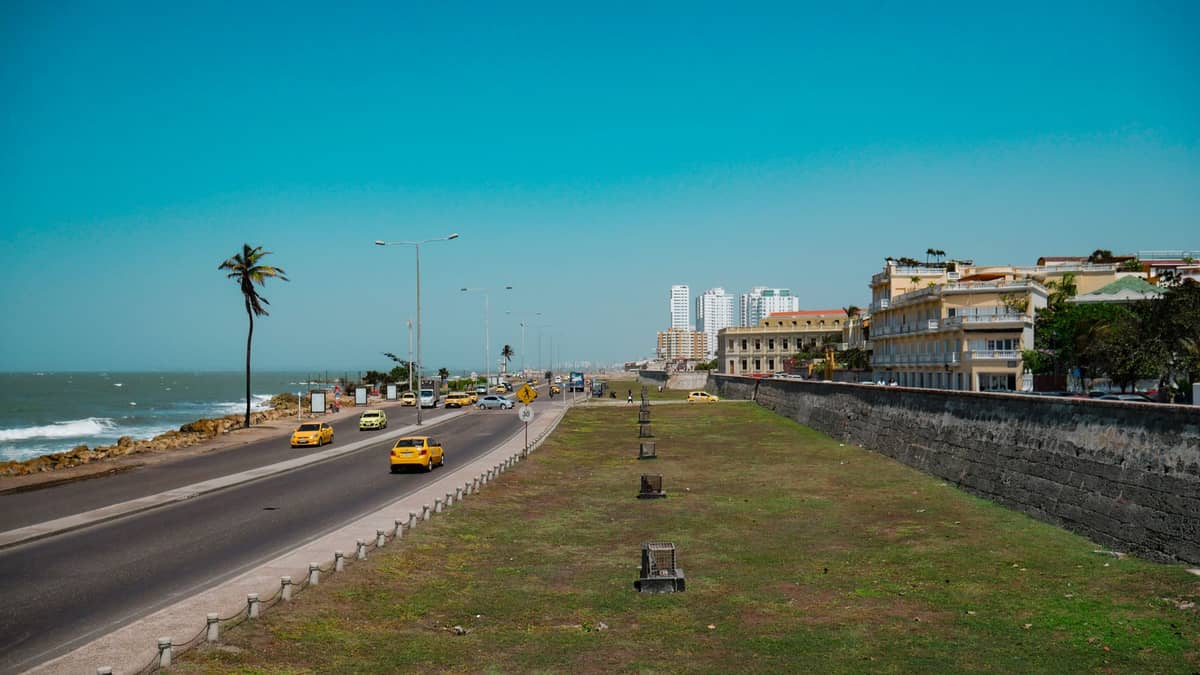
What the Murallas Actually Are
The Cartagena City Walls, known locally as the Murallas de Cartagena de Indias, are not a single structure. They are a continuous defensive system of walls, bastions, moats, and earthworks that took about two centuries to complete, with construction beginning in the late 16th century and the final major sections finished in the 18th century. The Spanish colonial administration built them in direct response to catastrophic pirate raids, most famously Francis Drake's sack of the city in 1586. What you walk on today is the tangible result of one of the most expensive infrastructure projects in the history of the Spanish Empire in the Americas.
The broader fortification system, counting all connected bastions and defensive works, stretches approximately 11 kilometers around the historic center. The walls are built primarily from coral rock quarried locally, which gives the stone a warm honey color that shifts to deep amber in the late afternoon light. In places the ramparts rise close to 9 meters above street level and are wide enough at the top to walk two or three people abreast comfortably. The cannons pointing seaward at the Baluarte de San Francisco Javier are original, set into their embrasures as they were during the colonial era.
The walls were inscribed as a UNESCO World Heritage Site in 1984 as part of the Port, Fortresses and Group of Monuments of Cartagena. That designation matters to visitors because it is the legal reason the walls have survived intact: development inside the perimeter is tightly restricted, and the city is required to maintain the fabric of the fortifications.
ℹ️ Good to know
Entry to the walls and the streets of the walled city is free, 24 hours a day. Some specific baluartes (bastions) may restrict access after evening hours. Museums and churches inside the walls charge their own separate admission fees.
How the Experience Changes by Time of Day
Early morning, roughly 6:30 to 8:30 a.m., is when the walls belong to the city rather than to tourists. Locals jog the top sections, vendors set up carts below, and the light hitting the coral stone from the east is clean and directional. The air carries the smell of salt water and, from the streets below, frying food from nearby arepas stands. At this hour the stone is cool underfoot, crowds are minimal, and you can actually hear the Caribbean.
Midday from around 11 a.m. to 3 p.m. is the hardest time to be on the walls. Cartagena sits near sea level in a tropical climate with daytime temperatures that often reach between 30 and 32 degrees Celsius, and the walls offer almost no shade on the upper walkways. The stone radiates heat, the humidity is constant, and tour groups cluster at the most photogenic viewpoints. If you must visit at midday, carry water, wear a hat, and plan for a shorter loop rather than the full perimeter.
Sunset, from around 5:30 to 6:30 p.m. depending on the season, is the most celebrated time to be on the walls and for good reason. The western-facing sections near the Baluarte de Santa Catalina and the stretch overlooking the Caribbean fill with people sitting on the cannon platforms. Street musicians sometimes appear. The sky over the water turns orange and purple, and the colonial towers of the city glow behind you. It is genuinely impressive, but it is also the most crowded moment of the day by a considerable margin. Arrive 30 to 45 minutes before sunset to claim a good spot on the wall ledge.
After dark, the walls take on a completely different quality. The fortifications are lit at night, and the absence of crowds makes the scale of the stonework more apparent. The upper walkways are open and populated by couples and small groups of friends rather than tour buses. However, poorly lit sections exist in the less-visited stretches between bastions. Walking the walls at night in groups of two or more is reasonable; solo walks through quieter sections late at night are worth approaching with the same common sense you would apply to any unfamiliar city.
Tickets & tours
Hand-picked options from our booking partner. Prices are indicative; availability and final rates are confirmed when you complete your booking.
Totumo Volcano and lunch at a VIP hotel from Cartagena
From 34 €Instant confirmationFree cancellationCity tour of Cartagena with entry to San Felipe castle
From 25 €Instant confirmationFree cancellationSelf-guided e-Scavenger Hunt in Cartagena Colombia
From 31 €Instant confirmationFree cancellationNight tour of Cartagena de Indias aboard a Limo Chiva
From 10 €Instant confirmationFree cancellation
The Best Route to Walk
Most visitors enter the walled city through the Torre del Reloj, the clock gate on Plaza de los Coches that serves as the symbolic main entrance from the Getsemaní side. From there, you can access the wall tops at multiple points. The most rewarding section for first-time visitors is the stretch from the Baluarte de San Francisco Javier west and north toward the Baluarte de Santa Catalina, which faces the open Caribbean. This section offers the best sea views, the most intact cannon positions, and the golden-hour light that most wall photographs are taken from.
If you want a structured route that also takes you past the key colonial monuments inside the walls, the Torre del Reloj is the logical starting point. From there, walk north along the inside of the walls toward the San Diego neighborhood, then climb to the ramparts and follow the seaward face west. The full accessible circuit, including descents to street level to visit plazas, takes around 2 to 3 hours at a relaxed pace.
Not every section of the walls is accessible at the same level. The upper walkway is continuous in some stretches and interrupted by stairs or closures in others. Wear shoes with a sole that grips uneven stone, as the coral-rock surface can be slick in wet weather or after morning dew. The walls are not wheelchair accessible at the top, though the streets at ground level within the historic center are navigable with care despite the cobblestones.
💡 Local tip
Photography tip: For sea-facing shots without harsh shadows, position yourself on the north-facing bastions between 7 and 9 a.m. For the classic warm-toned silhouette shot with cannons in frame, the western bastions between 5:30 and 6:15 p.m. are standard, but busy. A longer lens lets you isolate cannon details against the sky without tourist shoulders in frame.
Historical Context Worth Knowing
Cartagena de Indias was the primary port through which silver and gold from the South American interior passed on its way to Spain. That made it one of the most valuable pieces of real estate in the 16th-century world and, consequently, one of the most attacked. Drake's 1586 raid was followed by assaults from the French, Dutch, and English over the following century and a half. The Spanish response was methodical: a massive investment in stone fortifications that turned the city into one of the most heavily defended ports in the Caribbean.
The walls worked in their most significant test. In 1741, British Admiral Edward Vernon attacked Cartagena with a fleet of approximately 186 ships and 23,000 men in what became known as the Siege of Cartagena de Indias. The Spanish garrison, led by Blas de Lezo, repelled the assault despite being vastly outnumbered. The fortifications, including the walls and the Castillo San Felipe de Barajas, are credited as critical factors in that defense. Vernon's defeat remains one of the largest naval failures in British military history.
Understanding this history changes what you see when you look at the walls. The depth of the bastions, the angles of the cannon positions designed to create overlapping fields of fire, the moat channels, the sheer thickness of the coral-stone walls at their base: none of this is decorative. Every architectural decision has a military logic. A good guided tour will explain those details in situ in ways that a self-guided walk cannot fully replicate.
What to Combine With Your Visit
The walled city is dense with attractions within a few hundred meters of the walls themselves. The Palacio de la Inquisición on Plaza de Bolívar is one of the finest colonial buildings in Colombia, and the museum inside is genuinely informative about the city's colonial-era history. The Santuario San Pedro Claver is a few blocks away and worth the small entrance fee for both the church architecture and the story of Claver's work with enslaved Africans brought through Cartagena.
Immediately outside the walls on the Getsemaní side, the neighborhood itself is a strong complement to the formal heritage circuit inside. The Getsemaní street art and the community around Iglesia de la Trinidad offer a very different register of Cartagena's cultural life, one that is rooted in Afro-Colombian history and the city's working-class identity rather than its colonial elite past.
For travelers with more time, the Castillo San Felipe de Barajas sits about 1 kilometre from the walls on a hill to the east and is the other half of the fortification story. The two sites are often visited together in a half-day. Allow at least 90 minutes for the Castillo itself.
Practical Details and Who Should Skip This
The Murallas are free to walk and technically accessible around the clock, which makes them unusually low-friction for a UNESCO-listed site. You do not need to book in advance, queue for tickets, or plan around closing times for the basic experience. Guided tours, typically lasting two to three hours and costing approximately COP 60,000 to 120,000 per person, add historical depth and are worth considering if colonial military history interests you. Verify current tour prices locally, as they shift with demand and exchange rates.
The dry season from December to April brings the most reliable conditions: minimal rain, lower humidity than the wet season, and clear skies for photography. Even in the dry season, Cartagena is warm and humid. Light, breathable clothing and sun protection are necessary rather than optional. During the rainy season from May to November, particularly heavy rainfall in September and October can make the upper wall surfaces slippery and reduce visibility for photos, but the walls remain open and the rain tends to be intermittent rather than all-day.
Travelers who want air-conditioned comfort, interactive displays, or a quick highlight in under 30 minutes may find the experience underwhelming. The walls reward slow walking and genuine curiosity about military architecture and colonial history. If neither of those interests you, the time might be better spent at one of the museums inside the walled city, where the experience is more structured. Visitors with significant mobility limitations should note that the upper ramparts involve stairs and uneven stone and are not accessible; the street-level historic center is still worth their time.
⚠️ What to skip
Heat warning: Between 11 a.m. and 3 p.m., the exposed upper walkways receive direct sun with no shade. Temperatures on the stone surface feel significantly hotter than ambient air temperature. Carry at least 500ml of water, wear sunscreen, and consider limiting wall time to the early morning or late afternoon if you are sensitive to heat.
Insider Tips
- The stretch of wall between Baluarte de Santa Catalina and Baluarte de San Miguel, facing the Caribbean on the north side, is less visited than the western sunset section. It offers cleaner sightlines and is a better spot for early-morning photography without other tourists in frame.
- Local vendors selling fresh coconut water (agua de coco) position themselves at the base of the main wall access points throughout the day. At COP 3,000 to 5,000 per coconut, they are cheaper and more refreshing than anything available inside the tourist restaurants near the walls.
- If you want a guided experience without the standard group tour, a number of history-focused walking guides operate out of Plaza de Bolívar and can be hired for a more personalized circuit. Agree on the fee and route in advance and confirm whether the price includes any museum entries.
- The walls look completely different from the water. A late-afternoon boat tour of the bay passes the seaward face of the fortifications and gives a sense of scale that is impossible to appreciate from the top. Several operators run these from the Pegasos docks near the Torre del Reloj.
- Avoid the section immediately behind the Las Bóvedas arcade during peak afternoon hours. It is one of the narrowest upper wall sections and fills with slow-moving tour groups between 3 and 5 p.m., making it difficult to actually look at the fortifications rather than the back of someone's head.
Who Is Cartagena City Walls (Murallas) For?
- History and architecture enthusiasts who want to understand the practical logic of colonial military engineering
- Photographers chasing golden-hour Caribbean light over coral-stone battlements
- Travelers combining a wall walk with a broader half-day circuit of the Centro Histórico
- Couples looking for a sunset viewpoint that does not require a reservation or entrance fee
- First-time visitors to Cartagena who want geographic orientation: walking the walls gives you the layout of the entire historic center
Nearby Attractions
Other things to see while in Centro Histórico (Ciudad Amurallada):
- Catedral Santa Catalina de Alejandría
Standing at the east corner of Parque de Bolívar in Cartagena de Indias, the Catedral Basílica Metropolitana de Santa Catalina de Alejandría is one of the oldest episcopal sees in the Americas. Construction began in the 16th century, and the building remains the seat of the Archbishop of Cartagena de Indias today. Entry is free, the doors open daily, and the surrounding plaza makes this one of the most rewarding stops in the entire Centro Histórico.
- Iglesia de Santo Domingo
The Iglesia de Santo Domingo is widely considered the oldest surviving church in Cartagena de Indias, anchoring a plaza that doubles as one of the historic center's most lively gathering points. The building itself rewards close inspection, while the square around it offers a completely different experience depending on the hour you arrive.
- India Catalina Statue
Standing at the entrance to Cartagena de Indias, the bronze India Catalina Statue has marked the city's identity since 1974. Free, open around the clock, and loaded with historical weight, it is the first landmark many visitors encounter and the last symbol they remember.
- Las Bóvedas
Built in the late 1790s as military storerooms and later used as dungeons, Las Bóvedas are the last major colonial construction inside Cartagena's fortified perimeter. Today, 23 arched vaults house craft shops and galleries. Entry is free, and the structure sits at the northern end of the walled city in the San Diego district.