Getsemaní Street Art: Walking Cartagena's Living Outdoor Gallery
Getsemaní's streets hold more than 200 murals spanning roughly a kilometre of open-air art. Free to walk at any hour, this officially recognised Cultural Heritage Neighborhood uses colour, symbolism, and raw scale to tell the story of a community that fought back against displacement — and won.
Quick Facts
- Location
- Barrio Getsemaní, Cartagena de Indias, Bolívar, Colombia — just outside the Walled City
- Getting There
- Walk across the bridge from Centro Histórico (10 min), or take a local bus to Plaza de la Trinidad. Taxis from Bocagrande cost roughly 15,000–20,000 COP.
- Time Needed
- 1.5–3 hours for a self-guided walk; half a day with café stops and exploration
- Cost
- Free — murals are on public walls with no entry fee
- Best for
- Photography, cultural history, slow travellers, street art enthusiasts
What Getsemaní Street Art Actually Is
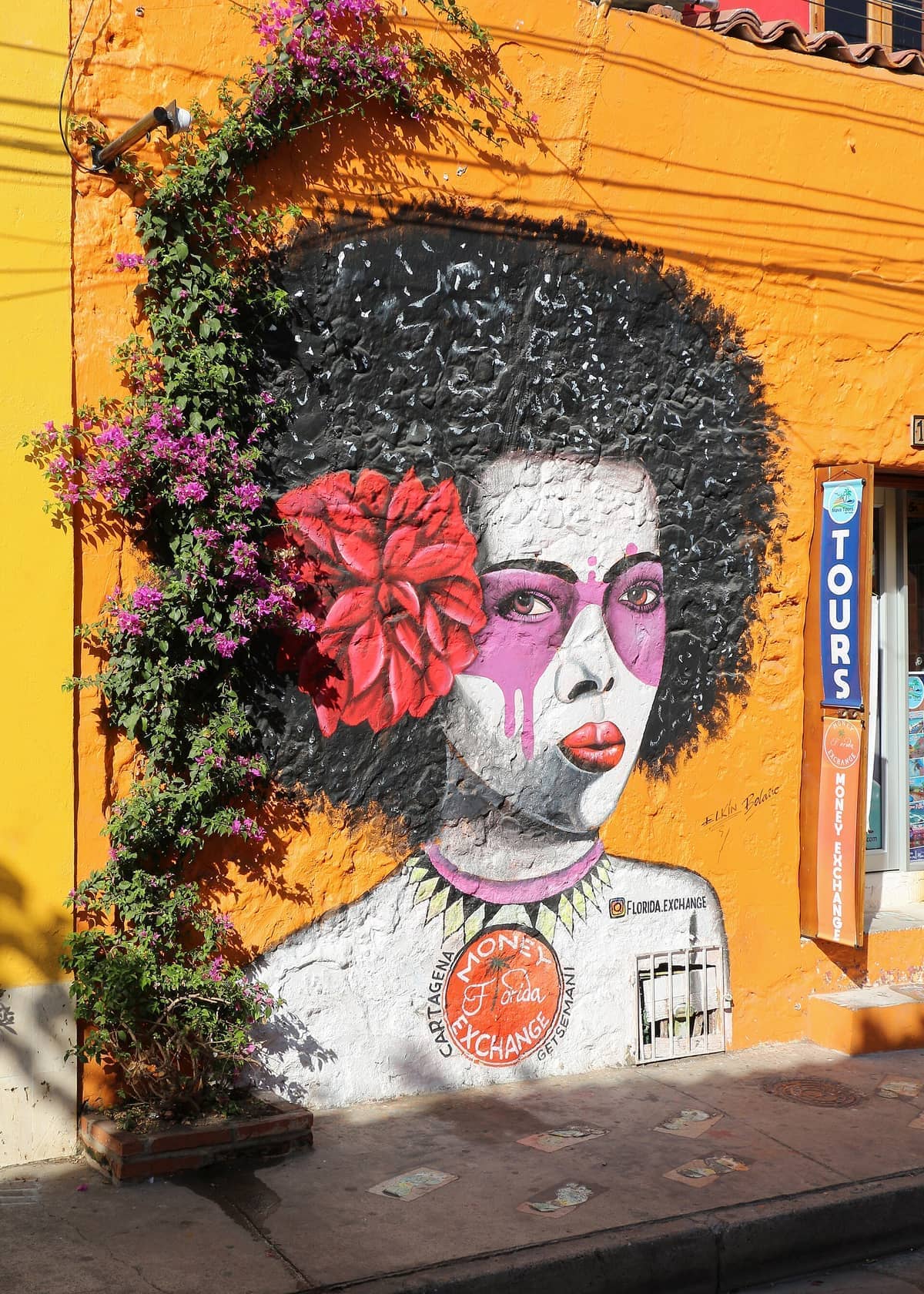
The Getsemaní Street Art Zone is not a curated gallery, a ticketed attraction, or a single scheduled event. It is an entire neighbourhood whose walls became canvases from around 2010 onward, when residents began commissioning and creating murals as a direct response to rising property prices and the threat of displacement that followed Cartagena's tourism boom. Today, more than 200 walls across roughly a kilometre of streets carry paintings that range from intimate portraits of elderly residents to large-scale political statements about land rights, Afro-Colombian identity, and collective memory.
In September 2025, Colombia's national government formally recognised Getsemaní's Vida de barrio on the Lista Representativa del Patrimonio Cultural Inmaterial, acknowledging that its significance is not just architectural but social and artistic. That designation matters for visitors: it signals that what you are seeing is not street decoration applied for tourism purposes. The art here emerged from community pressure, and much of it still addresses the neighbourhood's residents directly.
💡 Local tip
The murals are accessible 24 hours a day with no fee. Daytime and early evening offer the best light for photography and the safest conditions for exploring narrower alleys. Late-night wandering is not recommended for first-time visitors unfamiliar with the area.
The Walk: What You Will See and Where
Most visitors enter Getsemaní from the Walled City side, Most visitors enter Getsemaní from the Walled City side, crossing near the Torre del Reloj and following Avenida del Mercado until the streets narrow and the colonial plaster walls give way to something louder. and following Avenida del Mercado until the streets narrow and the colonial plaster walls give way to something louder. The shift is immediate. Within a block, you are looking at a four-storey face, painted in ochre and deep blue, staring back at you from a crumbling facade. This is not the polished Centro Histórico of boutique hotels and flower-balcony photographs. The streets are rougher, the buildings more worn, and the art is proportionally more urgent.
Calle de la Sierpe is the spine of the art walk. Move slowly along it and into the side streets — particularly Callejón Angosto, a narrow passage where murals press in from both walls simultaneously, creating a corridor of imagery that is genuinely disorienting at close range. The concentration of work around Plaza de la Trinidad is especially dense. The plaza itself functions as the neighbourhood's living room: locals play dominoes in the shade of almond trees, children cut across on bicycles, and food vendors set up in the late afternoon. The murals surrounding the square include both large commissioned pieces and smaller, older tags that have been partially painted over, creating a layered archaeological quality.
From Plaza de la Trinidad, the Iglesia de la Trinidad provides an unintentional anchor: its pale colonial facade, dating to the 17th century, sits directly across from contemporary murals depicting Black women in ceremonial dress. The visual conversation between the two is not subtle, and it is not meant to be.
Tickets & tours
Hand-picked options from our booking partner. Prices are indicative; availability and final rates are confirmed when you complete your booking.
Totumo Volcano and lunch at a VIP hotel from Cartagena
From 34 €Instant confirmationFree cancellationCity tour of Cartagena with entry to San Felipe castle
From 25 €Instant confirmationFree cancellationSelf-guided e-Scavenger Hunt in Cartagena Colombia
From 31 €Instant confirmationFree cancellationNight tour of Cartagena de Indias aboard a Limo Chiva
From 10 €Instant confirmationFree cancellation
How the Experience Changes by Time of Day
Early morning, from around 7am to 9am, Getsemaní belongs almost entirely to its residents. The smell of frying empanadas drifts from open kitchen windows, motorbikes navigate narrow streets with the ease of long familiarity, and the murals are lit with low, raking sunlight that catches every brush stroke and cracked patch of plaster. This is the quietest and most photogenic window of the day. The absence of tourist groups means you can stand in the middle of a street for two minutes lining up a composition without becoming an obstacle.
By mid-morning, walking tours begin arriving. Small groups gather around guides who point up at specific murals and explain their political context. By noon, the heat in Cartagena — typically in the high 20s to low 30s °C with high humidity year-round — makes extended outdoor walking uncomfortable. If you are exploring during the dry season (December to April), carry water and plan to duck into one of the neighbourhood's cafés or juice bars around midday. The streets are shadier than Bocagrande's open boulevard, but not shaded enough for comfortable three-hour walks in direct sun.
Late afternoon, from around 4pm until dusk, is arguably the best overall compromise: the heat has eased slightly, the golden light is good for photography, the plaza fills with local life, and the neighbourhood's bars and small restaurants open up, giving natural pause points between mural clusters. After dark, the murals are poorly lit by streetlamps and the narrower alleys become uncomfortable for visitors who do not know the area. Stick to the well-trafficked streets around the plaza if you stay into the evening.
The History Behind the Walls
Getsemaní sits just outside Cartagena's UNESCO-listed Walled City, separated from it by a short bridge that once marked a clear social boundary. For most of the colonial and post-colonial period, the neighbourhood was home to enslaved people, freed Africans, and the working-class poor who built and maintained the city but were excluded from living within its walls. That history of exclusion is not background context here — it is the subject matter of dozens of the murals.
When tourism expanded rapidly in Cartagena's Centro Histórico during the 2000s, real-estate pressure began pushing into Getsemaní. Property values rose, long-term residents faced rent increases, and the neighbourhood's character was threatened. The street art response that emerged from around 2010 was community-led and politically conscious. Several murals explicitly reference gentrification, depicting elderly residents alongside text that translates roughly as 'we are still here.' Understanding this context transforms what might otherwise look like impressive decoration into something with considerably more weight. For broader context on the neighbourhood's identity, the Cartagena Afro-Colombian culture guide provides essential background.
Practical Walkthrough: How to Do It Well
The most direct starting point is Plaza de la Trinidad, reachable on foot from the Walled City in around 10 minutes. From the plaza, walk Calle de la Sierpe in both directions, then work inward through the side streets. Do not try to plan a rigid route — the neighbourhood is compact enough that you will naturally circle back and discover pieces you missed. A one-way walk along the main street takes 20 minutes; actual exploration including doubling back and stopping takes closer to two hours.
If you want guided context, local street art tours depart from the plaza area and typically last 90 minutes to two hours. Guides explain the political content of specific murals and identify artists, some of whom are internationally known. These tours cost money but provide interpretive depth that a self-guided walk cannot replicate. Verify current tour availability and pricing locally, as operators change.
Getsemaní pairs naturally with a visit to the adjacent Calle del Arsenal, which runs along the neighbourhood's southern edge and transitions from mural walls into bars and live music venues by evening. The combination of street art in the afternoon and Calle del Arsenal at night makes for a full Getsemaní day without needing to leave the neighbourhood. For those planning a longer stay in Cartagena, the 3-day Cartagena itinerary places Getsemaní on day two alongside the historic centre.
⚠️ What to skip
Some alleys — including Callejón Angosto — are narrow and can feel isolated. Keep valuables out of sight and avoid exploring unfamiliar backstreets alone after dark. The main streets around Plaza de la Trinidad are busy and well-observed during the day and early evening.
Photography: Making the Most of the Murals
The scale of many murals makes wide-angle lenses essential for capturing full compositions. Several pieces on Calle de la Sierpe span three or four floors, requiring you to step back into the middle of the narrow street to fit the whole image in frame — which means waiting for traffic gaps. Early morning and late afternoon light produces the most colour-accurate results; midday sun creates harsh shadows on the textured plaster that can obscure fine brushwork.
The small squares and junctions where two or three mural walls meet simultaneously are particularly strong settings for environmental portraits if you are photographing people with their permission. The neighbourhood is not a performance space for visitors — residents are going about their day — so ask before pointing a camera at individuals. Most people respond positively to a polite request.
Weather affects the visual quality of the murals. During the rainy season (May through November), heavy afternoon downpours are common, and wet plaster desaturates colours considerably. The dry season from December to April provides consistently better photographic conditions. For more detail on timing, the best time to visit Cartagena guide covers monthly weather patterns in full.
Who Should Reconsider This Visit
Visitors with very limited mobility may find parts of the street art zone challenging. Callejón Angosto and similar narrow passages have uneven surfaces and no wheelchair infrastructure. The main streets are manageable but not formally adapted. If your mobility requires smooth, wide pavements, the experience will be partial.
If you are visiting Cartagena on a very short itinerary focused primarily on the historic Walled City and beaches, Getsemaní's street art will not be for everyone. It requires genuine curiosity about the social and political context. Visitors looking purely for postcard aesthetics may find the neighbourhood's rawness — the peeling paint, the loud political imagery, the working-class street life — less comfortable than the manicured streets of the Centro Histórico. That rawness, however, is precisely what makes it worth the 10-minute walk.
Insider Tips
- The very best light for photography falls on Calle de la Sierpe between 7am and 8:30am, when the sun is low and the street is still quiet. Even 20 minutes spent here before the walking tours arrive produces significantly cleaner shots than anything possible at midday.
- Ask locally about the 'Getsemaní Mío' initiative — a community-based art programme connected to the neighbourhood's resistance movement. Local guides affiliated with it provide context on specific murals that no printed map or app can replicate.
- Several murals have been painted over and replaced since 2010, meaning the 'gallery' is not static. If you visited five years ago, return: roughly a third of the visible work will be different.
- The mural concentration thins out toward the neighbourhood's southern end near Calle del Arsenal, but a few of the largest pieces are located there precisely because the wider streets allow for bigger wall surfaces. Do not stop your walk at the plaza.
- Combine the street art walk with a stop at the Mercado de Bazurto on a separate morning for a full picture of Cartagena's working-class geography. The two neighbourhoods, though different in character, share a social history that the murals repeatedly reference.
Who Is Getsemaní Street Art For?
- Photography enthusiasts who want scale, colour, and genuine narrative content rather than staged backdrops
- Travellers with an interest in Afro-Colombian history and the politics of urban displacement
- Solo walkers or small groups who move slowly and read context rather than tick sights
- Repeat visitors to Cartagena who have already covered the Walled City and want a less-polished perspective on the city
- Anyone building a full day in Getsemaní that starts with art and ends with Calle del Arsenal at night
Nearby Attractions
Other things to see while in Getsemaní:
- Calle del Arsenal
Calle del Arsenal stretches along the Bahía de las Ánimas in Getsemaní, blending colonial military history with an evolving lineup of bars, restaurants, boutique hotels, and terraces. Free to walk at any hour, it earns its reputation as one of Cartagena de Indias's most versatile streets.
- Iglesia de la Trinidad
Built under a royal decree of 1642, the Iglesia de la Santísima Trinidad is one of Cartagena's oldest churches and the architectural centerpiece of Plaza de la Trinidad. The square in front of it functions as Getsemaní's living room, drawing locals every evening while travelers pass through on their way across the neighborhood.