Óbuda, meaning 'Old Buda', is the quietest and most historically layered of Budapest's three founding cities. Sitting on the west bank of the Danube in District III, it holds Roman amphitheatres, a baroque main square, and a genuine neighborhood feel that the city center lost decades ago.
Óbuda is where Budapest's story actually begins. Long before the Chain Bridge or the Parliament existed, this stretch of the Danube's western bank was Aquincum, a major Roman provincial capital. Today it reads as a patchwork of eras: crumbling baroque facades alongside Cold War-era apartment blocks, Roman excavations a short walk from a riverfront island that hosts one of Europe's largest music festivals. If you want to understand Budapest beyond its postcard moments, Óbuda rewards the effort.
Orientation: Where Óbuda Sits in Budapest
Óbuda occupies the northern section of the Buda bank, forming part of Budapest's District III (Óbuda-Békásmegyer). It sits directly north of the Castle Hill district and Víziváros, connected to Pest by the Árpád Bridge in the north and the Margit Bridge in the south. The Danube forms its eastern boundary, while Bécsi út and Vörösvári út mark its western and northern edges respectively, with Bogdáni út completing the loop back to the river.
Understanding Óbuda's position requires knowing Budapest's founding geography. In 1873, three separate cities merged to create Budapest: Pest on the eastern bank, and Buda and Óbuda on the western bank. Óbuda was already old then. Its name literally translates as 'Old Buda', and in German it was called Alt-Ofen, a reference stretching back to the medieval period. This is the northern end of the Buda chain, where the Buda Hills begin to flatten toward the Danube plain.
Nearby, Margaret Island sits mid-river just to the south and is reachable on foot or by tram across the Margit Bridge. Further south along the Buda bank, the terrain rises toward Castle Hill and the historic core. To the north, District III transitions into the large housing estates of Békásmegyer, which lie beyond what most locals consider Óbuda proper. The district also contains Aquincum Museum, which marks the outer northern edge of what most visitors consider the Óbuda neighborhood proper.
Character and Atmosphere: A Neighborhood That Hasn't Performed for Tourists
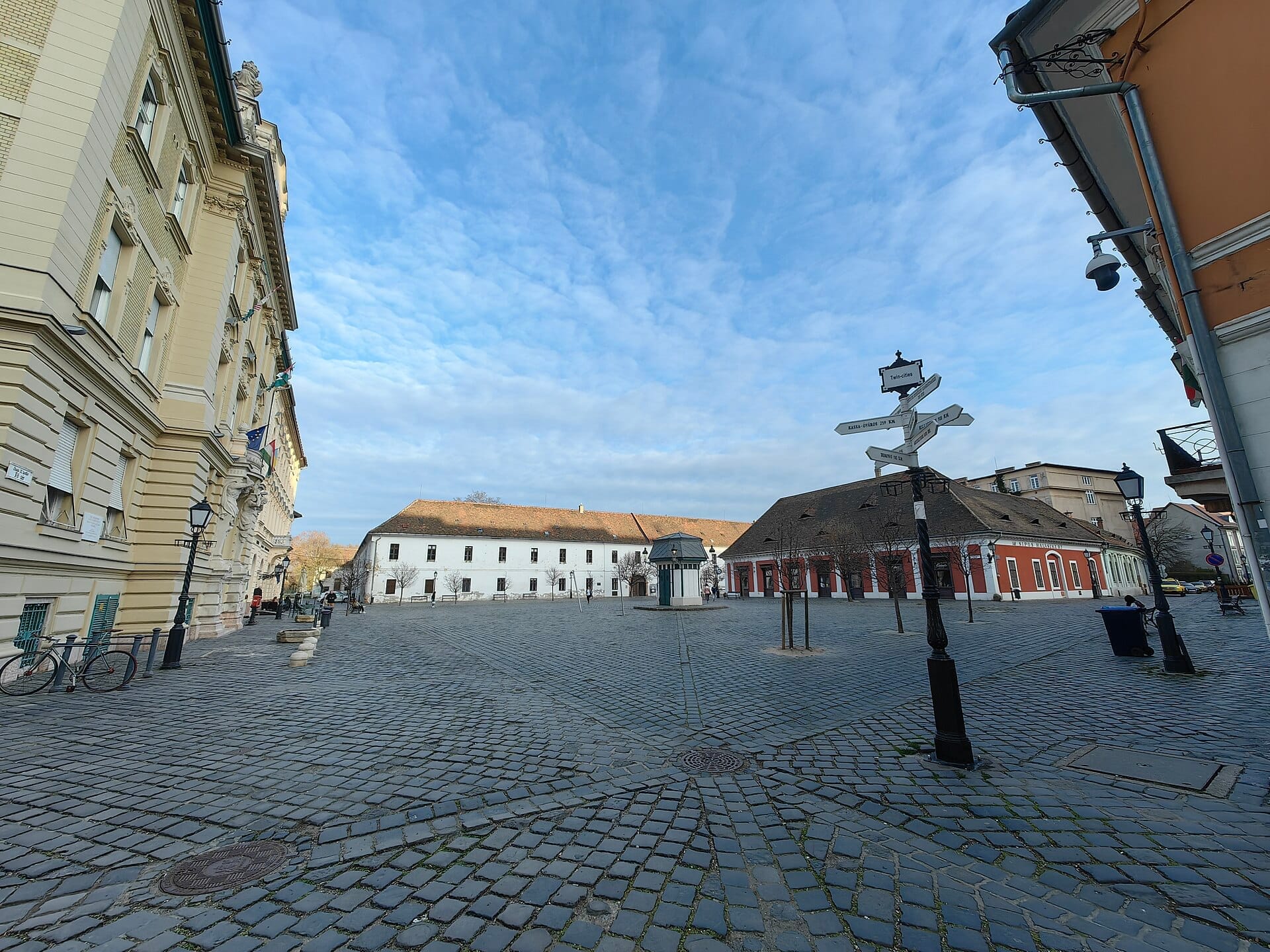
Óbuda does not try to be charming. That, paradoxically, is exactly what makes it charming. The streets around Fő tér (Main Square) feel like a Budapest that time partially passed over: narrow lanes, worn plaster facades in pale yellows and greens, courtyards glimpsed through iron gates. On weekday mornings, the square belongs to locals heading to the market, older residents on benches, and pigeons. The tourist infrastructure that defines the Inner City simply hasn't arrived here at scale.
By mid-morning the light turns golden over Fő tér and the fountain at its center casts long shadows across the cobblestones. The square is anchored by a well-known sculpture group depicting figures sheltering from rain under umbrellas, a quietly absurd piece of public art that somehow fits the neighborhood's understated character perfectly. Cafes around the square open early, and the pace of life is decidedly unhurried.
Moving away from the square in any direction reveals the neighborhood's layering. Walk toward the river along Lajos utca or Pacsirtamező utca and the streets widen, Soviet-era housing blocks appear, and the human scale shifts. These were built to house workers when the area industrialized in the mid-20th century, and they're still occupied by families who've been here for generations. It's a reminder that Óbuda is a real residential district, not a preserved museum quarter.
After dark, Óbuda is quiet by Budapest standards. There is no equivalent of the ruin bar strip in District VII, and the area clears out early on weeknights. This makes it genuinely peaceful for travelers who want to sleep before midnight, but it's not the right base if evening atmosphere is a priority. The exception is the riverfront near Óbuda Island during the Sziget Festival in August, when the entire area briefly transforms.
ℹ️ Good to know
The Sziget Festival takes place each August on Óbuda Island (Óbudai-sziget), just off the Buda bank near Árpád Bridge. The island is connected to the mainland by footbridge during the festival. It draws hundreds of thousands of visitors over roughly a week and significantly affects accommodation and transport in the surrounding area. Book well ahead if visiting during this period.
What to See and Do in Óbuda
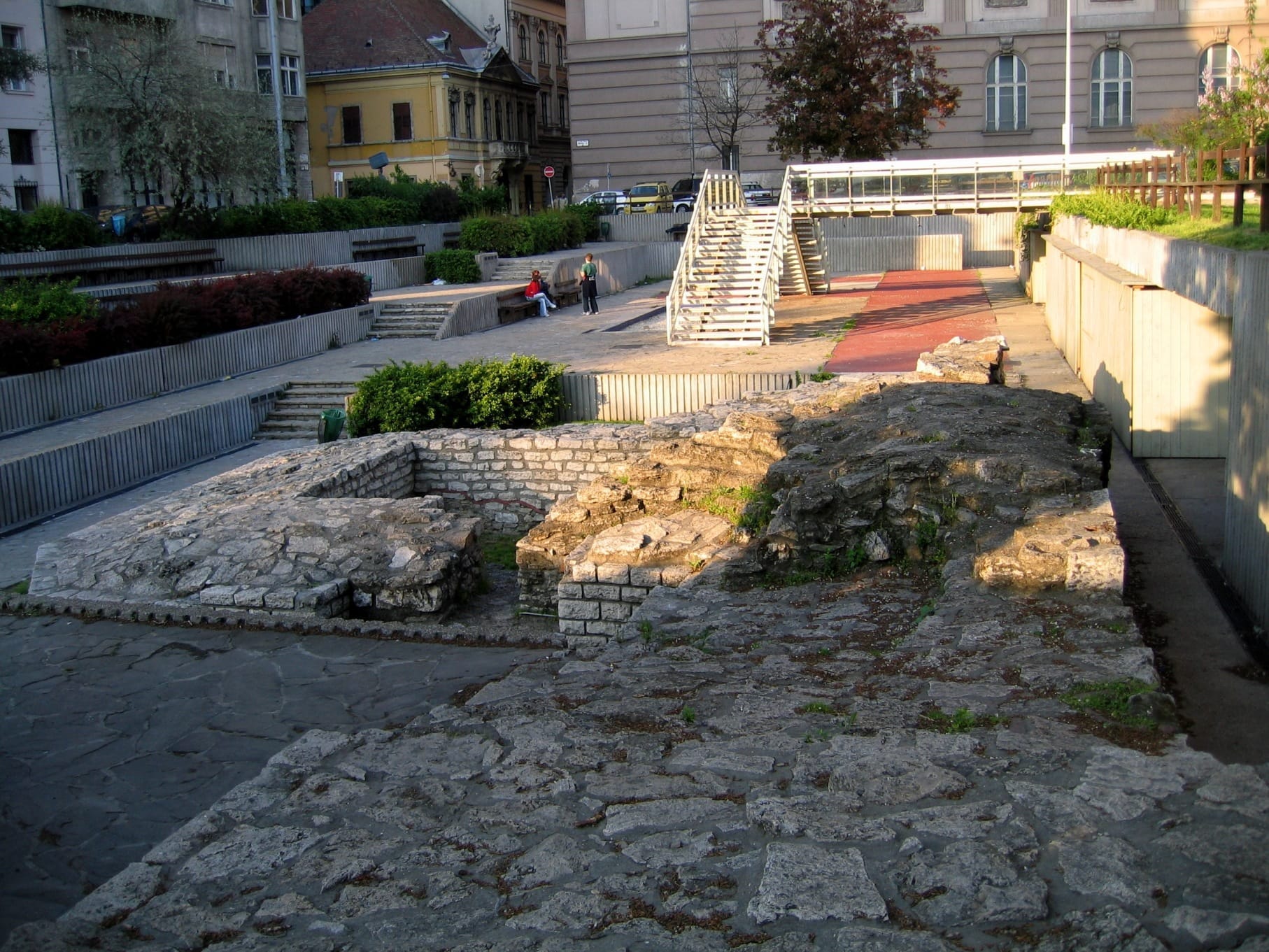
The most significant site in Óbuda is the Aquincum Museum, which preserves the remains of the Roman civilian town of Aquincum. This later became the capital of the Roman province of Pannonia Inferior after the larger province of Pannonia was divided, and at its height it supported a population of tens of thousands. The outdoor ruins extend across a large area and include streets, public baths, a market hall, and a mithraic temple. An indoor museum displays mosaics, household objects, and a reconstructed organ. It's one of the more substantial Roman sites in Central Europe and consistently undervisited relative to its importance.
Near the museum, along Szentendrei út, are the remains of the Roman civil-town amphitheatre (Polgárváros amphitheatre), the smaller of Aquincum's two amphitheatres, which served the civilian settlement. The ruins are partially open to the public and sit somewhat incongruously amid a residential area. Further south, near Flórián tér / Pacsirtamező, stands the larger military amphitheatre associated with the legionary fortress, which once seated on the order of 10,000–13,000 spectators. Together they give a sense of how large and organized Roman Aquincum actually was.
Fő tér itself deserves time beyond a passing glance. The square contains several baroque-era buildings and connects to a network of quiet streets that retain their 18th and early 19th century scale. The Zichy Palace on the square has been used as a cultural venue and exhibition space, and the area hosts small outdoor markets and events through the warmer months.
Aquincum Museum and Roman civilian ruins (open seasonally, check hours before visiting)
Roman military amphitheatre ruins near Flórián tér / Pacsirtamező
Fő tér baroque square with the umbrella sculpture group
Zichy Palace and surrounding baroque streets
Óbuda Island (Óbudai-sziget) for the Sziget Festival or quieter riverside walks in other seasons
💡 Local tip
Aquincum Museum is reached by taking the H5 HÉV suburban rail from Batthyány tér (M2 metro) northward to the Aquincum stop. The ride takes about 15 minutes and from the station it is a short walk (around 500m) to the ruins. Confirm current opening hours and admission prices before visiting, as they vary by season.
Eating and Drinking in Óbuda
Óbuda's food scene is anchored in tradition rather than trend. The neighborhood has a handful of long-established Hungarian restaurants, particularly around Fő tér, that serve the kind of food Budapestians actually eat: gulyás, pörkölt, stuffed cabbage, roast meats, and layers of pastry. Prices are notably lower here than in the Inner City or the Castle District, and the service tends to be unhurried in a way that can read as either relaxed or slow depending on your expectations.
Several traditional restaurants near the main square have operated for decades, and a few have the feel of genuine local institutions rather than tourist-facing operations. Fish dishes appear regularly on menus given the proximity to the river, and Hungarian wines from regions like Eger and Tokaj are standard on wine lists.
Coffee culture in Óbuda is more straightforward than in the specialty-focused cafes of Districts VI and VII. Expect espresso-based drinks in older-style cukrászdák (pastry shops) alongside dense cakes and rétes (strudel). There is no equivalent of the artisan coffee scene that has taken over parts of Pest, but that's not really the point here.
For a wider food context across the city, the Budapest food guide covers the full range of dining styles and price points across all districts. Óbuda represents the more conservative, traditional end of the spectrum, which can be exactly what you want after a few days of navigating the tourist-heavy restaurants of the Inner City.
⚠️ What to skip
Óbuda is not a nightlife destination. Bars around Fő tér tend to close by 10 or 11pm on weeknights, and the streets are quiet long before midnight. If you want the ruin bar experience or late-night options, plan evenings in District VII and use Óbuda as a daytime excursion instead.
Getting There and Around Óbuda
Óbuda is served by the H5 HÉV suburban rail line, which runs from Batthyány tér (also a stop on Metro Line M2) northward along the Buda bank. The key stops for Óbuda are Szentlélek tér (for Fő tér and the neighborhood center) and Aquincum (for the Roman museum). The journey from Batthyány tér takes roughly 10 to 15 minutes depending on the stop. HÉV tickets can be purchased at stations or validated using the standard BKK travel card. Verify current fare structures before traveling, as these are subject to change.
Bus 9 runs from Nyugati pályaudvar (served by Metro Line M3) across the river and up the Buda bank to Flórián tér, which is at the southern edge of the Óbuda neighborhood. This is a useful connection if you're coming from the Pest side without using the metro-to-HÉV transfer at Batthyány tér. Tram connections also link the area to the broader network.
For those exploring by foot from the city center, crossing at Margit Bridge brings you onto the Buda bank at the southern edge of Óbuda. From there, it's a 20 to 25 minute walk north along Lajos utca to Fő tér. It's a walkable route and passes through a transitional stretch of the neighborhood that gives a realistic sense of how Óbuda's character differs from the tourist-facing riverbank near the Castle. See the full getting around Budapest guide for a comprehensive breakdown of transit options across the city.
Where to Stay in Óbuda
Accommodation in Óbuda is sparse compared to the city's central districts. There are no major hotel clusters here, which is partly what preserves the neighborhood's character. A small number of guesthouses, apartments, and boutique properties are available, primarily around the Fő tér area and along the main routes toward the HÉV stations.
Staying in Óbuda makes most sense for travelers who want a quieter base, have a particular interest in Roman history or the Sziget Festival, or are visiting for longer than the standard two or three days and want to experience Budapest away from the central tourist zones. For those prioritizing proximity to the city's main attractions, the Budapest neighborhood accommodation guide gives a fuller comparison of which districts suit different travel styles.
The HÉV connection means central Buda (Batthyány tér, M2 metro) is only 10 to 15 minutes away by rail, and the city's main sights are accessible within 30 to 40 minutes of travel. It is a viable base but works best for self-sufficient travelers comfortable navigating public transit.
Óbuda in Context: How It Connects to the Broader City
Óbuda's history runs parallel to the broader arc of Budapest itself. For anyone interested in how the city developed from Roman times through the medieval period and into the 19th century unification, reading the Budapest history guide alongside a visit to Aquincum provides a useful frame. The Roman foundations visible here directly connect to why the Buda side of the river was settled and fortified long before Pest developed on the eastern bank.
The neighborhood also sits within easy reach of some of Budapest's best outdoor experiences. Margaret IslandMargaret Island is accessible by tram or on foot via Margit Bridge, offering a car-free green space on the river with thermal pool facilities and running paths. The Buda Hills begin just to the west of the neighborhood, reachable via buses from Kolosy tér, and offer hiking and forest trails within the city limits.
If Roman history is your main draw, pair Aquincum with the broader museum circuit across Budapest for a fuller picture of the city's collections. And if you're weighing up the city as a whole before committing to an itinerary, the guide on things to do in Budapest helps put Óbuda in proportion to the rest of what the city offers.
TL;DR
Óbuda is one of Budapest's oldest quarters, one of the three cities unified in 1873, and contains some of the most significant Roman remains in Central Europe at Aquincum.
The neighborhood is best experienced as a half-day or full-day excursion from central Budapest, reachable in 10-15 minutes by HÉV from Batthyány tér (M2).
It suits travelers interested in history, authentic neighborhood life, and escaping tourist density, not those looking for nightlife, fine dining, or landmark sightseeing density.
Accommodation options are limited but the transit connection to central Buda is fast enough that it works as a quieter base for longer stays.
Visit Aquincum in the morning when the site is least crowded, then walk south to Fő tér for lunch and a wander through the baroque streets before heading back to the city center.
Budapest punches well above its weight as a museum city. From a world-class collection of Old Masters to underground WWII hospitals and open-air Communist statues, these are the museums that make Budapest worth dedicating serious time to.
Budapest rewards visitors in every season, but the timing of your trip shapes everything from what you pay to how crowded the sights are. This guide breaks down every month so you can match your priorities, whether that's mild weather, low prices, major festivals, or the city's legendary Christmas markets.
Budapest is one of Europe's great Art Nouveau cities, with a distinct national style that sets it apart from Vienna or Paris. This guide covers the key buildings, the architects behind them, how to explore the city's Szecesszió heritage on foot, and what to watch out for along the way.
The Budapest Card bundles unlimited public transport with free museum entry, one free thermal bath visit at Lukács, and a free Danube river cruise into one pass. But at up to €129, it only pays off under specific conditions. Here's a clear breakdown of who should buy it, who should skip it, and how to activate it correctly.
Budapest food is hearty, affordable, and deeply underrated. This guide covers the essential dishes to try, where to find them, what things actually cost in 2026, and how to avoid the tourist traps that pass off mediocre goulash stew as the real thing.
Budapest rewards those who look beyond the Parliament and Chain Bridge. From ancient Roman ruins in Óbuda to a Cold War bunker beneath Castle Hill, this guide points you toward the city's most overlooked and underrated experiences.
Budapest carries more than 2,000 years of history across its two riverbanks. This guide traces the city's major eras, from Roman legions to Habsburg grandeur and Cold War upheaval, and shows you exactly where to see that history in person.
December transforms Budapest into one of Europe's most atmospheric winter destinations, with free Christmas markets, steaming thermal baths, and far fewer crowds than summer. This guide covers weather realities, the two flagship markets, pricing, crowd patterns, and practical tips for getting the most from a winter visit.
Three days is exactly enough time to get a serious handle on Budapest. This itinerary splits the city logically across both banks of the Danube, covers the unmissable sights without rushing, and leaves room for the thermal baths, Jewish Quarter, and a proper evening out.
Budapest punches well above its weight in the luxury travel market. Five-star hotels cost 40-60% less than comparable properties in Vienna or Paris, the thermal spa culture is unmatched in Europe, and the fine dining scene has quietly matured into something genuinely world-class. This guide covers where to stay, where to soak, and where to eat at the top end of the market.
Budapest after dark is one of Europe's most distinct nightlife scenes, built around crumbling courtyards, thermal bath parties, and riverfront venues that keep going until sunrise. This guide covers the key districts, best venues, realistic drink prices, and how to navigate the city's nights without the common tourist mistakes.
Budapest's ruin bars are unlike anything else in Europe: abandoned buildings transformed into labyrinthine bars, galleries, and gardens. This guide covers the best venues, realistic prices, transport logistics, and seasonal tips to help you experience them properly.
Budapest is one of Central Europe's safer capitals, but petty crime, taxi overcharging, and bar bill scams catch many visitors off guard. This guide breaks down exactly what to watch for, where the risks concentrate, and how to handle each situation confidently.
Budapest rewards shoppers across every budget, from paprika and Tokaji wine at the Great Market Hall to luxury boutiques on Andrássy Avenue and Soviet-era curiosities at Ecseri flea market. This guide covers where to go, what to buy, and how to avoid overpaying on Váci Street.
Budapest sits on top of nearly 130 natural hot springs, and its thermal baths are among the most atmospheric in Europe. This guide cuts through the hype: which baths are actually open in 2026, what you'll realistically pay, how to avoid peak crowds, and which options suit your budget and travel style.
Everything you need to plan the Budapest to Prague journey, whether you want the comfort of a direct train, the cheapest bus fare, or the fastest flight. Includes prices, schedules, booking tips, and what to expect on each route.
Budapest is one of Europe's most photogenic cities, and knowing where to look changes everything. This guide covers the best panoramic viewpoints, hilltop terraces, and elevated bars where the city reveals itself in full.
Budapest rewards families with an impressive range of kid-friendly experiences: a century-old zoo, a narrow-gauge railway run by children, interactive science centers, and a car-free island with playgrounds and bike rentals. This guide covers the best family activities in Budapest, with practical advice on what works for different ages, what to skip, and how to plan your days efficiently.
Budapest sits at the center of one of Central Europe's best rail networks, putting medieval towns, thermal lake resorts, and even Vienna within easy reach. This guide covers the top day trips from Budapest with exact transport options, realistic fares, and clear assessments of what each destination is actually worth your time.
Budapest rewards budget travelers generously. From sweeping hilltop panoramas to centuries-old bridges and grand market halls, some of the city's most memorable experiences cost absolutely nothing. This guide covers the best free things to do in Budapest, organized so you can plan a full day without opening your wallet.
Budapest has one of Central Europe's most comprehensive public transport networks, run by BKK. This guide covers every mode of transport, ticket types with current prices, how to avoid fines, and the best ways to get from the airport to the city center.
Budapest is one of Central Europe's most rewarding cities, but it's not for everyone. This guide breaks down exactly what you get: the UNESCO-listed landmarks, thermal baths, food scene, and nightlife, alongside the real drawbacks, seasonal trade-offs, and practical logistics you need to know before booking.
Budapest is one of Europe's most atmospheric cities for couples, combining grand architecture, thermal spa culture, candlelit river cruises, and sweeping hilltop views. This guide covers the best romantic experiences in Budapest, from free sunset walks to splurge-worthy dinner cruises, with practical advice on timing, cost, and what to skip.
Budapest rewards visitors with an unusually rich mix of history, architecture, and culture packed into a compact, walkable city. This guide covers the best things to do in Budapest — from iconic landmarks and thermal baths to underrated neighborhoods — with practical advice on what is worth your time and what is not.
Budapest divides naturally into distinct neighborhoods, each with its own character, price range, and practical trade-offs. This guide breaks down the best areas to stay based on what you actually want from your trip, from walkable sightseeing bases to quieter hillside retreats.