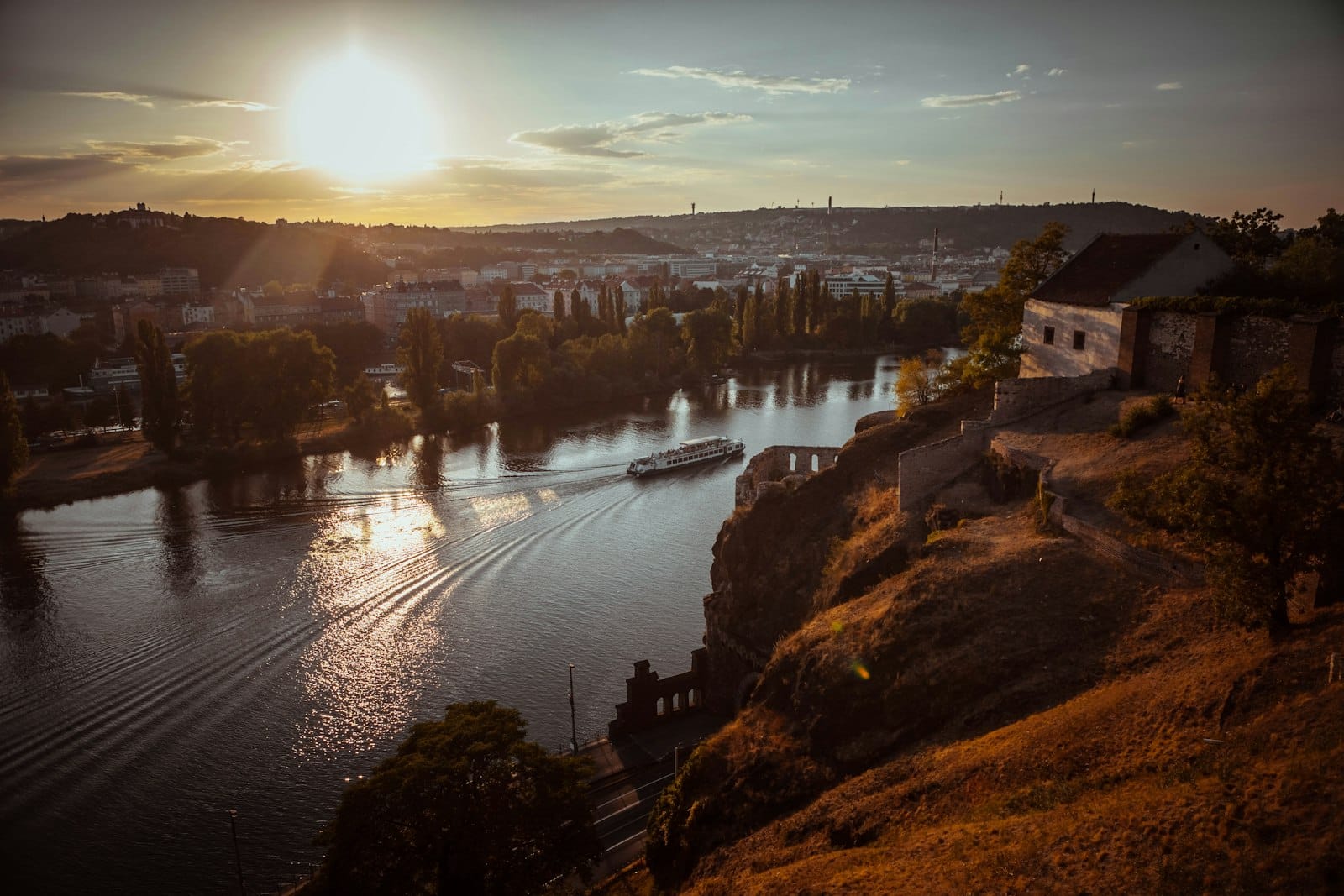
Perched on a rocky promontory above the Vltava River, Vyšehrad is one of Prague's oldest and most atmospheric districts. A fortified complex dating to the 10th century, it holds a neo-Gothic basilica, the national cemetery, Romanesque ruins, and some of the finest river views in the city, all within a park that most tourists never reach.
Vyšehrad sits on a cliff above the right bank of the Vltava, about 3 kilometers southeast of Prague Castle, and it operates by entirely different rules from the historic center. The crowds thin out, the air quiets down, and what you get instead is a walled plateau of lawns, Baroque ramparts, Romanesque stonework, and a cemetery where Czech poets, composers, and painters are buried side by side.
Orientation
Vyšehrad occupies a sandstone outcrop on the eastern bank of the Vltava, marking the southern boundary of Prague's historic core. Administratively it falls within Prague 2, sandwiched between the residential streets of Nusle to the east and the river embankment to the west. The plateau sits roughly 70 meters above the water, with the Nusle Bridge, one of Central Europe's longest urban viaducts, forming its northern edge at street level.
The district divides naturally into two zones. The upper fortress complex, enclosed by 17th-century Baroque ramparts and entered through the Tábor Gate or the Leopold Gate, contains the major monuments and open parkland. Below the cliff, along the embankment near Výtoň, the neighborhood transitions into a quieter, lower-key residential strip with tram stops and river access. Most visitors only see the upper plateau, but understanding the two levels helps you plan your approach and exit.
Vyšehrad connects logically to several other parts of the city. Walking north along the river embankment from the Výtoň stop brings you toward Nové Město (New Town) and eventually to the Dancing House and Wenceslas Square. The fortress plateau itself is part of the broader UNESCO-listed Prague Heritage Reserve, placing it in the same protected category as Old Town and Prague Castle, even though most visitors spend far less time here.
Character & Atmosphere
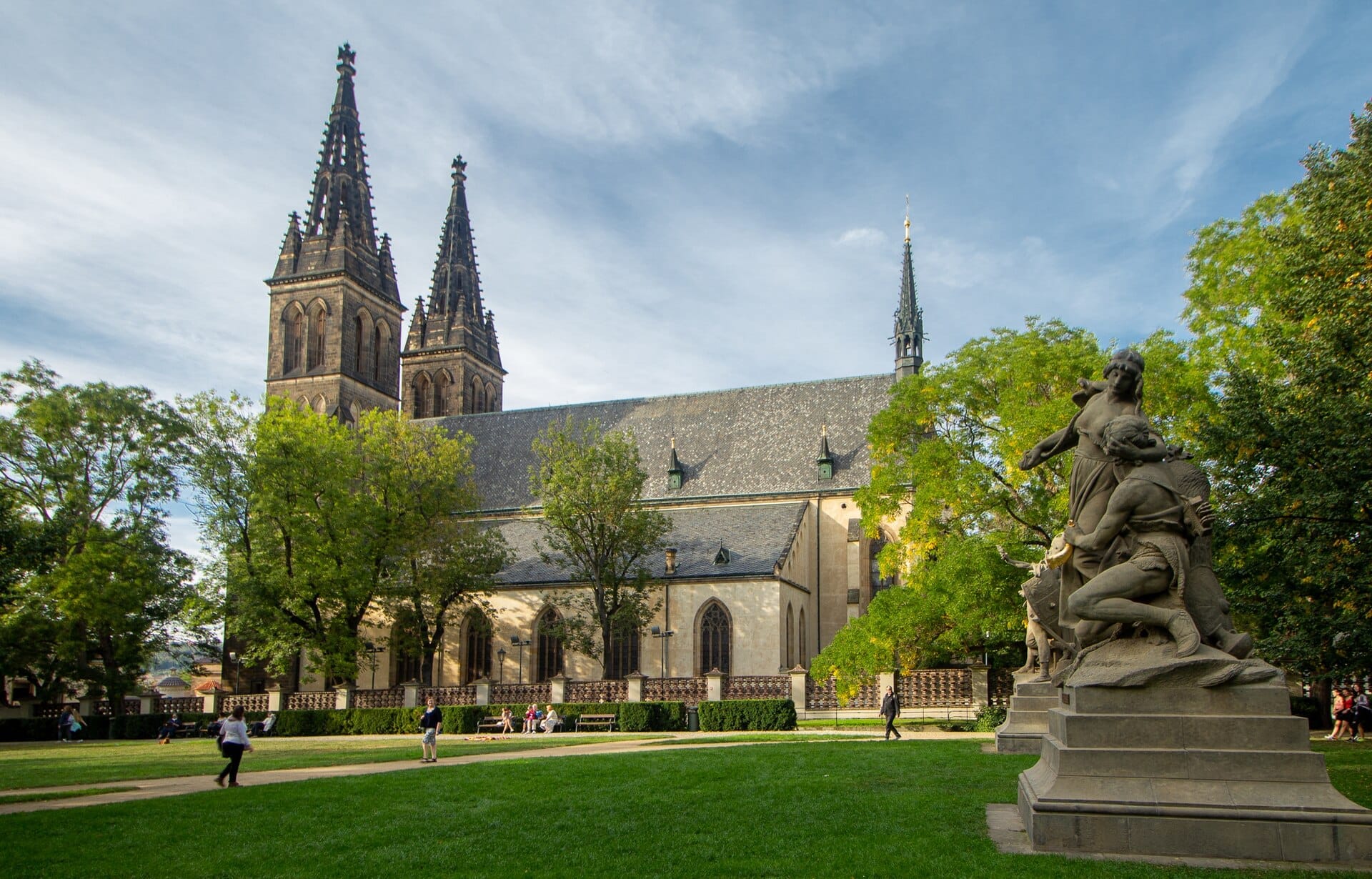
Vyšehrad rewards visitors who arrive expecting a park rather than a sightseeing circuit. The grounds are open year-round and free to enter, and on weekday mornings the plateau belongs almost entirely to locals: dog walkers crossing the lawns between the basilica and the cemetery, older residents on the benches near the Leopold Gate, students from the nearby university faculties cutting through on their way to class. The light at that hour is long and flat, catching the twin spires of the Basilica of Saints Peter and Paul and throwing shadows across the Baroque stonework.
By midday, especially in summer, the character shifts. Tour groups arrive, mostly smaller ones than you'd find at Prague Castle, and the paths between the main gates and the basilica see consistent foot traffic. The cemetery, enclosed behind iron gates, draws a quieter crowd. Even at its busiest, Vyšehrad never approaches the saturation point of Old Town Square. There is always somewhere to sit and look at something without being jostled.
Evenings are the plateau's most underrated hour. After the last tours wrap up, the ramparts along the western wall become a place where people simply stand and watch the light leave the city. The Vltava below catches the last color, the bridges to the north glow in sequence, and the spires of the basilica turn from grey to amber. There are only a few modest bars or cafés within the fortress walls, so the evening crowd is largely self‑selecting: people who have come specifically for the view and the quiet.
💡 Local tip
Weekday mornings between 8am and 10am offer the most peaceful experience on the plateau. The cemetery opens early, the light is favorable for photography, and you'll share the grounds with far more locals than tourists.
What to See & Do
The Basilica of Saints Peter and Paul is the visual anchor of the whole complex. The current neo-Gothic structure dates mostly from the late 19th and early 20th centuries, built over a succession of earlier churches on the same site. Its twin black spires are visible from several points along the river and from parts of the New Town below. The interior is richly decorated with Art Nouveau murals, making it worth entering even if you've already seen a dozen Prague churches.
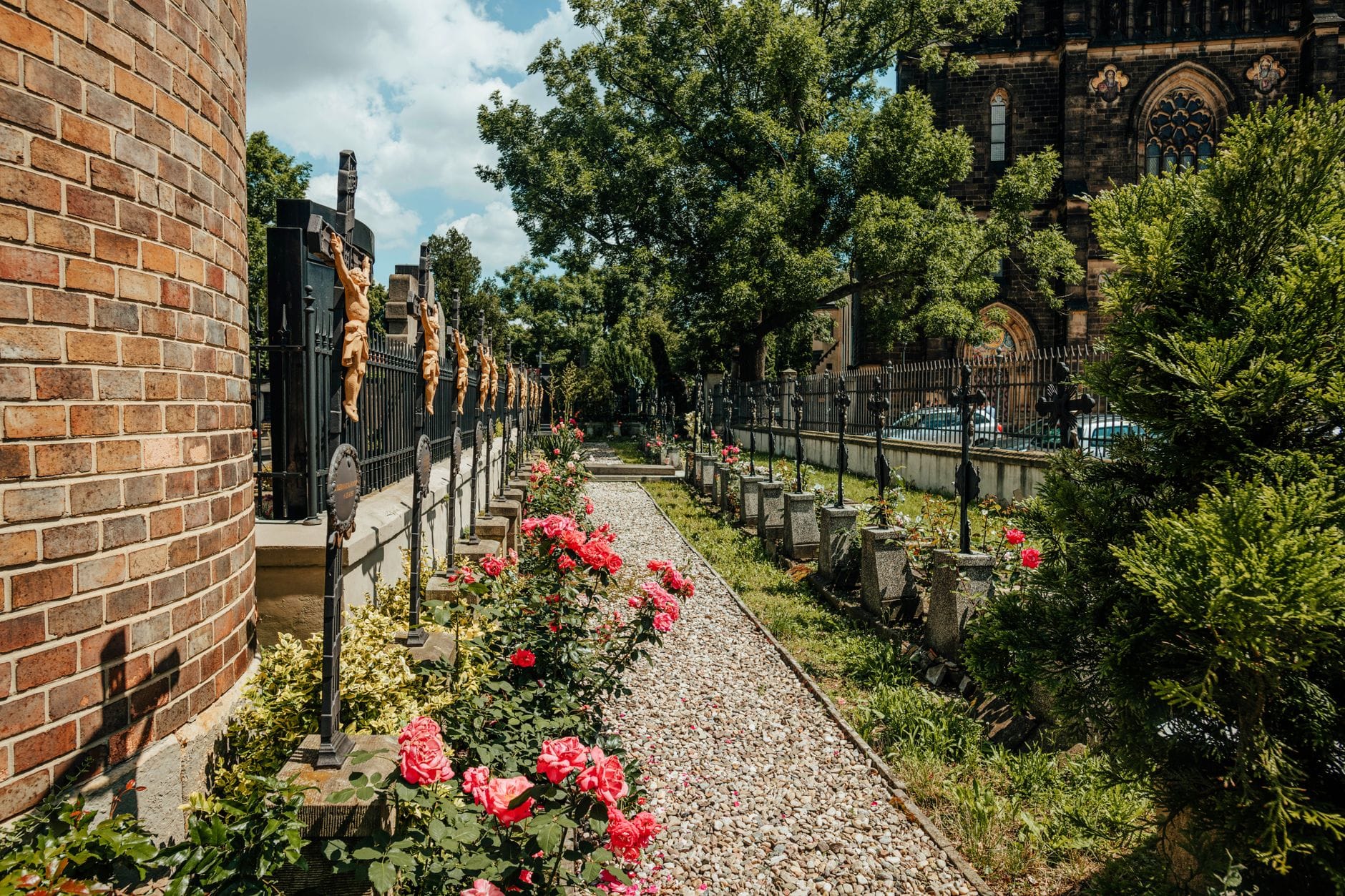
Directly beside the basilica, the Vyšehrad Cemetery is one of the most significant burial grounds in Central Europe. Established in the 19th century as a pantheon for notable Czech figures, it holds the graves of composer Antonín Dvořák, writer Karel Čapek, painter Alfons Mucha, and dozens of other artists, writers, and scientists. The Slavín mausoleum at the far end of the cemetery is the collective tomb for those deemed most distinguished. Unlike many tourist sites, this one demands a slower pace: the inscriptions, the funerary sculpture, and the layout all reward careful attention.
The Rotunda of St Martin, tucked into the southern part of the grounds near the Leopoldova brána, is Prague's oldest surviving Romanesque structure, dating to the late 11th century. It's small, austere, and easy to overlook, but it represents something the more famous sites in Old Town can't offer: over 900 years of continuous presence on the same spot. The exterior is the main draw, as the interior is only accessible on specific occasions.
The Casemates, underground chambers carved into the Baroque fortification walls, house original Baroque statues from Charles Bridge. The statues you see on the bridge today are replicas; the weathered originals were moved here for preservation. The Casemates require a separate entry ticket and offer a genuinely unusual perspective on the city's most iconic monument. They also shelter a large sculptural group depicting figures from Czech legend, commissioned in the 19th century.
Basilica of Saints Peter and Paul: neo-Gothic exterior, Art Nouveau murals inside, requires entry ticket
Vyšehrad Cemetery and Slavín mausoleum: national cemetery, free to enter, opening hours vary seasonally
Rotunda of St Martin: exterior always accessible, interior openings are limited
Casemates and original Charles Bridge statues: ticketed underground tour
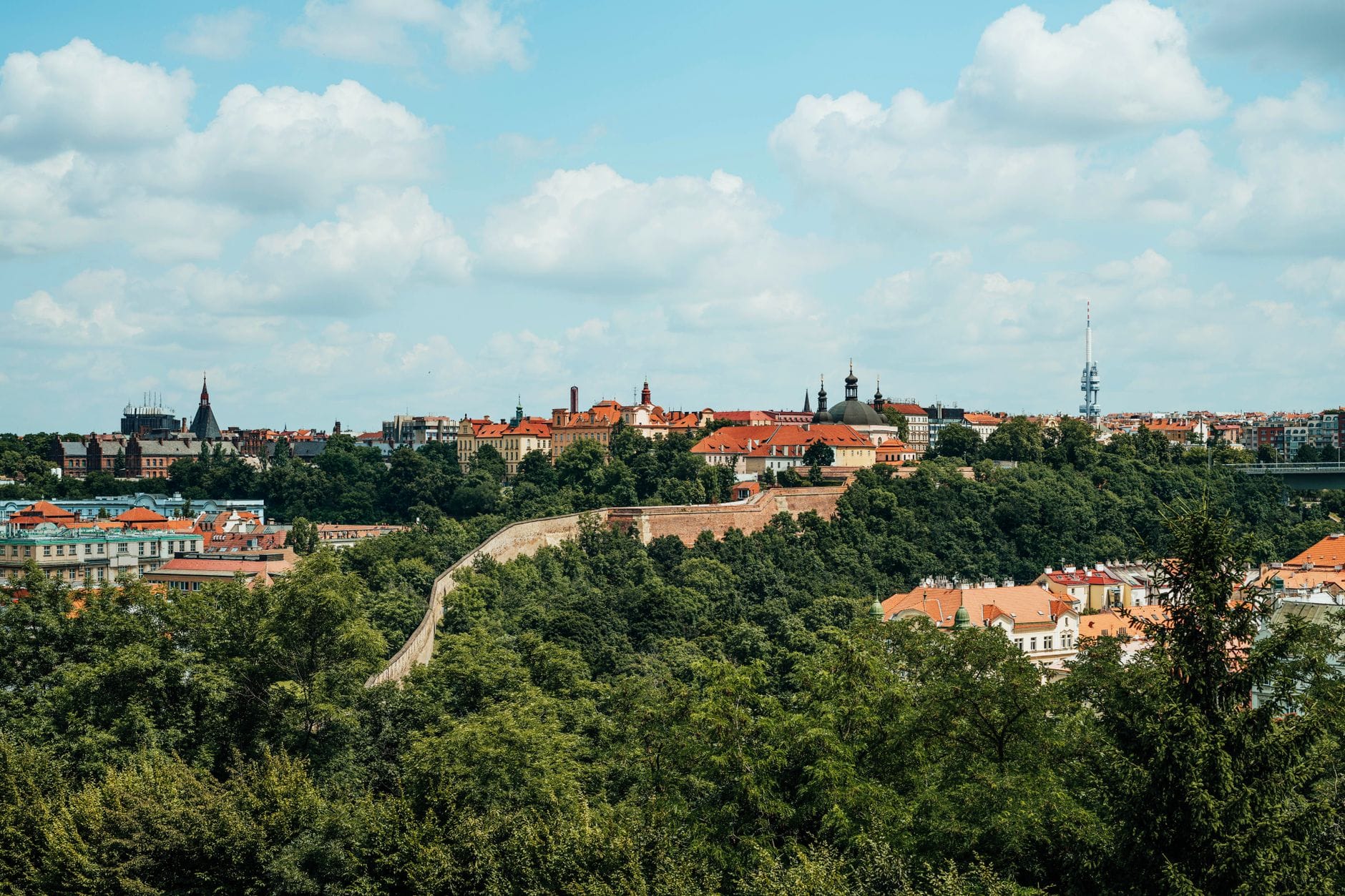
Baroque ramparts and Tábor/Leopold gates: free to walk, fine river views from the western wall
Sculptures by Josef Myslbek depicting Czech legendary figures, displayed in the Vyšehrad gardens
ℹ️ Good to know
Opening hours and ticket prices for the basilica and casemates change seasonally and are managed by the Vyšehrad Administration (praha-vysehrad.cz). Check the official site before visiting, as hours differ significantly between summer and winter.
Eating & Drinking
Food options within the fortress walls are limited by design. There are a small number of seasonal kiosks and a café near the basilica that operates in warmer months, but Vyšehrad is not a place to arrive hungry and expect to find a full restaurant meal. The upside is that this keeps the plateau calm and non-commercial.
For a proper meal, the streets immediately below the plateau offer more. Along the embankment near Výtoň and in the surrounding residential streets of Vyšehrad and Podolí, you'll find neighborhood restaurants and cafés that cater primarily to locals rather than visitors. Prices here are noticeably lower than in Old Town or around Wenceslas Square, and the atmosphere is correspondingly quieter.
Visitors who want to combine Vyšehrad with a riverside drink or food should consider the Náplavka riverfront, which runs along the western bank of the Vltava to the north. This stretch of embankment, roughly a 15-minute walk from Výtoň along the river, has a strong weekend market scene in spring and summer, with food stalls, coffee carts, and informal bars operating from the embankment. It's a natural pairing with a morning visit to the fortress.
Getting There & Around
The easiest approach by public transport is Metro Line C to Vyšehrad station. The station sits at the south end of the Nusle Bridge, and from the exit a clearly signed path leads in about a 10‑minute walk to the Tábor Gate, the main entrance into the fortress complex. The walk is mostly flat until the final approach, making this the most accessible route.
Alternatively, trams running along the river embankment stop at Výtoň, from which you climb via Libušina and Na Libušince streets up to the complex from the riverside. This approach is steeper but gives you a sense of the cliff's scale and passes closer to the river before ascending. A second tram option is the Albertov stop, from which Vratislavova Street leads uphill to the plateau from the east.
On foot from the center, Vyšehrad is reachable in 30 to 40 minutes from Wenceslas Square by walking south along the river embankment. The route is straightforward and passes through the quieter southern reaches of New Town. For those combining Vyšehrad with Prague Castle on the same day, note that the two sites are on opposite sides of the city center, separated by roughly 5 kilometers: Metro Line C connects Vyšehrad station northward to Muzeum, where you transfer to Line A for Malostranská, the most convenient station for Prague Castle.
⚠️ What to skip
The paths along the outer ramparts involve uneven stone surfaces and some steep drops without full fencing. Appropriate footwear is advisable, and visitors with young children should stay aware of the edge zones along the western walls above the river.
Where to Stay
Vyšehrad is not a primary hotel district, and that is part of its appeal for a certain type of traveler. The surrounding streets of Prague 2, particularly Vyšehrad and the adjacent Podolí and Nusle neighborhoods, have a range of smaller hotels, guesthouses, and apartments at prices considerably lower than Old Town. Guests staying here trade immediate walkability to major sights for calm streets and a more residential rhythm. For a broader overview of where to stay across the city, the Prague accommodation guide covers all major districts with honest comparisons.
Vyšehrad metro station on Line C puts you within four stops of the main railway station and within easy range of Old Town. For visitors who prefer quiet evenings and quick metro access over being central, this part of Prague 2 is worth considering. The neighborhood has no significant nightlife of its own, so noise is rarely an issue after dark.
Context: History and Significance
Vyšehrad's place in Czech history exceeds its physical scale. According to medieval legend, it was the seat of the earliest Přemyslid rulers before Prague Castle became dominant, and the mythological princess Libuše was said to have prophesied the founding of Prague from this very cliff. Whether or not those legends hold historical weight, they established Vyšehrad as a symbol of Czech identity that persisted through centuries of Habsburg rule, the 19th-century national revival, and into the modern era.
The fortress you see today is largely a 17th-century Baroque construction, built by Habsburg engineers over the earlier medieval structures. By the 19th century, as the fortress lost its military function, Czech cultural figures began to reclaim it as a national monument. The decision to establish the cemetery as a pantheon for distinguished Czechs was a deliberate act of cultural assertion during a period when the Czech language and identity were under sustained pressure. That context gives the cemetery more weight than a casual visit might suggest.
Vyšehrad was declared a National Cultural Monument in 1962 and forms part of the UNESCO‑listed Prague Heritage Reserve, rather than being a separate UNESCO site. For visitors with a deeper interest in how the city's layers of history connect, the Prague history guide provides useful context on the relationship between Vyšehrad, Prague Castle, and the broader arc of Bohemian history.
Honest Assessment: Is Vyšehrad Right for You?
Vyšehrad is not for every traveler, and there is no point pretending otherwise. If your priority is maximizing the number of major sights in a short visit, the time it takes to reach and explore the plateau could be spent at the Jewish Quarter, the Old Town, or Prague Castle, all of which are denser with world-class attractions per square meter.
Where Vyšehrad earns its place is in what it offers that nowhere else in Prague can: a quiet fortress park above the river, a cemetery that functions as a genuine cultural document, and views of the city that are less photographed but no less striking than those from Petřín or Letná. It suits travelers who want at least one afternoon that doesn't involve a crowd, and it suits anyone with a particular interest in Czech art, music, or literature, since many of the figures who shaped those fields are buried within a few meters of each other here.
Vyšehrad also pairs well with a walk along the Náplavka embankment to the north, making it possible to combine a morning at the fortress with an afternoon by the river. For travelers trying to structure a longer visit to Prague, the one-week Prague itinerary shows how Vyšehrad fits naturally into a broader city plan without feeling like a detour.
TL;DR
Vyšehrad is a 10th-century fortress complex on a cliff above the Vltava, about 3 km southeast of Prague Castle, with free access to its grounds year-round.
Key attractions include the neo-Gothic Basilica of Saints Peter and Paul, the national cemetery with graves of Dvořák and Mucha, the Rotunda of St Martin, and the Casemates housing original Charles Bridge statues.
Best reached by Metro Line C to Vyšehrad station, with a signed 10‑minute walk to the Tábor Gate; trams serve the lower embankment at Výtoň.
Food and drink options are minimal inside the fortress: plan meals before or after at nearby riverside spots along Náplavka.
Suited to travelers who want history, views, and quiet rather than density of sights; not ideal as a first stop for short city breaks, but highly rewarding for anyone spending three or more days in Prague.
Three days is the ideal amount of time to experience Prague's historic core without rushing. This itinerary takes you from the medieval lanes of Old Town to the hilltop grandeur of Prague Castle, the haunting beauty of Josefov, and the quieter pleasures of Malá Strana and Vyšehrad.
Prague's museum scene stretches far beyond the obvious. This guide covers the city's finest art, history, and specialist museums, from the National Gallery's scattered palaces to underground alchemical laboratories and intimate synagogues that carry centuries of history.
Prague rewards visitors differently depending on when you arrive. This guide breaks down every season with clear seasonal notes of weather, crowd levels, hotel prices, and key events, so you can choose the right time for your trip rather than the most popular one.
Prague rewards those who climb. From medieval towers rising above Old Town to forested hills and riverside terraces, the city's skyline is best understood from above. This guide covers every worthwhile viewpoint, whether you're after a paid 360-degree panorama or a free hilltop perch with a cold beer.
Prague sits at the center of Bohemia, making it one of the best-positioned cities in Europe for day trips. Within two hours by train or bus, you can reach a Gothic castle above a forested valley, a UNESCO town wrapped in a river bend, a Nazi memorial site, and one of Europe's notable spa resorts.
Prague has one of Central Europe's most efficient public transport networks, covering the city by metro, tram, and bus under a single integrated ticket system. This guide covers fares updated for 2026, airport transfer options, ride-hailing realities, and the mistakes most visitors make on their first day.
Seven days is the right amount of time to see Prague properly. This guide breaks down exactly how to spend each day, which neighborhoods to prioritize, what the castle complex actually demands in terms of time, and how to fit in a day trip without losing a full day to logistics.
Prague's historic center packs over 1,100 years of architectural history into roughly 870–900 hectares, from Romanesque crypts and Gothic cathedrals to one of the world's most substantial collections of Cubist buildings. This guide breaks down every major style, tells you exactly what to see, and gives you the practical details to plan your visit.
Prague's Christmas markets run from late November through early January, turning Old Town Square and Wenceslas Square into some of Europe's most atmospheric winter destinations. This guide covers every major market, what to eat and drink, how to avoid the worst crowds, and exactly what to budget.
David Černý is the Czech Republic's most provocative public artist, and Prague is his gallery. This guide covers his major installations across the city, how to build a self-guided walking route, and what you need to know before you go.
Prague sets a high bar for romance: Gothic spires, cobblestone lanes, river views, and a classical music scene that rivals much larger capitals. This guide covers the best things to do in Prague for couples across every season, from iconic spots timed to avoid the crowds to quieter corners most visitors miss entirely.
Prague rewards those who look beyond Charles Bridge and Old Town Square. This guide reveals the city's quieter side: Baroque gardens tucked behind unmarked doors, medieval cellars beneath busy streets, panoramic hilltops where locals outnumber tourists, and neighborhoods reshaping Prague's creative identity.
Prague's history spans more than a thousand years of empire, revolution, occupation, and reinvention. This guide breaks down the key eras, explains what shaped the city's architecture and culture, and tells you exactly where to see that history in person.
Summer is Prague's most popular season, but it comes with trade-offs: intense heat, peak-season crowds, and higher prices. This guide covers everything you need to plan a smart trip to Prague in June, July, or August, from booking timelines to beat-the-crowd strategies.
Winter strips Prague back to its essentials: gothic spires against grey skies, Christmas markets on cobblestone squares, and a fraction of the summer crowds. This guide covers the real conditions — temperatures, daylight, costs, and which attractions stay open — so you can plan with confidence.
Josefov is one of Europe's most significant Jewish heritage sites, packed into just a few city blocks between Old Town Square and the Vltava River. This guide covers every major site, how ticketing works, the best time to visit, and what most visitors get wrong before they arrive.
Prague delivers five-star experiences at prices that would seem impossible in Paris or London. This guide covers the best luxury hotels with practical pricing data, the fine-dining restaurants worth booking weeks ahead, and the high-end experiences that go well beyond the standard tourist circuit.
Prague nightlife runs deeper than the tourist bars around Old Town Square. This guide breaks down the city's after-dark scene by district, covering the best clubs, bars, jazz venues, and rooftop spots, with practical advice on prices, timing, and where locals actually go.
Prague is one of Europe's better-value capitals, but it is not the ultra-cheap destination the myth suggests. This guide breaks down exactly what things cost in 2026, where to save money without sacrificing the experience, and which tourist traps quietly drain your wallet.
Prague rewards shoppers across every budget, from Bohemian crystal and hand-carved puppets to international luxury labels on Pařížská Street. This guide breaks down the best shopping districts, markets, malls, and genuinely worthwhile souvenirs, with practical details on hours, transport, and what to skip.
The journey from Prague to Munich covers just under 400 km and can be done by direct train, bus, or flight. This guide breaks down every realistic option with prices, journey times, and practical booking advice so you can choose the right one for your trip.
The Prague to Vienna corridor is one of Central Europe's best-connected routes, with trains, buses, and flights running daily. This guide breaks down every option by cost, comfort, and real travel time so you can pick the right one for your trip.
This step-by-step guide walks you through Prague's most rewarding route, from the medieval core of Old Town across Charles Bridge and up to the castle complex on Hradčany hill. Covers distances, timing, ticket costs, seasonal advice, and the shortcuts most visitors miss.
Prague is one of Europe's most rewarding cities for families, offering everything from a world-class zoo and a funicular railway to interactive museums and vast green parks. This guide covers the best activities for children of all ages, how to get around cheaply, which neighborhoods work best for families, and what to skip.
Prague rewards visitors with one of Europe's most intact medieval city centres, a world-class Jewish quarter, and neighbourhoods far beyond the tourist trail. This guide covers the best things to do in Prague across every budget and interest, with crowd warnings, seasonal advice, and precise logistics.
Prague's dining scene is far more nuanced than the tourist-trap stereotype suggests. This guide breaks down the best neighborhoods for food, what to order, which restaurants are worth booking in advance, and how much to expect to pay — from a 90 CZK bowl of goulash to a Michelin tasting menu.
Choosing where to stay in Prague shapes your entire trip. This guide breaks down every major neighborhood by location, price, atmosphere, and drawbacks so you can book with confidence, whether you have three days or three weeks.