Wenceslas Square (Václavské náměstí): Prague's Historic Boulevard
Wenceslas Square is not a square in the traditional sense but a 750-metre boulevard at the heart of Prague's New Town. Free to enter and open around the clock, it has been the stage for coronations, revolutions, and ordinary daily life for nearly 700 years.
Quick Facts
- Location
- Václavské náměstí, 110 00 Praha 1 (New Town / Nové Město)
- Getting There
- Můstek (Lines A & B) at the lower end; Muzeum (Lines A & C) at the upper end
- Time Needed
- 30–60 minutes to walk through; allow more for the National Museum
- Cost
- Free (open public space)
- Best for
- History, architecture, people-watching, and understanding modern Czech identity
- Official website
- prague.eu/en/objevujte/wenceslas-square-vaclavske-namesti
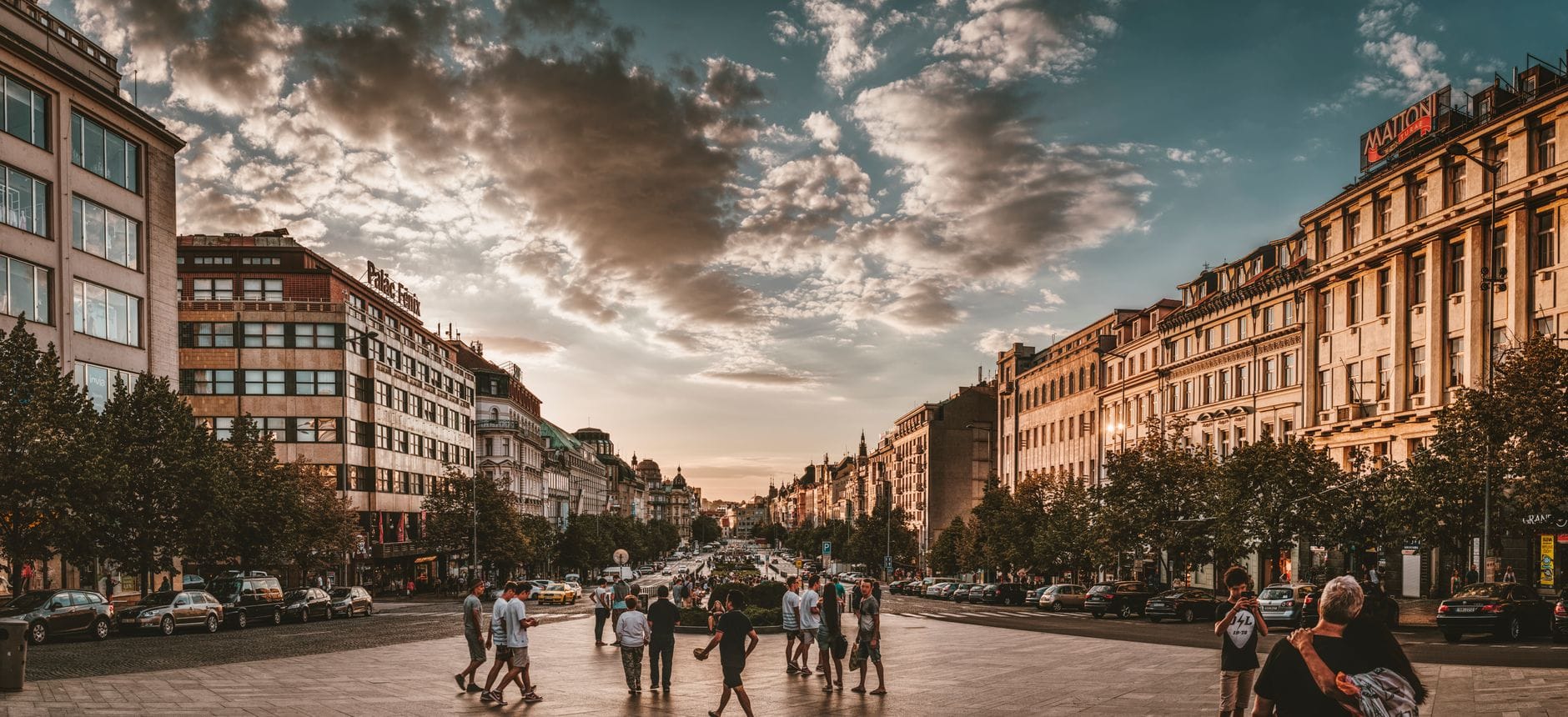
What Wenceslas Square Actually Is
Despite its name, Wenceslas Square is not a square. It is a long, gently sloping boulevard stretching approximately 750 metres through the centre of Prague's New Town, around 60 metres wide, with a broad pedestrian median lined with trees, benches, and lamp posts. Cars flow along both sides; trams used to run through it, and the ghost of those tracks is still visible in places. The formal Czech name, Václavské náměstí, uses the word náměstí, which covers both plazas and elongated public spaces in Czech urban planning tradition.
The square was laid out in 1348 on the orders of Charles IV as part of his ambitious expansion of Prague into what became Nové Město, New Town. It was originally called the Horse Market, serving as a trading ground for livestock and one of the commercial anchors of the new district. The horse market function persisted for centuries before the space gradually transformed into a civic and commercial boulevard.
ℹ️ Good to know
Both metro stations serving Wenceslas Square, Můstek and Muzeum, are transfer hubs: Můstek is on Lines A (green) and B (yellow), while Muzeum is on Lines A (green) and C (red). This makes the square one of the most directly accessible points in Prague by public transport.
The Layout: Walking from Bottom to Top
The square runs roughly northwest to southeast on a gentle uphill grade. The lower end, near Můstek station, connects directly to Old Town via Na Příkopě and meets the commercial grid of the city centre. This end is busier, louder, and more commercial, with fast food, exchange offices, and retail chains clustered at street level. Pickpocketing is a real concern in this stretch, particularly around the metro entrance and on crowded evenings.
Walking uphill through the central median, the character shifts gradually. Department stores and hotels from the early 20th century line the sides, many of them architecturally significant. The buildings represent a layered timeline: Neo-Baroque, Art Nouveau, Functionalist, and post-war additions sit side by side without much harmony but with a great deal of historical honesty. The Hotel Juliš, the Palác Lucerna arcade, and several banking buildings from the interwar period are worth pausing to examine at facade level.
The Lucerna Palace, accessible from the square's lower half, is one of the few genuine architectural surprises in this area: an early 20th-century arcade built by the grandfather of former Czech president Václav Havel, with a cinema, concert hall, and bars arranged around a covered atrium. It is usually quiet even when the square outside is packed.
The upper end, at Muzeum station, broadens into a wide forecourt in front of the National Museum. The equestrian statue of Saint Wenceslas, patron saint of Bohemia, commands this space from a prominent plinth. Around its base are smaller statues of other Bohemian saints: Ludmila, Prokop, Vojtěch, and Anežka. The statue was created by sculptor Josef Václav Myslbek and installed in its current form in 1912, though the project spanned decades.
Tickets & tours
Hand-picked options from our booking partner. Prices are indicative; availability and final rates are confirmed when you complete your booking.
Self guided tour with interactive city game of Prague
From 5 €Instant confirmationFree cancellationPrague by night city tour
From 27 €Instant confirmationFree cancellationPrague city tour with Vltava River cruise
From 38 €Instant confirmationFree cancellationPrague Castle online audio guide
From 5 €Instant confirmationFree cancellation
The National Museum at the Head of the Square
The Neo-Renaissance building at the top of the square is the National Museum of the Czech Republic (Národní muzeum), one of the largest museums in Central Europe. Its construction was completed in 1891, and it served as a deliberate architectural statement of Czech cultural identity at a time when Bohemia was still part of the Austro-Hungarian Empire. The dome and colonnaded facade make it the visual anchor of the entire boulevard.
During the Warsaw Pact invasion of August 1968, Soviet tanks positioned near the square fired at the museum facade, leaving bullet holes that remained visible for decades. During restoration work completed in recent years, the decision was made to preserve some of those marks as historical evidence. The building has undergone significant renovation and the interior collections, covering natural history, Czech history, and cultural heritage, are open to visitors. Admission is charged; check the museum's official website for current prices and hours before visiting.
💡 Local tip
If you are visiting primarily for architecture or history, the museum exterior and forecourt are rewarding on their own and cost nothing to see. The interior requires a ticket and a separate block of time.
Historical Weight: What Happened Here
Wenceslas Square has been the primary stage for Czech public life at moments of crisis and transformation. In October 1918, the founding of the independent Czechoslovak Republic was proclaimed here. In 1939, German forces marched through as the occupation began. In 1948, the Communist Party used mass rallies on the square to consolidate power. In January 1969, student Jan Palach set himself on fire at the top of the square in protest against the Soviet-led normalisation that followed the 1968 invasion, a moment that became a lasting symbol of resistance.
In November 1989, the square became the focal point of the Velvet Revolution. Hundreds of thousands of people gathered here over several nights, keys jangling in the air as a signal of opening and change. Within weeks, 41 years of Communist rule ended. A small memorial near the Wenceslas statue marks Jan Palach's sacrifice, and the spot remains a place where flowers and candles appear on significant dates. For visitors interested in this period of history, the Museum of Communism Prague is located a short walk away and provides detailed context.
This accumulation of historical events gives the square a particular quality that is difficult to articulate but easy to feel when you know what you are looking at. The trees and lamp posts and cafe chairs exist alongside invisible coordinates of enormous consequence. It is not a museum, but it is one of the most densely historical outdoor spaces in Europe.
Time of Day and How the Square Changes
In the early morning, before 8am, the boulevard belongs to dog walkers, commuters cutting through the median, and delivery trucks servicing the hotels. The air is cool, the tram and metro infrastructure produces a low mechanical hum from below, and the light falls long and flat across the facades on the eastern side. This is the best hour for photography of the National Museum facade, when the crowds have not yet gathered in the forecourt.
Midday brings the full weight of tourism between June and September. The central median becomes difficult to walk through quickly, and the ground-floor cafes along both sides are at capacity. Street vendors, caricature artists, and occasional musicians set up along the pedestrian strip. The quality of food at the square itself is generally mediocre and priced accordingly; most restaurants on the square proper cater to tourists rather than locals.
By evening, particularly Thursday through Saturday, the lower half of the square shifts tone considerably. Clubs, bars, and adult entertainment venues are concentrated in the streets immediately adjacent to the lower square. Noise levels rise, and the demographic changes. Families and older visitors are better served by visiting before 7pm. In winter, the Christmas market on the square transforms the atmosphere entirely, with wooden stalls, mulled wine, and seasonal food replacing the summer crowd.
For a broader picture of how Prague's public outdoor spaces vary by time and neighbourhood, the guide to the best time to visit Prague covers seasonal considerations in detail.
Practical Information for Visitors
The square is freely accessible at all hours. There are no gates, tickets, or timed entry requirements. Metro access via Můstek and Muzeum stations connects directly to both Lines A and B (at Můstek) and Lines A and C (at Muzeum), making it one of the most straightforward points to reach in Prague from any direction.
The central median has benches and is largely flat, making it accessible for visitors with mobility limitations, though the slight uphill gradient over 750 metres should be noted. The side streets and some building entrances have steps. There are no formal cloakrooms, luggage storage, or visitor facilities on the square itself; the nearest facilities are within the metro stations.
⚠️ What to skip
Currency exchange offices on and around Wenceslas Square are frequently cited by consumer protection bodies as using unfavourable rates or hidden commissions. Use ATMs from major banks instead, and check rates before any transaction.
Photography is unrestricted in the public space. The upper forecourt in front of the National Museum offers the most compositionally satisfying view back down the length of the boulevard, especially in late afternoon when the light comes from the west. Wide-angle lenses help capture the full breadth of the space from that vantage point.
If Wenceslas Square is your entry point into Prague's central districts, the Prague walking tour guide offers a structured route connecting it to Old Town Square, Charles Bridge, and Malá Strana.
Who Will Not Enjoy This
Visitors expecting a quiet, photogenic European plaza will find Wenceslas Square disappointing, particularly in high season. It is a working urban boulevard with heavy foot traffic, vehicle noise from the flanking roads, and a commercial character at street level that prioritises turnover over atmosphere. The southern portion near Muzeum is calmer and more monumental, but the overall experience is urban rather than picturesque.
It is also not a food destination. The restaurants on the square itself are largely unremarkable. Anyone visiting solely to eat should look one or two streets east or west, where local establishments serve the same city centre clientele at noticeably better value.
For visitors with limited time who want Prague's most concentrated architectural beauty, the Old Town Square and the streets between it and the river offer more visual reward per block than most of Wenceslas Square's commercial stretch.
Insider Tips
- The forecourt of the National Museum at the very top of the square gives you the best full-length view back down the boulevard. Most visitors walk up from the bottom and miss this perspective entirely by entering the metro at Muzeum without turning around.
- The Lucerna Palace arcade, entered from Štěpánská street or Vodičkova street, runs parallel to the square and cuts through an early 20th-century covered arcade with a distinctly different atmosphere. It also hosts the famous Lucerna Music Bar downstairs, one of Prague's older live music venues.
- The Jan Palach memorial is a small bronze cross set into the pavement near the Wenceslas statue. It is easy to walk over without noticing. Fresh flowers appear here on January 16 (the anniversary of his death) and November 17 (Velvet Revolution Day) every year.
- If you visit during the Christmas market season (typically late November through early January), arrive before 11am or after 8pm to avoid the worst of the crowd concentration. The stalls stay open into the evening and the lighting is at its best after dark.
- The area immediately around Můstek station, particularly on the side streets running south toward Vodičkova, has a cluster of local lunch places that serve daily specials to office workers at prices well below the square's tourist-facing restaurants.
Who Is Wenceslas Square For?
- History-focused visitors who want to stand in the spaces where 20th-century Czech history unfolded
- First-time visitors to Prague using it as a central orientation point to understand the city's layout
- Architecture enthusiasts interested in the full range of early 20th-century Central European commercial styles
- Travellers visiting in winter who want to experience the Christmas market in a large urban setting
- Anyone connecting between the Old Town and New Town on foot who wants context rather than just transit
Nearby Attractions
Other things to see while in New Town (Nové Město):
- Dancing House (Tančící dům)
Designed by Frank Gehry and Vlado Milunić and completed in 1996, the Dancing House stands on the Vltava embankment as one of Prague's most photographed and debated buildings. Here's what the experience actually looks like from the outside, from the rooftop bar, and from the gallery inside.
- Franciscan Garden
Hidden behind the commercial noise of Wenceslas Square, the Franciscan Garden (Františkánská zahrada) is a free, walled courtyard garden Hidden behind the commercial noise of Wenceslas Square, the Franciscan Garden (Františkánská zahrada) is a free, walled courtyard garden with roots in the 14th century, a Baroque pavilion, and rose beds that offer genuine quiet in the middle of Prague's busiest district. Entry is free, and the contrast with the streets outside is immediate., a Baroque pavilion, and rose beds that offer genuine quiet in the middle of Prague's busiest district. Entry is free, and the contrast with the streets outside is immediate.
- Jerusalem Synagogue
Built in 1904–1906, the Jerusalem Synagogue is the largest synagogue of Prague's Jewish community and one of the most visually arresting religious buildings in the city. Its exterior fuses Moorish Revival arches with Art Nouveau ornament, while the interior overwhelms with color, pattern, and scale.
- Kafka's Rotating Head (Franz Kafka Sculpture)
Standing 11 metres tall outside the Quadrio shopping centre in New Town, the Head of Franz Kafka is a kinetic sculpture of 42 polished stainless steel layers that slowly rotate out of sync, fragmenting and reassembling Kafka's face. It is free to see at any time, though the programmed rotation runs at set intervals between morning and late evening, and it is one of the most photographed modern artworks in the Czech Republic.