Franciscan Garden: Prague's Quiet Courtyard Escape in the Heart of New Town
Hidden behind the commercial noise of Wenceslas Square, the Franciscan Garden (Františkánská zahrada) is a free, walled courtyard garden Hidden behind the commercial noise of Wenceslas Square, the Franciscan Garden (Františkánská zahrada) is a free, walled courtyard garden with roots in the 14th century, a Baroque pavilion, and rose beds that offer genuine quiet in the middle of Prague's busiest district. Entry is free, and the contrast with the streets outside is immediate., a Baroque pavilion, and rose beds that offer genuine quiet in the middle of Prague's busiest district. Entry is free, and the contrast with the streets outside is immediate.
Quick Facts
- Location
- vnitroblok mezi Jungmannovým náměstím a Vodičkovou ulicí
- Getting There
- Můstek metro station (Lines A and B), 2-minute walk
- Time Needed
- 20–45 minutes
- Cost
- Free admission
- Best for
- A quiet break from sightseeing, rose photography, local atmosphere
- Official website
- prague.eu/en/objevujte/franciscan-garden-frantiskanska-zahrada
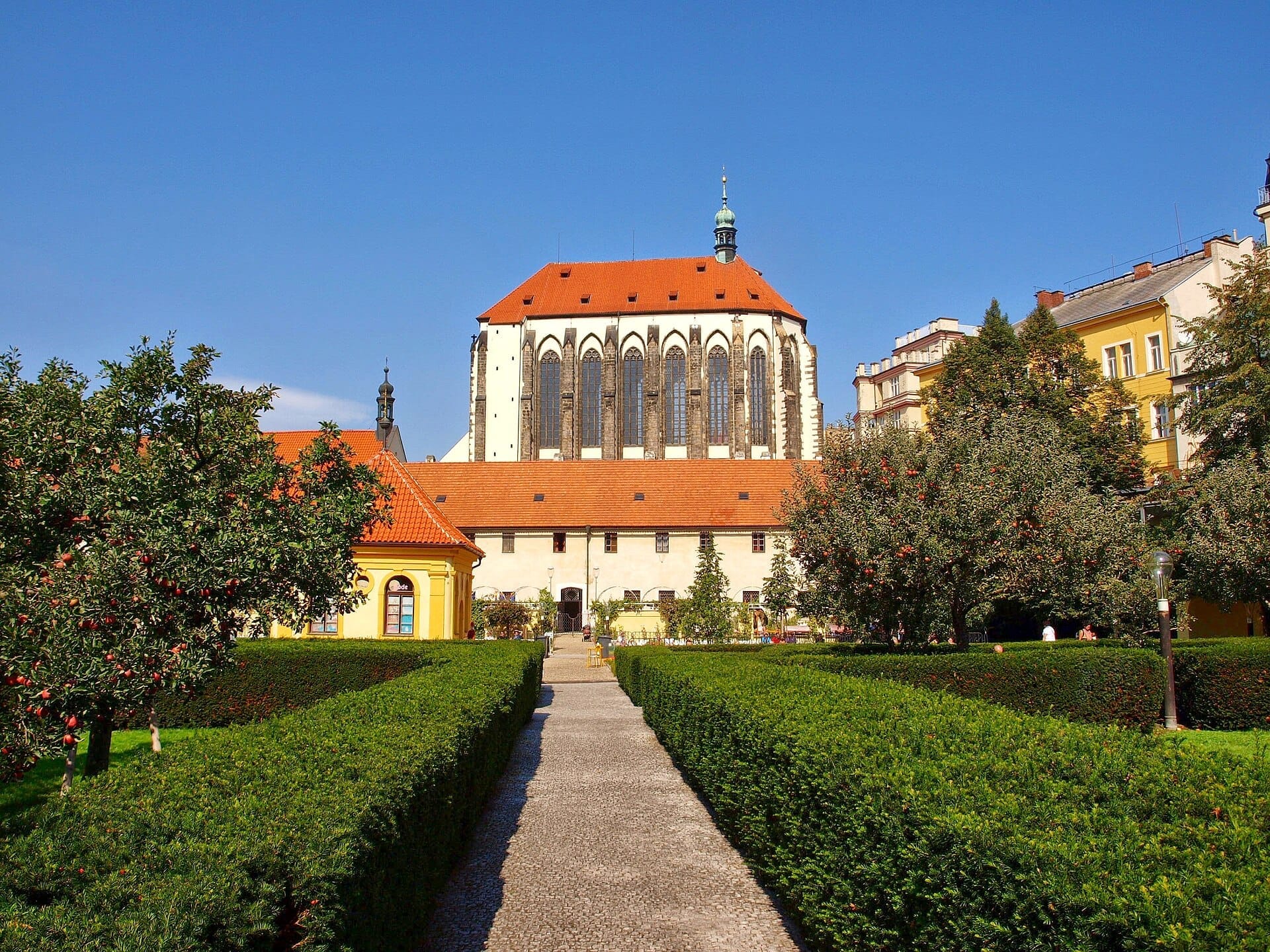
What the Franciscan Garden Actually Is
The Franciscan Garden, known in Czech as Františkánská zahrada, is a walled courtyard garden tucked into the dense urban block between Jungmannovo Square, Vodičkova Street, and the rear passages of Wenceslas Square. It covers roughly half a hectare, and the moment you step through one of its arched passages, the traffic noise drops away with surprising abruptness. The garden is geometrically laid out with rose beds, trimmed hedges, lime trees, and gravel paths that converge on a small Baroque pavilion at the centre.
This is not a grand park. There are no panoramic views, no lake, and no monumental fountain. What it offers instead is enclosure and stillness: a walled rectangle of greenery where office workers eat lunch on wooden benches, parents push strollers along the paths, and the odd tourist stops mid-stride, genuinely surprised to find this much quiet this close to one of Central Europe's most commercial streets.
💡 Local tip
The garden has three entrances: from Jungmannovo náměstí (Jungmann Square), through Pasáž Světozor from Vodičkova Street, and via passages near Wenceslas Square. The Světozor entrance is the least obvious and therefore the least crowded. The garden has three entrances: from Jungmannovo náměstí (Jungmann Square), through Pasáž Světozor from Vodičkova Street, and via passages near Wenceslas Square. The Světozor entrance is the least obvious and therefore the least crowded. Opening hours vary by season: 07:00–22:00 from mid-April to mid-September, 07:00–20:00 from mid-September to mid-October, and 08:00–19:00 from mid-October to mid-April.
A Garden with Seven Centuries of History
The garden's origins trace back to the founding of Prague's New Town in the 14th century, when it served as the fruit and vegetable garden of the Franciscan monastery that once occupied this urban block. The Barefoot Franciscans tended and restored the grounds repeatedly from the 17th century onward, shaping the early Baroque ground plan that still defines the layout today.
The small pavilion standing at the garden's centre was originally a chapel built around the turn of the 18th century. It has been repurposed over the decades but remains the garden's visual anchor, its modest Baroque facade giving the space a formal quality that distinguishes it from a simple municipal park. The surrounding monastery buildings, now absorbed into the commercial fabric of New Town, still form the garden's walls on several sides.
The 20th century was less kind. Fire-fighting reservoirs were installed during World War II, damaging the original layout. The garden fell into neglect and only received a full restoration in the 1990s, after which it reopened as a public green space. Today it sits within Prague's New Town, a district whose medieval street grid still holds despite centuries of redevelopment. For historical context on how this part of the city evolved, the Prague history guide provides a useful overview.
Tickets & tours
Hand-picked options from our booking partner. Prices are indicative; availability and final rates are confirmed when you complete your booking.
Must-sees of Prague guided tour with Wallenstein Palace Gardens
From 26 €Instant confirmationFree cancellationPrague Renaissance and Baroque gardens tour with a friendly historian
From 43 €Instant confirmationSelf guided tour with interactive city game of Prague
From 5 €Instant confirmationFree cancellationPrague by night city tour
From 27 €Instant confirmationFree cancellation
How the Garden Changes Through the Day
Morning visits, roughly from opening until 9:00, are the quietest. The light is soft and low, cutting between the surrounding buildings at an angle that makes the rose beds glow. The gravel is freshly raked in summer, and there is almost no one here except the occasional dog walker and a groundskeeper moving between the hedges. The smell of cut grass or damp stone is more pronounced in the early hours.
By midday, especially on weekdays, the benches fill with office workers from the surrounding buildings. This is the garden at its most local: people eating sandwiches, checking phones, reading. The atmosphere is relaxed rather than touristic. If you are visiting Prague in summer and the heat on Wenceslas Square is becoming oppressive, this is where many locals instinctively come to decompress. The lime trees provide genuine shade along the central path.
Late afternoon to early evening in summer, from about 17:00 onward, brings a second wave. Families appear, children run along the paths, and the rose beds catch the warm directional light that photographers favour. In spring, when the roses are in early bloom, this is the most photogenic time to visit. By contrast, winter visits are brief and contemplative: the garden is largely bare, the Baroque pavilion stands starkly against grey sky, and you will likely have the space almost entirely to yourself.
What to Look At: The Roses, the Pavilion, and the Walls
The rose beds are the garden's central feature and the primary reason photographers come here. Several dozen varieties are maintained in the formal beds, and during peak bloom in June, the colour range is wide: deep reds, pale pinks, cream whites, and salmon tones. The scent is noticeable on still mornings. Labels identify some varieties, though the signage is not comprehensive.
The Baroque pavilion at the centre is small enough that most visitors photograph it and move on, but it rewards a closer look. The stucco detailing on the facade is intact and finely worked, a reminder that this space was designed with genuine architectural care, not simply left over from monastic function. The building is not generally open to the public.
The enclosing walls themselves are worth a moment's attention. Parts of them belong to the former monastery complex, and the texture of the stonework, patchworked with repair and restoration from different centuries, tells a compressed version of the garden's history. Ivy covers sections of the southern wall in summer, and the contrast between the warm stone and the greenery gives the garden its characteristic feel of contained, almost accidental nature.
Getting There and Practical Notes
The garden is a two-minute walk from Můstek metro station, which sits at the junction of Lines A and B and is one of the most central stops in the city. From Wenceslas Square, walk toward the lower end (the Můstek end) and look for passages on the left side heading toward Vodičkova Street. The garden is a two-minute walk from Můstek metro station, which sits at the junction of Lines A and B and is one of the most central stops in the city. From Wenceslas Square, walk toward the lower end (the Můstek end) and look for the Jungmannovo náměstí entrance or passages heading toward Vodičkova Street. If you are navigating the broader area, Prague City Tourism covers the metro system and tram network in detail. If you are navigating the broader area, the guide to getting around Prague covers the metro system and tram network in detail.
Admission is free. There are no bag checks, no timed entry, and no booking required. The garden is a public space maintained by the city. It is reasonably accessible for pushchairs and mobility aids given the level gravel paths, though specific wheelchair accessibility details for all entrances are not confirmed in official sources, so visitors with specific mobility requirements should verify in advance.
ℹ️ Good to know
Photography is unrestricted. The best light for the rose beds falls in the late afternoon on the western side of the garden. A basic wide-angle lens captures the full formal layout from the garden's corners; a telephoto or macro lens rewards detail work on individual blooms.
The garden fits naturally into a broader walking loop of New Town. From here, it is a short walk to Wenceslas Square, the commercial and historical spine of the district, and to the Municipal House, one of Prague's finest Art Nouveau buildings. Those building a fuller itinerary can reference the Prague walking tour guide for route suggestions that connect these sites efficiently.
Honest Assessment: What It Is and Isn't
The Franciscan Garden is regularly described in shorthand as a secret or surprise, but it is well-listed on city tourism maps and appears in most printed guides to Prague. It is not difficult to find. What it genuinely offers is proportionate quiet: not wilderness, not a major attraction, but a well-maintained historic space that provides real contrast to the dense commercial environment around Wenceslas Square.
Visitors expecting a large park, sweeping views, or a significant museum experience will be underwhelmed. The garden takes 20 minutes to walk through thoroughly. Its value is as a pause, not a destination in itself. That said, for anyone spending a day on foot in New Town, the free entry and central location make it an easy addition to any itinerary.
If you are specifically interested in Prague's green spaces and gardens, the Wallenstein Garden in Malá Strana offers a more formally grand Baroque garden experience, while Petřín Hill provides scale and views that the Franciscan Garden does not attempt.
Insider Tips
- The Pasáž Světozor entrance from Vodičkova Street passes through a classic Czech arcade (pasáž) with a small cinema and café inside. It is worth walking through even if you skip the garden itself.
- Weekday mornings between 07:00 and 09:00 are the emptiest the garden gets. If you want photographs without benches full of people, this is the window.
- The rose beds are at their fullest in June. By late July, many varieties are past peak bloom. If roses are your primary reason for visiting, time accordingly.
- The garden benches are unmarked and freely usable. Bringing coffee and sitting for 15 minutes is a standard local behaviour here, not something requiring any transaction.
- The garden's surrounding walls include sections of the former Franciscan monastery. Looking at the building faces along the southern and eastern edges, you can distinguish older stonework from 20th-century modifications, a small architectural puzzle for those interested in the city's building history.
Who Is Franciscan Garden For?
- Travellers who need a free, central resting point mid-itinerary without entering a café or shop
- Photographers looking for Baroque architectural detail and formal rose compositions
- Anyone exploring New Town on foot who wants contrast to Wenceslas Square's commercial intensity
- Visitors travelling with young children who need open walking space without traffic
- History-focused visitors interested in Franciscan monastic heritage in Prague's urban fabric
Nearby Attractions
Other things to see while in New Town (Nové Město):
- Dancing House (Tančící dům)
Designed by Frank Gehry and Vlado Milunić and completed in 1996, the Dancing House stands on the Vltava embankment as one of Prague's most photographed and debated buildings. Here's what the experience actually looks like from the outside, from the rooftop bar, and from the gallery inside.
- Jerusalem Synagogue
Built in 1904–1906, the Jerusalem Synagogue is the largest synagogue of Prague's Jewish community and one of the most visually arresting religious buildings in the city. Its exterior fuses Moorish Revival arches with Art Nouveau ornament, while the interior overwhelms with color, pattern, and scale.
- Kafka's Rotating Head (Franz Kafka Sculpture)
Standing 11 metres tall outside the Quadrio shopping centre in New Town, the Head of Franz Kafka is a kinetic sculpture of 42 polished stainless steel layers that slowly rotate out of sync, fragmenting and reassembling Kafka's face. It is free to see at any time, though the programmed rotation runs at set intervals between morning and late evening, and it is one of the most photographed modern artworks in the Czech Republic.
- Lucerna Palace
Lucerna Palace (Palác Lucerna) is a landmarked early 20th‑century entertainment and shopping complex in Prague's New Town, built between 1907 and 1921. Its covered arcade connects Štěpánská and Vodičkova streets and contains a cinema, concert hall, bars, and shops — all freely accessible to passersby. Designated a Czech national cultural monument in 2017, it remains one of Prague’s key early multi‑purpose entertainment buildings still in active use.