Petřín Hill: Prague's Green Escape Above Malá Strana
Petřín Hill is one of Prague's largest urban green spaces, rising to 327 metres above sea level on the city's west bank above Malá Strana. The hill is free to enter at any hour, with parkland paths, a miniature Eiffel-inspired lookout tower, and some of the most sweeping views over the city's red-roofed skyline. The historic Petřín funicular is closed for reconstruction until around September 2026.
Quick Facts
- Location
- Petřínské sady, Malá Strana, Prague 1
- Getting There
- Tram 9, 12, 20 or 22 to Újezd, then walk up (funicular closed for reconstruction until ~Sept 2026). Tram 22 to Pohořelec for top-of-hill access.
- Time Needed
- 1.5 to 3 hours for the hill; add 30 min for the tower
- Cost
- Hill: free. Funicular: closed for reconstruction until around September 2026 (normally a standard PID ticket). Tower: approx. 150 CZK adult (verify current prices).
- Best for
- Panoramic views, walking, families, spring cherry blossoms, escaping the Old Town crowds
- Official website
- prague.eu/en/objevujte/petrin-gardens-petrinske-sady
What Petřín Hill Actually Is
Petřín Hill is not a single attraction but a layered hillside park, officially called Petřínské sady, that rises above the Baroque quarter of Malá Strana on the west side of the Vltava River. The hill reaches approximately 327 metres above sea level, making it one of the most prominent natural features within the city limits. Its name is thought to derive from the Latin petra, meaning rock, and the hill was historically known in German as Laurenzberg, after the Chapel of Saint Lawrence that once stood here. Before the city grew around it, the slopes were cultivated as vineyards.
Today, Petřín is one of Prague's largest continuous green spaces, and it is free to enter at all times. The park itself never closes. What draws most visitors to the summit, beyond the open air, is the Petřín Lookout Tower, a wrought-iron structure built in 1891 for the Prague Jubilee Exhibition and widely compared in shape to the Eiffel Tower, though it stands only 63.5 metres tall. The comparison is not incidental: the tower was directly inspired by Gustave Eiffel's Paris structure, built two years earlier.
ℹ️ Good to know
The park is free and always open, but the Petřín Lookout Tower and Mirror Maze have separate admission fees and seasonal opening hours. Check the Prague City Tourism website for current times before you visit, as hours vary by month.
Getting Up the Hill: Walking vs. the Funicular
Most visitors arrive at the base via tram, alighting at the Újezd stop in Malá Strana. From there, visitors currently need to walk up: the Petřín funicular railway has run since 1891, making it one of the oldest funiculars in Central Europe, but it is closed for reconstruction and is not expected to reopen until around September 2026 (Q3 2026). It normally operates using standard Prague Integrated Transport (PID) tickets, so if you already have a valid travel pass, you can board without buying anything extra when it is in service. A single funicular ticket typically costs around the standard PID single fare, though fares are subject to change and should be verified at pid.cz before travel.
The funicular ride takes about four minutes and deposits you near the summit, close to the lookout tower. For those who prefer to walk, several marked footpaths wind up through the orchard terraces and woodland. The most direct route from Újezd takes around 20 to 25 minutes at a moderate pace. The paths are paved in sections but become uneven and steeper nearer the top. In winter, icy patches on the slopes are a genuine hazard: waterproof shoes with grip are worth wearing between November and March.
Visitors coming from the Prague Castle side can enter from the Pohořelec tram stop or the Koleje Strahov bus stop and descend through the park, which makes Petřín a natural connector on any Prague walking tour that links the castle district with Malá Strana.
⚠️ What to skip
Accessibility note: The funicular provides the most step-free route up the hill, but the paths around the summit still involve uneven terrain. Visitors with limited mobility should be aware that full access to all areas of the park is not guaranteed.
Tickets & tours
Hand-picked options from our booking partner. Prices are indicative; availability and final rates are confirmed when you complete your booking.
Self guided tour with interactive city game of Prague
From 5 €Instant confirmationFree cancellationPrague by night city tour
From 27 €Instant confirmationFree cancellationPrague city tour with Vltava River cruise
From 38 €Instant confirmationFree cancellationPrague Castle online audio guide
From 5 €Instant confirmationFree cancellation
The Views and When to Go for Them
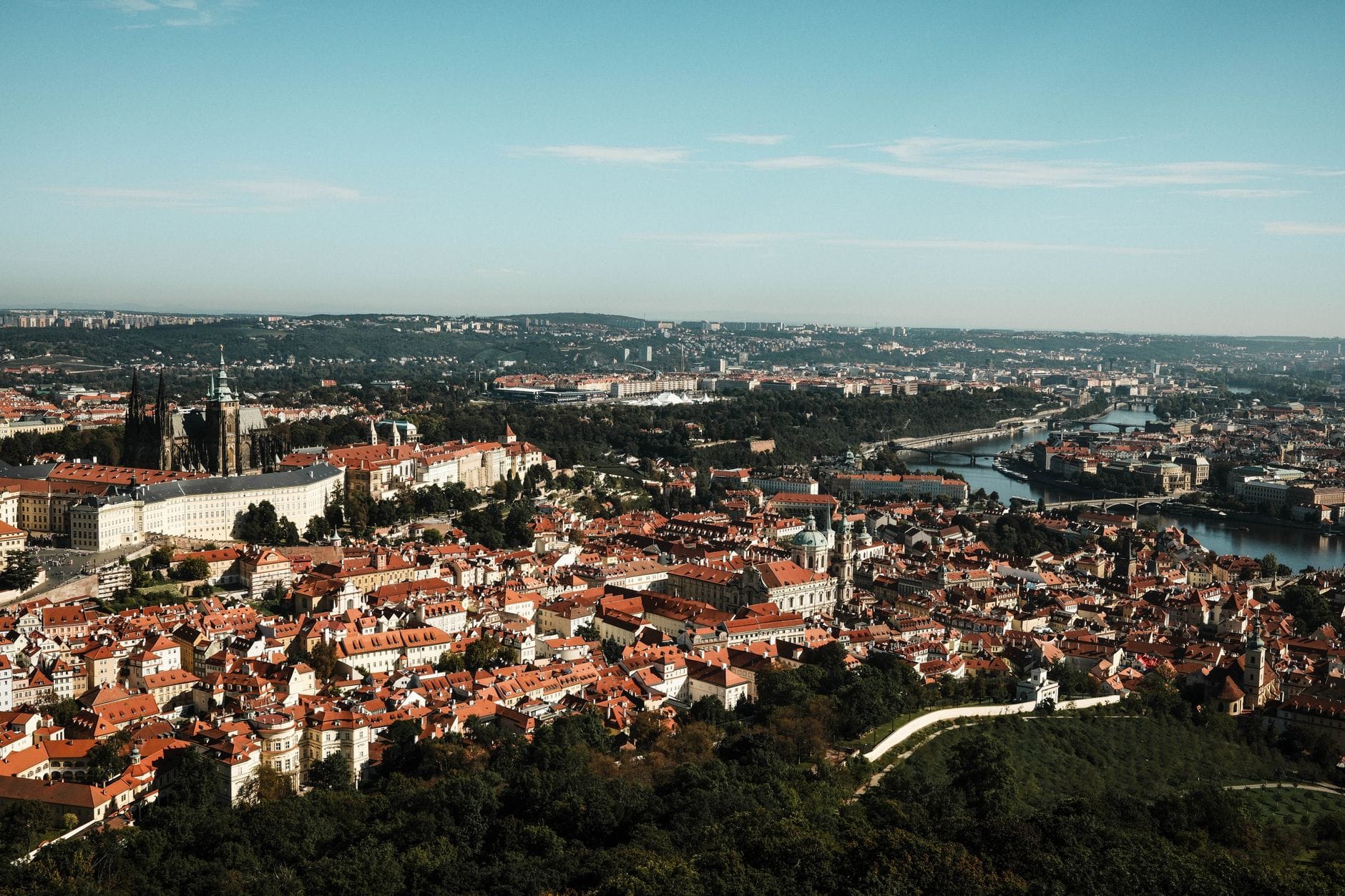
The main reason people climb Petřín, with or without the tower, is the view. From the terraced slopes and from the top of the lookout tower, the panorama takes in virtually the entire historic core: the red-roofed density of Malá Strana directly below, the spires of St. Vitus Cathedral above Prague Castle to the north, Charles Bridge crossing the Vltava, and the Old Town and New Town spreading east across the river. On clear days, the view extends far beyond the city limits into the Bohemian countryside.
Time of day changes this view considerably. At sunrise, the eastern sky lights up behind the city's silhouette and the streets below are almost empty. This is the hour when the park belongs to joggers, dog walkers, and a small number of photographers who have made the early trip worthwhile. By mid-morning on a weekend in summer, the funicular queue can stretch back noticeably and the lawns near the tower fill quickly. Late afternoon, particularly in spring and autumn, produces warm directional light on the city's stone and tile, and the crowd thins again after about 4pm.
The Petřín Lookout Tower itself adds another 63.5 metres of elevation via 299 steps inside the iron structure. The views from the top are wider and clearer than from the hillside, though the enclosed spiral staircase is narrow and steep. For those specifically seeking the city's best elevated views, it is worth comparing options: the Petřín Lookout Tower offers a more natural, park-framed setting, while the Old Town Hall Tower puts you directly above the medieval street plan on the opposite bank.
Spring Blossoms, Summer Crowds, and the Winter Hill
Petřín's character shifts substantially by season. In late March and April, the apple and cherry orchards on the lower slopes come into flower. The combination of white and pink blossoms against the stone backdrop of the city below is one of Prague's most photographed natural events each year. This is genuinely one of the most rewarding times to visit, though the same pleasant conditions draw large numbers of visitors, particularly on April weekends.
Summer brings families, picnickers, and a steady flow of tourists who combine the hill with a visit to nearby Prague Castle. The grass terraces are well-maintained and large enough that the park rarely feels uncomfortably crowded away from the tower itself. Heat can be noticeable on the exposed upper slopes in July and August, and afternoon thunderstorms, which are common in Prague during midsummer, move through quickly but can make the paths slippery.
In winter, Petřín takes on a quieter character that the summer visitor would barely recognise. Snow on the slopes, ice on the paths, and bare orchard trees create an atmosphere that rewards the walk up for those properly dressed. The lower visitor numbers mean the views from the park and the tower are unhurried. The funicular usually continues to operate in winter, though at present it is closed for modernization and service may be affected by severe weather conditions once it reopens.
The Mirror Maze, Hunger Wall, and Other Points of Interest
Beyond the lookout tower, the hill contains several other structures worth knowing about. The Mirror Maze (Bludiště) is a small but entertaining attraction that has occupied the hill since 1891, built for the same exhibition as the tower. It includes a diorama depicting the 1648 Battle on Charles Bridge between Prague students and Swedish forces. It charges a separate admission fee and is popular with children.
Running across the southern portion of the hill is the Hunger Wall (Hladová zeď), a section of medieval fortifications commissioned by Emperor Charles IV in the 14th century. According to historical accounts, the wall was built partly to provide paid work for Prague's poor during a period of famine, which is the origin of its name. The wall is still largely intact and forms a dramatic stone backdrop to the lower terraces of the park.
The Church of Saint Lawrence stands near the summit, though it is not regularly open for tourist visits. The Štefánik Observatory is also located on Petřín and offers public viewing sessions on clear evenings, particularly popular with families. For those with an interest in Prague's religious architecture, the Church of St. Nicholas in Malá Strana is a short walk downhill and worth combining with a Petřín visit.
Practical Walkthrough: A Suggested Route
A logical approach is to take the tram to Újezd, walk the usual funicular route up (the funicular is currently closed for modernization), visit the lookout tower and Mirror Maze near the summit, then walk downhill through the orchard terraces and past the Hunger Wall, exiting either back at Újezd or continuing along the southern paths toward Smíchov. This downhill walk takes 20 to 30 minutes at a relaxed pace and passes through some of the quieter, less-visited sections of the park.
Alternatively, arriving from the Pohořelec tram stop after visiting Prague Castle allows you to begin at the top and descend entirely on foot through the park into Malá Strana. This direction requires no funicular ticket and gives the walk a natural endpoint in the streets of the Lesser Town, from which Charles Bridge and the Old Town are easily reached.
Photography considerations: a standard wide-angle lens or a smartphone with a wide mode handles the panoramic views from the hill adequately, but the tower's metal lattice creates interesting framing for those with more time. Early morning light is directional and falls on the eastern city face; late afternoon light warms the stone of Malá Strana directly below the hill. Overcast days flatten the view, though they reduce haze over the full city panorama.
Is It Worth the Time?
Petřín Hill earns its place on a Prague itinerary for a specific reason: it is one of the few places in the city that feels genuinely restful. The Old Town is dense and loud at street level; Petřín is green, elevated, and quiet relative to the historic core. The views are among the most comprehensive in Prague, and because the hill itself costs nothing to access, it represents one of the better returns on a traveler's limited time.
That said, travelers on a very short trip who have already seen the city from another elevated vantage point may find the duplication less valuable. The tower admission price is moderate, and the internal stair climb is not suitable for visitors with limited mobility or those who have difficulty with heights. For a broader look at how Petřín fits into a Prague itinerary, the 3 days in Prague guide places it in context alongside other major sites.
Who should consider skipping: visitors with very limited mobility beyond what the funicular covers, anyone who has already visited the Žižkov Television Tower or Old Town Hall Tower the same day and is suffering from viewpoint fatigue, and travelers whose primary interest is architecture or museums rather than outdoor walking.
Insider Tips
- The funicular uses standard Prague PID transport tickets, so if you have a 24-hour or multi-day pass, you can normally ride it at no additional cost, but be aware that the Petřín funicular is currently closed for modernization and check its operational status before you go.
- The apple orchard on the lower southern slopes is far less visited than the area around the tower. Walking through it in late April, when the trees are in bloom, is one of the quietest and most rewarding experiences on the hill.
- The Štefánik Observatory on the hill's summit area runs public stargazing sessions on clear evenings. These are operated separately from the tower and maze, with their own schedule and fees. Check the observatory's website in advance as sessions fill quickly.
- To avoid the worst funicular queues on summer weekends once it reopens, either walk up (saving the funicular for the descent) or arrive before 9am. The park is publicly accessible at all hours and early mornings are genuinely tranquil.
- The Hunger Wall path along the southern edge of the hill connects to quieter residential streets in Smíchov and Košíře below, which few tourists discover. Following it downhill rather than retracing steps to Újezd gives a very different and more local-feeling exit from the hill.
Who Is Petřín Hill For?
- Travelers wanting panoramic views of Prague's historic skyline without paying Old Town prices
- Families with children who enjoy both outdoor walking and enclosed attractions like the Mirror Maze
- Photographers targeting the spring cherry and apple blossoms in late March to April
- Visitors combining Prague Castle with a scenic descent through parkland into Malá Strana
- Anyone seeking a quieter, less commercial counterpoint to the crowds of the Old Town
Nearby Attractions
Other things to see while in Malá Strana (Lesser Town):
- Charles Bridge
Charles Bridge is Prague's most recognizable landmark, a 516-metre medieval stone arch bridge lined with 30 Baroque statues linking the Old Town to Malá Strana. Free to cross at any hour, its experience shifts dramatically depending on when you arrive.
- Church of Our Lady Victorious (Infant Jesus of Prague)
Tucked along Karmelitská street in Malá Strana, the Church of Our Lady Victorious is one of Prague's most visited pilgrimage sites. It houses a 16th-century wax-coated wooden statue of the Infant Jesus that draws Catholic pilgrims from across the world, alongside curious visitors exploring Prague's Baroque heritage. Entry is free, and the attached museum adds unexpected depth to the visit.
- Church of St. Nicholas (Malá Strana)
The Church of St. Nicholas in Malá Strana is the most ambitious Baroque building in Prague, rising above the Lesser Town with a copper-green dome that defines the city's skyline. Built between 1704 and 1755, it rewards visitors with extraordinary ceiling frescoes, a soaring interior nearly 60 metres high, and a separate bell tower offering rooftop views across the red-tiled district below.
- Franz Kafka Museum
The Franz Kafka Museum occupies a converted 19th-century brickworks on the Malá Strana riverbank, a short walk from Charles Bridge. It holds original manuscripts, correspondence, photographs, and first editions that illuminate the life and literary world of one of the 20th century's most influential writers. The experience is deliberately unsettling, and that is precisely the point.