Charles Bridge (Karlův Most): What to Expect Before You Cross
Charles Bridge is Prague's most recognizable landmark, a 516-metre medieval stone arch bridge lined with 30 Baroque statues linking the Old Town to Malá Strana. Free to cross at any hour, its experience shifts dramatically depending on when you arrive.
Quick Facts
- Location
- Charles Bridge, Prague 1 (connecting Old Town and Malá Strana)
- Getting There
- Metro: Staroměstská (Line A); Trams: Karlovy lázně (17, 18) or Malostranské náměstí (12, 20, 22)
- Time Needed
- 20–45 minutes for a crossing; longer if you stop to study the statues
- Cost
- Free to cross. Audio guides available nearby, approx. 100 CZK (verify locally)
- Best for
- Early risers, architecture lovers, photographers, and anyone walking between the Old Town and Prague Castle
- Official website
- prague.eu/en/objevujte/charles-bridge-karluv-most
What Charles Bridge Actually Is
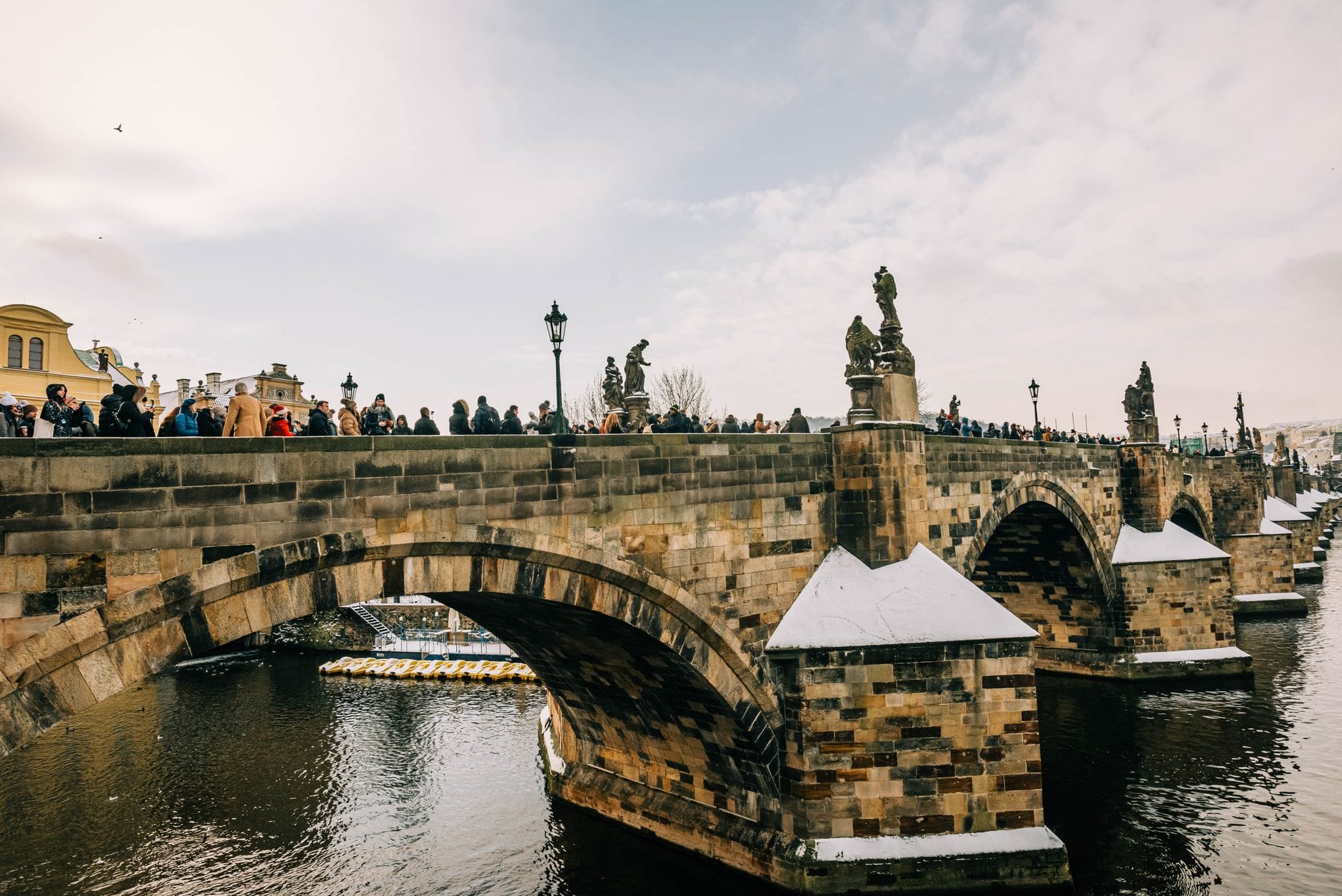
Charles Bridge, known in Czech as Karlův most, is a Gothic stone arch bridge completed around 1402 after construction began in 1357 under the orders of King Charles IV. It spans the Vltava River for approximately 516 metres at a width of about 9.5 metres, supported by 16 sandstone arches. For centuries it was the only fixed river crossing in Prague, which made it not just a thoroughfare but the commercial and ceremonial spine of the city. Coronation processions, trade caravans, and diplomatic delegations all moved across this bridge.
The bridge was originally called the Stone Bridge or Prague Bridge. The name Charles Bridge was only officially adopted in 1870, five centuries after its construction. What most visitors see today has evolved considerably: the 30 Baroque statues and statue groups that line both parapets were added in stages between 1683 and 1928. Most of the originals have been moved indoors to protect them from weathering, and what stands on the bridge now are high-quality replicas.
ℹ️ Good to know
The bridge is a free, open public thoroughfare accessible 24 hours a day, 365 days a year. There are no gates, no tickets, and no timed entry slots. Towers at each end have their own separate opening hours and paid admission.
The Experience: How It Changes by the Hour
The difference between Charles Bridge at 6 AM and 11 AM is almost impossible to overstate. In the early morning, particularly before 8 AM, the bridge belongs to a small, unhurried crowd: local joggers cutting across the river, photographers with tripods set up facing the castle, and the occasional fisherman on the embankment below. The cobblestones are wet with morning dew or overnight rain, the stone saints are backlit by a low sun coming from the east, and the only sounds are distant tram bells and the soft flow of the Vltava.
By mid-morning, particularly from 9:30 AM onward in peak season (May through September), the bridge becomes one of the most congested pedestrian spaces in Central Europe. Tour groups with flag-carrying guides move in tight formations, street artists work at easels along the parapets, and vendors operate from small stands selling jewellery and caricatures. The smell of roasting nuts drifts across from nearby stalls. Conversations in a dozen languages overlap into a low roar. The view is still there, but sharing it with hundreds of others changes its character entirely.
After sunset, the bridge takes on a third character. The sodium lamps cast a warm amber light across the sandstone statues, the castle glows white on the hill above Malá Strana, and the crowds thin significantly. Winter evenings are particularly atmospheric: cold air, low mist over the river, and far fewer people than summer. If the bridge is what drew you to Prague, dusk or early morning is when it delivers.
💡 Local tip
Aim for a crossing before 8 AM in summer. The light is excellent for photography, the crowds are minimal, and you can actually stop and examine the individual statues without being swept along by foot traffic.
Tickets & tours
Hand-picked options from our booking partner. Prices are indicative; availability and final rates are confirmed when you complete your booking.
Charles Bridge river boat cruise with walking guided tour
From 39 €Instant confirmationFree cancellationCharles Bridge, Old Town district and Prague Castle guided tour
From 60 €Instant confirmationFree cancellationPrague guided tour with Old Town, Jewish Quarter, and Charles bridge
From 20 €Instant confirmationFree cancellationPrague Charles Bridge self-guided tour with Tower Admission + optional VR Experience
From 16 €Instant confirmationFree cancellation
The 30 Statues: What You're Looking At
The statues are the soul of the bridge, and they reward attention. Each one represents a Catholic saint, and most were commissioned by the Habsburg nobility and religious orders between the late 17th and early 20th centuries. The most venerated is the statue of St. John of Nepomuk, positioned roughly in the middle of the bridge on the north-facing parapet. According to legend, the real John of Nepomuk was thrown into the Vltava from this bridge in 1393 on the orders of King Wenceslas IV. He was canonized in 1729, and the bronze bas-relief at the base of his statue is said to bring good luck if touched, which explains the conspicuous bright polish of that one spot against the otherwise darkened bronze.
Other statues worth pausing at include the group of St. Luthgard, considered by many art historians to be the finest Baroque sculpture on the bridge, created by Matthias Braun in 1710. At the opposite aesthetic extreme, the statue of St. Christopher, added in 1857, shows visible stylistic differences from the earlier Baroque works. If you cross slowly and read the identification plaques at the base of each group, you gain a compact survey of Central European Baroque religious sculpture without setting foot in a museum.
A practical note: several of the statues are undergoing restoration on a rolling basis. At any given time, one or two may be obscured by scaffolding. This is normal and does not significantly detract from the overall experience, but if you have a specific statue in mind, check recent visitor reports before your visit.
The Views: Castle, River, and Rooftops
The views from Charles Bridge are among the most photographed in Prague, and for good reason. Looking northwest from the middle of the bridge, you see the full silhouette of Prague Castle and St. Vitus Cathedral rising above the red-tiled rooftops of Malá Strana. Looking southeast, the spires of the Old Town come into view, with the towers of the Church of Our Lady Before Týn visible on clear days above the rooflines. The river itself is wide here, and the reflections of the bridge's arches in the water below are a photographic subject in their own right.
Both ends of the bridge are anchored by Gothic towers. The Old Town Bridge Tower, standing on the eastern end, is one of the finest examples of Gothic civic architecture in Europe. It has its own admission fee and opening hours, and climbing it gives an elevated view back across the bridge and river. The western end opens into Malá Strana through a pair of towers of different heights. Neither tower is required viewing to enjoy the bridge itself, but the Old Town Bridge Tower in particular is worth the separate climb for photographers.
If you are crossing from Old Town toward Malá Strana, the walk continues naturally into one of Prague's most architecturally coherent neighborhoods, with easy access to St. Nicholas Church and the winding streets leading up toward the castle. The bridge is not an isolated attraction; it functions as a physical and psychological gateway between two very different parts of the city.
Getting There and Practical Logistics
The most straightforward approach from the city centre is to walk from Staroměstská metro station (Line A), which takes about five minutes on foot heading west along the riverbank. Tram lines 17 and 18 stop at Karlovy lázně, a two-minute walk from the Old Town end of the bridge. From Malá Strana, trams 12, 20, and 22 serve Malostranské náměstí, also about five minutes from the Malá Strana bridge towers.
The bridge surface is historic cobblestone throughout. There are no steps at either entry point, so the crossing is technically step-free, but the irregular stone surface can be difficult for wheelchairs, pushchairs with small wheels, and those with mobility difficulties. High-heeled shoes are also a practical problem on the uneven stones. Wear flat, comfortable footwear regardless of the season.
In winter, the cobblestones can be icy and are not always gritted promptly. If you are visiting between December and February, particularly after overnight freezing temperatures, treat the surface as potentially slippery until proven otherwise. That said, a snow-covered bridge with almost no tourists in the grey morning light is one of Prague's quieter rewards.
⚠️ What to skip
Pickpocketing is a known issue on the bridge during peak hours. In dense summer crowds, keep bags zipped and in front of you. The congestion between 10 AM and 6 PM in July and August creates ideal conditions for distraction-based theft.
Honest Assessment: Is It Overhyped?
Charles Bridge is not overhyped. The architecture, the statues, and the views justify its reputation. What is overstated is the idea that it is inherently a peaceful or romantic experience. Visit at midday in August and it is closer to a slow-moving crowd management exercise than a contemplative stroll. The bridge is genuinely extraordinary, but when and how you visit determines what you actually get out of it.
Visitors who prioritize quiet and space may want to plan the bridge as part of a broader Prague walking itinerary that begins very early, crossing the bridge first before continuing up to the castle or down along the Malá Strana riverfront. Those with limited mobility or who find crowds distressing should be realistic: peak-season midday crossings involve significant physical contact with other pedestrians and no straightforward way to exit mid-bridge.
The bridge is also not a great option for those primarily interested in interior spaces, historical exhibits, or shelter from rain. It is an open-air structure with no facilities on the bridge itself. The nearest toilets and cafes are at either end, particularly in the streets around Malostranské náměstí on the western side.
Photography Tips
The best light on the bridge falls in the hour after sunrise when the sun rises from the east and illuminates the castle side. For the castle-and-bridge composition that defines the classic Prague postcard, you actually want to be off the bridge: the view from the embankment near Novotného lávka on the Old Town side, or from the Kampa Island shore on the Malá Strana side, gives you the full span of the bridge with the castle behind it.
For detail shots of the statues, a 50mm or short telephoto lens in the 85–135mm range works well to isolate individual figures against the sky. The statue of St. John of Nepomuk is best photographed from slightly downstream (the north parapet) to avoid backlight. If you want a long-exposure shot of the river from the bridge itself, you will need a very early arrival: tripods are technically prohibited during hours when pedestrian traffic is heavy. The area around Kampa Island directly beneath the bridge offers interesting compositions looking up at the arches.
Insider Tips
- The statue of St. John of Nepomuk has two brass plaques at its base: one showing Nepomuk being thrown from the bridge, one showing a confessor kneeling before a queen. Touch the confessor plaque (the one with the kneeling figure), not the queen scene, for the 'good luck' tradition locals actually observe.
- If you want the bridge nearly to yourself, cross between 6 and 7 AM in summer. Many tourists staying in the Old Town sleep until 8 or 9, giving you a 60–90 minute window of relative calm.
- The Malá Strana Bridge Tower (the shorter of the two western towers) dates from the 12th century, predating the current bridge. Many visitors walk past it without realizing it is Romanesque in origin, not Gothic like the rest.
- Swallows nest under several of the bridge's arches in spring and summer. In the early morning you can watch them flying low over the water just below the parapet level, which is practically impossible to see once foot traffic picks up.
- The bridge is directly upstream from Kampa Island and the small Čertovka channel. Walking down to the island after crossing gives you an elevated view back at the bridge arches from water level, which is a very different and much less photographed perspective.
Who Is Charles Bridge For?
- Photographers and architecture enthusiasts who can arrive before 8 AM
- Travelers walking between the Old Town and Prague Castle who want to combine transit with sightseeing
- History-focused visitors interested in Baroque sculpture and medieval urban infrastructure
- Evening walkers looking for an atmospheric route after dinner in Malá Strana
- First-time visitors to Prague who want to understand the city's geography by crossing it on foot
Nearby Attractions
Other things to see while in Malá Strana (Lesser Town):
- Church of Our Lady Victorious (Infant Jesus of Prague)
Tucked along Karmelitská street in Malá Strana, the Church of Our Lady Victorious is one of Prague's most visited pilgrimage sites. It houses a 16th-century wax-coated wooden statue of the Infant Jesus that draws Catholic pilgrims from across the world, alongside curious visitors exploring Prague's Baroque heritage. Entry is free, and the attached museum adds unexpected depth to the visit.
- Church of St. Nicholas (Malá Strana)
The Church of St. Nicholas in Malá Strana is the most ambitious Baroque building in Prague, rising above the Lesser Town with a copper-green dome that defines the city's skyline. Built between 1704 and 1755, it rewards visitors with extraordinary ceiling frescoes, a soaring interior nearly 60 metres high, and a separate bell tower offering rooftop views across the red-tiled district below.
- Franz Kafka Museum
The Franz Kafka Museum occupies a converted 19th-century brickworks on the Malá Strana riverbank, a short walk from Charles Bridge. It holds original manuscripts, correspondence, photographs, and first editions that illuminate the life and literary world of one of the 20th century's most influential writers. The experience is deliberately unsettling, and that is precisely the point.
- John Lennon Wall
The John Lennon Wall in Malá Strana is a free, ever-changing outdoor graffiti wall with roots in Cold War resistance. Official visiting hours are generally listed as 10:00–19:00, it costs nothing to see, and it sits just a short walk from Charles Bridge, rewarding those who understand its history as much as its color.