John Lennon Wall: Prague's Living Canvas of Protest and Peace
The John Lennon Wall in Malá Strana is a free, ever-changing outdoor graffiti wall with roots in Cold War resistance. Official visiting hours are generally listed as 10:00–19:00, it costs nothing to see, and it sits just a short walk from Charles Bridge, rewarding those who understand its history as much as its color.
Quick Facts
- Location
- Velkopřevorské náměstí, Malá Strana, Prague 1
- Getting There
- Trams 12, 15, 20, or 22 to Malostranské náměstí or Hellichova, then 5-min walk
- Time Needed
- 15–30 minutes
- Cost
- Free, no tickets required
- Best for
- History seekers, photography, couples, casual walkers
- Official website
- www.prague.eu/cs/objevujte/zed-johna-lennona
What Is the John Lennon Wall?
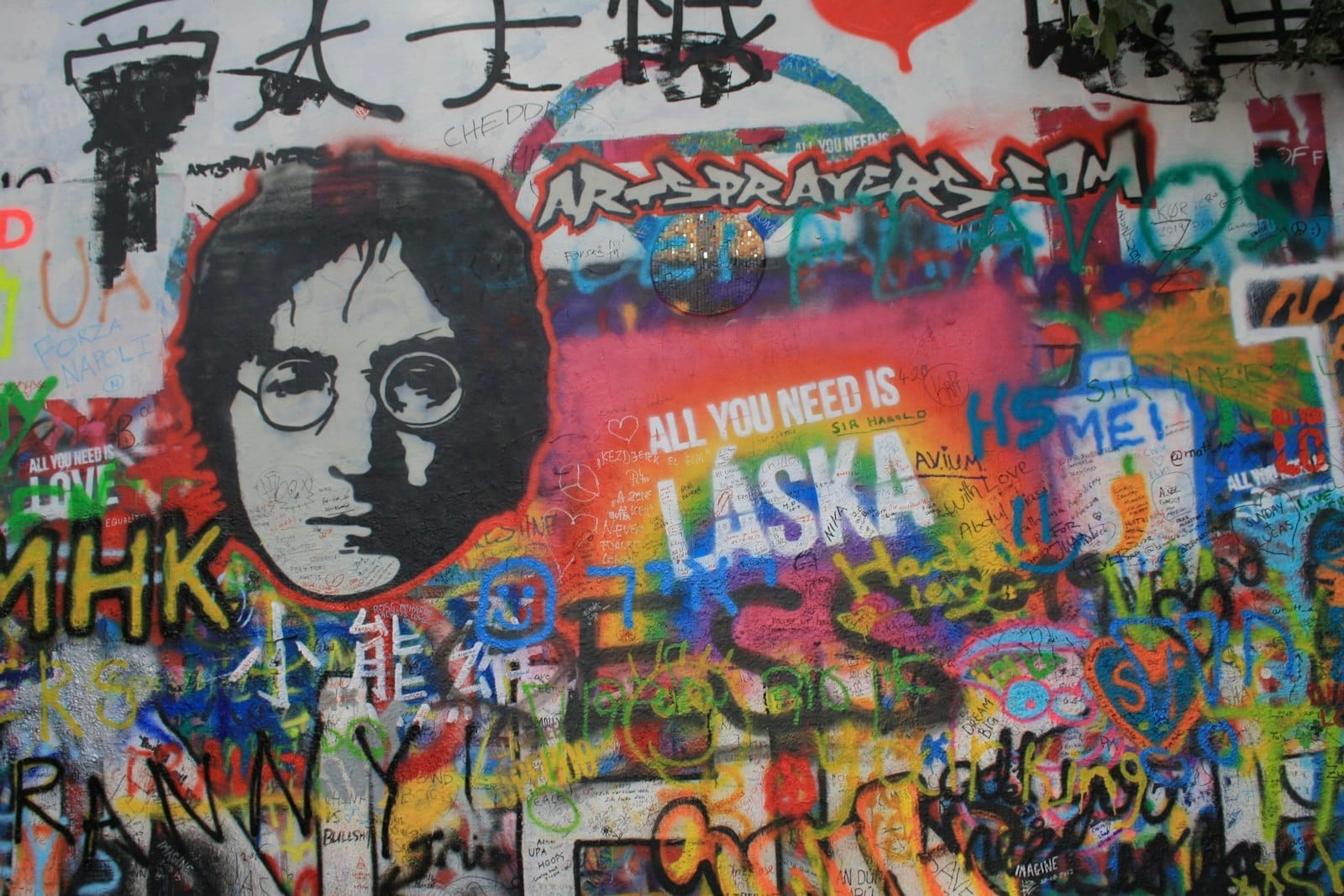
The John Lennon Wall, known in Czech as Lennonova zeď or Zeď Johna Lennona, occupies one side of Velkopřevorské náměstí, a small square in Malá Strana pressed up against the compound of the Sovereign Military Order of Malta. It is not a museum, a gallery, or a ticketed attraction. It is a public wall, permanently in flux, covered floor-to-ceiling in layers of spray paint, marker, and handwritten text that build on one another season after season.
What makes it worth your time is not any single image on the surface, but the accumulated weight of what the wall represents and how it got here. The story begins not with a graffiti artist, but with a political assassination thousands of kilometers away.
How It Started: From Lennon's Death to Cold War Symbol
After John Lennon was shot in New York on December 8, 1980, an anonymous artist painted his portrait on this wall, accompanied by Beatles lyrics and messages of peace. In the context of communist Czechoslovakia, those were not innocent decorations. The government of the time classified the graffiti as anti-state subversion.
Through the 1980s, the StB (Czechoslovak secret police) repeatedly whitewashed the wall overnight. By the next day, new graffiti would appear. Young Czechoslovaks who gathered here to write messages, light candles, or simply stand near the wall risked interrogation and arrest. The wall became a quiet, stubborn focal point for a generation that had few other places to express dissent openly.
After the Velvet Revolution of 1989, the wall lost its dangerous edge but not its cultural significance. It continued to attract visitors and artists from across the world. In 2019, more than 30 artists from five countries participated in a coordinated redesign, painting a world map featuring the word FREEDOM in 30 languages. The image faded and was painted over again within months, as it always is. That impermanence is the point. For more context on how this period shaped Prague, the Prague history guide covers the communist era and its legacy across the city.
Tickets & tours
Hand-picked options from our booking partner. Prices are indicative; availability and final rates are confirmed when you complete your booking.
Must-sees of Prague guided tour with Wallenstein Palace Gardens
From 26 €Instant confirmationFree cancellationSelf guided tour with interactive city game of Prague
From 5 €Instant confirmationFree cancellationPrague by night city tour
From 27 €Instant confirmationFree cancellationPrague city tour with Vltava River cruise
From 38 €Instant confirmationFree cancellation
What to Expect When You Arrive
💡 Local tip
The wall faces south and catches good light from late morning through early afternoon. This is also when colors photograph most accurately. Arrive before 9am for an empty square, or after 7pm to see it lit by street lamps with far fewer people.
Velkopřevorské náměstí is a narrow, enclosed square. The wall stretches roughly 10 meters wide and stands around 3 meters tall. The surface at any given time is a layered collision of portraits, peace symbols, song lyrics, declarations of love, political slogans, and abstract marks in every color combination imaginable. There is no interpretive signage explaining what you are looking at. You either know the history or you don't.
The cobblestones in front of the wall are often dotted with small offerings: candles, flowers, handwritten notes tucked into crevices. Locals and tourists both contribute. The smell of fresh marker or chalk is noticeable mainly when someone has just added a new message, and while additions still appear, spraying paint is officially prohibited and monitored, so it is uncommon to encounter anyone legally painting mid-work.
In peak season (June through August), the square fills quickly by mid-morning. At the busiest moments, 40 or 50 people crowd into a space that comfortably holds 20. Selfie sticks come out, tour groups narrate loudly in a half-dozen languages, and the experience becomes purely visual rather than reflective. If that bothers you, plan accordingly.
How the Experience Changes by Time of Day
Early morning, before 8am, the square is almost always empty. The light is soft and flat, not ideal for saturated photography, but the silence gives you space to actually look at the wall rather than navigate around other people. The French Embassy opposite is closed. The only sounds are birds and the distant tram bells from Malostranské náměstí.
Late afternoon brings the largest crowds, especially on weekends. Groups finishing a Charles Bridge walk tend to follow the natural path toward Kampa Island, then circle into the square. If you are visiting in this window, expect to share the space and accept that the atmosphere will be social rather than contemplative.
At night, the wall reads differently. Spotlighting from the ground catches certain layers of paint and ignores others, making compositions emerge that are invisible in daylight. The square is quiet again. The wall's proximity to the lamplit alleyways of Malá Strana makes the setting genuinely atmospheric, though the darkness limits what your camera can do without a tripod.
Getting There and Getting Around
The most direct public transport route is trams 12, 20, 22, or 23 to Malostranské náměstí or Hellichova, followed by a 5-minute walk south through the quiet lanes of Malá Strana. From Charles Bridge, cross to the Lesser Town side, descend toward Kampa Island, and the square is a short walk west along the waterfront. The walk itself is worth it: the route passes under stone archways and alongside baroque garden walls.
The surrounding streets are all pedestrian-friendly, though the cobblestones are uneven in places. The square itself is level and accessible without steps. There are no ticket offices, barriers, or controlled entry points. You simply walk up to the wall.
ℹ️ Good to know
There are no public toilets at the wall. The nearest facilities are in the cafes and restaurants around Malostranské náměstí, roughly a 5-minute walk north.
Photography: What Actually Works Here
The wall is a photographer's problem as much as a gift. The surface is dense with competing visual information and no single focal point. Wide-angle shots from across the square tend to flatten the layering. Moving close, within a meter or two, and selecting a specific section of the wall produces far more interesting images. Look for areas where one layer of paint has partially worn through another, or where handwriting overlaps with portraiture.
Direct midday sun creates harsh shadows from the textured surface. Overcast days produce even, diffuse light that brings out the full range of colors without bleaching the whites or blocking the shadow areas. For those using phones, portrait mode struggles here because the depth cues are ambiguous across a flat surface.
Adding a person into the frame, someone reading the wall, painting on it, or simply standing before it at a distance, gives the image scale and context that solo wall photography lacks. Street photographers do well here in the early evening when the light drops and the human element becomes more interesting than the wall itself.
Is It Worth Your Time? An Honest Assessment
If you approach the John Lennon Wall as a pretty photo backdrop, it delivers that in under five minutes. If you approach it knowing the history, understanding what it meant to stand here in 1985 versus standing here today, the experience is richer. It pairs naturally with a visit to Kampa Museum nearby, which contextualizes Central European art and memory more formally, or with a walk across Charles Bridge to anchor the Malá Strana portion of your day.
The wall is not a place to linger for an hour. Twenty minutes is typically enough. What lingers is the idea of it: a wall that authorities tried repeatedly to erase, and that kept coming back, not because any single image was remarkable, but because the act of returning mattered.
⚠️ What to skip
The John Lennon Wall can disappoint visitors who expect a carefully preserved historic artifact. The surface changes constantly. What you see today may be painted over by next week. If a specific image drew you here, it may already be gone.
Travelers with very limited time in Prague and tight itineraries may find it falls below other priorities. It is free and close to multiple major sights, so the barrier to including it is low. But it should not come at the expense of seeing the interiors of major Malá Strana landmarks if you have only a half-day in this part of the city.
Insider Tips
- Arrive before 8am on any day of the week for an empty square. The experience is fundamentally different without a crowd pressing behind you.
- Look at the lower sections of the wall near ground level, where older layers are partially exposed through chips and scuffs. This is where the actual history accumulates visibly.
- The wall is on private property belonging to the Order of Malta; while the square is freely accessible, access to contributing art is now regulated and spraying or painting without permission is forbidden, so do not assume you can freely add to the wall.
- Combine the visit with Kampa Island, just a few steps away, which offers a quieter, greener transition between the wall and Charles Bridge without retracing your steps.
- If you visit during or after rain, the wet cobblestones reflect the wall's colors and create a completely different photographic angle than anything you'll find in standard travel images of the site.
Who Is John Lennon Wall For?
- History and Cold War-era travelers who want tangible connection to communist-era resistance
- Photographers looking for texture, color, and street-level human interest
- Couples exploring Malá Strana on foot, particularly in the evening
- First-time visitors fitting in a loop from Charles Bridge through Kampa Island
- Travelers on any budget, since the wall costs nothing and takes minimal time
Nearby Attractions
Other things to see while in Malá Strana (Lesser Town):
- Charles Bridge
Charles Bridge is Prague's most recognizable landmark, a 516-metre medieval stone arch bridge lined with 30 Baroque statues linking the Old Town to Malá Strana. Free to cross at any hour, its experience shifts dramatically depending on when you arrive.
- Church of Our Lady Victorious (Infant Jesus of Prague)
Tucked along Karmelitská street in Malá Strana, the Church of Our Lady Victorious is one of Prague's most visited pilgrimage sites. It houses a 16th-century wax-coated wooden statue of the Infant Jesus that draws Catholic pilgrims from across the world, alongside curious visitors exploring Prague's Baroque heritage. Entry is free, and the attached museum adds unexpected depth to the visit.
- Church of St. Nicholas (Malá Strana)
The Church of St. Nicholas in Malá Strana is the most ambitious Baroque building in Prague, rising above the Lesser Town with a copper-green dome that defines the city's skyline. Built between 1704 and 1755, it rewards visitors with extraordinary ceiling frescoes, a soaring interior nearly 60 metres high, and a separate bell tower offering rooftop views across the red-tiled district below.
- Franz Kafka Museum
The Franz Kafka Museum occupies a converted 19th-century brickworks on the Malá Strana riverbank, a short walk from Charles Bridge. It holds original manuscripts, correspondence, photographs, and first editions that illuminate the life and literary world of one of the 20th century's most influential writers. The experience is deliberately unsettling, and that is precisely the point.