Museum Kampa: Central European Modern Art in a Riverside Mill
Museum Kampa occupies the beautifully restored Sova's Mill complex on Kampa Island, steps from Charles Bridge. As home to the Jan and Meda Mládek Foundation collection, it holds one of Central Europe's most significant concentrations of 20th-century Czech and Central European modern art, including major works by František Kupka and Otto Gutfreund.
Quick Facts
- Location
- U Sovových mlýnů 503/2, Kampa Island, Malá Strana, Prague 1
- Getting There
- Tram to Malostranské náměstí (lines 12, 20, 22, 23) or Hellichova (lines 12, 15, 20, 22, 23), then a 5–10-minute walk down to Kampa Island
- Time Needed
- 1.5 to 2.5 hours for the permanent collection; longer if a major temporary exhibition is on
- Cost
- Adults 360 CZK, Students/Seniors 240 CZK, Children under 6 free, Family ticket 700 CZK
- Best for
- Modern and contemporary art lovers, architecture enthusiasts, couples, rainy-day culture
- Official website
- www.museumkampa.cz
What Museum Kampa Actually Is
Museum Kampa is a private gallery and foundation, not a state institution. Its full official name is Museum Kampa – The Jan and Meda Mládek Foundation (Czech: Museum Kampa – Nadace Jana a Medy Mládkových), and it opened to the public in 2001. The driving force behind it was Meda Mládková, a Czech-born art collector who spent decades in exile building one of the most significant private collections of Central European modernism in the world. When she returned the collection to Prague after 1989, Kampa Island was chosen as its home.
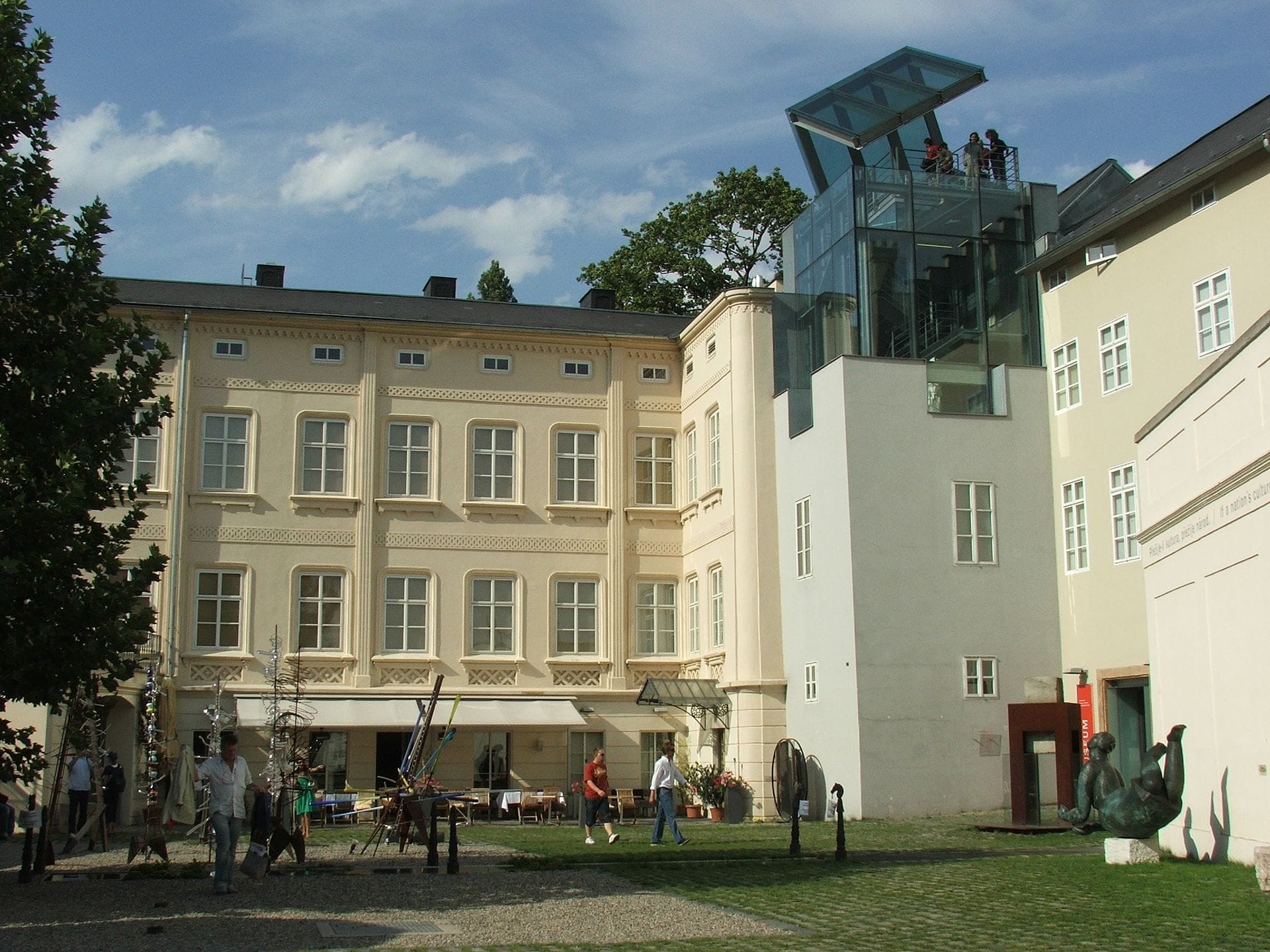
The building itself is inseparable from the experience. Sova's Mill (Sovovy mlýny) is a historic mill complex that was reconstructed specifically to house the collection. The architecture blends old stone walls with contemporary interventions: industrial wooden beams, polished concrete floors in some sections, and large windows framing the Čertovka millstream below. Coming from the tourist density of Charles Bridge, the transition into this courtyard feels like stepping into a different register of the city entirely.
ℹ️ Good to know
Open year-round, Monday through Sunday, 10:00–18:00. Last entry is at 17:30. The museum does not close on Mondays, which is unusual for Prague's museum scene and useful to know when planning around other closures.
The Collection: Kupka, Gutfreund, and the Central European Canon
The permanent collection is anchored by two artists: František Kupka and Otto Gutfreund. Kupka (1871–1957) was a Czech-born painter who became one of the earliest practitioners of abstract art in Europe, working in Paris from the early 20th century. Museum Kampa holds an unusually substantial group of his works, from preparatory drawings to fully resolved oil paintings, allowing you to trace the development of his visual thinking across decades. If you have any interest in the origins of abstraction, this is a serious scholarly resource dressed in an approachable space.
Otto Gutfreund (1889–1927) was among the first sculptors in Europe to bring Cubist principles fully into three dimensions. His bronzes and terracottas at Kampa are compact, tense objects that reward close looking. The museum pairs these historical anchors with 20th-century Czech and Slovak art more broadly, covering the interwar period, the post-war decades, and the complex artistic production of the Communist era, when many artists worked in deliberate tension with official ideology.
The temporary exhibition program rotates several times a year and consistently focuses on Central European modernism and contemporary art. If you are building a picture of Prague's art landscape, it pairs well with a visit to the National Gallery at Veletržní Palace, which holds the broader Czech national modern art collection, or the House of the Black Madonna for Czech Cubism in its architectural context.
Tickets & tours
Hand-picked options from our booking partner. Prices are indicative; availability and final rates are confirmed when you complete your booking.
Self guided tour with interactive city game of Prague
From 5 €Instant confirmationFree cancellationPrague by night city tour
From 27 €Instant confirmationFree cancellationPrague city tour with Vltava River cruise
From 38 €Instant confirmationFree cancellationPrague Castle online audio guide
From 5 €Instant confirmationFree cancellation
The Setting: Kampa Island and the Čertovka
Museum Kampa sits at the southern end of Kampa Island, a narrow strip of land separated from Malá Strana by the Čertovka, a narrow millstream sometimes called the Prague Venice. The mill complex backs directly onto this waterway, and on the ground floor and in the courtyard, you can hear the water moving below the walkways. In spring, when water levels are higher, the sound is constant and low. In summer it quiets to a trickle.
The museum courtyard opens toward the Vltava and the southern face of Charles Bridge. The giant bronze babies by sculptor David Černý, crawling across the lawn outside, have become one of the most photographed details on Kampa Island, though they belong to the outdoor sculpture collection rather than the indoor galleries. The relationship between the formal interior exhibitions and the informal outdoor installations gives the site a layered quality that rewards time spent wandering rather than rushing.
Kampa Island itself is worth exploring beyond the museum. The park area to the north is a popular sitting spot, and the adjacent John Lennon Wall is a short walk away along Malá Strana's back streets. The broader Malá Strana neighborhood offers one of Prague's best concentrations of Baroque architecture, gardens, and quieter streets away from the Old Town crowds.
How the Experience Changes by Time of Day
Morning visits, between 10:00 and midday, are consistently the quietest. The light entering the mill's upper gallery windows is soft and indirect, which works particularly well for viewing Kupka's paintings, where color temperature matters. By early afternoon, group visits from larger tour packages can arrive and temporarily change the atmosphere on the main floors. If you are coming specifically for the permanent collection and want unhurried access, weekday mornings are the reliable choice.
Late afternoon, particularly in summer from around 16:00 to closing, brings a second quieter window. The crowds that moved through after lunch tend to have dispersed, and the angle of the late sun through the river-facing windows produces a different quality of light in the lower galleries. This is also when the outdoor area around the mill becomes very pleasant: warm stone, low sun on the water, the bridge nearby turning golden.
💡 Local tip
Avoid midday on weekends in July and August. Charles Bridge, which sits directly above the museum, reaches its peak pedestrian density at this time, and the overflow into Kampa Island can make the outdoor areas feel congested. The galleries themselves are not usually overcrowded, but the approach and surroundings are.
Practical Walkthrough: Getting There and Getting Around
The most straightforward approach is by tram to Malostranské náměstí (lines 12, 20, 22, 23) or to the closer Hellichova stop (lines 12, 15, 20, 22, 23). From Malostranské náměstí, walk south along Mostecká Street toward Charles Bridge, then turn left before the bridge ramp down into Kampa Island. The walk takes roughly five minutes and passes through one of Malá Strana's more atmospheric side streets. Alternatively, if you are already on Charles Bridge, the museum is visible from the bridge's south side: descend the steps at the Malá Strana end and follow the path down to the island.
There is no parking on Kampa Island itself. Driving to this part of Malá Strana is not practical, and the one-way system in the surrounding streets is confusing even with navigation. Public transport or walking from the center is the only sensible approach.
The museum spans multiple floors of the mill building. The layout is not linear, and there is no single prescribed route through the galleries. Some visitors find this freeing; others find it disorienting. Pick up the floor plan at the ticket desk. The ticket desk staff generally speak English. Visitors with significant mobility limitations should contact the museum in advance at info@museumkampa.cz or by calling +420 257 286 147, as the mill's historic structure means some areas may not be easily accessible.
Photography and What to Bring
Personal photography without flash is generally permitted in the permanent collection, though this can vary with temporary exhibitions. Check signage at the entrance to each gallery. The exterior of the building, the courtyard, and the outdoor sculptures are all freely photographable. The stone mill exterior reflects well in the Čertovka on calm days, and the view from the courtyard toward Charles Bridge is one of the better architecture photographs available in this part of the city without requiring a tripod or special access.
The galleries are heated in winter and reasonably cool in summer. No particular dress code applies. If you are combining the museum with a longer walk around Malá Strana or across Charles Bridge, comfortable shoes matter more than anything else. A light jacket is useful in shoulder seasons when the riverside areas can feel cooler than the rest of the city.
⚠️ What to skip
Kampa Island sits in a flood-prone zone along the Vltava. Major flooding in 2002 severely damaged the museum and many of the artworks. The collection was subsequently housed elsewhere while the mill was repaired. Today the museum has flood-protection measures in place, but if you are visiting during a period of very high water levels, check the museum's website or social channels for any closures.
Is Museum Kampa Worth Your Time?
Museum Kampa is not the right choice for visitors whose main interest is medieval history, Old Town architecture, or Czech folk culture. It is a focused modern and contemporary art museum with a specific curatorial point of view. If that is not what you are looking for on this trip, Prague's other offerings will be a better use of your time.
For visitors with an active interest in 20th-century European art history, particularly the Central and Eastern European strands that rarely get full representation in Western museums, Museum Kampa fills a real gap. Kupka's place in the history of abstraction is consistently underrepresented in major international collections, and seeing a substantial body of his work here, in the city where he was born, has a particular weight. If this resonates, consider pairing it with the broader museum itinerary across Prague to structure your visits efficiently.
The museum's location also makes it a natural anchor for a longer walk through Malá Strana. After your visit, the Vrtba Garden is a short walk uphill, and the Wallenstein Garden is accessible in the opposite direction. If you are planning a full day in this part of the city, Museum Kampa works well as either an opening or a closing stop.
Insider Tips
- The museum café on the ground floor overlooks the Čertovka. It is a genuinely calm place for coffee compared to the tourist-facing cafés on Malostranské náměstí, and the prices are reasonable for the location.
- The outdoor sculptures by David Černý, including the crawling bronze babies, are accessible without a museum ticket. If you only want to see them, you do not need to enter the building.
- The museum shop has a better-than-average selection of Czech art books and Kupka monographs that are hard to find elsewhere in Prague. Worth checking even if you are not buying.
- Temporary exhibitions often open on Thursday evenings with extended hours or special programming. Check the museum's website before your visit to see if anything coincides with your dates.
- If you are visiting in winter, the outdoor area around the mill is often nearly empty, and the view toward Charles Bridge from the courtyard has a quality of light and quiet that the summer crowds make impossible. January and February mornings are particularly still.
Who Is Kampa Museum (Museum of Modern Art) For?
- Modern and contemporary art enthusiasts, especially those interested in Central European abstraction and Cubism
- Travelers combining a Malá Strana walking day who want a cultural anchor beyond churches and viewpoints
- Couples looking for a quieter, less crowded alternative to the main Old Town attractions
- Architecture-minded visitors interested in adaptive reuse of historic industrial buildings
- Rainy-day visitors needing a full indoor experience in a memorable setting
Nearby Attractions
Other things to see while in Malá Strana (Lesser Town):
- Charles Bridge
Charles Bridge is Prague's most recognizable landmark, a 516-metre medieval stone arch bridge lined with 30 Baroque statues linking the Old Town to Malá Strana. Free to cross at any hour, its experience shifts dramatically depending on when you arrive.
- Church of Our Lady Victorious (Infant Jesus of Prague)
Tucked along Karmelitská street in Malá Strana, the Church of Our Lady Victorious is one of Prague's most visited pilgrimage sites. It houses a 16th-century wax-coated wooden statue of the Infant Jesus that draws Catholic pilgrims from across the world, alongside curious visitors exploring Prague's Baroque heritage. Entry is free, and the attached museum adds unexpected depth to the visit.
- Church of St. Nicholas (Malá Strana)
The Church of St. Nicholas in Malá Strana is the most ambitious Baroque building in Prague, rising above the Lesser Town with a copper-green dome that defines the city's skyline. Built between 1704 and 1755, it rewards visitors with extraordinary ceiling frescoes, a soaring interior nearly 60 metres high, and a separate bell tower offering rooftop views across the red-tiled district below.
- Franz Kafka Museum
The Franz Kafka Museum occupies a converted 19th-century brickworks on the Malá Strana riverbank, a short walk from Charles Bridge. It holds original manuscripts, correspondence, photographs, and first editions that illuminate the life and literary world of one of the 20th century's most influential writers. The experience is deliberately unsettling, and that is precisely the point.