House of the Black Madonna: Prague's Landmark Czech Cubism Museum
Built in 1911–1912 by Josef Gočár, the House of the Black Madonna is the first Cubist building in Prague and one of the most architecturally significant structures in Old Town Prague. Today it houses the Czech Cubism permanent exhibition of the Museum of Decorative Arts, alongside the Grand Café Orient and a specialist design shop.
Quick Facts
- Location
- Ovocný trh 19, Old Town Prague (corner of Celetná Street, near the Powder Tower)
- Getting There
- Náměstí Republiky (Metro Line B), approx. 5-minute walk
- Time Needed
- 1 to 1.5 hours for the exhibition; longer if you stop at the café
- Cost
- 150 CZK standard / 80 CZK reduced (verify current rates before visiting; concessions for students, seniors, etc.)
- Best for
- Architecture lovers, design and applied arts enthusiasts, culture travelers
- Official website
- www.kubista.cz
What Is the House of the Black Madonna?
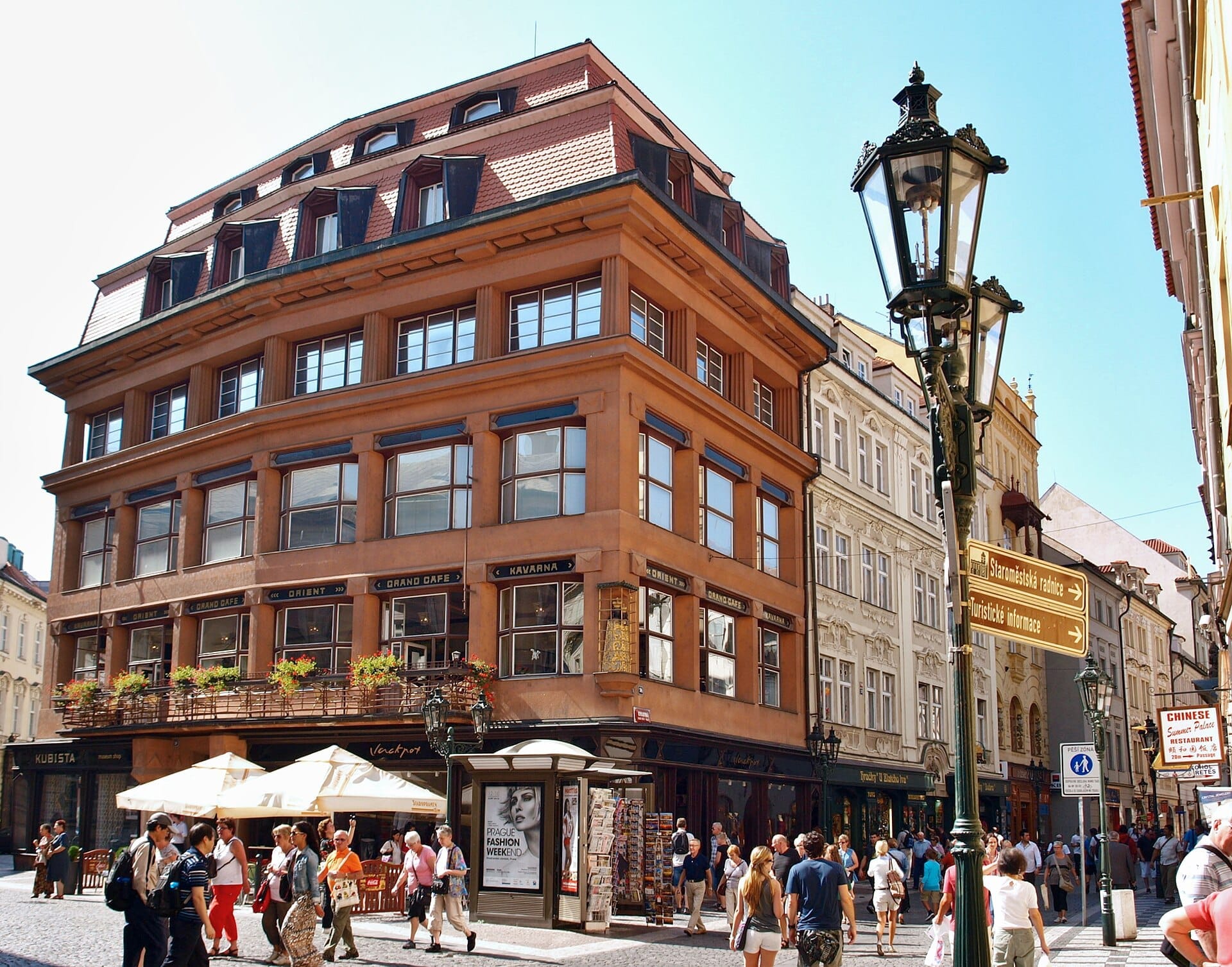
The House of the Black Madonna (Czech: Dům u Černé matky Boží) stands on the corner of Ovocný trh and Celetná Street in Old Town Prague, and it earns its architectural reputation immediately. Completed in 1912 to designs by Josef Gočár, this was the first Cubist building erected in Prague and, by most accounts, one of the earliest examples of Cubist architecture anywhere in the world. That is not a minor claim. While Paris was pioneering Cubism in painting, Prague was doing something almost without parallel: applying the movement's formal logic to the construction of a commercial building on a medieval street.
Gočár's commission was for a department store, a thoroughly modern building type, inserted into a block of Baroque and Renaissance facades. The result was a six-story reinforced concrete structure with a facade of angular projections, crystalline bays, and deeply modeled surfaces that catch light in a way that flat Neo-Baroque neighbors simply do not. The building does not shout. Standing across Ovocný trh and observing it carefully, you notice how the prismatic forms create a constantly shifting play of shadow across the facade, different at midday than at the golden hour before the museum closes.
The name comes from a Baroque statue of the Black Madonna and Child, which was preserved from an earlier building on the same site and installed in a gilded cage on the corner of the facade. It sits there today, easy to miss if you are walking quickly, but unmistakable once you know to look up.
💡 Local tip
Stand on the opposite pavement on Ovocný trh before entering. The full facade reads best from a slight distance. Once you are inside, you lose the sense of the exterior composition entirely.
The Czech Cubism Exhibition: What You Actually See Inside
The permanent Czech Cubism exhibition is managed by the Museum of Decorative Arts and spread across the upper floors. It is not a large collection by international standards, but it is precise and well-curated, focused on applied arts rather than painting: furniture, ceramics, glassware, metalwork, and graphic design, all produced between roughly 1910 and 1925 by Czech designers working in a Cubist idiom.
The furniture is the highlight for most visitors. Chairs, cabinets, and tables with faceted surfaces and sharp angular profiles make it immediately clear that Czech Cubism was a genuine design movement, not just an aesthetic borrowed from French painters. The pieces were made to be used, and the tension between the sculptural ambition of their forms and the functional demands of a chair or a sideboard gives them an energy that photographs do not fully capture. Look at the joints and construction details up close.
Ceramics and glassware occupy another section. These are smaller objects, easier to overlook, but some of the most formally inventive pieces in the collection are here: vases and pitchers with geometric relief patterns that look machine-made but were produced by hand. The exhibition labels are in Czech and English, which helps considerably for context and dating.
Visitors with a deeper interest in Czech design history may want to pair this visit with the broader collections at the Museum of Decorative Arts in Josefov, which holds the full holdings of the same institution. The Black Madonna location is specifically focused on Cubism, so it is a more targeted experience.
Tickets & tours
Hand-picked options from our booking partner. Prices are indicative; availability and final rates are confirmed when you complete your booking.
Prague Black Light Theatre Srnec tickets
From 25 €Instant confirmationFree cancellationBlack light theatre show in Prague Images of Love
From 18 €Instant confirmationFree cancellationSelf guided tour with interactive city game of Prague
From 5 €Instant confirmationFree cancellationPrague by night city tour
From 27 €Instant confirmationFree cancellation
How the Building Feels at Different Times of Day
Tuesday is the one extended day, with the museum open until 20:00. On Tuesday evenings, the crowds that fill this stretch of Celetná during the afternoon thin considerably, and the facade takes on a completely different quality in low light. The angular bays catch the warm tones of street lighting in a way that emphasizes the three-dimensionality Gočár was after. If you are in Prague mid-week, this is the time to come.
Weekend mornings between 10:00 and noon tend to be the quietest period inside the galleries. The afternoon, particularly on Saturdays, brings tour groups moving through in organized clusters, which can make the furniture rooms feel cramped. The collection is not enormous, so crowd pressure matters more here than in a large national museum.
The building sits on a pedestrianized section of Old Town, so there is no ambient traffic noise inside. The galleries are quiet, with polished floors that carry footsteps. Mornings have a calm, almost studious atmosphere. By mid-afternoon it is noticeably warmer and more active, particularly on the Grand Café Orient floor.
Grand Café Orient: Worth a Stop on Its Own
The Grand Café Orient occupies the first floor of the building, and it deserves mention even for visitors who are not particularly interested in the museum. Restored and reopened in 2005, it is one of the few spaces in Prague where the Cubist interior design extends to the furniture, light fixtures, and decorative details of the room itself. The original Cubist cafe on this floor opened in 1912 alongside the department store and closed around 1920. The current restoration is faithful to the period without feeling artificially frozen.
Coffee, pastries, and light meals are available. The atmosphere is calmer than most Old Town cafes, partly because the location is slightly off the main tourist corridor and partly because the interior design encourages a more deliberate kind of sitting. It opens before the museum (check current hours directly with the cafe), so it is also a reasonable choice for an early start before the galleries open.
ℹ️ Good to know
The ground floor houses the Kubista design shop, which sells reproductions of Czech Cubist objects: ceramics, jewelry, and small decorative pieces. Quality is consistent and prices reflect that. It is one of the more thoughtful souvenir options in Old Town.
Historical and Architectural Context
To understand why this building matters, it helps to know that Prague in the early twentieth century had an unusually active architectural culture. The city was part of the Habsburg Empire, and its architects were in close dialogue with Vienna and the broader European avant-garde. Czech architects, including Gočár, Pavel Janák, and Vlastislav Hofman, developed what became known as Czech Cubism between roughly 1910 and 1920: a movement that applied the formal fragmentation of Cubist painting to three-dimensional objects, from buildings to furniture to ceramics. The House of the Black Madonna was their most prominent built statement. If you want to understand this movement across the city's architectural landscape, the Black Madonna is the natural starting point.
Gočár had to negotiate an unusual constraint: the site was already associated with a Baroque-era building, and the statue of the Black Madonna was considered culturally significant enough to preserve. The solution, housing the statue in a projecting gilded cage on the building's corner, is one of the most quietly interesting moments in the entire facade. It is an act of continuity within a building that was otherwise aggressively modernist for its time and place.
Czech Cubism as a movement lasted less than a decade before it evolved into Rondocubism, a more decorative national style, in the 1920s. The concentration of Cubist buildings in Prague, unique in the world, is part of what makes the city's broader architectural and cultural history so specific and worth engaging with seriously.
Practical Information: Getting There, Tickets, and What to Know
The museum is located at Ovocný trh 19, a short walk from two of Old Town's main reference points. From Náměstí Republiky metro station (Line B), walk west along Celetná Street for about five minutes. From Old Town Square, walk east along Celetná Street for roughly the same distance. The building is on the corner; you will see the facade before you reach the entrance.
Opening hours as of the most recent available information: Tuesday 10:00 to 20:00, Wednesday through Sunday 10:00 to 18:00, closed Monday. Admission is 150 CZK standard and 80 CZK reduced. Verify current prices at the official website or on arrival, as museum ticket prices change periodically.
Photography inside the galleries is generally permitted without flash for personal use, but confirm with staff at the entrance. Bag storage is available. The building is in a pedestrianized area, so there is no parking directly adjacent. Public transport is the most practical option; see the Prague public transport guide for full ticketing and route details.
⚠️ What to skip
Accessibility: The building is a historic structure in a pedestrian Old Town zone. No detailed step-free access information is provided in official sources. Visitors with mobility needs should contact the Museum of Decorative Arts directly before visiting to confirm current arrangements.
Who Should Skip This, and Who Will Find It Valuable
This is a relatively small, specialist museum. Visitors expecting a broad survey of Czech art history or a large collection will find it limited in scope. If your primary interest is painting, this is not the right stop; the collection is focused on applied and decorative arts. It is also not a particularly child-friendly experience: the objects are fragile, the rooms are quiet, and there is nothing interactive for younger visitors.
For travelers who are seriously interested in design, architecture, or twentieth-century applied arts, it is among the more rewarding single-building experiences in Prague. Combined with a walk along Celetná Street to the Powder Tower and then back toward Old Town Square, it fits naturally into a half-day exploring the eastern end of the historic center.
Insider Tips
- The Kubista shop on the ground floor is open during museum hours and does not require a museum ticket to enter. If you are short on time, the shop alone gives you a ground-floor look at the building's interior volumes.
- Tuesday evenings are the quietest and most atmospheric time to visit: the galleries are nearly empty after 17:00, and the facade is worth observing in fading natural light before you go inside.
- Look for the Baroque Black Madonna statue in its gilded cage on the building's corner before you enter. It is easy to walk past without noticing, and it tells a specific story about how the building was designed to coexist with what was already there.
- The Grand Café Orient on the first floor has Cubist-designed interior fittings that are part of the building's significance. Even if you do not take the museum tour, having coffee there gives you a legitimate architectural experience.
- If you are interested in following Czech Cubism beyond this building, several other Cubist and Rondocubist structures exist within walking distance in Old Town. The House at the Black Madonna itself stands at the corner of Celetná Street and Ovocný trh, and nearby examples by Gočár and his contemporaries along Celetná are worth noting on the way.
Who Is House of the Black Madonna (Czech Cubism Museum) For?
- Architecture and design enthusiasts who want to understand a genuinely rare movement in built form
- Applied arts travelers interested in furniture, ceramics, and decorative objects from the early twentieth century
- Visitors on a short Prague itinerary who want a single focused cultural experience that does not require hours
- Travelers who appreciate context and want to understand why Prague's architectural heritage is distinct from other Central European capitals
- Anyone looking for a calmer, less crowded alternative to the major Old Town landmarks nearby
Nearby Attractions
Other things to see while in Old Town (Staré Město):
- Church of Our Lady before Týn
The Church of Our Lady before Týn is Prague's most recognizable Gothic landmark, its twin 80-metre spires rising sharply above the rooflines of Old Town Square. Entry is free, but visiting hours are short and the interior tells a story most visitors walk past without ever stepping inside.
- Church of St. Nicholas (Old Town)
Standing in the north-west corner of Old Town Square, St. Nicholas Church is a compact Baroque masterpiece built between 1732 and 1737. Entry is free, the interior is genuinely beautiful, and most visitors walk past it without stopping. Here is why they should not.
- Clementinum
The Clementinum is one of the largest building complexes in Prague, stretching over 2 hectares in the heart of Old Town. Its guided tours take visitors into a breathtaking Baroque library hall and up a narrow tower for panoramic rooftop views over the city's spires.
- Estates Theatre (Stavovské divadlo)
The Estates Theatre in Prague's Old Town is one of the best-preserved 18th-century opera houses in Europe, and one of the surviving venues where Mozart himself conducted. Built in 1783, it staged the world premiere of Don Giovanni and remains an active performance space under the National Theatre umbrella.