Clementinum Prague: Inside the Baroque Library and Astronomical Tower
The Clementinum is one of the largest building complexes in Prague, stretching over 2 hectares in the heart of Old Town. Its guided tours take visitors into a breathtaking Baroque library hall and up a narrow tower for panoramic rooftop views over the city's spires.
Quick Facts
- Location
- Karlova 1, Prague 1 – Old Town (visitor entrance); near Charles Bridge
- Getting There
- Metro Line A to Staroměstská; Trams 17 & 18 to Staroměstská stop
- Time Needed
- 45–90 minutes (guided tour runs approx. 50 minutes)
- Cost
- Adults 380 CZK; concessions 230 CZK; family 810 CZK; under 6 free. 50% discount on first two morning tours. Prague Card discounts apply. Verify current prices before visiting.
- Best for
- Architecture lovers, history enthusiasts, photographers, book-curious travelers
- Official website
- www.klementinum.com/en
What Is the Clementinum?
The Clementinum (Czech: Klementinum) is a sprawling Baroque complex occupying more than 2 hectares in Prague's Old Town, wedged between Karlova Street and the Vltava riverbank. It is Prague's second-largest building complex after Prague Castle, consisting of several interconnected courtyards, churches, chapels, a tower, and library halls built up gradually between the 16th and 18th centuries. Today it serves as the home of the National Library of the Czech Republic, and the parts open to visitors, the Baroque Library Hall and the Astronomical Tower, are among the most visually striking interior spaces in Central Europe.
The complex's origins trace back to at least the 11th century, when a chapel dedicated to St Clement stood on the site. The Jesuits arrived in 1556 and began transforming what was then a modest ecclesiastical property into a full-scale college. Over the following two centuries they absorbed dozens of neighboring houses and plots, eventually creating what became, at its peak, the third-largest Jesuit college in the world. In 1622 the Jesuits established a university here, later merged with Charles University. When the Jesuit order was dissolved in 1773, the complex passed to secular academic and cultural institutions, and by 1782 it had become the principal home of the Bohemian state library, the forerunner of today's National Library.
ℹ️ Good to know
Visitor access to the Clementinum's interiors is by guided tour only. Tours cover the Baroque Library Hall and the Astronomical Tower. The National Library's reading rooms and most of the complex are not open to general visitors.
The Baroque Library Hall: What You Actually See
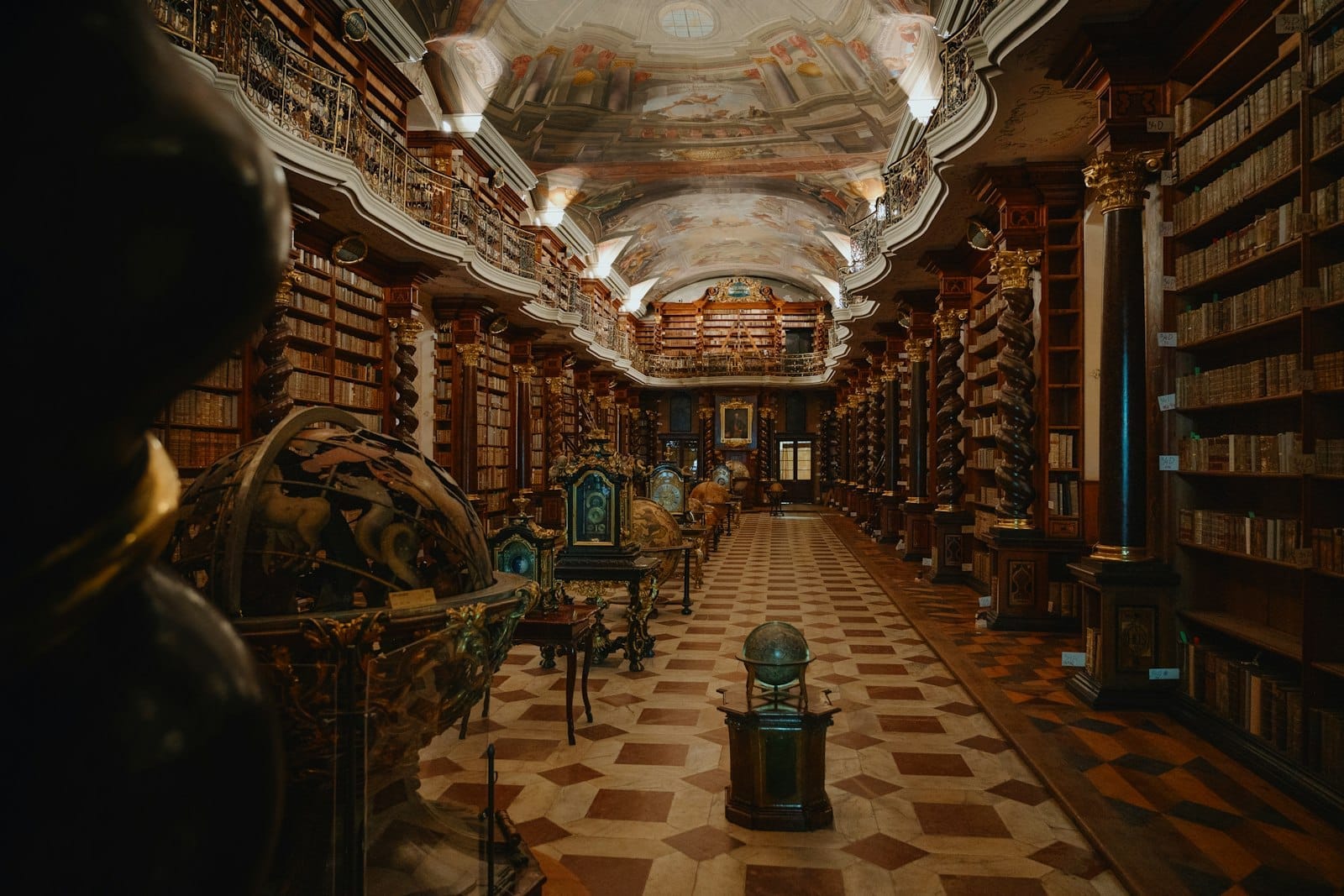
The centerpiece of any Clementinum visit is the Baroque Library Hall, completed in 1727. From the moment you step through the door, the scale catches you off guard. The long, barrel-vaulted room is lined on both sides with floor-to-ceiling dark walnut bookcases, each filled with leather-bound volumes going back centuries. The ceiling is covered in a continuous fresco cycle by Johann Hiebel depicting the allegory of the arts and sciences, and globes from the 17th and 18th centuries sit at intervals along the central aisle.
The smell inside is distinctive: old paper, wood polish, and a faint mustiness that seems embedded in the walls. The bookcases still hold their original collections, not decorative props. You are not permitted to wander freely through the hall; the tour is guided, and the group moves through in a controlled flow. Photographs are permitted, and the hall is reliably popular with photographers because the symmetry and depth of the room reward a wide-angle lens. Morning light enters from the east-facing windows and creates warm tones across the wooden shelving, so the first tours of the day tend to produce the cleanest shots.
What the hall does not offer is extensive dwell time. This is not a museum where you linger for an hour reading exhibits. The tour moves at a steady pace, your guide explains the key historical facts and points out details in the ceiling fresco, and then the group proceeds. Visitors who find themselves wanting to spend more time simply studying the shelves or the artwork may feel slightly rushed. That is a genuine limitation worth knowing in advance.
Tickets & tours
Hand-picked options from our booking partner. Prices are indicative; availability and final rates are confirmed when you complete your booking.
Self guided tour with interactive city game of Prague
From 5 €Instant confirmationFree cancellationPrague by night city tour
From 27 €Instant confirmationFree cancellationPrague city tour with Vltava River cruise
From 38 €Instant confirmationFree cancellationPrague Castle online audio guide
From 5 €Instant confirmationFree cancellation
The Astronomical Tower: Climbing for a View
The Astronomical Tower rises above the complex and has served as a scientific observation post since the 18th century. The Czech meteorological record, one of the longest continuous weather observation sequences in Europe, began here in 1775. The tower is not tall by modern standards, but because Prague's Old Town is relatively flat and low-rise, the view from the top platform takes in a remarkable panorama of red-tiled rooftops, Gothic spires, and the curve of the Vltava.
The climb involves a narrow historic stairway with steep, uneven steps and no lift. It is physically manageable for most visitors in reasonable health, but it is genuinely not accessible to those with mobility limitations. The platform at the top is open and exposed to wind, which in cooler months can be biting. The view east takes in the towers of the Church of Our Lady Before Týn and the roofline of Old Town Square; to the west you can see across to the hills of Malá Strana and the silhouette of Prague Castle.
⚠️ What to skip
The Astronomical Tower stairway is steep, narrow, and has no lift. Visitors with limited mobility, vertigo, or difficulty with uneven steps should confirm suitability with the venue before booking.
Historical Context: Why the Clementinum Matters
Understanding the Clementinum requires some sense of what the Jesuits were doing in 16th-century Bohemia. Their arrival in Prague in 1556 was part of the Counter-Reformation effort to reassert Catholic influence in a region where Protestant ideas had taken deep root. The college they built here became not just a religious institution but a cultural and intellectual engine, accumulating manuscripts, scientific instruments, maps, and books. The library's holdings today include some of the most important medieval manuscripts in the Czech Republic. If you want a broader sense of how the Jesuits and the Catholic Church shaped Prague's architectural landscape, the Prague architecture guide covers the period in detail.
The complex also illustrates how large-scale urban space was consumed for institutional purposes in Baroque Prague. To build the Clementinum, the Jesuits demolished approximately 30 houses and three churches over the course of the construction period. The resulting complex is essentially a city within a city, with multiple internal courtyards that you pass through on the way to the tour entrance. These courtyards are accessible during opening hours and worth a few minutes of quiet observation even before your tour begins.
Practical Walkthrough: Getting There and What to Expect
The visitor entrance is on Karlova Street, the narrow lane that runs between Old Town Square and Charles Bridge. Karlova is one of the most trafficked pedestrian corridors in Prague, and in the late morning and afternoon it can feel genuinely compressed with people. The entrance itself is easy to miss if you are moving quickly; look for the signage on the left side of the street heading toward the bridge.
The nearest Metro stop is Staroměstská on Line A, roughly a 5-minute walk. Trams 17 and 18 stop at the same name. From Charles Bridge, the entrance is less than 2 minutes on foot heading into the Old Town. From Old Town Square, walk down Karlova and you will reach it in about 4 minutes.
Tours run throughout the day within operating hours, which are currently listed as daily 9:00 to 20:00 year-round. All times and prices should be confirmed at the official site before your visit, as scheduling can change. The first two tours of the morning carry a 50% discount, which makes an early start genuinely worthwhile both financially and for avoiding crowds.
💡 Local tip
Book your tour slot in advance online, especially during peak summer months. Walk-up availability exists, but the tours have limited group sizes and midday slots frequently sell out in high season.
Best Time to Visit and What Changes by Hour
The first tour slot of the day is the single best option for most visitors. The 50% morning discount is one reason. The other is atmosphere: Karlova Street is quiet before 10:00, the courtyards of the complex have an unhurried quality, and the library hall catches early light through its windows before the interior gets busy with successive tour groups cycling through.
By midday, the Clementinum sits at the center of some of the most tourist-dense streets in Prague. The courtyards fill up with people passing through or waiting for their tour, and the experience loses some of its stillness. Late afternoon visits, roughly 16:00 to 18:00, offer a secondary window of relative calm as day-trippers start heading back to their accommodation. Evening visits during summer (when the complex stays open until 20:00) can be atmospheric for the tower view, with softer light over the rooftops.
If you are planning a broader day in the area, the Clementinum works well as a first stop before moving on to the Old Town Hall Tower or continuing across Charles Bridge into Malá Strana. For a more curated itinerary, the 3-day Prague itinerary includes it alongside the other major Old Town landmarks.
Photography Tips
The Baroque Library Hall is the primary photographic draw. A wide-angle lens captures the full depth of the barrel vault and the symmetry of the bookcases. The hall is moderately lit with ambient and artificial light; a camera that handles ISO 800 to 1600 reasonably well will manage without flash, which is not appropriate in the space. The ceiling fresco rewards a longer lens if you want detail of the painted figures.
On the tower platform, the view to the east toward Old Town Square and to the northwest toward the castle district offers the most recognizable skyline compositions. Morning light favors the eastern view; late afternoon light works better looking toward the castle. The platform is relatively small, so with a tour group present you may need to wait a moment for clear sightlines.
Insider Tips
- Book the earliest available morning tour to get the 50% ticket discount and to experience the library hall before successive tour groups create a busier atmosphere.
- The internal courtyards of the Clementinum can be entered without a ticket during opening hours. Spend a few minutes in the courtyards before your tour; they give a sense of the complex's scale and are rarely crowded.
- The Prague Card includes a discount on standard admission. If you are planning multiple major attractions, calculate whether the card makes financial sense before buying a standalone Clementinum ticket.
- The tour commentary covers the highlights efficiently but moves at pace. If you want to study the ceiling fresco in detail, position yourself near the front of the group when you enter the library hall so you have slightly more time before the group moves on.
- Karlova Street directly outside the entrance is one of the narrowest and most congested pedestrian corridors in the city. Do not plan a rushed approach. Leave buffer time, especially between 11:00 and 16:00 in summer.
Who Is Clementinum For?
- Architecture and Baroque art enthusiasts who want to see a genuinely intact 18th-century library interior
- Photographers looking for one of the most visually dramatic interior spaces in Prague
- History travelers interested in the Counter-Reformation, Jesuit education, and the intellectual history of Bohemia
- Visitors who want a rooftop view over the Old Town roofscape without the longer queues of the Astronomical Clock tower
- Travelers with limited time who want a single compact stop combining architectural history and a panoramic viewpoint
Nearby Attractions
Other things to see while in Old Town (Staré Město):
- Church of Our Lady before Týn
The Church of Our Lady before Týn is Prague's most recognizable Gothic landmark, its twin 80-metre spires rising sharply above the rooflines of Old Town Square. Entry is free, but visiting hours are short and the interior tells a story most visitors walk past without ever stepping inside.
- Church of St. Nicholas (Old Town)
Standing in the north-west corner of Old Town Square, St. Nicholas Church is a compact Baroque masterpiece built between 1732 and 1737. Entry is free, the interior is genuinely beautiful, and most visitors walk past it without stopping. Here is why they should not.
- Estates Theatre (Stavovské divadlo)
The Estates Theatre in Prague's Old Town is one of the best-preserved 18th-century opera houses in Europe, and one of the surviving venues where Mozart himself conducted. Built in 1783, it staged the world premiere of Don Giovanni and remains an active performance space under the National Theatre umbrella.
- House of the Black Madonna (Czech Cubism Museum)
Built in 1911–1912 by Josef Gočár, the House of the Black Madonna is the first Cubist building in Prague and one of the most architecturally significant structures in Old Town Prague. Today it houses the Czech Cubism permanent exhibition of the Museum of Decorative Arts, alongside the Grand Café Orient and a specialist design shop.